
Installing performance parts on your vehicle does not automatically void your factory warranty under federal law. The Magnuson-Moss Warranty Act, enforced by the Federal Trade Commission, prohibits manufacturers from canceling your entire warranty simply because you added aftermarket parts. Understanding why performance parts void warranty claims in specific situations, rather than across the board, is the key distinction every enthusiast needs before bolting on upgrades. The difference between a denied repair claim and a fully voided warranty is significant, and most vehicle owners never realize the two are not the same thing.
Why performance parts void warranty claims under federal law
The Magnuson-Moss Warranty Act is the federal statute that governs consumer product warranties in the United States. Under this law, manufacturers cannot void your entire factory warranty simply because an aftermarket part is present on your vehicle. Coverage can only be denied for the specific system or component directly affected by the modification. That distinction matters enormously when you are standing at a dealership service counter.
The Federal Trade Commission enforces Magnuson-Moss and has made clear that warranty denial requires demonstrated causation. A manufacturer or dealer must prove the aftermarket part caused the failure before rejecting a claim. Aftermarket part presence alone is not legal grounds for denial. The failure and the modification must be directly connected.
Factory warranties and extended warranties operate under different rules. Extended warranties often contain stricter anti-modification language than manufacturer-backed coverage. That means a service contract you purchased from a dealer or third-party provider may deny claims far more aggressively than your original factory warranty would. Reading both documents before you modify anything is non-negotiable.
Key protections the Magnuson-Moss Warranty Act provides:
- Manufacturers cannot issue blanket warranty voids based solely on aftermarket parts
- Denial must be limited to the component or system the modification affected
- The burden of proving causation falls on the manufacturer or dealer
- The FTC can investigate and act on warranty violations
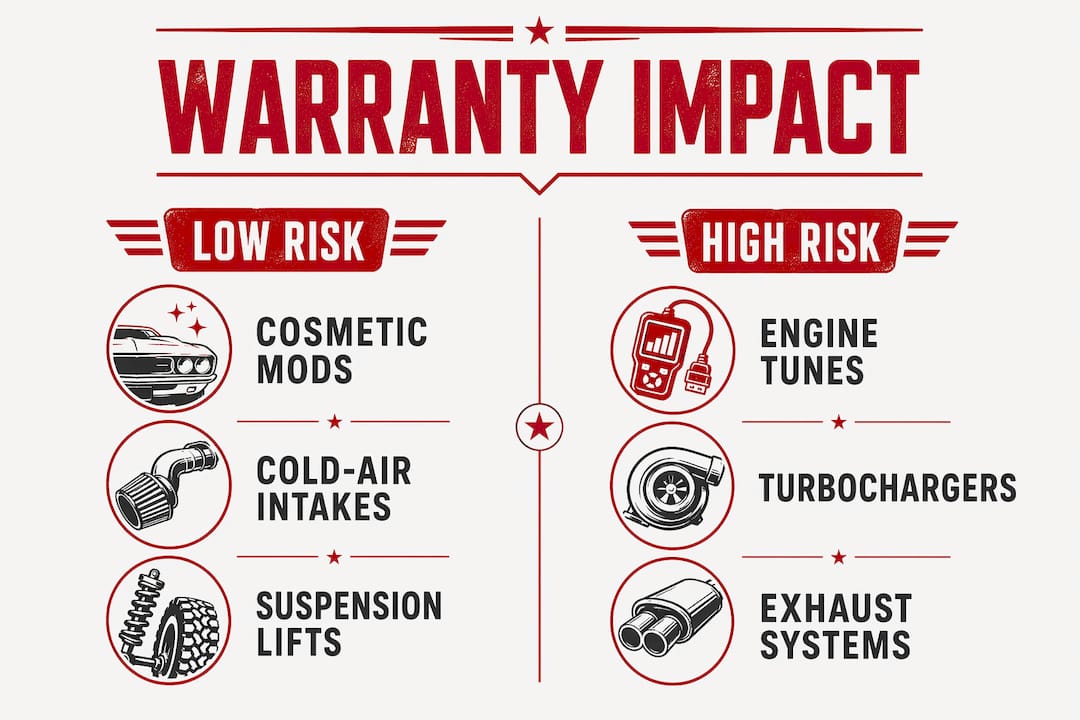
- Cosmetic modifications that do not affect mechanical systems rarely trigger any denial
Pro Tip: Request a copy of your full warranty contract before any service visit. Knowing exactly what your coverage says puts you in a stronger position if a dealer tries to deny a claim.
Which performance parts are most likely to trigger a denial?
Not all modifications carry the same warranty risk. The type of part and where it sits in the drivetrain determines how much scrutiny your claim will face.
-
ECU tunes. An ECU tune reprograms your engine’s factory software to increase power output, adjust fuel mapping, or raise boost pressure. Manufacturers argue that ECU tunes impose uncompensated risk by running components outside tested limits. This is the single most contested modification in warranty disputes.
-
Turbocharger and supercharger upgrades. Forced induction adds heat and pressure that the factory powertrain was not designed to handle at elevated levels. Any engine or transmission failure following a forced induction upgrade will face intense scrutiny.
-
Transmission performance upgrades. Shift kits, upgraded clutch packs, and higher-stall torque converters alter how the transmission manages load. Engine and transmission failures are among the most frequently challenged claims when factory parameters have been changed.
-
Performance camshafts. Swapping in a high-lift camshaft changes valve timing and duration across the entire engine cycle. Dealers will flag this immediately when diagnosing top-end or valvetrain failures.
-
Performance chips. A performance chip modifies ignition timing, fuel delivery, or throttle response. Like an ECU tune, it shifts the engine outside factory-calibrated parameters and draws scrutiny on any related claim.
Cosmetic upgrades, cold-air intakes on naturally aspirated engines, and suspension lifts on trucks rarely cause warranty denials on their own. The effects of aftermarket parts on warranty coverage scale directly with how much the part changes operating conditions in the powertrain.
How do dealerships determine if a modification caused a failure?
Dealerships use a combination of diagnostic tools, service history review, and visual inspection to build a causation argument. The process is not always transparent, and owners who do not know their rights often accept denial without question.

The most common dealer tactic is citing diagnostic data without providing a written explanation of how the modification caused the specific failure. Requesting detailed diagnostic reports and written causation statements is the single most effective step you can take at this stage. A verbal “your warranty is voided” carries no legal weight.
Dealers also review ECU data logs, which can reveal if the engine was tuned or if operating parameters exceed factory limits. Modern vehicles store this data, and a dealer technician can pull it during any diagnostic scan. If you have an ECU tune, assume the dealer will find evidence of it.
Key documentation practices that protect your position:
- Keep receipts and installation records for every aftermarket part
- Log dates, mileage, and installer details for each modification
- Retain oil change and maintenance records to show proper upkeep
- Photograph parts before and after installation
- Save any written communications with the dealer regarding the modification
Pro Tip: Ask the service advisor to put the denial reason in writing before you leave the dealership. If they refuse, send a follow-up email summarizing what was said verbally. That email creates a paper trail.
Dealerships often use the phrase “voided warranty” as shorthand for denying a single repair claim rather than canceling all coverage. If a dealer claims your entire warranty is void, ask them to cite the exact clause in your warranty contract that authorizes full cancellation. Most cannot.
What steps should you take if your warranty claim is denied?
A denied claim is not the end of the road. Vehicle owners have real legal tools available, and a structured response often reverses unjust denials.
-
Request written proof of causation. Ask the dealer to provide a written diagnostic report explaining exactly how your modification caused the failure. Vague references to “aftermarket parts” do not satisfy the Magnuson-Moss causation requirement.
-
Gather your documentation. Pull together every installation record, maintenance log, and receipt related to the modification. Detailed maintenance records shift the burden of proof back toward the manufacturer during a dispute.
-
Escalate to the manufacturer’s regional office. Dealer-level decisions are not final. Every major manufacturer has a regional customer relations team that reviews escalated warranty disputes. Contact them directly and provide your documentation.
-
File a complaint with the FTC or your state attorney general. If you believe the denial violates Magnuson-Moss, you can file a formal complaint. State lemon laws may also apply depending on the nature of the defect and your state’s specific statutes.
-
Consult an automotive attorney. Warranty disputes involving significant repair costs often justify legal consultation. Many automotive attorneys offer free initial consultations and work on contingency for Magnuson-Moss cases.
“The manufacturer has the burden of proof. They must show the aftermarket part caused the defect. If they cannot demonstrate that connection, the warranty denial does not hold up under federal law.”
Understanding the difference between a factory warranty and an extended service contract matters here. Extended warranties differ substantially from factory coverage and often allow providers to deny claims with far less justification when aftermarket parts are present. If your denial comes from a third-party service contract, your legal options are different and typically narrower. For high-mileage vehicles, reviewing performance upgrade considerations before modifying can help you weigh the risk against remaining coverage.
Key Takeaways
The Magnuson-Moss Warranty Act protects vehicle owners from blanket warranty cancellation, requiring manufacturers to prove a direct causal link between any aftermarket modification and the specific failure being denied.
| Point | Details |
|---|---|
| Federal law limits denial scope | Manufacturers can only deny coverage for the component directly affected by the modification, not the entire warranty. |
| Causation is the legal standard | A dealer must prove the aftermarket part caused the failure. Presence alone is not enough to deny a claim. |
| ECU tunes carry the highest risk | Powertrain and tune-related modifications face the most scrutiny because they alter factory-tested operating parameters. |
| Documentation is your best defense | Keeping installation records and maintenance logs shifts the burden of proof back to the manufacturer during disputes. |
| Extended warranties have stricter rules | Third-party service contracts often contain aggressive anti-modification clauses that factory warranties do not. |
What I have learned after years of watching these disputes play out
The most common mistake vehicle owners make is accepting a verbal warranty denial without asking for anything in writing. Dealers count on that. The moment you walk out without documentation, you have handed them the advantage.
The second mistake is confusing an extended service contract with a factory warranty. These are fundamentally different products with different legal protections. Owners who bought a third-party service contract at the finance desk often discover it has far more aggressive modification exclusions than the original manufacturer warranty. Read both documents before you touch anything on the vehicle.
What actually works in disputes is simple: documentation and persistence. The owners who win warranty disputes are the ones who kept receipts, logged their maintenance, and escalated past the service counter. The Magnuson-Moss framework gives you real leverage, but only if you use it. A dealer’s first “no” is rarely the final answer when you show up with a paper trail and a clear understanding of your rights.
— Ozkonic Kustomz
Parts that meet quality standards and fit right the first time
Vehicle owners who modify with quality, properly fitted components reduce the risk of installation-related failures that give dealers an opening to deny claims.
Ozkonickustomz sources directly from vetted manufacturers, so every part ships with confirmed fitment data and meets stringent quality standards. The Highway 22 modular wiring kit is a strong example: a clean, compatible wiring solution for truck builds that installs correctly and leaves no room for a dealer to argue installation error. Ozkonickustomz also carries suspension components, hardware, and accessories built to OEM-level tolerances. Browse the full catalog at ozkonickustomz.com and get the right part the first time.
FAQ
Does installing aftermarket parts automatically void my warranty?
No. Under the Magnuson-Moss Warranty Act, manufacturers cannot void your entire factory warranty simply because an aftermarket part is present. They must prove the part caused the specific failure being claimed.
Will an ECU tune void my powertrain warranty?
An ECU tune does not void the entire warranty, but it significantly increases the risk of denial for powertrain-related claims. Manufacturers argue that tunes operate components outside tested limits, which forms the basis for denying engine and transmission repairs.
What is the difference between a factory warranty and an extended warranty for modifications?
A factory warranty is governed by Magnuson-Moss and offers strong federal protections. Extended service contracts often contain stricter anti-modification clauses that allow providers to deny claims more easily when aftermarket parts are installed.
How do I fight a warranty denial related to aftermarket parts?
Request a written diagnostic report showing how the modification caused the failure, gather all installation and maintenance records, and escalate to the manufacturer’s regional office if the dealer-level denial stands.
Do cosmetic modifications affect my warranty?
Cosmetic modifications rarely trigger warranty denials. The performance impact of a modification is what drives denial decisions, not the simple presence of an aftermarket part on the vehicle.