
A performance camshaft is the primary control mechanism for valve timing, lift, and duration in an internal combustion engine. The role of performance camshaft design is to determine exactly when intake and exhaust valves open, how far they open, and how long they stay open. Those three variables shape your engine’s entire powerband, idle character, throttle response, and torque curve. Get the cam right, and every other modification you’ve made starts working harder. Get it wrong, and you’ve built an expensive collection of parts that fight each other.
How does a performance camshaft control engine power?
A performance camshaft controls valve timing and motion, directly determining where in the RPM range your engine makes its best power. The cam lobe shape governs three core parameters: duration, lift, and overlap. Each one pulls a different lever on engine behavior.
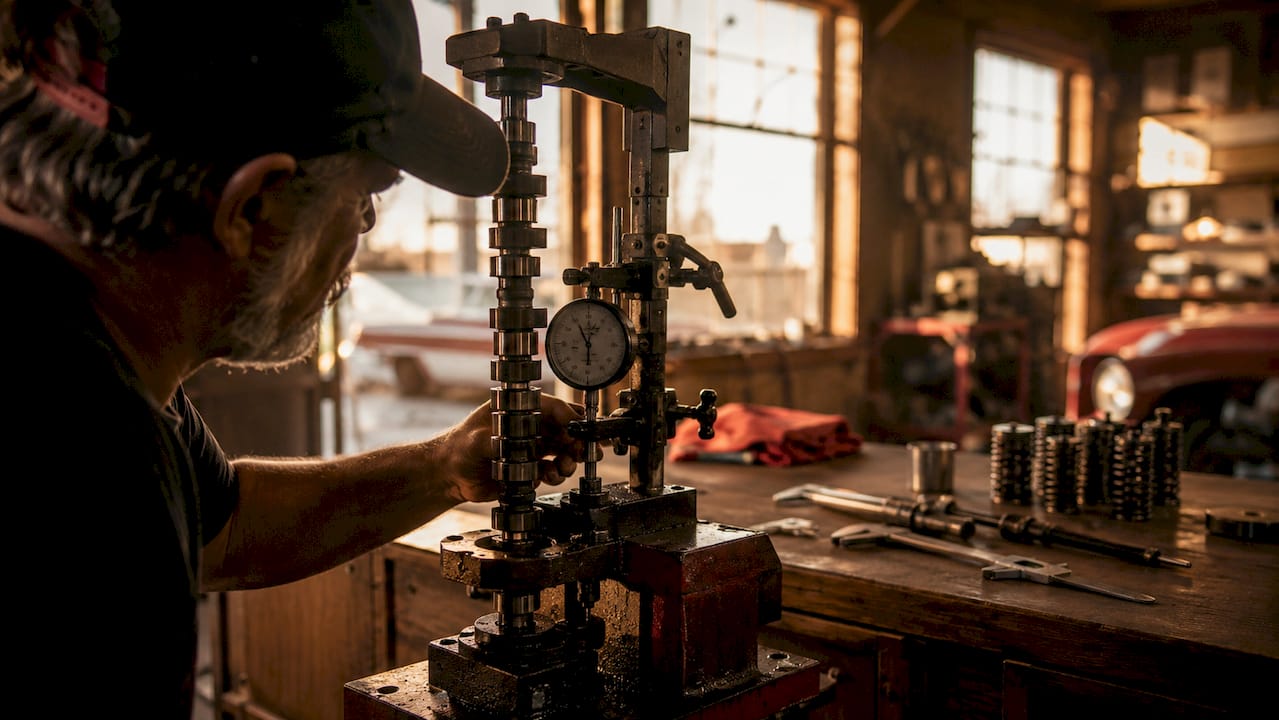
Duration measures how long a valve stays open, expressed in degrees of crankshaft rotation. The industry standard measures duration at 0.050-inch valve lift, which prevents manufacturers from inflating numbers with loose advertised specs. Shorter duration builds low-speed torque, which is why a mild street cam feels strong off the line. Longer duration pushes the powerband higher, favoring top-end pull at the cost of low-RPM grunt.
Lift controls how far the valve opens. Higher lift allows more air and fuel to enter the cylinder per cycle. More airflow means more combustion energy, which translates directly to horsepower. Lift works in concert with duration. A high-lift, short-duration cam behaves very differently from a high-lift, long-duration cam.
Lobe Separation Angle (LSA) is the spec most builders overlook. LSA governs the overlap between intake and exhaust valve events. A tight LSA of roughly 106–110° increases overlap, producing a more aggressive idle and stronger top-end scavenging. A wide LSA of 112–116° reduces overlap, smoothing idle and improving manifold vacuum. That vacuum matters for power brakes, emissions systems, and daily drivability.
- Short duration (under 210° at 0.050"): strong low-RPM torque, smooth idle, good vacuum
- Medium duration (210–230° at 0.050"): balanced street/strip performance
- Long duration (over 230° at 0.050"): top-end power, rough idle, reduced vacuum
- High lift (over 0.550"): requires upgraded valve springs and retainers
- Tight LSA: aggressive idle, high-RPM scavenging, suits naturally aspirated builds
- Wide LSA: smooth idle, better boost retention, suits forced induction
Pro Tip: Always compare cams using 0.050-inch duration numbers, not advertised duration. Two cams with identical advertised specs can behave completely differently once you look at the 0.050 figures and LSA together.
Camshaft profiles: which type fits your build?
Not every cam suits every engine. Matching cam timing events with cylinder head airflow at your target RPM range is the single most important factor in making horsepower. A cam that outpaces your heads’ flow capacity wastes duration. A cam that underserves a high-flowing head leaves power on the table.
| Build Type | Cam Profile | LSA Range | Key Tradeoff |
|---|---|---|---|
| Daily street driver | Mild, short duration | 112–116° | Smooth idle, strong low-end torque |
| Street/strip | Medium duration, moderate lift | 110–112° | Balanced power across RPM range |
| Naturally aspirated race | Long duration, high lift | 106–110° | Maximum top-end power, rough idle |
| Turbo or supercharged | Moderate duration, wide LSA | 112–116° | Retains boost, reduces blowthrough |
| Drag racing | Long duration, high lift | 106–108° | Peak power at high RPM, no idle concerns |
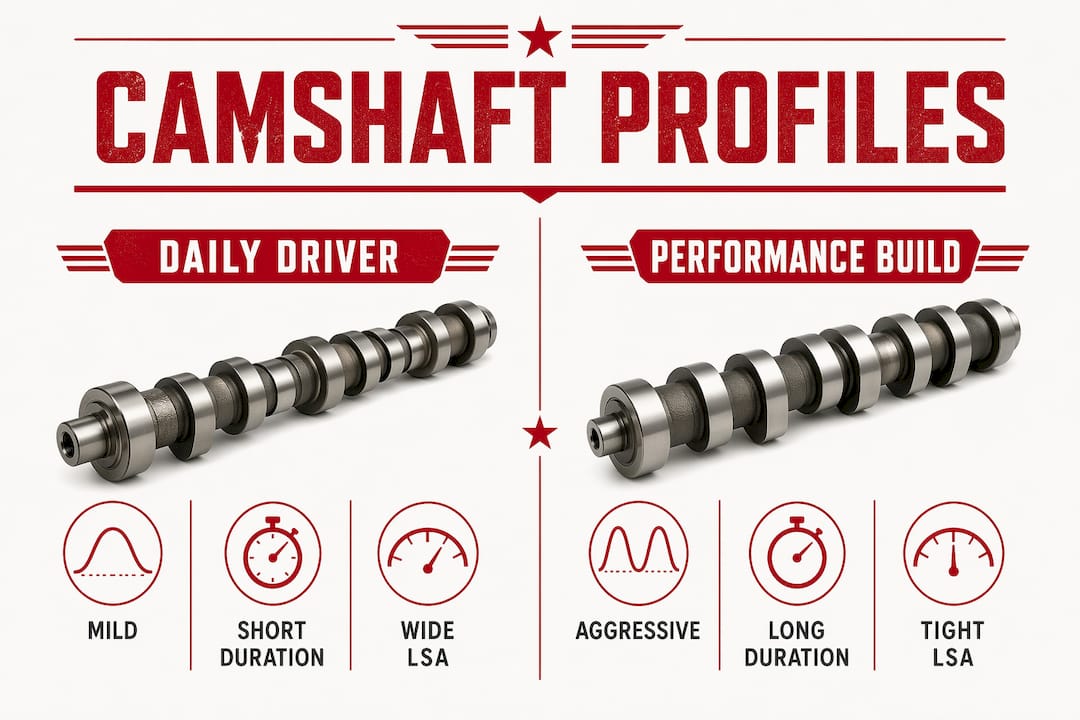
Wider LSA cams are preferred for forced induction because tight overlap bleeds boost pressure out of the cylinder before compression begins. A turbo LS build running a tight-LSA cam wastes boost at low RPM and fights the engine’s own breathing. Naturally aspirated engines benefit from tighter LSA because the overlap creates a scavenging effect, pulling exhaust gases out and fresh charge in at high RPM.
Cylinder head selection ties directly into this equation. A small-port head on a classic small-block Chevy reaches peak flow at lower RPM. Pairing it with a long-duration cam that peaks at 6,500 RPM produces a mismatch. The cam demands airflow the head cannot deliver at that speed. Hot Rod’s camshaft selection guide for LS, Coyote, and Hemi engines consistently reinforces this point: cam and head flow must align for effective cylinder filling.
Supporting modifications also vary by cam choice:
- Mild cams: stock valve springs often work, minimal tuning needed
- Aggressive cams: require upgraded valve springs, pushrods, and a full retune
- Forced induction cams: need boost-referenced fuel tuning and wider LSA
- High-lift cams: demand retainers, locks, and spring seat machining
What supporting parts does a cam upgrade actually require?
A camshaft upgrade alone rarely delivers full gains. Performance cam upgrades require supporting parts like valve springs, intake modifications, and a professional tune to fully unlock performance. Skipping any one of those elements creates a bottleneck that cancels out what the cam was supposed to deliver.
Here is the upgrade pathway that experienced builders follow:
- Assess your entire build first. Cam specs only make sense in context. Know your compression ratio, cylinder head flow numbers, intended RPM range, and whether you run forced induction or nitrous.
- Upgrade valve springs before installation. A high-lift cam with stock springs causes float at high RPM. Valve float destroys power and can bend pushrods or damage the cam itself.
- Match pushrods and rocker arms. Changing lift changes pushrod geometry. Incorrect pushrod length causes side loading on the valve stem, accelerating wear.
- Upgrade intake and exhaust to match. A cam that moves more air needs a matching intake manifold and exhaust headers. Leaving a stock intake on an aggressive cam is like widening a highway and leaving a one-lane on-ramp.
- Get a professional tune. Fuel mapping and ignition timing must match the new cam’s airflow demands. Without a tune, you risk running lean at peak power, which causes detonation and engine damage.
Cam upgrades only translate into gains if matched with heads, intake, exhaust, compression, and RPM capability. Ignoring this causes suboptimal performance or serious drivability problems.
Pro Tip: Break in a performance camshaft correctly by running the engine at 2,000–2,500 RPM for the first 20–30 minutes without letting it idle. Flat-tappet cams especially need this to seat the lobes against lifters under proper oil pressure and load.
Understanding how tuning ties into cam selection is worth studying further. A performance chip explained article covers how ECU tuning interacts with hardware changes like camshaft upgrades on modern engines.
How does variable valve timing compare to a fixed cam upgrade?
Variable Valve Timing (VVT) adjusts valve timing relative to crankshaft position on the fly, giving modern engines flexibility that fixed cam profiles cannot match. VVT adjusts valve timing but does not change duration or lift, which remain fixed by the physical cam profile. That distinction matters for performance builders.
- VVT advances or retards timing across the RPM range to balance power, economy, and emissions
- Fixed cam profiles deliver one set of timing events at all RPM, optimized for a specific powerband
- VVT cannot increase lift beyond what the cam lobe physically allows
- A performance cam upgrade on a VVT engine changes the base profile that VVT then adjusts around
- Disabling or locking VVT on a race engine removes flexibility but simplifies tuning
VVT systems like GM’s AFM, Ford’s Ti-VCT, and Chrysler’s VVT work well for street engines that need to pass emissions and return reasonable fuel economy. For dedicated performance builds, a fixed cam upgrade still delivers a more targeted powerband. The two approaches are not mutually exclusive. Many builders upgrade the cam on a VVT engine to shift the base profile higher while retaining the system’s ability to adjust timing at low load.
The limitation of VVT is that it cannot compensate for a cam that is fundamentally wrong for the application. A cam with too little lift on a high-compression, large-displacement engine will not make adequate power regardless of how aggressively VVT advances timing. The physical cam profile sets the ceiling.
Key Takeaways
A performance camshaft’s duration, lift, and LSA must match your engine’s heads, compression, and intended RPM range to produce real power gains.
| Point | Details |
|---|---|
| Duration drives powerband location | Short duration builds low-RPM torque; long duration shifts power to high RPM. |
| LSA controls idle and overlap | Tight LSA suits naturally aspirated builds; wide LSA is required for forced induction. |
| Supporting parts are non-negotiable | Valve springs, pushrods, intake, exhaust, and a tune must match the cam profile. |
| Cam and head flow must align | A cam that outpaces cylinder head flow wastes duration and produces no extra power. |
| VVT adjusts timing but not lift | Fixed cam upgrades still set the performance ceiling that VVT systems work around. |
What I’ve learned from matching cams to builds
The biggest mistake I see performance builders make is treating a camshaft like a bolt-on upgrade. They find a cam with impressive duration numbers, order it, drop it in, and wonder why the car runs worse than before. The cam was not wrong. The build was not ready for it.
Every cam selection starts with an honest assessment of the whole engine. What are the heads flowing? What compression ratio are you running? What RPM range do you actually use? A 230° duration cam on a low-compression engine with stock heads produces a rough idle, poor vacuum, and no meaningful power gain. That same cam on a built short-block with ported heads and a matching intake is a completely different story.
I also see builders ignore LSA until it bites them. Forced induction builders especially need to run wider LSA. Tight overlap on a boosted engine bleeds charge pressure before the piston can compress it. The result is a car that feels slow despite making boost. Switching to a wider LSA cam on the same turbo setup often produces more felt power than the cam change alone would suggest.
The break-in process also gets skipped more than it should. A flat-tappet cam that is not broken in correctly at sustained RPM will wipe a lobe within the first few hundred miles. That failure is not a cam quality issue. It is a process issue. Follow the break-in procedure, use the correct high-zinc break-in oil, and do not let the engine idle cold during that first 30 minutes.
My recommendation for first-time cam upgrades: start with a mild to medium profile that matches your existing heads and compression. Build the supporting parts around it. Get a tune. Drive it. Then decide if you want more. Chasing maximum duration on a first build almost always ends in frustration.
— Ozkonic Kustomz
Performance parts for your cam upgrade build
Building around a new camshaft means every connected component needs to be right. The cam is only as good as the hardware supporting it.
Ozkonickustomz stocks automotive hardware and electrical components that performance builders rely on during engine builds and upgrades. From ignition terminal components that complement a freshly tuned cam setup to modular wiring solutions for clean engine bay builds, the catalog covers the supporting work that makes a cam upgrade complete. Ozkonickustomz sources directly from vetted manufacturers, so fitment and quality are confirmed before anything ships. Browse the full performance parts catalog to find what your build needs next.
FAQ
What does a performance camshaft actually do?
A performance camshaft controls valve timing, lift, and duration to determine when and how far intake and exhaust valves open. This directly shapes where the engine makes power across the RPM range.
How does camshaft duration affect performance?
Shorter duration improves low-speed torque while longer duration increases top-end power. Duration measured at 0.050-inch lift is the industry standard for accurate cam comparisons.
What is LSA and why does it matter?
Lobe Separation Angle governs valve overlap and directly affects idle quality, manifold vacuum, and powerband shape. Tight LSA suits naturally aspirated performance builds; wide LSA is the correct choice for turbocharged or supercharged engines.
Do I need a tune after a camshaft upgrade?
Yes. Fuel mapping and ignition timing must match the new cam’s airflow demands. Running an untuned engine after a cam swap risks lean conditions at peak power, which causes detonation and engine damage.
Can VVT replace a performance cam upgrade?
No. VVT adjusts timing relative to crank position but cannot change the lift or duration fixed by the physical cam profile. A performance cam upgrade sets the base profile that VVT then works around.