

Hybrid performance tuning is the process of recalibrating a hybrid vehicle’s engine and electric systems to improve power output, efficiency, and drivability. Unlike traditional engine tuning, this discipline requires adjusting multiple interconnected systems at once: the internal combustion engine (ICE), the electric motor, and the battery management system. Tools like ECU remapping software, dyno setups, and Hybrid Control Unit (HCU) calibration are all part of the process. Done right, hybrid tuning delivers measurable gains in throttle response, fuel economy, and overall driving feel without sacrificing reliability.
What is hybrid performance tuning and how does it work technically?
Hybrid performance tuning works by recalibrating the software and hardware that govern how a hybrid’s power sources interact. The ECU controls the combustion engine’s fuel maps, ignition timing, and power delivery curves. The HCU sits alongside the ECU and manages the electric motor’s contribution, regenerative braking behavior, and battery state-of-charge (SoC). Tuning both units in sync is what separates effective hybrid calibration from guesswork.
The interaction between the ICE and electric motor is where most of the tuning complexity lives. When these two power sources hand off to each other poorly, you feel it as a lurch, hesitation, or flat spot in acceleration. Tuning the ECU without synchronizing the HCU causes drivetrain shudders and error codes because the electric-to-gas power transition falls out of sync. Calibrating both units together eliminates that problem.
Key technical adjustments in hybrid tuning include:
- Ignition timing and fuel maps: Advancing timing and refining fuel delivery improves combustion efficiency and torque output.
- Power delivery curves: Smoothing the torque curve reduces the abrupt power transitions common in stock hybrid calibrations.
- State-of-charge optimization: Adjusting the SoC window lets the electric motor assist for longer periods, though this requires careful thermal management.
- Thermal management calibration: Keeping battery and motor temperatures within safe ranges is non-negotiable for long-term reliability.
Pro Tip: Before touching any software, pull a full diagnostic scan. Error codes and sensor faults will corrupt your tune from the start.
Chiptuning turbocharged hybrid engines can increase torque by 10–20%, while naturally aspirated hybrids see smaller gains. That gap exists because turbocharged systems have more headroom in their factory calibrations to exploit.
What are the benefits of hybrid tuning beyond raw horsepower?
The biggest misconception about hybrid tuning is that it is only about adding power. The real gains are often in drivability, efficiency, and system harmony. Hybrid tuning focuses on improving drivability and smoothing transitions between electric and combustion power, not just increasing peak output. That shift in focus is what makes hybrid tuning genuinely useful for daily drivers, not just track enthusiasts.
The four most meaningful benefits of a well-executed hybrid tune are:
- Sharper throttle response. Reducing lag between pedal input and power delivery makes the car feel more alive, especially at low speeds where electric motor response is critical.
- Smoother power transitions. Eliminating the hesitation when the ICE kicks in or the electric motor cuts out makes acceleration feel linear and predictable.
- Improved fuel economy. Refining how the battery charges and discharges reduces unnecessary combustion engine use. Manufacturers often limit the ICE in hybrids for fuel economy or insurance reasons, and professional recalibration can unlock that untapped potential safely.
- Reduced drivetrain stress. Smoother power handoffs mean less mechanical shock on the transmission and motor mounts over time.
“Hybrid tuning is less about making a car louder or just faster and more about system orchestration across various components for reliability and performance.” — APTuning
That quote captures the mindset shift every hybrid owner needs before starting a tune. The goal is coordination, not brute force.
What are common hybrid performance tuning techniques?
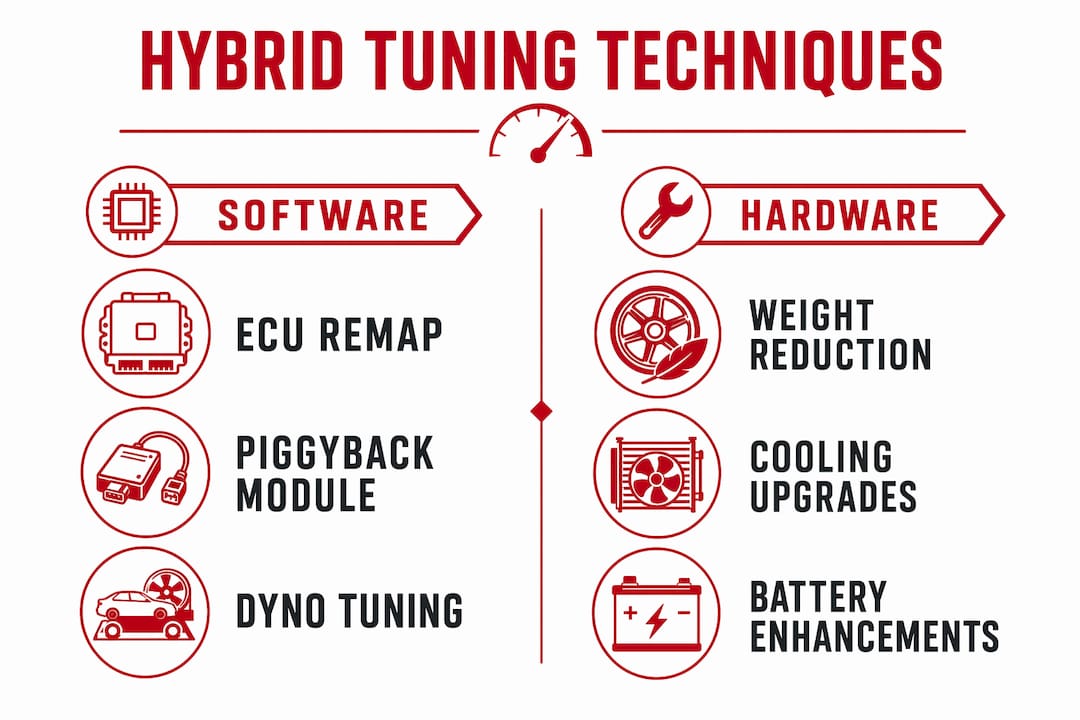
Hybrid tuning techniques fall into two broad categories: software-based and hardware-based. Most serious builds use both.

| Technique | Method | Best For | Limitations |
|---|---|---|---|
| ECU remapping (flash tuning) | Rewriting factory ECU maps | Permanent power and efficiency gains | Requires HCU sync; voids warranty |
| Dyno-based custom tuning | Real-time calibration on a dynamometer | Bespoke, system-integrated results | Higher cost; needs specialist |
| Piggyback modules | Intercepts and modifies ECU signals | Reversible, low-risk adjustments | Limited gains; no deep calibration |
| Hardware upgrades | Cooling, lightweight parts, battery improvements | Supporting software gains | No standalone power increase |
Professional dyno-based custom tuning is the gold standard for hybrid tuning. It allows real-time monitoring of transmission stress, battery temperature, and energy recovery efficiency during the calibration process. That live data feedback is something a bench flash simply cannot replicate.
Piggyback modules like those used on some Toyota Prius builds offer a reversible entry point for enthusiasts who want to experiment without committing to a full remap. The tradeoff is that they cannot touch deep HCU parameters, so the gains are modest.
Hardware upgrades complete the picture. Weight reduction through lightweight parts improves acceleration, braking, and efficiency in hybrids by relieving powertrain load. Upgraded cooling systems protect the battery and motor under the higher thermal loads that come with a more aggressive tune.
Pro Tip: For ECU remapping on performance-oriented hybrids, platforms like HP Tuners give tuners the software depth needed to work across both the engine and transmission control systems.
What are the key risks and considerations when tuning hybrid vehicles?
Hybrid tuning carries real risks that conventional engine tuning does not. The battery pack, electric motor, and power electronics all operate within tight tolerances. Pushing past those tolerances without proper calibration causes failures that are expensive and sometimes irreversible.
The most common risks include:
- Battery degradation. Battery SoC optimization increases electric assist duration but risks faster battery wear without precise thermal management. Pushing the SoC window too wide accelerates cell aging.
- Thermal overload. Misunderstanding thermal loads leads to hybrid drivetrain failure. Cooling upgrades are not optional on a tuned hybrid; they are the foundation.
- Warranty voids. Most manufacturer warranties do not cover damage caused by aftermarket ECU modifications. Know what you are giving up before you flash.
- Error codes and system conflicts. Tuning the ECU without matching HCU calibration generates fault codes that can disable hybrid mode entirely.
- Expert calibration gaps. Hybrid ECU tuning requires expertise in hybrid system communications and safety margins. A tuner experienced only with gasoline cars is not qualified to touch a hybrid’s HCU.
The staged approach works best here. Start with diagnostics and cooling, then move to software, then hardware. Skipping steps to save time or money is how builds fail.
How does hybrid tuning differ from tuning conventional ICE cars?
Hybrid tuning is fundamentally more complex than tuning a gasoline-only vehicle. A conventional ICE tune touches one control system: the ECU. A hybrid tune requires coordinating two control systems, the ECU and the HCU, along with the battery management system. That added layer changes everything about the process.
| Factor | Conventional ICE tuning | Hybrid tuning |
|---|---|---|
| Control systems | ECU only | ECU + HCU + BMS |
| Power sources | Engine only | Engine + electric motor |
| Key metrics | Horsepower, torque, AFR | Power, SoC, thermal load, energy recovery |
| Tuning focus | Engine output | System orchestration |
| Risk profile | Engine wear, detonation | Battery degradation, drivetrain shudder |
| Software complexity | Moderate | High |
Hybrid ECU tuning requires balancing battery health, regenerative braking, and electrical flow, making it far more complex than tuning gasoline cars. That complexity is not a barrier. It is a reason to work with a specialist who understands both sides of the powertrain.
The electric motor in a hybrid also changes what “performance” means. On a gasoline car, more power means more engine output. On a hybrid, better performance often means better coordination between the motor and engine, not just a bigger number on the dyno sheet. That is a mindset shift that separates good hybrid tuners from great ones.
Key Takeaways
Hybrid performance tuning delivers the best results when software calibration, hardware upgrades, and thermal management work together as a system rather than as isolated changes.
| Point | Details |
|---|---|
| ECU and HCU must sync | Tuning the ECU alone causes drivetrain shudder and error codes without matching HCU calibration. |
| Turbocharged hybrids gain more | Chiptuning turbocharged hybrids can increase torque by 10–20%; naturally aspirated hybrids see smaller gains. |
| Dyno tuning is the gold standard | Real-time monitoring of battery temperature and transmission stress makes dyno tuning the most accurate method. |
| Staged upgrades outperform flash-only builds | Starting with diagnostics and cooling before software changes protects the battery and drivetrain long-term. |
| Benefits go beyond power | Smoother transitions, sharper throttle response, and better fuel economy are often more valuable than peak horsepower gains. |
The “more power” mindset fails hybrid builds
The most common mistake I see in hybrid tuning is treating it like a gasoline build. Someone gets a flash tune, skips the cooling work, and wonders why the battery degrades in six months. The “more power at all costs” mindset is counterproductive in hybrids. Balanced tuning that prioritizes diagnostics and cooling consistently outperforms aggressive one-step software flashes.
What I have found works is a staged approach. Diagnose first. Upgrade cooling. Then address software. Then consider hardware like lightweight components. Each stage builds on the last. Many hybrids have untapped engine potential because manufacturers deliberately limit output for fuel economy or insurance compliance. That headroom is real, and it is safe to access when you approach it methodically.
The hybrid tuning community has matured significantly. Tuners who specialize in platforms like the Toyota RAV4 Hybrid, Ford Escape Hybrid, and BMW 330e are producing results that would have seemed impossible five years ago. The tools are better, the knowledge base is deeper, and the results speak for themselves. The enthusiasts who win are the ones who respect the complexity of the system rather than fighting it.
— Ozkonic Kustomz
Upgrade your hybrid build with Ozkonickustomz
Ozkonickustomz stocks aftermarket performance parts built for enthusiasts who take their builds seriously. Whether you are supporting a dyno tune with better instrumentation or adding hardware upgrades to complement your software calibration, the right parts make the difference between a build that lasts and one that fails under load.

From Dakota Digital EFI interface modules to pulse generators that keep your data accurate under real driving conditions, Ozkonickustomz carries the components that serious hybrid builders rely on. Browse the full catalog at Ozkonickustomz and find the parts that fit your build and your goals.
FAQ
What is hybrid performance tuning in simple terms?
Hybrid performance tuning is the process of recalibrating a hybrid vehicle’s ECU and Hybrid Control Unit to improve power, efficiency, and drivability. It involves adjusting fuel maps, ignition timing, and electric motor coordination across the full powertrain.
How much power can hybrid tuning add?
Chiptuning turbocharged hybrids can increase torque by 10–20%, while naturally aspirated hybrids see smaller gains. The exact result depends on the platform, the tuner’s skill, and whether hardware upgrades support the software changes.
Does hybrid tuning void the warranty?
ECU remapping typically voids the manufacturer’s powertrain warranty. Check your specific warranty terms before proceeding, and work with a tuner who documents all changes made to the vehicle.
Is dyno tuning necessary for hybrid vehicles?
Dyno tuning is the most reliable method for hybrid calibration because it allows real-time monitoring of battery temperature, transmission stress, and energy recovery during the tune. A bench flash alone cannot capture that live system data.
What is the biggest risk of tuning a hybrid car?
Battery degradation from poor thermal management is the most common and costly risk. Upgrading the cooling system and calibrating the battery’s state-of-charge window carefully are the two steps that prevent it.