

High mileage vehicle performance upgrades in CA are defined as targeted modifications and maintenance strategies applied to vehicles with 75,000 or more miles to restore power, improve fuel efficiency, and extend engine life. California’s combination of stop-and-go urban traffic, long highway stretches, and extreme summer heat creates specific demands that generic upgrade advice simply does not address. Products like Pennzoil High Mileage Oil, Cerma STM-3 engine treatment, and performance chips each serve a distinct role in a well-planned upgrade strategy. The goal is not to turn a worn engine into a race motor. The goal is to get the most reliable, efficient performance from what you already have.
What are the most effective maintenance treatments for high-mileage engines in California?
The foundation of any high mileage vehicle tuning plan is the right oil. Industry experts recommend switching to a dedicated high-mileage motor oil after 75,000 miles. Pennzoil High Mileage Oil, for example, contains seal-conditioning agents that swell aging gaskets and reduce oil consumption. That matters in California, where summer temperatures in the Central Valley and Inland Empire regularly push engines harder than the manufacturer ever anticipated.
Beyond oil, ceramic matrix treatments represent a meaningful leap over traditional additives. Cerma STM-3 uses Nano Silicon Carbide to bond a protective layer directly to cylinder walls and bearings. That layer stays in place across multiple oil changes, which means worn surfaces on a 200,000-mile engine get permanent protection rather than a temporary chemical coating. This is the kind of treatment that makes a measurable difference on a vehicle that has already seen hard use.

Timing belt, transmission, and cooling system inspections become non-negotiable past 100,000 miles. Delaying these checks can push repair costs 200–300% above what scheduled maintenance would have cost. California’s heat accelerates coolant degradation and puts extra strain on rubber belts and hoses. Owners of Dodge and Ram trucks with Mopar 5.7L or 6.4L HEMI engines should follow manufacturer synthetic oil specifications without exception, since these engines are particularly sensitive to oil viscosity and change intervals.
Key maintenance treatments to apply in sequence:
- Switch to high-mileage synthetic oil with seal conditioners at 75,000 miles
- Apply a ceramic matrix treatment like Cerma STM-3 to restore worn cylinder surfaces
- Inspect and replace timing belts per manufacturer intervals, not mileage guesses
- Flush and refill the cooling system with the correct coolant type for your engine
- Service the transmission fluid before symptoms appear, not after
Pro Tip: Apply ceramic engine treatments in spring before California’s summer heat peaks. The bonding process works best when the engine reaches full operating temperature consistently, which spring driving conditions support without the added stress of extreme heat.
How do tire and aerodynamic upgrades influence fuel efficiency on high-mileage cars?
Tire selection is one of the most cost-effective fuel efficiency upgrades available for a high-mileage vehicle. Low rolling resistance tires improve fuel economy by 1–3% compared to standard all-season tires. That gain compounds over California’s long commutes. A set of LRR tires typically costs $100–$200 more than a comparable standard set, but the fuel savings over 30,000 miles of California highway driving recover that cost.
Tire pressure is the no-cost version of the same benefit. Under-inflated tires increase fuel consumption by 0.5–1% through added rolling resistance. Checking pressure before every long trip takes two minutes and costs nothing. For California enthusiasts who drive Highway 99, Interstate 5, or the 405 regularly, that small habit adds up to real savings across a year.
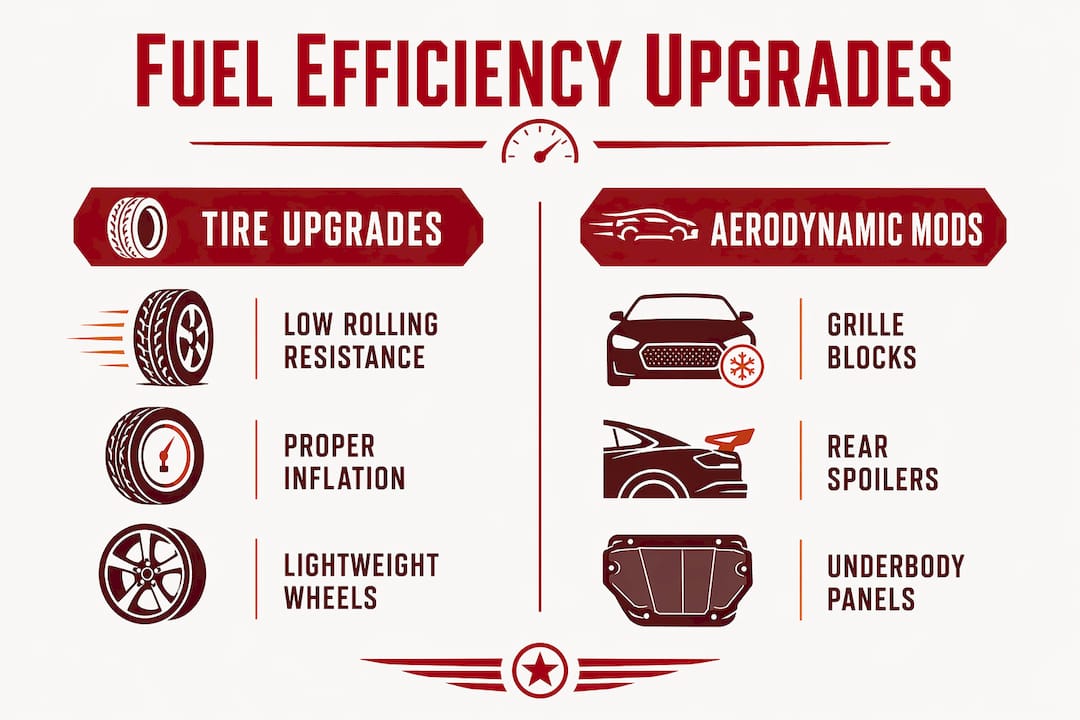
Aerodynamic modifications take the efficiency gains further. Grille blocks tested by Hagerty showed approximately 1 MPG improvement at highway speeds by reducing frontal drag. Underbody air dams work on the same principle, directing airflow away from the undercarriage. These are minor mods, but they do not stress a worn engine the way a power upgrade would.
| Upgrade | Approximate Cost | MPG Gain |
|---|---|---|
| Low rolling resistance tires | $100–$200 extra per set | 1–3% |
| Correct tire pressure | No cost | 0.5–1% |
| Grille block | $20–$80 DIY | ~1 MPG highway |
| Underbody air dam | $50–$150 | Varies by vehicle |
Pro Tip: If you install a grille block, monitor coolant temperature on your first few drives, especially in slow traffic. Most modern engines handle it fine at highway speeds, but stop-and-go conditions in Los Angeles or Sacramento can push temperatures higher than expected.
What tuning and performance mods are safe for high-mileage vehicles in California?
Performance tuning on a high-mileage vehicle is viable, but only after the engine passes a health check. Worn oxygen sensors, failing mass airflow sensors, or degraded ignition components will undermine any ECM tune before it delivers a single horsepower. A measurement-first approach to tuning means pulling diagnostic codes, checking compression, and confirming fuel trims are within spec before touching calibration files.
Performance chips and ECM tuning can improve throttle response and fuel economy on older engines when the baseline is clean. For a deeper look at how these devices work and what realistic gains look like, the performance chip guide at Ozkonickustomz covers the specifics without overpromising. The key point is that a chip cannot fix a mechanical problem. It can only extract more from an engine that is already running correctly.
HEMI engines in Dodge, Chrysler, and Ram vehicles carry a specific risk that every California enthusiast should know. MDS lifter failures occur commonly between 80,000 and 150,000 miles and lead directly to camshaft damage if ignored. Addressing this failure before any power modification is not optional. Adding boost or aggressive cam timing to an engine with a compromised MDS system accelerates the damage from inconvenient to catastrophic.
Safe tuning principles for high-mileage engines:
- Confirm compression readings are within 10% across all cylinders before tuning
- Replace spark plugs, ignition wires, and coil packs before ECM calibration
- Avoid aggressive cam profiles on engines with over 100,000 miles
- Use incremental tune revisions and log data between changes
- Address known failure patterns like HEMI MDS lifter issues before any power mod
California’s CARB regulations add another layer of consideration. Any modification that affects emissions systems must be CARB-exempt to remain street legal. Check the CARB EO number on any intake, exhaust, or tune before purchasing.
How to troubleshoot and prioritize upgrades for high-mileage vehicles in California
Proactive maintenance beats reactive repair on every financial metric. Well-maintained high-mileage vehicles see repair costs 40–60% lower than vehicles managed reactively. That gap widens significantly past 200,000 miles. California enthusiasts who treat maintenance as an upgrade category rather than a chore consistently get more performance per dollar than those chasing bolt-on parts first.
The right order of operations matters. Fixing an oil leak before installing a performance intake is not just common sense. It is the difference between a mod that works and a mod that masks a worsening problem. Use an OBD-II scanner to pull live data before spending money on any upgrade. Coolant temperature, fuel trim values, and misfire counts tell you exactly where the engine stands.
Prioritized upgrade checklist for California high-mileage vehicles:
- Pull diagnostic codes and address all active faults first
- Inspect for oil leaks at valve covers, oil pan, and rear main seal
- Check coolant condition and thermostat function before summer
- Assess suspension wear: ball joints, tie rod ends, and shocks on vehicles over 100,000 miles
- Confirm transmission fluid condition and check for slipping under load
- Replace air filter and inspect intake ducting for cracks
- Test battery and charging system, since California heat degrades batteries faster than cold climates
- Verify tire condition, pressure, and alignment before any performance mod
Suspension wear is frequently underestimated as a performance factor. Worn shocks and loose ball joints reduce cornering stability and tire contact patch, which negates any handling improvement from other mods. On California roads, where highway on-ramps and canyon roads are part of daily driving for many enthusiasts, suspension condition directly affects both safety and driving feel.
Key Takeaways
High-mileage vehicle performance upgrades in California deliver the best results when maintenance comes first and modifications follow a logical, data-driven sequence.
| Point | Details |
|---|---|
| Switch to high-mileage oil at 75,000 miles | Seal conditioners in products like Pennzoil High Mileage Oil reduce oil consumption and protect aging gaskets. |
| Use ceramic treatments on worn engines | Cerma STM-3 permanently bonds to cylinder walls, providing lasting protection beyond standard oil additives. |
| LRR tires and correct pressure compound savings | Low rolling resistance tires improve fuel economy 1–3%, and proper inflation adds another 0.5–1% at no cost. |
| Fix known failure patterns before tuning | HEMI MDS lifter issues between 80,000 and 150,000 miles must be resolved before any power modification. |
| Proactive maintenance cuts long-term costs | Scheduled inspections reduce repair costs 40–60% compared to reactive strategies on high-mileage vehicles. |
What I have learned tuning high-mileage vehicles in California
The biggest mistake California enthusiasts make is treating a high-mileage build like a fresh engine build. They buy the intake, the tune, and the exhaust, and then wonder why the car runs worse than before. The answer is almost always something foundational: a leaking injector, a tired oxygen sensor, or in HEMI trucks, an MDS lifter that was already failing before the first mod went on.
Regional knowledge matters more than most guides admit. California’s summer heat in the San Joaquin Valley is genuinely brutal on cooling systems. An engine that runs fine in Oregon with a slightly marginal thermostat will overheat on a July afternoon between Fresno and Bakersfield. Grille blocks and aerodynamic mods that work beautifully on the coast need coolant temperature monitoring the moment you head inland.
The aero mods surprised me most. A simple grille block on a highway commuter delivered consistent real-world fuel economy gains without touching the engine. That result lines up with what minor aerodynamic improvements and correct tire care can deliver when applied together. The compounding effect is real, and it does not stress an aging powertrain the way a power upgrade does.
My honest advice: spend the first $500 on diagnostics, oil, and a ceramic treatment. Spend the next $500 on tires and pressure monitoring. After that, your engine will tell you clearly what it can handle next.
— Ozkonic Kustomz
Quality parts for your high-mileage build at Ozkonickustomz
California enthusiasts working through a high-mileage upgrade plan need parts that fit correctly the first time. Ozkonickustomz sources directly from vetted manufacturers, which means no counterfeit ignition components and no guessing on fitment for your specific make and model.
The Ozkonickustomz catalog includes ignition terminals and distributor components for GM HEI systems, modular wiring kits for truck builds, and professional crimper sets for clean, reliable wiring work. Every order ships fast, and the return policy removes the risk from buying parts online. Browse the full catalog at ozkonickustomz.com and find exactly what your build needs next.
FAQ
What counts as a high-mileage vehicle for upgrade purposes?
A vehicle with 75,000 or more miles is generally considered high mileage for upgrade and maintenance planning purposes. At this threshold, seal aging, oil consumption, and component wear begin to influence which modifications are appropriate.
Do performance chips work on high-mileage engines?
Performance chips can improve throttle response and fuel economy on high-mileage engines, but only when the engine is mechanically sound. Worn sensors, misfires, or compression loss will prevent any chip from delivering meaningful gains.
Are grille blocks legal in California?
Grille blocks are a physical modification with no direct emissions impact, so they are generally legal in California. They do not affect CARB-regulated systems, but you should monitor coolant temperature after installation, especially in stop-and-go traffic.
How often should I change oil on a high-mileage California vehicle?
High-mileage vehicles in California should follow the manufacturer’s interval using a high-mileage synthetic oil, typically every 5,000–7,500 miles depending on the engine. California’s heat accelerates oil degradation, so erring toward shorter intervals is the safer choice.
What is the first upgrade to make on a high-mileage vehicle?
The first upgrade is a full diagnostic scan followed by a switch to high-mileage motor oil with seal conditioners. Addressing active faults and oil condition before any performance modification protects the investment in every upgrade that follows.