
Performance parts online shopping is the process of selecting aftermarket components that enhance your vehicle’s power, handling, or durability by verifying compatibility, quality, and vendor reliability before purchase. Done right, specific exhaust upgrades alone can deliver up to 20 percent performance gains. That number only holds when the part fits correctly and gets installed on the right vehicle. This guide walks you through every step of a structured buying process, from gathering your vehicle data to evaluating vendor policies, so you spend money on parts that actually work.
What vehicle information do you need before shopping for performance parts?
Your vehicle profile is the foundation of every successful purchase. Generic information like “2018 F-150” is not enough. A comprehensive vehicle profile must include year, make, model, trim level, engine type, drivetrain configuration, and transmission type. Missing even one of these details can send you the wrong part.
Here is the full list of data points to collect before you start your performance parts online buying checklist:
- Year, make, model, and trim: A base trim and a sport trim of the same truck often use different suspension geometry and mounting points.
- VIN (Vehicle Identification Number): Your 17-character VIN encodes your exact factory build. Find it on the driver’s side dashboard or door jamb sticker. It confirms engine codes, axle ratios, and factory options.
- Engine type and displacement: A 5.0L and a 5.7L in the same model year are not interchangeable for intake manifolds or headers.
- Drivetrain and transmission: Two-wheel drive and four-wheel drive variants use different driveshafts, transfer cases, and sometimes exhaust routing.
- Sub-model and production date: Some manufacturers changed part specifications mid-year. A part built for an early-production 2019 may not fit a late-production 2019.
- Suspension codes and axle specifications: Critical for lift kits, coilovers, and rear air suspension upgrades.
Skipping this step is the single most common reason enthusiasts end up paying restocking fees. Treat your vehicle profile as a living document. Update it every time you add a modification, because aftermarket changes affect what fits next.
How to verify performance parts compatibility effectively

Compatibility verification is the step most buyers rush, and it is where most expensive mistakes happen. The safest verification method is cross-referencing OEM part numbers rather than relying solely on a website’s year/make/model filter. Filters are a starting point, not a guarantee.
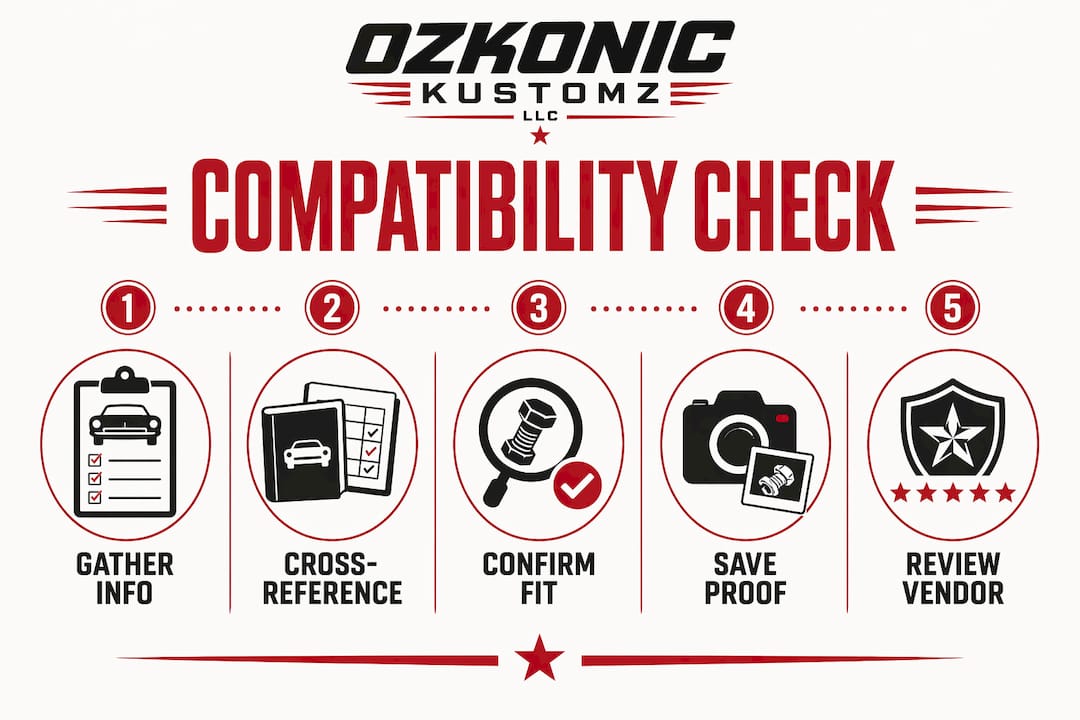
Follow this numbered process for every part you plan to buy:
- Pull the OEM part number from your factory service manual or a dealer parts lookup. Use it to cross-reference the aftermarket part’s application list.
- Read the full fitment notes. Manufacturers publish exclusions for specific trims, option packages, or production date ranges. These notes are often buried below the main description.
- Identify whether the part is direct-fit or universal-fit. Direct-fit parts bolt on with no modification. Universal-fit parts require fabrication, welding, or custom brackets. Know which you are buying before checkout.
- Request dimensional drawings or photos from the seller. A reputable vendor provides these on request. Vendors who cannot supply part numbers, drawings, or photographic fitment proof should be avoided entirely.
- Measure your vehicle’s existing components. Use digital calipers to check bolt pattern diameters, flange widths, and mounting hole spacing. Precision measurement tools like digital calipers and torque wrenches prevent costly errors before installation.
- Call or email the vendor directly. Describe your exact build and ask them to confirm fitment in writing. A good vendor will tell you if the part does not fit rather than lose you to a return.
Pro Tip: Save every fitment confirmation email or chat transcript. If a dispute arises during a return, written vendor confirmation is your strongest evidence.
| Verification method | Best used for | Limitation |
|---|---|---|
| Website year/make/model filter | Initial part search | Does not account for sub-models or mid-year changes |
| OEM part number cross-reference | Confirming exact fitment | Requires access to factory parts data |
| Dimensional measurement | Universal-fit parts | Requires physical access to vehicle |
| Vendor written confirmation | Complex or rare builds | Response time varies by seller |
How do you compare performance parts vendors and online platforms?
Not every online seller operates with the same standards. Evaluating vendors before you buy protects you from counterfeit parts, hidden fees, and zero-support returns. Set clear build goals and filter vendors by policy, not just price. A $40 savings means nothing if the return policy charges a 25 percent restocking fee.
Key criteria to evaluate when you compare performance parts pricing online:
- Fitment guarantee: Does the vendor guarantee the part fits your vehicle as described, or do they shift responsibility to the buyer after purchase?
- Return and exchange policy: Look for restocking fee percentages, return windows (30 days is standard), and whether they cover return shipping on incorrect parts.
- Warranty coverage: Performance parts should carry at least a manufacturer’s limited warranty. Confirm what is covered and for how long.
- Shipping costs and speed: Some vendors advertise low part prices but charge $60 in freight. Calculate total landed cost before comparing prices across sellers.
- Customer service access: Can you reach a real person by phone or live chat? Vendors who offer upgrade advice and pre-purchase fitment support are worth a price premium.
- Seller documentation transparency: Legitimate sellers list part numbers, include application guides, and respond to technical questions. Vague listings with no specifications are a warning sign.
Pro Tip: Search the vendor’s name plus “fitment issue” or “wrong part” in automotive forums before buying. Real buyer experiences surface problems that polished product pages hide.
Seasonal sales create pressure to buy fast. Resist it. A rushed purchase on an incompatible part costs more than the discount saved. The best performance parts shopping decisions come from research done before a sale starts, not during one.
Budgeting and planning total costs beyond part prices
The sticker price of a performance part is rarely the total cost. Total investment must include the purchase price, professional installation fees, supporting modifications, and any required tuning services. Ignoring these layers is how enthusiasts blow budgets mid-build.
Plan for these cost categories before you buy:
- Professional installation: Labor rates at performance shops range widely by region and complexity. A header swap on a V8 truck can run several hours of billed labor. Get a quote before ordering the part.
- Supporting modifications: A cold-air intake may require a new mass airflow sensor calibration. A suspension lift often needs new brake lines, extended sway bar links, and alignment work. Budget for the whole system, not just the headline part.
- Tuning and calibration: Engine management changes from intake, exhaust, or forced induction upgrades require a tune. A professional dyno tune adds cost but protects the engine and maximizes the gain. Learn more about tuning total costs before committing to a build.
- Quality versus price tradeoffs: Cheap parts fail faster and can damage surrounding components. A failed budget turbo can destroy an engine. Spend where it counts and cut costs on accessories, not structural components.
- Staged purchasing: Prioritize parts by impact and dependency. Install and test one system before adding the next. This approach catches fitment issues early and keeps spending controlled.
A written budget that accounts for all five categories prevents the most common mid-build crisis: running out of money before the car runs.
Common mistakes when shopping online for performance parts
Most fitment failures are preventable. Ignoring detailed fitment notes leads to wasted money and time, and it is the most common pitfall for online shoppers. The fine print in a fitment note often contains the one detail that makes or breaks the install.
Avoid these mistakes on your performance parts compatibility checklist:
- Relying only on website filters: Filters are built on database entries that contain errors. Always cross-check with OEM numbers.
- Buying universal-fit parts without fabrication readiness: If you do not have welding equipment or a fabricator lined up, a universal part will sit in a box.
- Skipping OEM verification: Experienced buyers manually verify fitment notes and cross-check OEM numbers rather than trusting filters alone.
- Not contacting the vendor before purchase: A two-minute call can confirm fitment and save a two-week return process.
- Ignoring restocking fees: A 20 percent restocking fee on a $500 part is $100 lost. Read the return policy before checkout, not after.
Staged part orders and pre-installation mock-ups prevent cascading fitment issues in multi-component upgrades. Test one part before ordering the next piece that depends on it.
When a wrong part arrives, act fast. Most vendors require return authorization within a set window. Document the discrepancy with photos, reference your fitment confirmation, and contact support the same day the package arrives.
Key Takeaways
Buying performance parts online successfully requires verified vehicle data, OEM cross-referencing, and full cost planning before any purchase is made.
| Point | Details |
|---|---|
| Build a complete vehicle profile | Collect VIN, engine code, drivetrain, sub-model, and production date before searching. |
| Cross-reference OEM part numbers | Website filters miss sub-model exclusions; OEM numbers confirm exact fitment. |
| Evaluate vendor policies, not just price | Return windows, restocking fees, and fitment guarantees affect total cost more than part price alone. |
| Budget for the full system | Include installation labor, supporting mods, and tuning in every build budget. |
| Stage your purchases | Install and test one component before ordering the next dependent part. |
What I’ve learned after years of sourcing performance parts
The biggest mistake enthusiasts make is treating online shopping for performance parts like buying a phone case. A phone case that does not fit goes back for free. A wrong header that gets installed before anyone notices costs labor, gaskets, and a restocking fee. The stakes are different.
At Ozkonickustomz, we see the same pattern repeatedly. A buyer finds a great price, skips the fitment notes, and orders. The part arrives. It does not fit. Now they are out shipping costs, waiting on a return, and the build is stalled. The fix is always the same: slow down before checkout, not after.
The enthusiasts who build the best vehicles are not the ones with the biggest budgets. They are the ones who document everything. They keep a build sheet with every modification, every part number, and every vendor confirmation. When they add the next part, they already know exactly what the vehicle is. That document is worth more than any discount code.
Community forums like those on dedicated truck and performance car platforms are underrated research tools. Real owners post real fitment experiences, including the failures. A 10-minute search on a model-specific forum can confirm or kill a purchase faster than any product description. Use them before you buy, not after something goes wrong.
Staged builds also protect your wallet. If you are planning intake, exhaust, and a tune together, install the intake first. Drive it. Confirm it works. Then add the exhaust. Each stage gives you a clean data point. If something goes wrong, you know exactly what caused it.
— Ozkonic Kustomz
Quality performance components, ready for your build
Ozkonickustomz sources directly from vetted manufacturers, so every part ships with confirmed fitment documentation and real technical support behind it.
The catalog includes modular wiring kits built for truck performance projects, GM HEI ignition terminals compatible with classic and high-performance engines, and suspension components for trucks and off-road builds. Every listing includes part numbers, application notes, and a team you can actually reach before you buy. Fast shipping and straightforward return policies mean you are not gambling on a purchase. Browse the full Ozkonickustomz catalog at ozkonickustomz.com and find parts backed by the fitment confidence your build deserves.
FAQ
What is the most reliable way to verify performance parts compatibility?
Cross-referencing OEM part numbers against the aftermarket part’s application list is the most reliable method. Website year/make/model filters contain database errors and do not account for sub-model or mid-year production changes.
Why does my VIN matter when buying performance parts online?
Your VIN encodes your exact factory build, including engine codes, axle ratios, and factory-installed options. It confirms details that a basic model search cannot, which prevents ordering parts built for a different factory configuration.
What costs should I budget for beyond the part price?
Total costs include professional installation labor, supporting modifications like brackets or brake lines, and tuning or calibration fees. Skipping these in your budget is the leading cause of stalled builds and overspending.
What is the difference between direct-fit and universal-fit parts?
Direct-fit parts bolt on to a specific vehicle with no modification required. Universal-fit parts require fabrication, custom brackets, or welding to install correctly. Always confirm which type you are buying before checkout.
How do I avoid restocking fees on wrong parts?
Read the vendor’s return policy before purchasing, not after. Confirm fitment in writing with the seller, keep all documentation, and act on returns the same day a wrong part arrives to stay within the return authorization window.