
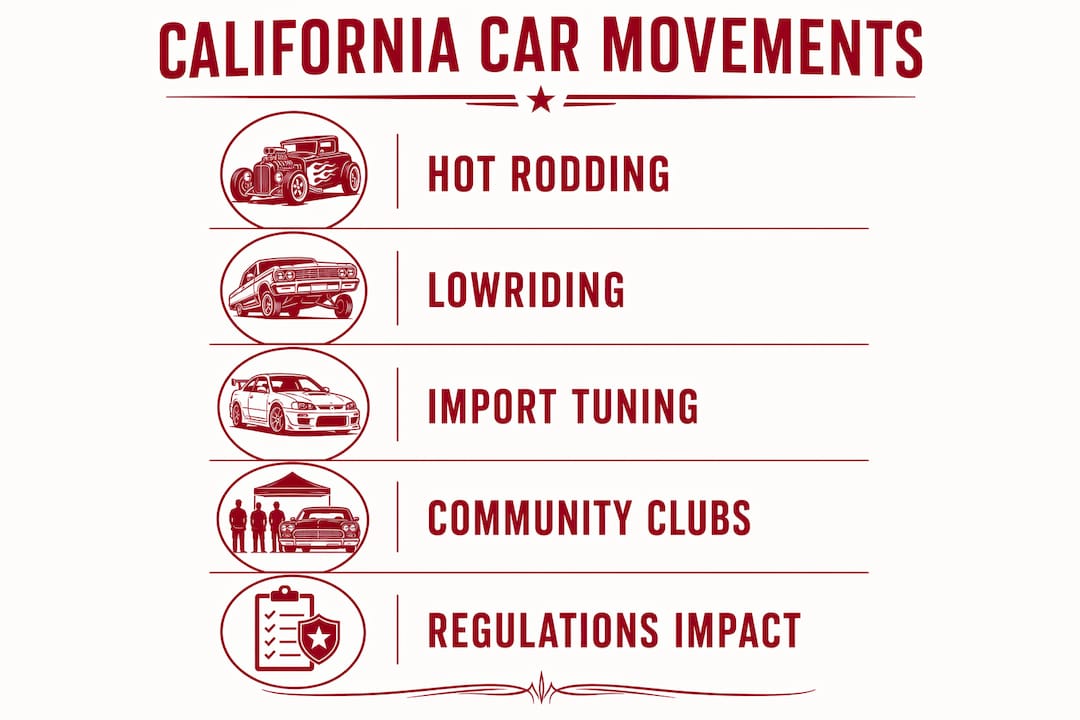
California car culture is a lifestyle built around customized automobiles, shared identity, and community. It grew out of post-World War II prosperity, when returning veterans found cheap surplus parts and wide-open dry lake beds perfect for speed. Three movements define it most clearly: hot rodding, lowriding, and import tuning. Each one emerged from a distinct community, each one left a mark on the state’s social fabric, and together they explain why California remains the center of gravity for American automotive life.
The defining elements of California car culture:
- Hot rodding: White veterans stripping and modifying prewar cars for speed, starting in the 1940s
- Lowriding: Mexican-American communities in Southern California turning cars into rolling art and cultural statements
- Import tuning: Asian-American youth in the 1990s blending performance and aesthetics through Japanese and Korean imports
- Car clubs and meets: Neighborhood-level gatherings that build community as much as they celebrate machines
- Year-round outdoor events: California’s climate makes car shows and cruises a constant, not a seasonal hobby
How California car culture shaped the state’s identity
The automobile did not just change how Californians got around. It reshaped where they lived, how cities grew, and who they became. After World War II, Los Angeles expanded outward in every direction, and the car was the only way to navigate it. Suburbs, drive-ins, and cruising strips became the social infrastructure of a generation.
Hot rodding was the first movement to go mainstream. Veterans returning from the Pacific brought mechanical skills and a hunger for speed, and the dry lake beds of the Mojave gave them a place to use both. The Southern California Timing Association, founded in the late 1930s and active through the postwar boom, gave the sport structure and legitimacy. By the late 1940s, hot rodding had moved from the desert to the street, and Hot Rod magazine, founded in 1947, was spreading the gospel nationwide.
Los Angeles County’s population growth tells the story of each wave. According to migration data cited in academic research, the county is home to the largest immigrant population in the United States. Each major population surge correlated with a new car culture movement: postwar White veterans built hot rods, a steady influx of Mexican immigrants from 1940 to 1970 produced the lowrider scene, and a wave of Asian immigrants in the late 1980s and early 1990s sparked import tuning.
The three movements that define California’s car scene
Hot rodding
Hot rodding started as a practical exercise. Prewar Fords were cheap, parts were plentiful, and the goal was simple: go faster. Veterans who had spent years maintaining aircraft and military vehicles knew exactly what to strip, swap, and rebuild. The culture was almost entirely male and predominantly White, rooted in the postwar optimism of a generation that had survived something terrible and wanted to feel alive.
Key traits of hot rod culture:
- Focus on mechanical performance over aesthetics
- Strong ties to drag racing and organized speed events
- Foundational influence on every car movement that followed
Lowriding
Lowriding came from a completely different place. Mexican-American veterans returning to Southern California in the 1940s faced segregation and discrimination. The lowrider was their answer: a slow, deliberate, beautifully customized car that said we are here on every boulevard it traveled. California Vehicle Code Section 24008, enacted in 1958, banned modifications that dropped a car’s frame below its wheel rims, a law widely seen as targeting the lowrider community specifically.
Key traits of lowrider culture:
- Hydraulics, custom paint, and chrome as artistic expression
- Deep roots in Chicano identity and family tradition
- Multigenerational clubs passing skills and pride from parent to child
Import tuning
Import tuning arrived in the early 1990s with a new generation of Asian-American youth who felt caught between cultures. Japanese and Korean imports were affordable, reliable, and endlessly modifiable. The scene split into two camps: one focused on outright performance, the other on visual customization. Both drew from hot rodding’s mechanical ethos and lowriding’s emphasis on personal expression, creating something genuinely new.
Key traits of import tuning:
- Blending of performance upgrades with aesthetic modifications
- Strong community ties across Korean, Japanese, and Chinese American groups
- Direct influence on the global tuning industry
What regulations actually do to California car culture
California’s legal environment has always pushed back against car culture, sometimes hard. The 1958 Vehicle Code restriction on lowered frames was just the beginning. In 1988, state lawmakers gave local governments the power to pass anti-cruising ordinances, and cities across Southern California used that authority aggressively. Lowriders found workarounds, including hydraulic systems that could raise a car to street-legal height on demand, but the legal pressure was constant.
California’s emissions standards are the strictest in the country, and they affect every enthusiast who wants to modify an engine, swap a component, or register an out-of-state vehicle. The California Air Resources Board (CARB) requires that most aftermarket parts carry an Executive Order number to be street-legal. That single requirement has shaped the entire aftermarket parts industry.
Key regulatory pressure points for California enthusiasts:
- California Vehicle Code Section 24008: Restricts how low a vehicle’s frame can sit relative to its wheel rims
- Anti-cruising ordinances: Local laws that restricted boulevard cruising for decades, largely repealed in recent years
- CARB Executive Order requirements: Mandate that aftermarket emissions-related parts meet state standards
- Out-of-state vehicle registration: Vehicles from other states must pass California’s smog check before registration
How Hollywood turned California car culture into a national obsession
Film and television did more to spread California car culture than any magazine or car show. American Graffiti (1973) captured the cruising culture of the early 1960s with an accuracy that felt like a documentary. Bullitt (1968) turned the streets of San Francisco into a racetrack and made the Ford Mustang a cultural icon. These films did not just entertain; they told people across the country that cars could mean something.
Hot Rod magazine, launched in 1947, built a national audience for a culture that had been purely regional. Music reinforced the message from a different angle. West coast hip hop in the early 1990s put lowriders front and center, from Eazy-E’s references to his modified Chevy Impala to Dr. Dre’s lyrics about hydraulics. By the time the Fast and Furious franchise arrived in 2001, import tuning had its own cinematic mythology.
Why California car culture still matters today
Lowrider culture is fundamentally about community, with the car itself often secondary to the relationships it builds. That dynamic holds across all three major movements. Car meets, shows, and club gatherings function as neighborhood institutions, especially in communities where other social infrastructure is thin.
“It’s the one way that communities, particularly working class communities, historically have created space for themselves to not just express how they want to portray their culture.” — Professor Denise Sandoval, California State University, Northridge
David Kennedy of the NHRA Motorsports Museum has described car culture as a device that brings people together regardless of background or vehicle type. That inclusivity is not incidental. It is structural. You show up with your car, and the car is the common language.
Electric vehicles are starting to change the conversation. California leads the country in EV adoption, and a growing number of enthusiasts are bringing modified EVs and hybrids to shows and meets. Hybrid performance tuning is a real and growing discipline, not a novelty. The culture adapts.
How to navigate California’s modification laws as an enthusiast
California’s regulatory environment rewards preparation. Knowing which parts carry CARB approval before you buy saves time, money, and a failed smog check. Ozkonickustomz publishes detailed guides on CARB parts requirements and California vehicle modification laws so you can build confidently within the rules.
Pro Tip: Before purchasing any aftermarket exhaust, intake, or emissions-related component, verify its CARB Executive Order number. A part without one is not street-legal in California, regardless of how it performs on a dyno.
Ozkonickustomz sources directly from vetted manufacturers, which means every part in their catalog meets fitment and quality standards before it ships. For California enthusiasts, that matters more than anywhere else in the country.
Build your California-legal setup with confidence. Ozkonickustomz carries air suspension kits and wiring harnesses trusted by the California customization community, backed by expert support and fast shipping.
Northern vs. Southern California: two different car scenes
Southern California owns the origin story. Los Angeles is where hot rodding, lowriding, and import tuning were all born, and the San Gabriel Valley, East Los Angeles, and the South Bay still host some of the most active car club scenes in the country. The weather, the sprawl, and the boulevard culture made SoCal the natural home for a car-centered lifestyle.
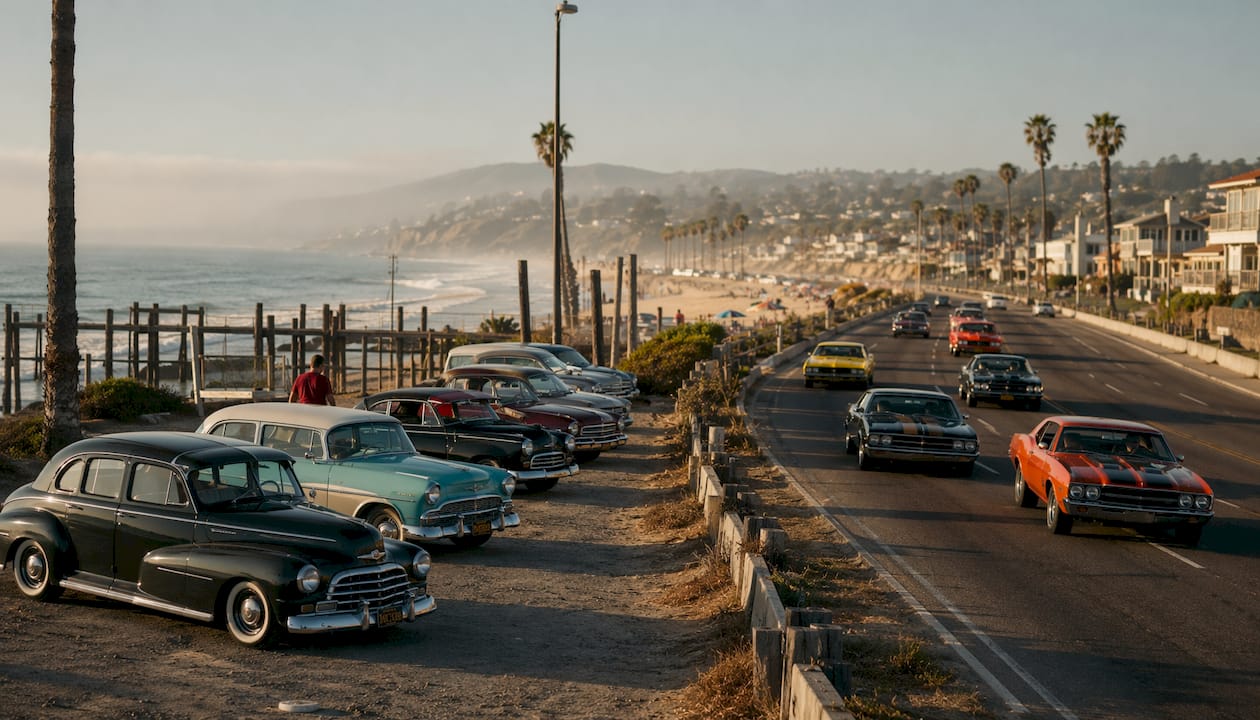
Northern California developed its own identity. The Bay Area produced a distinct lowrider scene with strong ties to both Chicano and African American communities. Sacramento and the Central Valley have deep roots in truck culture and off-road building. The geography is different, the pace is different, and the builds often reflect that. NorCal tends toward function; SoCal leans toward show.
What car clubs actually do for California communities
A California car club is rarely just about the cars. The most established clubs run charity drives, sponsor youth programs, and organize community clean-ups. The car is the entry point; the club is the structure that keeps people connected year-round.
Lowrider clubs in particular have operated as multigenerational family institutions. A grandfather who built a 1964 Impala in East LA might have grandchildren now learning to customize lowrider bicycles, a trend Professor Sandoval has noted as a way younger generations stay connected to the culture when full car builds are financially out of reach. Hot rod clubs affiliated with organizations like the NHRA provide mentorship, technical education, and a path from backyard tinkering to sanctioned competition. Import clubs built around specific makes, such as Honda or Nissan, function as technical networks where members share tuning knowledge, source parts collectively, and compete at regional events. What all of these groups share is a social function that extends well beyond the parking lot.
Key Takeaways
California car culture is a multigenerational, community-driven lifestyle rooted in three distinct movements, each born from a specific immigrant community and shaped by California’s unique geography, regulations, and entertainment industry.
| Point | Details |
|---|---|
| Three founding movements | Hot rodding, lowriding, and import tuning each emerged from White, Latino, and Asian-American communities respectively. |
| Regulatory pressure | California Vehicle Code Section 24008 (1958) and CARB emissions standards have shaped what modifications are legal. |
| Community over cars | Lowrider culture is described as roughly 90% community and family focus, with the car itself secondary. |
| Entertainment amplified the culture | Hot Rod magazine launched in 1947 and films like American Graffiti spread California car culture nationally. |
| EVs are reshaping the scene | California’s EV adoption is pushing enthusiasts toward hybrid and electric builds as the culture continues to evolve. |