
California requires CARB-compliant aftermarket parts as a legal mandate to maintain strict statewide vehicle emissions controls that exceed federal EPA standards. The California Air Resources Board, known as CARB, issues Executive Orders (EOs) that certify which aftermarket parts are legal for use on California-registered vehicles. Understanding why California requires CARB parts matters whether you are building a performance truck, upgrading an off-road rig, or simply replacing a worn catalytic converter. Get it wrong, and you face fines, smog check failures, and a registration hold that grounds your vehicle until you fix the problem.
Why does California require CARB parts for aftermarket modifications?
California requires CARB-compliant parts because the state holds a unique federal waiver under the Clean Air Act. That waiver lets California set vehicle emissions limits stricter than the EPA’s national baseline. No other state can write its own emissions rules from scratch, but California can, and it has done so since the 1960s. 17 states plus the District of Columbia currently follow California’s standards, which means CARB compliance affects a large share of the U.S. vehicle market. That reach shows just how much weight California’s rules carry beyond its own borders.
The legal mechanism behind this requirement is California Vehicle Code Section 27156. That statute makes it illegal to sell, install, or operate any device that alters an emissions control system without a valid CARB Executive Order. The EO is CARB’s written certification that a specific part meets California’s emissions performance requirements for a defined set of vehicles. Without one, the part is illegal on a California-registered vehicle, regardless of how well it performs or how reputable the manufacturer is.
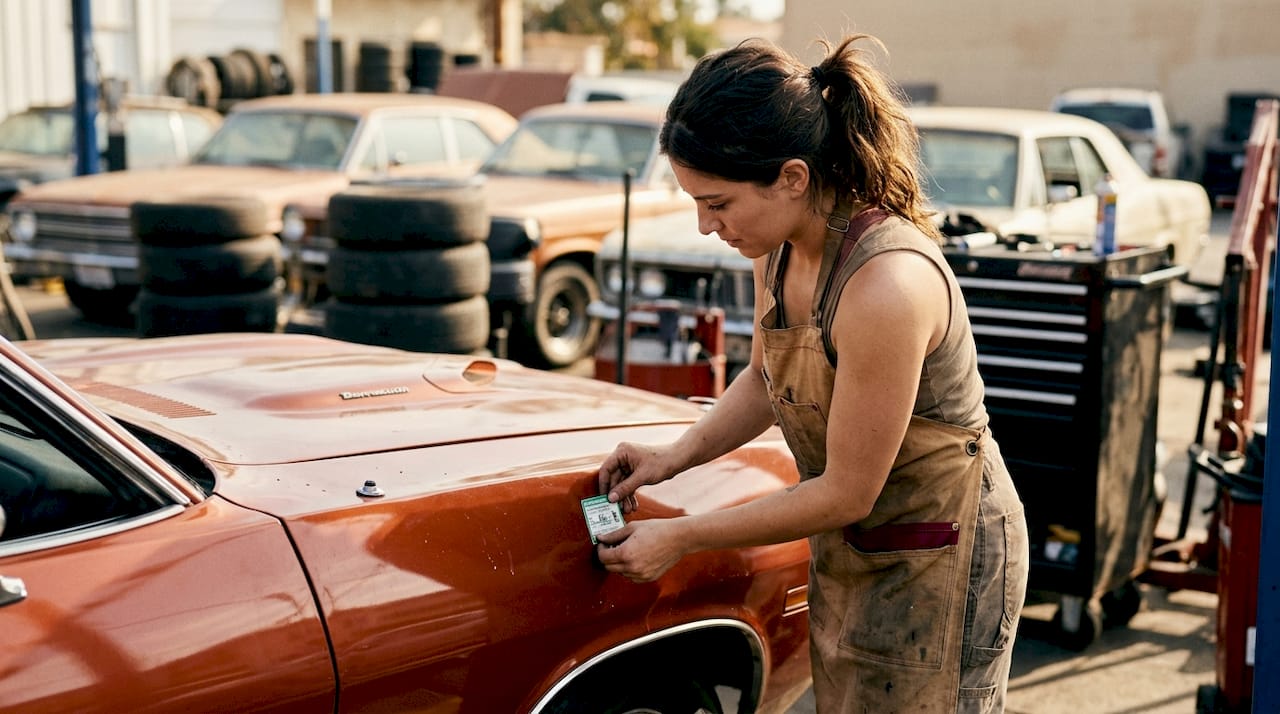
Enforcement is not theoretical. Smog check stations verify EO compliance at every inspection. Non-compliant parts trigger registration holds until the vehicle owner removes the illegal part and passes a new inspection. California also employs roadside emissions testing, and the legal burden of proof rests on the vehicle owner to produce a valid EO number on demand.
What legal requirements govern CARB compliance for aftermarket parts?
The CARB Executive Order system is the backbone of California emissions law for aftermarket parts. A manufacturer must submit test data proving their part does not increase hydrocarbon, carbon monoxide, or nitrogen oxide emissions beyond factory levels. CARB then issues an EO number specific to that part and the engine families it covers.
Here is what the compliance process requires in practice:
- Valid EO number: Every CARB-legal aftermarket part carries a unique EO number tied to specific vehicle makes, models, and engine families.
- Physical label on the part: A permanent EO label must be affixed to the part itself. Inspectors and law enforcement rely on that visible label for instant verification. A part without the label is non-compliant during any inspection, even if the manufacturer holds a valid EO.
- Vehicle-specific applicability: An EO approved for a 2018 Ford F-150 5.0L does not automatically apply to a 2020 model year or a different engine variant.
- Smog check verification: California smog stations check for EO labels and run OBD-II diagnostics. A missing label or a triggered check engine light fails the inspection.
- Registration holds for violations: Violators face mandatory fines and vehicle registration holds until the non-compliant part is removed and the vehicle passes re-inspection.
Recent legislative action addresses a long-standing frustration in the aftermarket industry. Legislation like SB 1069 aims to reform the EO application process by allowing conditional approvals once testing documentation is submitted, reducing the months-long delays that have kept legal parts off the California market. That reform matters for enthusiasts because it means more compliant options will reach shelves faster.
Pro Tip: Before you buy any aftermarket part, search the CARB database at arb.ca.gov to confirm the EO number is active and applies to your specific engine family and model year.
How does California’s emissions standard differ from federal EPA requirements?
The core difference is the strictness of the pollutant limits. CARB standards are more stringent than federal EPA requirements across hydrocarbons, nitrogen oxides, and particulate matter. A part certified as “50-state legal” by a manufacturer may meet EPA standards but still fail California’s stricter thresholds.
This gap creates a real problem for California car owners who shop nationally. Federal-grade catalytic converters, for example, are prohibited from retail sale in California. Shipping a federal converter to a California address is itself a violation. The same logic applies to cold air intakes, exhaust systems, and engine management components.
Modern vehicle ECUs detect the difference. The first sign of a non-CARB-compliant part is frequently a check engine light, because the ECU monitors emissions sensor outputs against factory calibration. A part that shifts airflow, exhaust backpressure, or oxygen sensor readings outside factory parameters triggers a fault code. That fault code alone fails a California smog check.
The resale impact is also real. A California vehicle with non-compliant modifications carries legal liability for the next owner. Buyers who know California emissions law will discount or walk away from a vehicle that cannot pass smog.
Pro Tip: If you are unsure whether a part is California-legal, check for the EO number in the product listing before you order. “CARB exempt” and “CARB legal” are not the same thing. “CARB legal” means an EO exists. “CARB exempt” is a marketing phrase with no legal standing.
What are the practical implications of CARB compliance on vehicle performance?
CARB-compliant parts do not mean slow parts. CARB regulations ensure aftermarket parts meet factory emissions output, not that they limit power. A CARB-approved high-flow cold air intake can still improve throttle response and horsepower. The requirement is that it does so without raising tailpipe emissions above the factory baseline for that engine.
The misconception that CARB compliance kills performance leads many enthusiasts to install non-compliant parts, and that decision carries serious consequences:
- Check engine lights: Non-CARB parts frequently trigger OBD-II fault codes because the ECU detects emissions sensor deviations. You can read more about how vehicle electronics detect non-compliance in modern vehicles.
- Smog check failures: A triggered fault code or a missing EO label fails the inspection automatically.
- Fines and citations: As of 2019, certain violations carry immediate fines with no fix-it ticket option, meaning you pay the fine and still must correct the violation.
- Mandatory Referee inspections: Vehicles flagged for emissions violations may be required to pass a state-run Bureau of Automotive Repair Referee inspection before registration is restored.
- Forced removal: The only path back to legal registration is removing the non-compliant part and passing a new smog check.
Many parts marketed as “universal fit” or “50-state legal” do not qualify under California law. CARB approvals are engine-specific and model-year-specific. A part with a valid EO for a 2016 Chevrolet Silverado 5.3L does not cover a 2016 Silverado with a 6.2L engine. Buying the wrong EO variant is a common and costly mistake.
How can California car owners verify CARB compliance before buying?
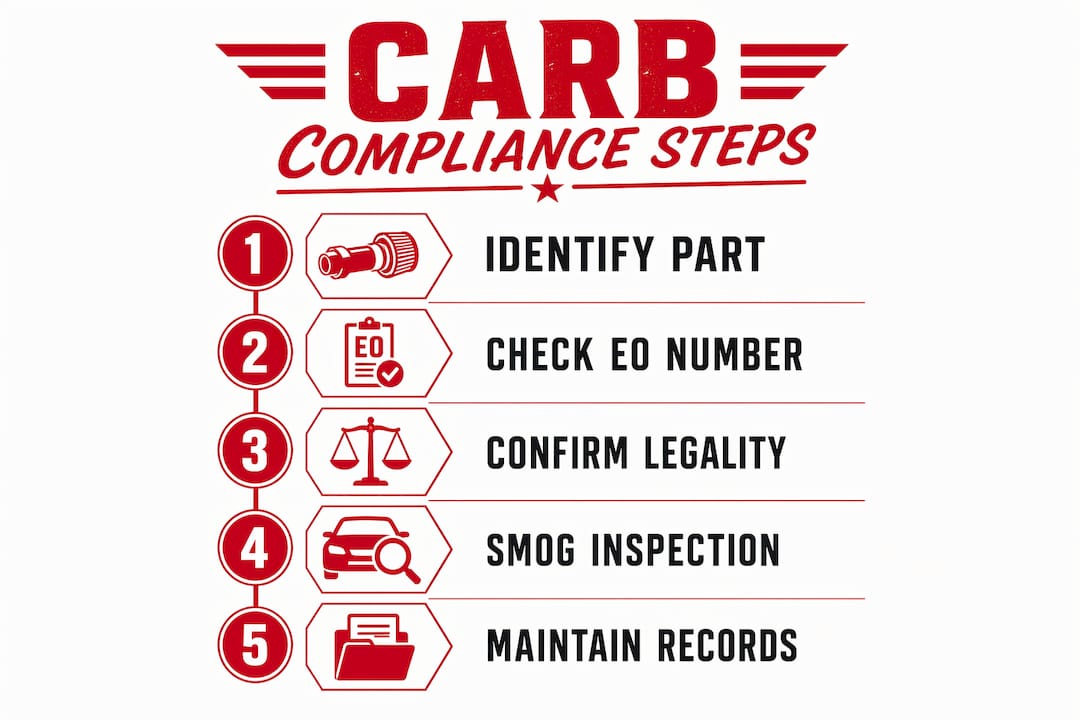
Verification takes five minutes and saves you from a failed smog check and a registration hold. Follow these steps before any aftermarket purchase:
- Find the EO number in the product listing. Any legitimate CARB-legal part lists its EO number in the product description. If the listing says “CARB compliant” without an EO number, ask the seller for it before ordering.
- Search the CARB database. The California Air Resources Board maintains a searchable database of approved aftermarket parts at arb.ca.gov. Enter the EO number and confirm it covers your vehicle’s make, model year, and engine family.
- Check the physical label on delivery. A permanent EO label must be on the part when it arrives. If the label is missing, contact the seller immediately. Do not install an unlabeled part.
- Match the EO to your engine family. Cross-reference the EO’s listed engine families against your vehicle’s VIN and engine code. Your owner’s manual or a smog check station can confirm your engine family designation.
- Consult a BAR-licensed smog station if unsure. The Bureau of Automotive Repair licenses smog check stations and can answer questions about specific parts and EO applicability for your vehicle.
During the SB 1069 reform phase, some parts may carry conditional approvals. Confirm with the manufacturer whether the EO is fully issued or still under conditional status before installation.
Key Takeaways
California’s CARB compliance requirement is a legal mandate backed by Vehicle Code Section 27156, enforced through smog checks, fines, and registration holds that apply to every California car owner who installs aftermarket emissions-related parts.
| Point | Details |
|---|---|
| CARB EO is mandatory | Every aftermarket emissions-related part needs a valid CARB Executive Order number to be legal in California. |
| Physical label required | The EO label must be permanently affixed to the part itself; a missing label fails inspection even with a valid EO on file. |
| California exceeds federal standards | Federal EPA-certified parts often fail California smog checks because CARB limits are stricter than EPA baselines. |
| “Universal” claims do not apply | CARB approvals are engine-specific and model-year-specific; “50-state legal” does not guarantee California compliance. |
| Verify before you buy | Search the CARB database at arb.ca.gov and confirm the EO number covers your exact engine family before purchasing. |
The real cost of getting CARB wrong
At Ozkonickustomz, we see the same pattern repeat itself. An enthusiast installs a cold air intake or a high-flow cat they found online, the check engine light comes on within a week, and the next smog check fails. Then comes the scramble to find a replacement part that is actually legal in California, often at twice the original cost because now there is urgency.
The frustrating part is that CARB compliance is not the enemy of performance. The regulation requires that a part not increase emissions above factory levels. It does not cap horsepower or ban modifications. There are CARB-approved intakes, exhausts, and engine management parts that deliver real performance gains. The problem is that the aftermarket industry has not always made it easy to find them, and some sellers actively obscure the compliance status of their products.
My honest take: the “50-state legal” label is the most misleading phrase in the aftermarket industry. It sounds like it covers California. It does not. California is not one of those 50 states for the purposes of that claim, because California’s standard is separate from the federal standard the phrase references. Every California car owner needs to understand that distinction before they spend a dollar on emissions-related parts.
The SB 1069 reform is genuinely good news. Faster EO approvals mean more legal options reach the market sooner. But until those approvals are fully issued, the burden is still on you to verify compliance before installation, not after.
— Ozkonic Kustomz
CARB-compliant performance parts for California car owners
California car owners should not have to choose between performance and compliance.
Ozkonickustomz sources aftermarket performance parts directly from vetted manufacturers, with verified fitment and compliance documentation for California-registered vehicles. Every part in the catalog is checked for quality and compatibility before it ships, so you are not left guessing whether your purchase will pass the next smog check. Expert support is available to help you match the right part to your engine family and model year. Fast shipping and a straightforward return policy back every order. Browse the full catalog at Ozkonickustomz and find parts that perform and comply.
FAQ
What is a CARB Executive Order for aftermarket parts?
A CARB Executive Order is a written certification issued by the California Air Resources Board confirming that a specific aftermarket part meets California’s emissions standards for defined vehicle makes, engine families, and model years.
Are federal EPA-certified parts legal in California?
Federal EPA-certified parts are often not legal in California because CARB standards are stricter than EPA baselines. Federal-grade catalytic converters, for example, cannot legally be sold or installed on California-registered vehicles.
What happens if I install a non-CARB part in California?
Installing a non-CARB part can result in a check engine light, a failed smog check, mandatory fines, and a vehicle registration hold until the illegal part is removed and the vehicle passes re-inspection.
Does “50-state legal” mean a part is CARB compliant?
No. “50-state legal” refers to federal EPA compliance, not California CARB compliance. California operates under a separate, stricter standard, and a part must carry a valid CARB EO number to be legal in the state.
How do I verify a part is CARB legal before buying?
Confirm the EO number in the product listing, then search the CARB database at arb.ca.gov to verify the EO covers your specific vehicle make, model year, and engine family before purchasing.
