
The Bureau of Automotive Repair (BAR) is California’s primary agency for licensing, regulating, and overseeing automotive repair dealers, Smog Check stations, and vehicle safety inspection facilities. The role of Bureau of Automotive Repair extends beyond simple licensing. BAR mediates consumer complaints, enforces repair standards, and manages specialized programs like the STAR certification to protect both car owners and the environment. For California automotive professionals and vehicle owners, understanding how BAR operates is the difference between knowing your rights and being caught off guard.
What is the role of Bureau of Automotive Repair in California?
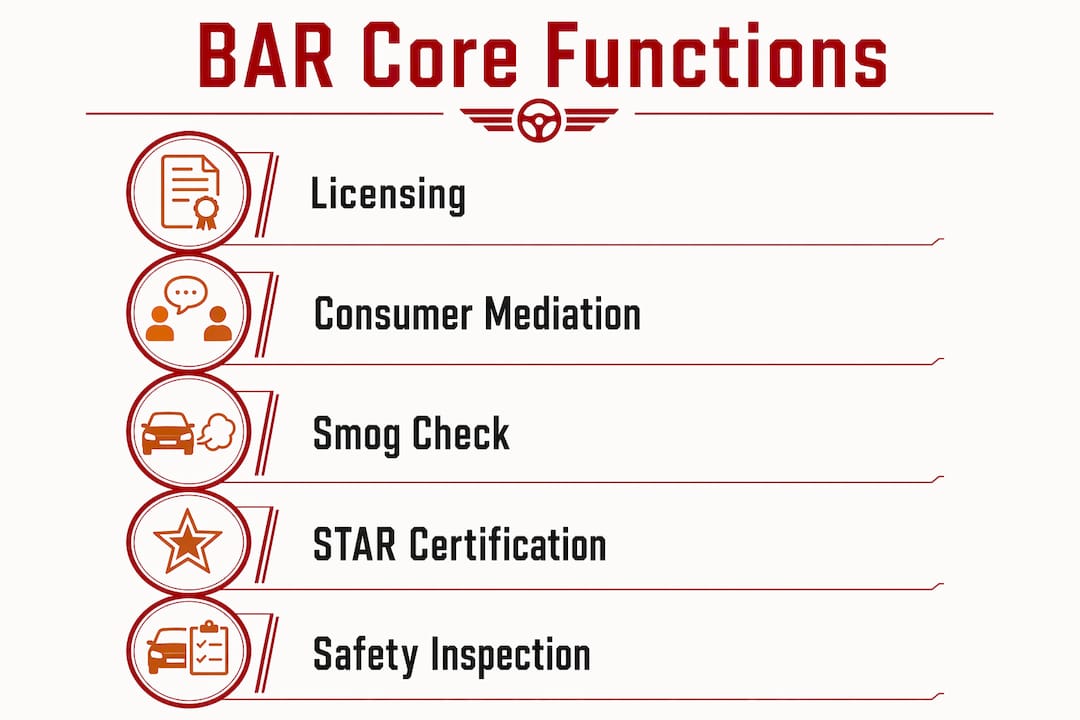
BAR holds regulatory authority over every compensated automotive repair business operating in California. Its core functions fall into three areas: licensing and certification, consumer complaint mediation, and environmental program oversight. Each function directly affects how repair shops operate and how car owners can protect themselves.
The agency’s automotive repair oversight covers thousands of licensed dealers across the state. BAR enforces compliance with California’s Business and Professions Code, which sets the legal framework for repair shop conduct, written estimates, and customer authorization requirements. Shops that ignore these rules face license suspension or revocation.
BAR also plays a direct consumer protection role. When a repair goes wrong, BAR steps in as a neutral mediator rather than an immediate enforcer. This approach keeps the system practical. Most disputes resolve through mediation without formal legal action, which benefits both consumers and shops.
What licenses and certifications does BAR issue and oversee?
BAR licenses automotive repair businesses and individual specialized roles, but does not require a BAR license for general automotive mechanics. This distinction matters. A shop owner performing compensated repairs must hold an Automotive Repair Dealer (ARD) license. An individual working as a general mechanic at that shop faces no separate BAR licensing requirement.
Specialized roles carry their own licensing requirements:
- Smog Check inspectors must hold a valid BAR-issued license to perform state-mandated emissions inspections.
- Smog Check repair technicians require a separate license to diagnose and repair vehicles that fail emissions tests.
- Vehicle safety systems technicians need BAR certification to inspect brake systems, lamps, and other safety components.
- STAR station operators must meet higher performance standards and receive STAR certification from BAR to service directed vehicles.
The licensing process requires applicants to pass BAR-administered exams, demonstrate relevant experience, and pay applicable fees. Shops must also maintain proper documentation and follow accepted trade standards, including manufacturer-recommended procedures. Failure to follow these standards is one of the most common triggers for consumer complaints and regulatory action.
Pro Tip: If you are hiring a Smog Check technician or safety systems inspector, verify their BAR license number on the BAR website before they perform any work. An unlicensed technician puts your shop’s ARD license at risk.
The division between general mechanics and licensed specialists reflects BAR’s focus on roles with direct environmental or safety impact. This keeps compliance requirements targeted rather than burdensome across the entire workforce.
How does BAR handle consumer complaints and dispute mediation?
Filing a complaint with BAR triggers a mediation process, not an immediate punitive investigation. BAR contacts both parties within 7 to 10 business days of receiving a complaint to review evidence and begin the resolution process. That timeline gives consumers a clear expectation and pushes shops to respond quickly.
The mediation process follows a structured sequence:
- Submit your complaint through BAR’s online portal or by mail, including all relevant documentation.
- BAR reviews the evidence and contacts the repair shop to present the consumer’s position.
- The shop responds with its own documentation, such as work orders, parts receipts, and technician notes.
- BAR mediates between both parties, often resulting in a refund, rework, or written explanation.
- Formal investigation begins only if mediation fails or if the shop shows a pattern of misconduct.
BAR prioritizes education in its mediation approach, intervening to inform shops about legal requirements before pursuing enforcement. This philosophy keeps most disputes out of formal legal channels and produces faster outcomes for consumers.
Documentation quality directly affects how fast your complaint moves. Well-organized submissions with clear evidence improve BAR’s response efficiency significantly. Weak documentation slows the process and can result in inconclusive findings.
Pro Tip: Before filing, gather your written estimate, final invoice, any photos of the vehicle before and after the repair, and a clear written timeline of events. Chronological documentation gives BAR the clearest picture and speeds up resolution.
A common misunderstanding is that BAR will immediately fine or shut down a shop after one complaint. BAR reviews complaints to distinguish between honest workmanship misunderstandings and actual violations. Enforcement actions follow only when patterns of misconduct or serious breaches emerge. One complaint rarely triggers a formal investigation on its own.
What recent regulatory updates has BAR implemented for 2026?
New BAR regulations effective July 1, 2026 introduce stricter disclosure and authorization requirements that affect every licensed repair dealer in California. These changes target two of the most common sources of consumer disputes: storage fees and towing services.
The key 2026 updates include:
- Storage fee disclosures must now be clearly communicated to consumers before any storage charges begin. Shops cannot retroactively apply storage fees without prior written notice.
- Separate written authorizations are required for towing services. A general repair authorization no longer covers towing. Each tow must have its own signed document.
- Vehicle storage location must be the shop’s primary business address or a disclosed alternative location. Consumers have the right to know exactly where their vehicle is held.
These rules directly affect how repair shops handle their documentation and communication practices. Shops that rely on verbal agreements or bundled authorizations will need to update their intake processes before July 1, 2026.
| Requirement | What changed | Who it affects |
|---|---|---|
| Storage fee disclosure | Must be given before charges begin | All ARD license holders |
| Towing authorization | Requires a separate written document | Shops offering towing services |
| Vehicle storage location | Must be disclosed to the consumer | Any shop storing vehicles off-site |
For car owners, these updates create stronger legal footing when disputing unexpected charges. For professionals, they represent a clear compliance deadline that carries real enforcement risk if missed. Shops that use wiring harness documentation and repair authorization forms as part of their standard workflow will find it easier to adapt these new disclosure requirements into existing processes.
What specialized programs does BAR manage for emissions and safety?
BAR manages California’s Smog Check program, the STAR certification program, and vehicle safety systems inspections. These programs connect automotive repair oversight to the state’s broader environmental and public safety goals.
Smog Check program and inspection systems
The Smog Check program requires most California vehicles to pass periodic emissions inspections. BAR uses two inspection systems: BAR-OIS for newer vehicles and BAR-97 EIS for older models. The system used depends on the vehicle’s model year and type. This split ensures that inspection technology matches the emissions control systems actually present in each vehicle.
Vehicles that fail their Smog Check must be repaired by a licensed Smog Check repair technician before they can be registered. BAR tracks failure rates and repair outcomes to monitor station performance over time.
STAR program certification
The STAR program certifies stations that meet higher inspection performance standards. STAR certification is required for stations that service “directed vehicles,” meaning vehicles that the state specifically routes to higher-performing stations based on their emissions history. A station earns STAR status by maintaining low failure-to-pass rates and high inspection accuracy.
STAR stations serve a critical function in California’s emissions control strategy. By concentrating the most complex inspections at the highest-performing stations, BAR improves the reliability of the entire Smog Check system.
Vehicle safety systems inspections
BAR also oversees inspections of brake systems, lighting, and other safety components. Technicians performing these inspections must hold a BAR-issued safety systems license. This program runs parallel to the Smog Check system and targets a different category of vehicle risk. For car owners in California, understanding high-mileage vehicle compliance requirements helps avoid failed inspections and registration delays.
Key Takeaways
The Bureau of Automotive Repair protects California consumers through licensing, mediation, and specialized emissions programs, with enforcement reserved for repeated or serious violations.
| Point | Details |
|---|---|
| BAR licensing scope | Repair dealers and specialized roles require licenses; general mechanics do not. |
| Complaint mediation timeline | BAR contacts both parties within 7 to 10 business days of a complaint submission. |
| 2026 regulatory changes | New rules effective July 1, 2026 require separate towing authorizations and storage fee disclosures. |
| Smog Check systems | BAR-OIS serves newer vehicles; BAR-97 EIS serves older models in the Smog Check program. |
| Enforcement philosophy | BAR prioritizes education and mediation before pursuing formal investigations or penalties. |
BAR’s approach gets more right than most people realize
Working closely with California automotive professionals, I have seen how BAR’s mediation-first model resolves disputes that would otherwise end in court. The agency’s focus on education over punishment is not a soft approach. It is a practical one. Most shops are not bad actors. They are businesses that sometimes make mistakes or miscommunicate. BAR’s intervention often corrects those problems faster than any legal process would.
The documentation lesson is one I cannot stress enough. Consumers who file complaints with clear, chronological evidence get faster responses and better outcomes. Shops that maintain thorough repair records face fewer escalations. Both sides benefit from the same habit: write everything down.
The 2026 storage and towing rule changes reflect a pattern I have watched develop over several years. Disputes over unexpected fees are among the most common complaints BAR receives. These new rules close the loopholes that allowed vague verbal agreements to create real financial harm. Shops that adapt early will avoid the compliance scramble that hits every time new regulations take effect.
The STAR program is underappreciated by most car owners. Choosing a STAR-certified station for your Smog Check is not just about convenience. It is about accuracy. STAR stations are held to measurably higher standards, and that matters when your vehicle is borderline on emissions.
— Ozkonic Kustomz
Professional-grade parts for California automotive repair work
California’s automotive repair regulations set a high bar for documentation, parts quality, and repair accuracy. Meeting that bar starts with using components that match manufacturer specifications and hold up under inspection.
Ozkonickustomz sources directly from vetted manufacturers to give California repair professionals and performance builders access to parts that meet those standards. From the Highway 22 modular wiring kit built for truck-mount applications to the American Autowire crimper set designed for clean, code-compliant connections, every product ships with guaranteed fitment and expert support. When your repair work needs to pass BAR scrutiny, the parts you use matter as much as the paperwork you file.
FAQ
What does the Bureau of Automotive Repair regulate?
BAR regulates automotive repair dealers, Smog Check stations, and vehicle safety inspection facilities in California. It licenses businesses and specialized technicians, mediates consumer complaints, and enforces repair and disclosure standards.
Does a general mechanic need a BAR license?
General automotive mechanics do not require a BAR license to work in California. BAR licensing applies to repair dealer businesses and individuals in specialized roles like Smog Check inspectors and safety systems technicians.
How long does BAR take to respond to a complaint?
BAR initiates contact with both the consumer and the repair shop within 7 to 10 business days of receiving a complaint. Submitting clear, organized documentation speeds up the process.
What is the STAR program in California’s Smog Check system?
The STAR program certifies Smog Check stations that meet higher inspection performance standards. Directed vehicles with a history of emissions issues are routed specifically to STAR-certified stations for more reliable testing.
What do the new 2026 BAR regulations require from repair shops?
New rules effective July 1, 2026 require repair shops to disclose storage fees before they begin, obtain separate written authorizations for towing services, and inform consumers of any off-site vehicle storage locations.