
California vehicle modification laws regulate changes to vehicles to maintain emissions compliance, noise limits, and safety standards set by the California Air Resources Board (CARB), the California Bureau of Automotive Repair (BAR), and the California Vehicle Code (CVC). The primary enforcement statute is CVC Section 27156, which prohibits installing aftermarket parts that alter emission controls without a CARB Executive Order (EO) number. Violations trigger non-correctable infractions, registration holds, and fines that can reach $37,500 per offense. Every California enthusiast who plans to modify a vehicle needs to understand these rules before touching a single bolt.
What modifications are legal and illegal under California vehicle modification laws?
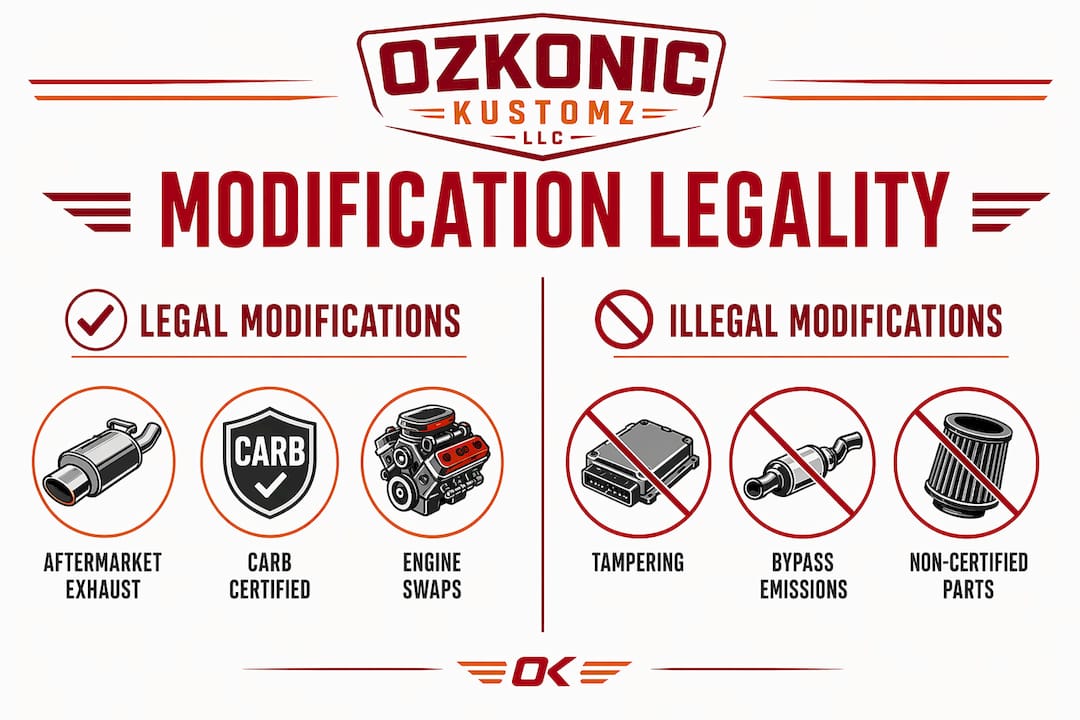
California law draws a clear line between certified modifications and illegal alterations. Legal modifications include aftermarket exhaust systems carrying a CARB EO number, body lifts within approved height limits, and performance parts that do not interfere with emission control devices. Illegal modifications include muffler deletes, non-certified engine swaps, window tint darker than the legal visible light transmission threshold, and suspension lifts that push the vehicle beyond California’s height restrictions.
CVC 27156 is the primary enforcement tool for anti-tampering violations. It applies to any part that modifies, removes, or bypasses an emission control system without CARB approval. CVC 27150 separately requires every vehicle to have a functioning muffler at all times. A muffler delete typically pushes exhaust noise above 100 decibels, which fails both the noise test and the BAR Referee inspection.

The table below shows common modifications and their legal status in California.
| Modification | Legal status | Key requirement |
|---|---|---|
| Aftermarket exhaust with CARB EO | Legal | Must display valid EO number |
| Muffler delete | Illegal | Violates CVC 27150; fails noise test |
| Engine swap (1976 or newer engine) | Conditional | BAR Referee inspection and DMV label required |
| Non-certified engine swap | Illegal | Violates CVC 27156; registration hold |
| Body lift within approved limits | Legal | Must stay within height restrictions |
| Excessive suspension lift | Illegal | Exceeds California height limits |
| Window tint within VLT limits | Legal | Must meet visible light transmission rules |
The Magnuson-Moss Act protects your right to use aftermarket parts unless those parts violate emission control laws. That protection disappears the moment you install an uncertified part that causes an emissions failure.
How do California emissions and smog check regulations affect modified cars?
California’s biennial Smog Check program is the front line of emissions enforcement for modified vehicles. Registration renewal requires a passing smog inspection for most vehicles, and ownership transfers trigger an additional check. The BAR administers the program and sets the inspection standards that every modified car must meet.
Smog Check exemptions exist but are narrower than most owners assume:
- Vehicles 8 model years old or newer are exempt from the biennial renewal inspection.
- Vehicles 4 model years old or newer are exempt from the ownership transfer inspection but must still pay the applicable fee.
- Vehicles manufactured before 1976 are exempt from Smog Check entirely, though they remain subject to anti-tampering laws under CVC 27156.
- Diesel vehicles, electric vehicles, and certain hybrids follow separate rules.
When a vehicle has an engine swap or a tampering allegation, the BAR Referee program takes over. The BAR Referee is a state-run inspection station that evaluates modifications the standard smog station cannot assess. A passing Referee inspection becomes the vehicle’s permanent emissions identity. That means the engine and its certification follow the vehicle for its entire registered life in California.
A modification that causes a smog failure puts the registration on hold immediately. The DMV will not renew registration until the vehicle passes a clean inspection. Owners who buy a modified car without verifying compliance often discover this problem at renewal time, which is one of the most expensive moments to fix it.
Pro Tip: Schedule your smog check before the registration deadline, not after. If a modified component causes a failure, you need time to source a certified replacement, complete a BAR Referee inspection if required, and submit paperwork to the DMV.
What are the penalties for non-compliant modifications in California?
The financial consequences of illegal modifications scale dramatically depending on the violation type. A basic muffler violation under CVC 27150 carries a base fine of $25. Emissions tampering under CVC 27156 can reach $37,500 per violation. That gap is not an accident. California treats emissions tampering as an environmental offense, not just a traffic infraction.
The practical consequences extend well beyond fines:
- Registration suspension until the vehicle passes a compliant inspection.
- Failed smog tests that block registration renewal indefinitely.
- Insurance claim denial if undisclosed or illegal modifications contributed to an incident.
- Policy cancellation for material misrepresentation when mods were never disclosed.
Insurance risk is the most underestimated consequence. Insurers require written disclosure of all modifications. Verbal disclosure to a shop technician does not satisfy that requirement. An insurer can deny a claim for an accident that has nothing to do with the modification if the modification was never formally reported. That is not a technicality. Courts have upheld those denials.
Correcting a tampering violation is also more complex than simply reinstalling factory parts. Reinstalling stock components without completing the BAR Referee process does not lift the registration hold. The vehicle must pass the full Referee inspection before the DMV updates its records.
Pro Tip: Disclose every modification to your insurer in writing and keep a copy. If you are unsure whether a part qualifies as a modification under your policy, ask your agent directly and document the response.
How to modify your vehicle legally in California
Legal modification in California follows a clear process. Skipping any step creates compliance gaps that surface at the worst possible time.
-
Source CARB EO-certified parts. Every performance part that touches the emission control system needs a valid CARB Executive Order number. Verify the EO number on the CARB website before purchasing. Ozkonickustomz sources parts directly from vetted manufacturers, which reduces the risk of receiving uncertified components that look legitimate but fail inspection.
-
Follow engine swap rules precisely. Engine swaps are legal only when the replacement engine comes from a 1976 or newer vehicle, meets California emissions standards for the receiving vehicle’s model year, passes a BAR Referee inspection, and receives an official BAR label. Notify the DMV of the engine change regardless of the vehicle’s age.
-
Verify exhaust noise compliance. California exhaust systems must not exceed 95 decibels under the SAE J1169 test procedure. CARB-certified aftermarket exhaust systems include documentation confirming they meet both emissions and noise limits. Keep that documentation in the vehicle.
-
Maintain complete records. Store CARB EO certificates, BAR Referee inspection reports, receipts, and installation records together. A smog station or law enforcement officer can ask for proof of certification at any time.
-
Disclose modifications to your insurer in writing. Send a written notice listing every modification and the certified part number. Request written confirmation that your policy covers the modified vehicle. Learning about a performance parts warranty issue after an accident is far more costly than a policy adjustment before one.
-
Consult a BAR Referee before complex builds. For engine swaps, forced induction additions, or major drivetrain changes, a pre-inspection consultation with a BAR Referee station clarifies what the final inspection will require. That conversation can save thousands of dollars in rework.
Pro Tip: When buying a used modified vehicle, request the full modification history and all CARB EO certificates before signing. A clean title does not guarantee a clean smog history.
Key takeaways
California vehicle modification laws require CARB EO certification, BAR Referee inspections for engine swaps, written insurer disclosure, and noise compliance under SAE J1169 to keep a modified vehicle street legal and insured.
| Point | Details |
|---|---|
| CVC 27156 is the core statute | Any part altering emission controls without a CARB EO number triggers fines and registration holds. |
| Smog Check exemptions are limited | Vehicles 8 years old or newer skip renewal checks, but modified cars often lose that exemption. |
| Penalties scale sharply | Muffler fines start at $25; emissions tampering fines reach $37,500 per violation. |
| Written insurer disclosure is required | Verbal disclosure is insufficient; undisclosed mods can result in claim denial regardless of fault. |
| BAR Referee inspection is permanent | A passing Referee result becomes the vehicle’s official emissions identity for its registered life. |
What I’ve learned watching California modifiers get it wrong
The most common mistake I see is treating California modification rules as a noise problem. Enthusiasts focus on the 95-decibel exhaust limit and assume that if the car sounds reasonable, it passes. That misses the bigger issue entirely. Emissions tampering under CVC 27156 carries penalties that dwarf anything a muffler violation produces. A single uncertified intake or tune can trigger a $37,500 fine and a registration hold that takes months to resolve.
The second mistake is underestimating the BAR Referee process. Owners assume that swapping back to stock parts ends the problem. It does not. The registration hold stays in place until the Referee formally clears the vehicle. I have seen builds sit unregistered for six months because the owner reinstalled factory parts but skipped the inspection step.
The third mistake is the insurance gap. Most modifiers disclose their builds to their shop and assume that counts. Insurers require written disclosure directly to the policy. A claim denial on a $40,000 build because a $200 cold air intake was never formally reported is a painful lesson that is entirely avoidable.
California’s regulations are strict, but they are also predictable. Every rule has a documented compliance path. The enthusiasts who build legally and document everything drive their vehicles for years without incident. The ones who cut corners spend that time and money on fines, inspections, and legal fees instead.
— Ozkonic Kustomz
Quality parts that meet California’s standards
California’s modification rules demand certified components, and sourcing the wrong part is the fastest way to a failed smog check or a registration hold. Ozkonickustomz carries performance and suspension components sourced directly from vetted manufacturers, so you get parts with the documentation California inspectors actually ask for.
Whether you are building a truck for off-road use or upgrading suspension for daily driving, Ozkonickustomz has the hardware to support a legal build. The Highway 22 modular wiring kit is a strong starting point for clean electrical work that holds up to inspection. For suspension upgrades, the rear air suspension kit fits 1999 Chevy 4x4 half-ton and three-quarter-ton trucks with verified fitment. Every order ships fast, and the team is available to answer compliance questions before you buy.
FAQ
What does CVC 27156 prohibit?
CVC 27156 prohibits installing any aftermarket part that modifies, removes, or bypasses an emission control system without a valid CARB Executive Order number. Violations result in non-correctable infractions and registration holds.
How do I pass California emissions with a modified car?
Every modification affecting the emission control system must carry a CARB EO number. For engine swaps, the replacement engine must pass a BAR Referee inspection and receive an official BAR label before the vehicle can pass smog.
What is the California emissions standard for exhaust noise?
California requires exhaust systems to stay at or below 95 decibels under the SAE J1169 test procedure. Muffler deletes routinely exceed 100 decibels and fail both noise and Referee inspections.
What is modified car insurance in California?
Modified car insurance in California refers to a policy that formally covers aftermarket changes to a vehicle. Insurers require written disclosure of all modifications, and undisclosed changes can result in claim denial or policy cancellation regardless of whether the modification caused the incident.
What do I need to disclose when I sell a modified car through the California DMV?
When selling a modified vehicle in California, the seller must notify the DMV of any engine changes and provide documentation of all modifications. The buyer inherits the vehicle’s emissions history, including any outstanding BAR Referee requirements or registration holds.