

Performance springs are suspension components engineered with increased or specialized stiffness to improve handling, reduce body roll, and sharpen vehicle response. Unlike factory springs, which prioritize ride comfort and load capacity, performance springs are tuned to specific spring rates that match vehicle weight, suspension geometry, and driving intent. Understanding performance springs explained properly means grasping three core concepts: spring rate, wheel rate, and motion ratio. These three factors determine what your tires actually feel, and getting them right is the difference between a car that handles and one that just looks modified.
What are the key technical concepts behind performance springs?
Spring rate is the force required to compress a spring by one inch, measured in pounds per inch (lb/in) or Newtons per millimeter (N/mm). A spring rated at 400 lb/in compresses one inch under 400 pounds of force. That number sounds definitive, but it does not tell the full story of what happens at the tire.
Wheel rate is the effective stiffness your tire actually experiences after accounting for suspension geometry and leverage. The formula is WR = k × MR², where k is the spring rate and MR is the motion ratio. Wheel rate is always lower than the spring’s rated stiffness because motion ratios are typically less than 1.0. That gap matters more than most DIY modifiers realize.
The motion ratio is the ratio of spring travel to wheel travel. A motion ratio of 0.8 means the spring moves 0.8 inches for every 1 inch of wheel movement. Because the formula squares the motion ratio, small geometry changes produce significant differences at the contact patch. A spring rated at 500 lb/in with a motion ratio of 0.8 delivers a wheel rate of only 320 lb/in. That is a 36% reduction from the rated number.
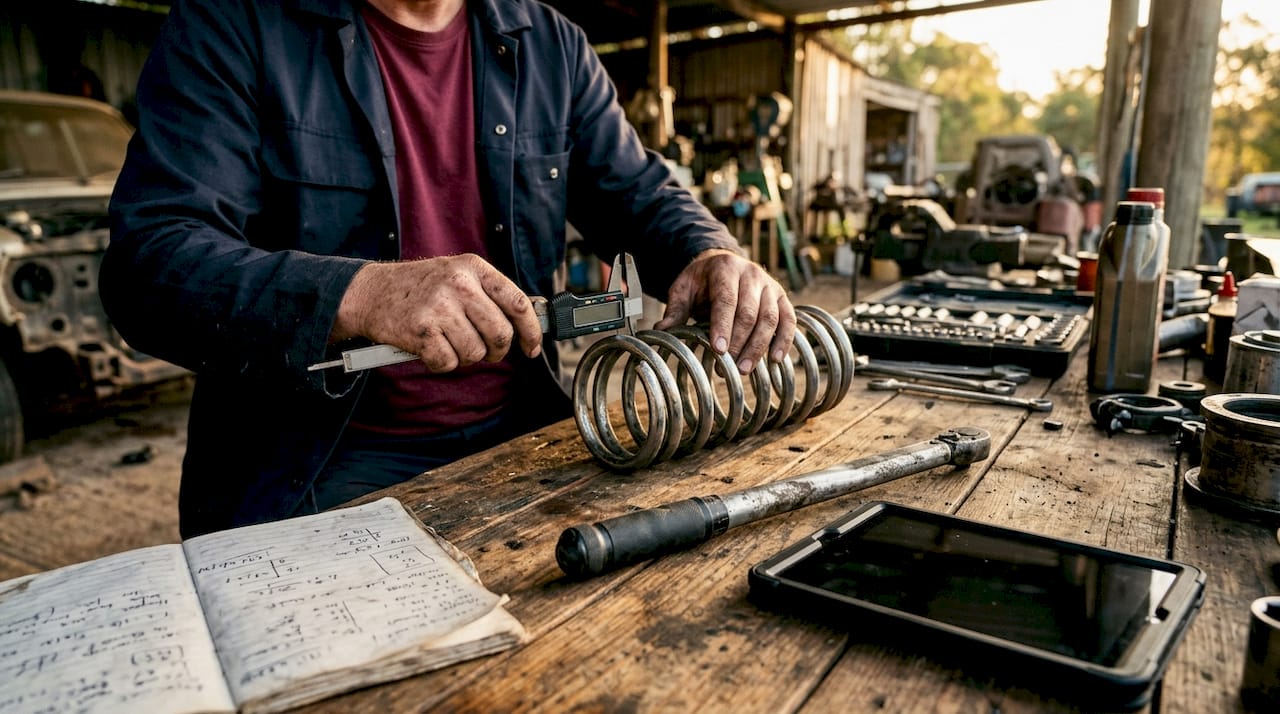
Pro Tip: Always calculate wheel rate before purchasing springs. A spring that looks aggressive on paper can feel surprisingly soft at the tire once suspension geometry is factored in.
| Concept | Definition | Why It Matters |
|---|---|---|
| Spring rate | Force per inch of compression (lb/in) | Sets the baseline stiffness of the spring |
| Motion ratio | Spring travel divided by wheel travel | Determines how much of the spring rate reaches the tire |
| Wheel rate | Spring rate × motion ratio squared | The actual stiffness your tire feels |
What types of performance springs are available?
Linear springs maintain a consistent rate throughout their compression range. A 400 lb/in linear spring always requires 400 pounds per inch, whether it is barely compressed or near coil bind. This predictability makes linear springs the preferred choice for track and competition setups where tuning precision matters.
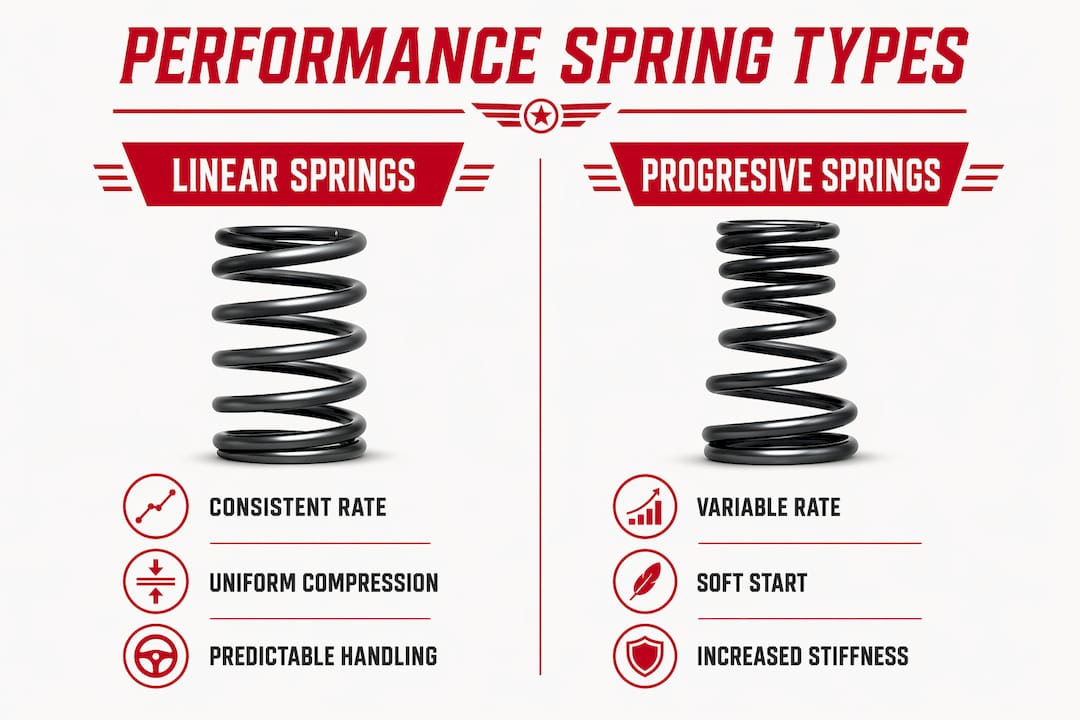
Progressive rate springs use variable coil spacing or geometry to increase stiffness as they compress. At low compression, they feel soft and compliant. Under hard cornering or heavy braking, they stiffen up. That sounds ideal, but the variable rate makes them harder to tune because the effective spring rate changes constantly with suspension travel.
Stiffness levels by application
The right stiffness depends entirely on how you drive. Street setups typically run 20–30% stiffer than stock springs. Track setups push 50–100% above OEM stiffness. Full competition builds, where aerodynamic downforce loads the suspension heavily, can require springs 200–300% stiffer than factory spec. Each tier represents a different trade-off between ride comfort and handling capability.
Stiffer springs reduce body roll and pitch, which keeps the chassis flatter through corners and under braking. That flatness improves tire contact patch consistency, which directly affects grip. However, stiffer springs can decrease mechanical grip if overdone, because the tire loses the ability to follow road surface irregularities. The spring is too rigid to let the wheel move with the road.
Front and rear spring rates rarely match on a performance build. Running a slightly higher rear ride frequency, roughly 10–20% above the front, reduces porpoising during corner entry and produces more balanced handling. This is a tuning detail most enthusiasts skip, but it makes a measurable difference in how the car transitions through corners.
Pro Tip: For a street and occasional track build, start with a linear spring at 25–30% above OEM stiffness. Progressive springs work well for daily drivers that see rough roads but rarely see a track.
- Linear springs: consistent rate, easier to tune, preferred for track use
- Progressive springs: variable rate, more compliant on the street, harder to dial in precisely
- Street stiffness: 20–30% above stock
- Track stiffness: 50–100% above stock
- Competition stiffness: 200–300% above stock
How do performance springs interact with shocks and sway bars?
Springs and shocks are not independent components. They form a system, and suspension upgrades require matched components to deliver actual performance gains. A spring controls how much the suspension moves. A shock controls how fast it moves. When those two are mismatched, the result is either a harsh, jarring ride or a bouncy, unstable one.
New stiffer springs can overwhelm worn shocks, causing the suspension to bounce and recover slowly. This is one of the most common mistakes in DIY suspension builds. The fix is straightforward: replace or re-valve shocks whenever you change spring rates. Skipping this step wastes money on springs and creates a worse driving experience than stock.
Sway bars, also called anti-roll bars, work alongside springs to control body roll. A stiffer sway bar reduces roll without changing the spring rate. This matters because raising spring stiffness to control roll also affects ride quality over bumps. A well-tuned sway bar lets you keep spring rates moderate while still achieving flat cornering. The two components complement each other rather than substitute for one another.
- Replace shocks when upgrading springs. Worn dampers cannot control increased spring forces.
- Match front and rear sway bar stiffness to your spring rate balance.
- Avoid mixing aggressive springs with stock sway bars. The handling balance will be unpredictable.
- Re-valve shocks if you are running significantly stiffer springs on a track build.
How do you choose the right performance springs for your vehicle?
Choosing performance springs starts with knowing your vehicle’s weight and weight distribution. A front-heavy car needs different front-to-rear spring rate ratios than a mid-engine or rear-engine platform. Weight distribution directly affects how the car rotates through corners, and spring rates amplify or correct that tendency.
- Define your use case. Street driving, occasional track days, and full competition each require different stiffness levels. Mixing use cases means compromising somewhere. Be honest about how you actually drive.
- Calculate wheel rate, not just spring rate. Measure or look up your vehicle’s motion ratio before selecting springs. A spring that looks right on paper may feel completely wrong at the tire.
- Check tire capability. Stiffer springs demand more from tires. A high spring rate paired with a budget all-season tire produces worse handling than a moderate spring rate with a quality performance tire. Tire grip and tread design set the ceiling for what your suspension can achieve.
- Plan the full system. Budget for shocks, sway bars, and alignment alongside springs. Installing springs alone and calling it done is the most common and most costly mistake in suspension tuning.
- Align after installation. Stiffer springs change ride height and suspension geometry. A proper four-wheel alignment after installation is not optional. It protects tires and ensures the handling balance you paid for.
Choosing too stiff or too soft springs disrupts suspension geometry, causes uneven tire wear, and accelerates component failure. The goal is not maximum stiffness. The goal is the right stiffness for your specific vehicle, tires, and driving conditions.
Pro Tip: If you are building a dual-purpose street and track setup, consider air spring kits that allow adjustable load support. They add flexibility when your driving conditions change week to week.
Key Takeaways
Performance springs work best when spring rate, wheel rate, and motion ratio are calculated together and matched to compatible shocks, sway bars, and tires as a complete system.
| Point | Details |
|---|---|
| Spring rate vs. wheel rate | Always calculate wheel rate using WR = k × MR² before buying springs. |
| Stiffness by use case | Street builds need 20–30% above stock; track builds need 50–100% above stock. |
| Linear vs. progressive | Linear springs are easier to tune for track use; progressive springs suit daily drivers. |
| System matching | Replace or re-valve shocks whenever you change spring rates to avoid instability. |
| Alignment is mandatory | Install a four-wheel alignment after every spring change to protect tires and geometry. |
What I’ve learned after years of suspension builds
The biggest misconception I see from enthusiasts is that stiffer always means faster. It does not. I have watched builds with extremely stiff springs lose grip on anything but a perfectly smooth track surface because the tire could not follow the road. The spring was so rigid it lifted the contact patch over bumps instead of letting the wheel absorb them.
The second mistake is treating springs as a standalone upgrade. Springs are the starting point of a conversation between your chassis, shocks, sway bars, and tires. When one component changes, the others need to respond. I have seen builds where someone installed quality springs on worn shocks and ended up with a worse ride than stock. The springs were fine. The system was broken.
What actually works is spending time on the math before spending money on parts. Calculate your wheel rate. Understand your motion ratio. Know your vehicle’s weight distribution. Then build the suspension as a package, not as a collection of individual upgrades. The integrated suspension approach is what separates builds that perform from builds that just look the part.
My honest advice for DIY modifiers: read before you buy. The technical concepts here are not complicated once you work through them once. And if you are unsure, ask someone who has built the same platform before. The suspension community shares knowledge freely, and that knowledge saves real money.
— Ozkonic Kustomz
Suspension parts and support from Ozkonickustomz
Suspension upgrades require reliable parts and the right hardware to back them up. Ozkonickustomz sources directly from vetted manufacturers, which means every component meets strict fitment and quality standards before it ships to you.
For enthusiasts building out a suspension package, Ozkonickustomz carries air spring kits, wiring hardware, and mounting components that support custom builds from the ground up. The Loadlifter 7500 XL Air Spring Kit is a strong option for truck owners who need adjustable load support alongside their spring upgrades. For electrical needs in a custom build, the modular wiring kit provides a clean, reliable foundation. Fast shipping, straightforward returns, and expert support make Ozkonickustomz the practical choice for DIY modifiers who want parts that fit right the first time.
FAQ
What are performance springs?
Performance springs are suspension coil springs engineered with higher or specialized spring rates than factory components to improve handling, reduce body roll, and sharpen vehicle response. They are available in linear and progressive rate designs for different driving applications.
How do performance springs differ from standard springs?
Standard springs prioritize ride comfort and load capacity. Performance springs are stiffer, typically 20–100% above OEM spec for street and track use, and are tuned to specific spring rates that improve cornering and reduce chassis movement.
What is wheel rate and why does it matter?
Wheel rate is the effective stiffness your tire feels, calculated as spring rate multiplied by the square of the motion ratio. It is almost always lower than the spring’s rated stiffness, which is why calculating wheel rate before selecting springs is critical for accurate tuning.
Can I install performance springs without replacing my shocks?
Installing stiffer springs on worn shocks causes a bouncy, unstable ride because the dampers cannot control the increased spring forces. Always replace or re-valve shocks when upgrading spring rates.
Do I need an alignment after installing performance springs?
Yes. Stiffer springs change ride height and suspension geometry, which shifts camber, caster, and toe settings. A four-wheel alignment after installation protects tire wear and restores the handling balance the springs are designed to deliver.