
Tire tread pattern performance is defined by how grooves, channels, tread blocks, and sipes interact with the road surface to control grip, water evacuation, braking force, and steering response. These tread pattern elements are not cosmetic. They are engineered systems that determine how your vehicle behaves in a corner, under hard braking, and through standing water. Understanding tread design performance means understanding why two tires with identical compounds can feel completely different on the same road. The geometry of the tread pattern shapes every dynamic input your car receives from the pavement.
How do tread pattern elements affect traction and water evacuation?
Tread patterns govern water management through a network of grooves and channels that push water away from the contact patch. When a tire rolls over wet pavement, those channels must move water fast enough to maintain rubber-to-road contact. If they cannot, the tire rides on a film of water instead of the surface. That is hydroplaning, and it eliminates steering and braking control entirely.
A 2026 University of Georgia study published in Applied Sciences found that hydroplaning risk rises with vehicle speed and shallow water depth but actually decreases past approximately 10mm of water depth. That finding is counterintuitive. It means the most dangerous hydroplaning window is thin water films at highway speed, exactly the conditions most drivers underestimate.
Tread blocks and sipes handle the grip side of the equation. Sipes are the thin slits cut into tread blocks. They create additional biting edges that grip the road surface, particularly on wet or icy pavement. More sipes mean more edges, but they also reduce block stiffness. Softer blocks deform more under lateral load, which can reduce dry cornering precision.
- Grooves and channels: Move water laterally and longitudinally away from the contact patch to prevent hydroplaning.
- Tread blocks: Provide the primary contact area for friction generation. Stiffer blocks improve dry handling; more flexible blocks improve wet grip.
- Sipes: Add biting edges for wet and cold conditions. Excessive siping reduces block rigidity and dry steering response.
- Void ratio: The percentage of open space in the tread. Higher void ratios improve wet traction but reduce dry contact area and increase noise.
Pro Tip: When evaluating a tire for wet performance, check the void ratio and circumferential groove depth, not just the tread depth number. A tire with 5mm of tread but wide, deep channels will outperform a tire with 6mm of shallow, narrow grooves in standing water.
Modern tread patterns balance water management, grip, noise, and heat buildup simultaneously. No single design element works in isolation. Every groove added for water evacuation is a groove removed from the dry contact patch.
What impact does tread geometry have on handling and steering response?
Tread pattern geometry directly influences how a tire generates and transmits lateral forces to the suspension. This goes well beyond wet versus dry grip. The shape, stiffness, and arrangement of tread blocks determine how the tire responds to steering inputs and how it behaves under acceleration torque.
A 2026 SAE paper using finite element simulation found that tread pattern geometry influences torque-induced steering correction forces that contribute to vehicle pull. That means your car can drift toward one side under acceleration not because of alignment, but because of how the tread blocks deform under torque. This is a critical insight for performance electric vehicle drivers, where instant torque makes this effect more pronounced.
- Block deformation under load: Tread blocks flex when lateral or longitudinal forces are applied. That flex creates a lag between steering input and tire response. Stiffer blocks reduce lag and sharpen steering feel.
- Asymmetric tread layouts: These place larger, stiffer blocks on the outer shoulder for cornering load and more grooves on the inner section for water evacuation. The result is a tire that handles dry corners well without sacrificing wet safety.
- Directional tread patterns: These use a V-shaped groove layout that channels water away from the center of the contact patch efficiently. They excel in wet conditions but offer less flexibility in mounting orientation.
- Lateral force response: The stiffness of the tread pattern affects how quickly the tire builds lateral force as the steering wheel turns. A pattern with high block stiffness responds faster, which performance drivers feel as sharper turn-in.
Pro Tip: For track days or spirited road driving, prioritize asymmetric tires with large outer shoulder blocks. The Continental ExtremeContact DWS 06 Plus uses this layout to deliver cornering grip without sacrificing wet-road capability.
Tread pattern influence on steering feel is real and measurable. A 2026 Tribology Letters study found that tread block friction transitions linked to temperature and deformation explain the grip transients drivers feel during hard braking and mid-corner steering adjustments. That initial bite when you turn into a corner is partly a function of how the tread blocks engage the surface at the friction transition point.
How does tread depth affect braking performance under ABS?
Braking performance and tread depth have a relationship that surprises most drivers. A 2026 SAE study conducted 216 braking tests on an SUV across tread depths ranging from 0.8mm to 7.1mm on wet and dry asphalt and concrete. The study found that ABS braking deceleration did not vary significantly between tread depths from 7.1mm down to 2.4mm. That result challenges the assumption that newer tires always stop shorter.
The critical threshold is below 1mm of tread depth. At that point, wet braking performance drops sharply. The tread pattern can no longer move water fast enough to maintain contact, and the ABS system cannot compensate for a tire that has lost its water management capability entirely.
| Tread Depth | Dry ABS Braking | Wet ABS Braking |
|---|---|---|
| 7.1mm (new) | Strong | Strong |
| 4–5mm (mid-life) | Strong | Strong |
| 2.4mm (wear indicator) | Strong | Adequate |
| 0.8mm (near bald) | Adequate | Significantly reduced |
The practical implication is clear. Dry braking stays relatively consistent as tires wear, but wet braking degrades sharply at very low tread depths. Drivers who wait until tires look worn before replacing them are accepting serious wet-road risk. The legal minimum tread depth in most U.S. states is 2/32 of an inch (approximately 1.6mm). That is a legal floor, not a safety recommendation.
Tread pattern design also affects how braking force distributes across the contact patch. Patterns with consistent block spacing maintain more even pressure distribution under ABS cycling, which keeps deceleration forces stable across the tire’s footprint.
What are the different tread pattern types and their performance trade-offs?
Tread pattern choice is a direct trade-off between wet traction and dry steering stability. Performance tires favor stiffer block designs while all-season tires use more grooves and sipes to handle varied conditions. Neither approach is universally superior. The right pattern depends on where and how you drive.
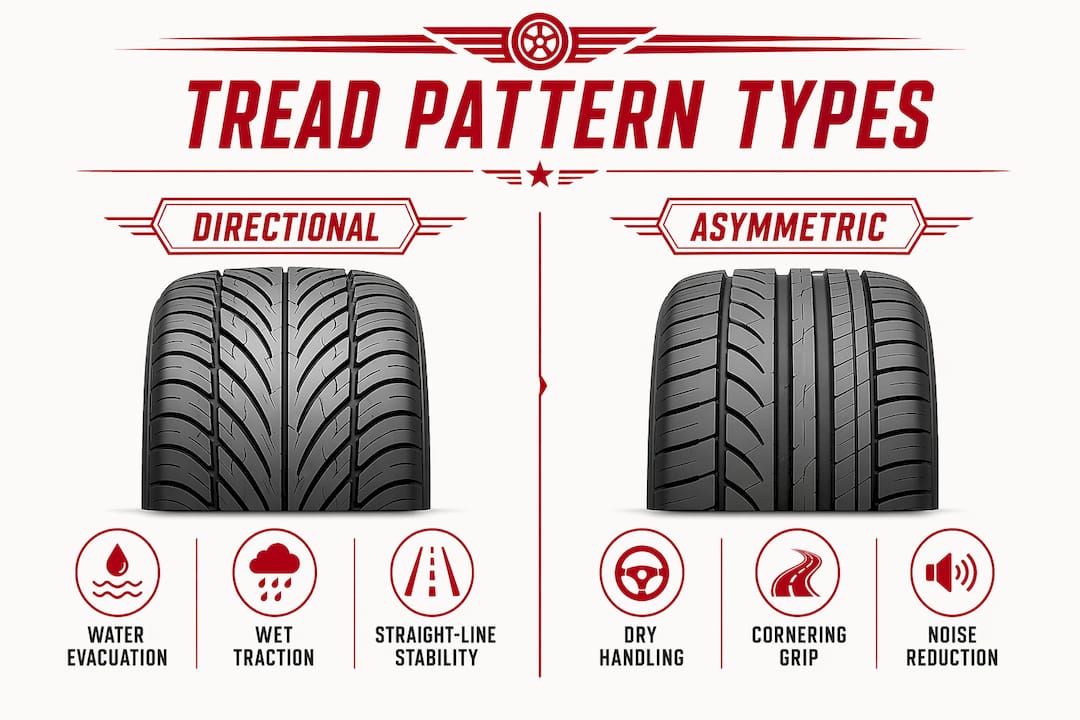
Directional patterns use a V-shaped or arrow-shaped groove layout. The General G-MAX RS uses this design to channel water away from the contact patch efficiently. Directional tires perform well in wet conditions and resist hydroplaning at speed. The trade-off is that they must be mounted in a specific rotational direction, which limits tire rotation patterns.
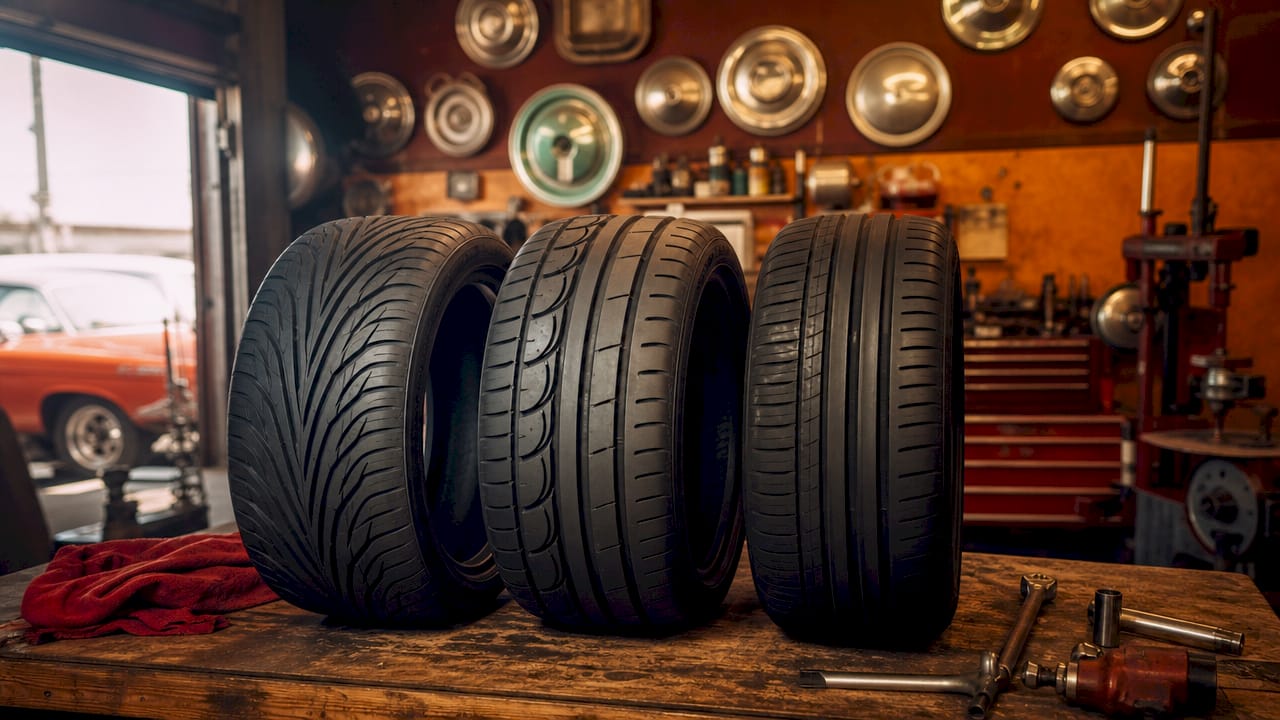
Asymmetric patterns split the tread into two distinct zones. The Continental ExtremeContact DWS 06 Plus is a well-known example. The inner half carries more grooves for water evacuation. The outer half uses larger, stiffer blocks for cornering grip. This design delivers strong performance across wet and dry conditions, making it the most versatile choice for performance street driving.
Solid rib and low-void patterns appear on dedicated summer performance tires. These maximize the dry contact patch at the expense of wet capability. They are designed for track use or dry-climate driving where water evacuation is a secondary concern.
| Tread Type | Wet Grip | Dry Grip | Comfort | Noise | Best Use |
|---|---|---|---|---|---|
| Directional | Excellent | Good | Good | Moderate | Wet roads, highway |
| Asymmetric | Very Good | Very Good | Very Good | Low | Mixed conditions, performance street |
| Solid rib / low-void | Fair | Excellent | Moderate | Low | Track, dry performance |
| All-season (high sipe) | Good | Moderate | Excellent | Moderate | Year-round commuting |
- Summer performance tires use harder compounds with lower void ratios. They deliver maximum dry grip but lose effectiveness below 45°F.
- All-season tires use higher void ratios and more sipes to handle light snow and rain. They sacrifice peak dry grip for year-round usability.
- Noise and comfort correlate directly with void ratio. More open tread patterns generate more road noise because air compresses and releases rapidly in the grooves.
How should performance drivers select tread patterns for their driving style?
Tread pattern selection starts with an honest assessment of your driving environment. A driver who runs track days on weekends and commutes on wet highways needs a different pattern than someone who only drives dry canyon roads. The tread pattern effects on braking and handling depend on the interplay with rubber compound and tire contour, not tread design alone. Changing the pattern without matching the compound to your conditions will not deliver the expected result.
The most common misconception is that more tread depth always means more grip. On dry pavement, a shallower tread with stiffer blocks often outperforms a deeper, more open pattern because the contact patch is larger and block deformation is lower. Wet performance is where depth and void ratio matter most.
- Prioritize asymmetric patterns for mixed-condition performance driving. They deliver the best balance of wet safety and dry handling precision.
- Choose directional patterns if you drive frequently in rain or on wet highways. Their water evacuation efficiency is superior to symmetric designs.
- Avoid high-sipe all-season tires for performance driving. The added flex from sipes reduces steering precision and lateral grip on dry pavement.
- Match compound to pattern. A performance-oriented asymmetric pattern on a touring compound will not behave like a true performance tire. The compound determines the friction ceiling; the pattern determines how that friction is managed.
- Consider your vehicle’s torque delivery. High-torque vehicles, especially electric trucks and performance SUVs, benefit from patterns with stiffer blocks that resist deformation under acceleration, reducing torque-induced pull.
Pro Tip: Before buying based on tread pattern alone, check the tire’s UTQG treadwear and traction ratings. A tire with an AA traction rating and an asymmetric pattern is a strong starting point for performance street use.
Viewing tread pattern as a dual system, one that manages both water displacement and block stiffness, gives you a framework for evaluating any tire. The best pattern for your driving is the one that balances those two demands for your specific conditions.
Key Takeaways
Tread pattern performance directly controls grip, braking, and handling by managing water evacuation, block stiffness, and contact patch geometry across all road conditions.
| Point | Details |
|---|---|
| Water evacuation is critical | Grooves and channels must clear water fast enough to prevent hydroplaning, especially at highway speed. |
| Block stiffness shapes steering | Stiffer tread blocks reduce deformation, sharpen steering response, and improve dry cornering precision. |
| ABS braking holds until 1mm depth | Wet braking performance drops sharply below 1mm tread depth, even with ABS active. |
| Asymmetric patterns offer the best balance | For performance street driving, asymmetric tread designs deliver strong wet and dry grip simultaneously. |
| Pattern alone does not determine grip | Tread design must align with rubber compound and tire contour to deliver expected performance. |
What I’ve learned about tread patterns after years in performance parts
Most performance drivers focus on compound ratings and brand reputation when buying tires. Tread geometry gets treated as an afterthought. That is a mistake I have seen cost drivers real performance on the road and on track.
The 2026 research on tread block friction transitions changed how I think about initial grip bite. That moment when a tire first loads up in a corner is not just about compound softness. It is about how the tread blocks engage the surface as temperature builds at the contact point. Drivers who complain about a tire feeling “cold” or “slow to wake up” are often describing a block geometry problem, not a compound problem.
The other thing I keep coming back to is the vehicle pull research. Tread pattern geometry contributes to steering correction forces under acceleration. For high-torque builds, especially trucks and performance EVs, this means tread selection is part of the alignment and handling conversation, not separate from it. Ozkonickustomz sees this regularly with truck and off-road builds where the wrong tread pattern creates pull that no alignment adjustment fully corrects.
Think beyond tread depth. Think about block geometry, void ratio, and how the pattern matches your compound and vehicle setup. That is where real handling tuning happens.
— Ozkonic Kustomz
Performance parts that support your full vehicle build
Tires are one piece of a complete performance build. The electrical and mechanical systems underneath your vehicle need the same attention to detail as the rubber on the road.

Ozkonickustomz sources directly from vetted manufacturers to give truck owners, performance builders, and off-road drivers access to hard-to-find components with guaranteed fitment. From modular wiring kits that clean up your electrical system to ignition terminals that support high-output engine builds, every part meets strict quality and compatibility standards. Fast shipping, straightforward returns, and expert support back every order. Browse the full catalog at Ozkonickustomz and find the components your build actually needs.
FAQ
What is the role of tread pattern performance in wet conditions?
Tread patterns manage water evacuation through grooves and channels that prevent hydroplaning. A 2026 University of Georgia study confirmed that hydroplaning risk peaks with shallow water at high speed, making tread void ratio and channel depth the most critical wet-weather factors.
How does tread depth affect ABS braking distance?
A 2026 SAE study found ABS braking deceleration stays consistent from 7.1mm down to 2.4mm tread depth. Wet braking performance drops significantly only below approximately 1mm, which is why replacing tires at the wear indicator is a minimum safety standard, not an optional guideline.
What tread pattern type is best for performance driving?
Asymmetric tread patterns deliver the strongest balance of wet and dry performance for street-driven performance cars. They place large, stiff blocks on the outer shoulder for cornering grip and open grooves on the inner section for water management.
Does tread pattern alone determine tire grip?
No. Tread pattern effects on grip depend on the rubber compound and tire contour working together. Changing the tread pattern without matching the compound to your driving conditions will not produce the expected grip improvement.
Why do some tires cause vehicle pull even after alignment?
Tread block deformation under acceleration torque generates lateral forces that contribute to vehicle pull. A 2026 SAE study using finite element simulation confirmed that tread pattern geometry influences these steering correction forces, meaning pull can be a tire design issue rather than an alignment problem.