
Performance fuel system upgrades are modifications to pumps, injectors, fuel lines, pressure regulators, and surge tanks that support increased horsepower, tuning precision, and engine reliability in modified vehicles. The types of fuel system upgrades you choose depend directly on your power goals and application, whether that is a street build pushing 400 horsepower or a dedicated track car chasing 1,000. Getting the hardware right matters, but so does matching wiring and calibration to every component you install. Ozkonickustomz stocks vetted aftermarket parts across all these categories, so you can build a complete system without chasing down mismatched components from multiple sources.
1. What are the main types of fuel system upgrades?
Fuel system modifications fall into six core categories: fuel pumps, fuel injectors, fuel lines, pressure regulators, surge tanks, and wiring and tuning support. Each category solves a specific delivery problem. Skipping one while upgrading another is the fastest way to create a lean condition or a reliability failure. A complete fuel system upgrade treats all six as a matched set.
2. In-tank fuel pumps for street performance builds
In-tank pumps are the right starting point for most street performance builds. They run quieter than external units, stay cooler because fuel surrounds them, and package cleanly inside the factory tank. Street-driven performance builds are best served by in-tank upgrades because of superior fuel cooling, lower noise, and easier fitment compared to external pumps.
Pump sizing is measured in liters per hour (LPH). A rough guide for naturally aspirated gasoline builds:
- 190–255 LPH: Street builds up to 400 HP
- 255–340 LPH: Forced induction builds up to 600 HP
- 340–450 LPH: High-output turbo or supercharged builds up to 800 HP
- 450+ LPH: Dual-pump or external setups for 800+ HP
Pro Tip: Always buy one size up from your current power level. Fuel pumps lose efficiency as they age, and headroom prevents a lean condition when you add more boost later.
3. External and dual-pump setups for high-horsepower applications
External fuel pumps mount outside the tank, usually near the firewall or frame rail. They handle higher flow rates than most in-tank units and are common in dedicated track builds or older vehicles where dropping the tank for an in-tank swap is impractical. The tradeoff is noise, heat exposure, and more complex plumbing.
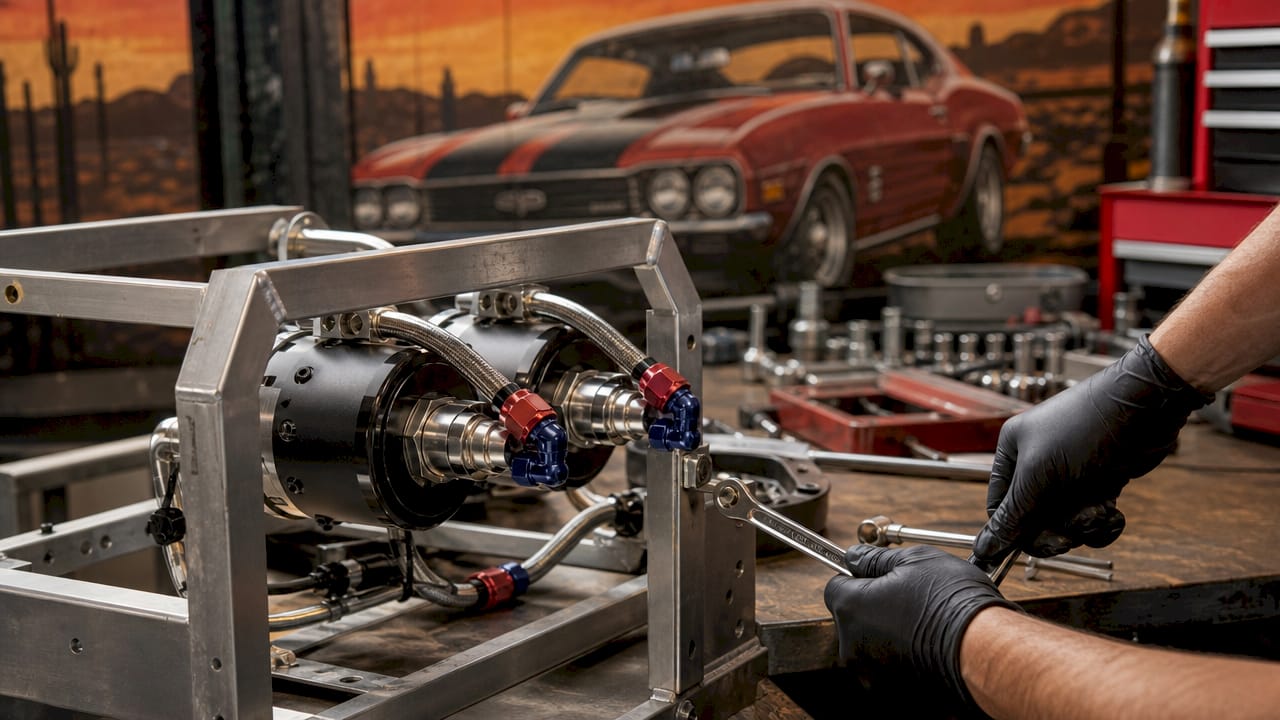
Dual-pump setups pair two pumps, often one in-tank and one external, to hit flow rates that a single pump cannot reach. These systems require careful wiring because running two high-current pumps off factory circuits causes voltage drop that kills actual flow. A relay kit and dedicated fusing are not optional on a dual-pump build. They are the minimum electrical requirement.
4. Types of fuel injectors and how to size them correctly
Fuel injectors are sized by their flow rate in cubic centimeters per minute (cc/min) or pounds per hour (lb/hr). The key rule: injectors must support a maximum duty cycle of 80–85% for reliable operation and tuning flexibility. Running injectors above 85% duty cycle causes lean spikes, rough idle, and accelerated wear.
E85 changes the math significantly. E85 requires approximately 30% more fuel volume than gasoline for the same power level. That means your injectors need to be about 30% larger when switching to ethanol. A 1,000 cc/min injector on gasoline becomes roughly a 1,300 cc/min requirement on E85.
Key factors when selecting injectors:
- Flow rate: Match to your target horsepower and fuel type
- Spray pattern: Matched to intake port geometry for complete atomization
- Impedance: High-impedance (saturated) injectors for most street ECUs; low-impedance (peak-and-hold) for race applications
- Fuel compatibility: Confirm ethanol resistance if running E85 or flex-fuel
Every injector upgrade requires a corresponding ECU tune. Installing larger injectors without recalibrating fueling maps causes rich conditions at idle and poor throttle response across the rev range.
5. Fuel line sizing and pressure regulators for delivery stability
Fuel line diameter is one of the most overlooked variables in a performance fuel build. Undersized lines create restriction that no pump can overcome. Current sizing standards for return-style systems recommend the following:
| Line Size | AN Fitting | Max Horsepower |
|---|---|---|
| 5/16 inch | AN-5 | Up to 250 HP |
| 3/8 inch | AN-6 | Up to 450 HP |
| 1/2 inch | AN-8 | Up to 800 HP |
| 5/8 inch | AN-10 | 800+ HP or long runs |
E85 builds need to step up one line size compared to an equivalent gasoline build. The higher fuel volume demand means restriction shows up faster under wide-open throttle.
Pressure regulators control the fuel pressure delivered to the injectors. A 1:1 boost-referenced regulator is the correct choice for any turbocharged application. It raises fuel pressure in proportion to boost pressure, keeping the pressure differential across the injectors constant. Without it, rising boost effectively reduces injector flow rate and creates a lean condition at peak power.
Pro Tip: A mismatched regulator or undersized feed line is often the real cause of a “bad tune.” Fix the hardware first, then recalibrate.
6. Surge tanks and lift pumps for extreme driving conditions
Fuel starvation is a real problem in hard cornering, sustained acceleration, or any situation where the fuel level drops and the pump uncovers. Surge tanks solve this by maintaining a small, always-full reservoir that feeds the main high-pressure pump regardless of tank level or g-forces.
In-tank surge systems suit street builds well. They are quieter, better cooled, and simpler to package than external units. External surge tanks give track and high-horsepower builds more precise fuel control and easier access for maintenance.
Surge tank pros and cons at a glance:
- In-tank surge: Quieter, fuel-cooled, compact. Best for street and mild track use.
- External surge: Higher capacity, easier to service, better for sustained high-demand use. Adds plumbing complexity.
- Lift pumps: Feed the surge tank from the main tank. Required in multi-pump systems to keep the surge reservoir full under all conditions.
Supporting wiring for multi-pump systems must handle the combined current draw of both the lift pump and the main high-pressure pump. A single relay or undersized wire feeding both pumps is a fire risk and a performance liability.
7. Wiring and tuning: the upgrades most builders skip
A high-capacity pump is only as good as the voltage reaching it. An advertised 450 LPH pump underperforms significantly when wiring and electrical connections are inadequate. Voltage drop across undersized wire or corroded connectors reduces pump speed and actual flow rate, often without any visible warning sign.
The fix is straightforward. Relay kits and heavier gauge wiring reduce voltage drop and protect the factory circuit from the high current draw of a performance pump. A dedicated relay pulls power directly from the battery, bypassing the thin factory wiring that was never designed for a 450 LPH pump.
Common wiring mistakes in fuel system builds:
- Running a high-flow pump off the stock fuel pump relay without a dedicated circuit
- Using undersized wire that causes voltage drop under load
- Skipping a fused circuit, which creates a fire risk if the pump shorts
- Ignoring ground quality, which causes as much voltage drop as a bad positive connection
Tuning is the final piece. Every hardware change in a fuel system, whether a new pump, larger injectors, or a boost-referenced regulator, requires a corresponding ECU calibration. A proper EFI wiring harness supports clean signal routing between the ECU and fuel system components, reducing noise and improving calibration accuracy.
Key takeaways
The most effective fuel system build matches pump flow, injector sizing, line diameter, regulator type, and wiring quality to a single, consistent horsepower target.
| Point | Details |
|---|---|
| Match all components to one HP target | Mixing undersized lines with a large pump creates restriction that negates the upgrade. |
| E85 requires 30% more fuel volume | Size injectors and fuel lines up when switching from gasoline to ethanol. |
| Wiring is not optional | A 450 LPH pump needs a dedicated relay and heavy gauge wire to deliver its rated flow. |
| Boost-referenced regulators are mandatory for turbo builds | A 1:1 regulator keeps injector pressure differential constant as boost rises. |
| Tune after every hardware change | New injectors or a new pump without ECU recalibration causes rich or lean conditions. |
What I have learned building fuel systems from the ground up
The single most common mistake I see is treating fuel system upgrades as individual parts purchases rather than a system design problem. A builder drops in a 450 LPH pump, keeps the stock 5/16-inch feed line, skips the relay kit, and wonders why the tune is still off. The pump is doing maybe 60% of its rated flow because the wiring and plumbing are strangling it.
My honest advice: start with your target horsepower number and work backward through every component. If you are building for 600 HP on E85, that number determines your injector size, your line diameter, your pump rating, and your regulator type before you buy a single part. Staged upgrades make sense when budget is a constraint, but each stage needs to be a complete, matched system at that power level, not a collection of mismatched parts waiting for the next upgrade.
The wiring piece gets ignored more than anything else. I have seen builders spend serious money on injectors and a pump, then run it all off a 20-year-old factory harness with corroded connectors. Voltage drop at the pump is invisible until the engine goes lean at full throttle. A quality integrated fuse box and proper relay wiring are not glamorous, but they are what separates a build that runs right from one that chases gremlins for months.
Finally, always consult a professional tuner after any fuel system change. Hardware sets the ceiling. The tune determines whether you actually reach it.
— Ozkonic Kustomz
Fuel system wiring hardware at Ozkonickustomz
Getting the hardware right starts with the electrical foundation that supports it.
Ozkonickustomz carries modular wiring kits built to handle the high current demands of upgraded fuel pumps, along with professional-grade crimper sets for secure, reliable connections at every terminal. Every product is sourced directly from vetted manufacturers, so you get confirmed fitment and quality without the guesswork of generic aftermarket sourcing. Fast shipping and expert support mean your build does not stall waiting on parts or answers. Browse the full electrical and fuel system hardware catalog at Ozkonickustomz and build your system right the first time.
FAQ
What size fuel pump do I need for a 600 HP build?
A 340–450 LPH in-tank pump covers most forced induction builds targeting 600 HP on gasoline. E85 builds at the same power level require a higher-flow pump due to the greater fuel volume demand.
Do I need larger fuel injectors for E85?
Yes. E85 requires about 30% more fuel volume than gasoline for the same power output, so injectors must be sized up by roughly 30% when switching fuels.
What is a boost-referenced fuel pressure regulator?
A boost-referenced regulator raises fuel pressure in proportion to boost, keeping the pressure differential across injectors constant. It is required on any turbocharged build to prevent lean conditions at peak power.
Why is my new fuel pump not performing as advertised?
Poor voltage management is the most common cause. Undersized wiring or corroded connections reduce pump speed and actual flow rate. Install a dedicated relay kit and heavy gauge wiring to resolve the issue.
Do I need a tune after upgrading fuel system components?
Yes. Every change to injector size, pump flow, or fuel pressure requires ECU recalibration. Running new hardware on an old fuel map causes rich or lean conditions that reduce power and can damage the engine.
Recommended
- High Mileage Vehicle Performance Upgrades in CA – Ozkonic Kustomz LLC
- The Role of Performance Camshaft in Engine Power – Ozkonic Kustomz LLC
- Hybrid Performance Tuning: What Car Enthusiasts Need to Know – Ozkonic Kustomz LLC
- Performance Chip Explained: What It Does and What to Expect – Ozkonic Kustomz LLC