

The racing differential is defined as the mechanical device that splits torque between driven wheels while allowing each wheel to rotate at a different speed. The role of differential types in racing goes far beyond basic torque splitting. The right differential choice determines corner-exit traction, tire wear rate, driver confidence, and ultimately lap times. Open differentials, limited-slip differentials (LSDs), spools, lockers, and electronic units each solve a different problem on track. Choosing the wrong one for your discipline is one of the most common and costly setup mistakes a racer can make.
How do different differential types affect race car performance?
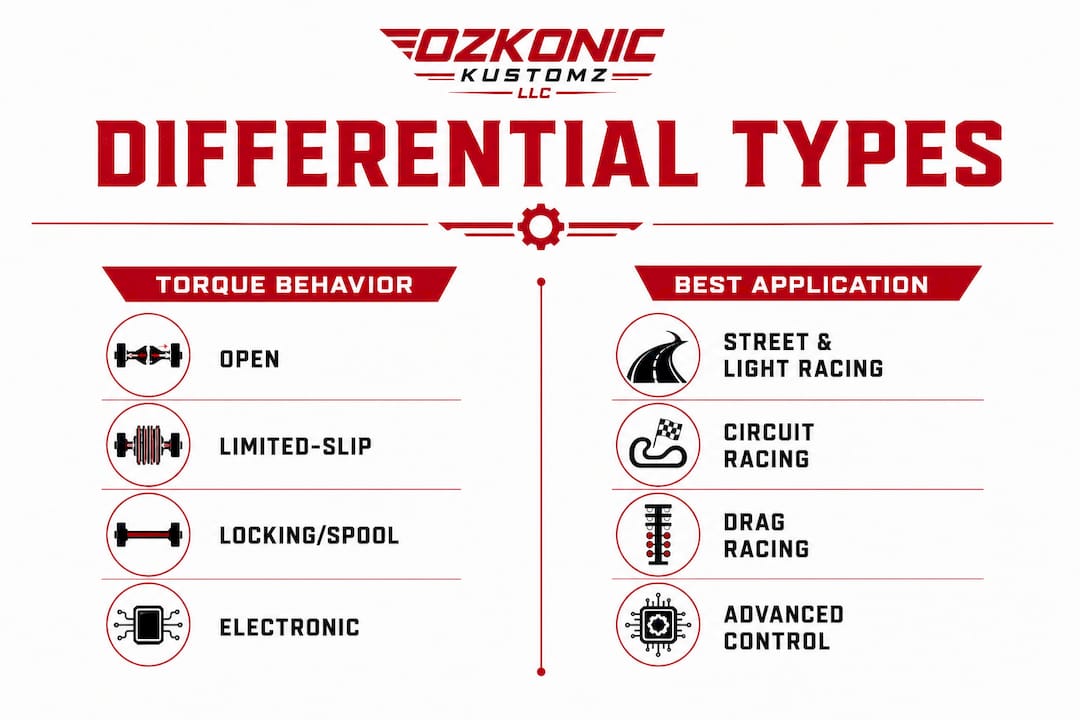
The open differential is the baseline design found in most road cars. It sends torque to whichever wheel has the least resistance. On a race track, that means a spinning inside wheel robs drive from the outside wheel when you need it most. Open differentials lose 100% of torque to the spinning wheel, which makes them nearly useless for performance driving.
Limited-slip differentials solve this by biasing torque toward the gripping wheel. LSDs maintain a 60–80% torque bias to the wheel with grip during cornering. That shift in torque delivery translates directly into faster corner exits and more consistent traction across varying surface conditions.
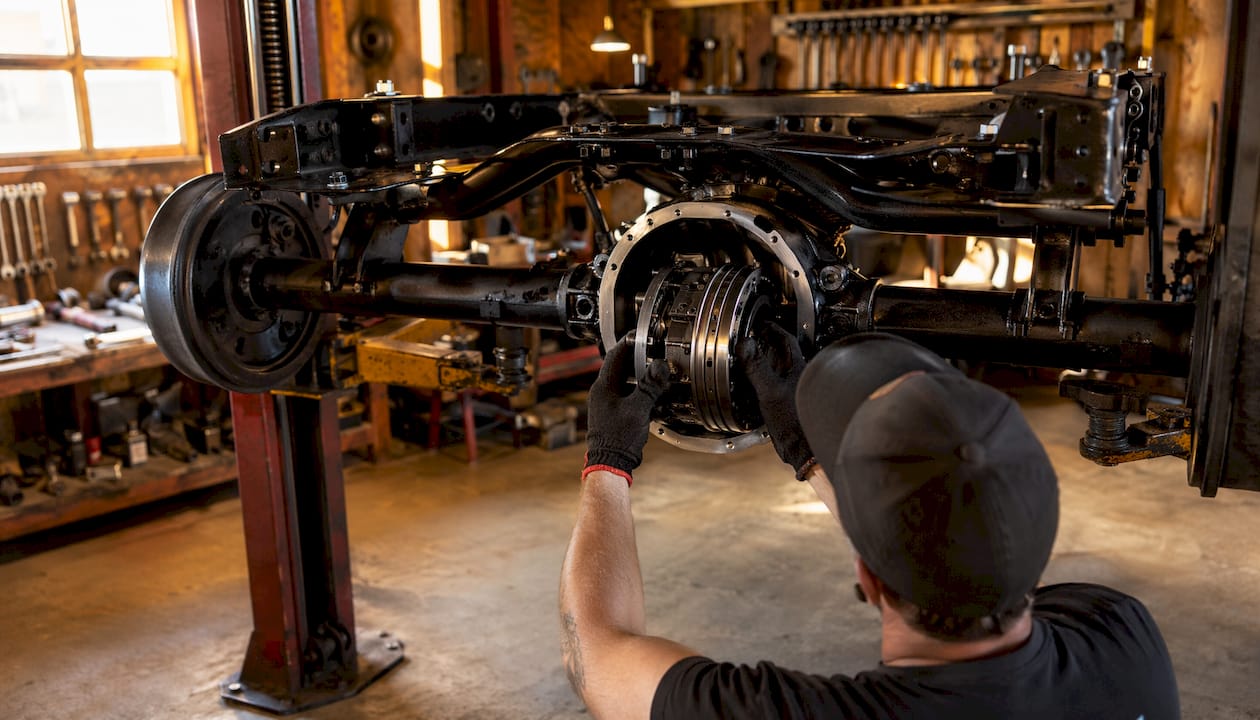
Spools and locking differentials take the opposite approach. A spool permanently locks both axles together, producing 100% lock and maximum launch traction. The trade-off is significant. Tire scrub and understeer become unavoidable in corners, which is why spools suit drag strips and oval tracks where cornering demands are minimal.
Electronic differentials represent the most advanced category. They use sensors and control units to apply torque vectoring in real time, shifting drive between wheels based on steering angle, throttle position, and lateral acceleration. This adaptability makes them the preferred choice in high-budget circuit racing programs where conditions change lap to lap.
| Differential type | Torque behavior | Best application |
|---|---|---|
| Open | 100% to spinning wheel | Road cars only |
| Clutch-type LSD | 60–80% bias to gripping wheel | Circuit and track days |
| Helical (Torsen) LSD | Progressive torque bias | Circuit and road racing |
| Spool/locker | 100% lock, both axles | Drag and oval racing |
| Electronic LSD | Adaptive torque vectoring | High-budget circuit racing |
Pro Tip: Differential type selection affects not just traction but tire wear patterns over a full race stint. A spool that works perfectly for a 10-second drag run will destroy rear tires in a 30-minute circuit race.
What is the impact of differential setup adjustments on handling?
Differential tuning is one of the most misunderstood tools in a race car setup. Most racers focus on suspension geometry and tire pressure, but differential tuning impacts tire wear, traction, lap times, and driver confidence throughout an entire race stint. Small changes in locking behavior produce measurable differences in how the car rotates through corners.
The core trade-off is straightforward. More locking improves corner-exit traction but causes understeer on corner entry. A more open setting sharpens turn-in but risks traction loss when you apply throttle. Racers and engineers balance these two demands based on track layout and driving style.
Preload is the setting that defines the minimum locking force the differential applies even when coasting. Adjusting preload in Formula 1 improved rear stability and gave drivers more confidence through mid-corner. Higher preload stabilizes the rear on corner entry but can reduce rotation if set too aggressively.
Ramp angles in clutch-type LSDs control how quickly the differential locks up under acceleration or deceleration. Steeper ramp angles produce faster, more aggressive lockup. Shallower angles create a progressive, gentler engagement. Racers tune ramp angles to match their throttle application style and the specific corner types on their circuit.
Setup priorities vary sharply by discipline:
- Circuit racing: Balance between entry rotation and exit traction. Moderate preload, progressive ramp angles.
- Drift: High locking on both acceleration and deceleration for predictable, controllable slides. Two-way LSD setups are standard.
- Drag racing: Maximum lock at all times. Spool or heavy-duty locker with no compromise on cornering.
- Rally: Variable surface grip demands a two-way LSD that locks predictably on loose and tarmac surfaces alike.
Pro Tip: When testing differential settings, change one variable at a time. Adjusting preload and ramp angles simultaneously makes it impossible to identify which change produced the handling difference you felt.
Which differential types suit different racing disciplines?
There is no universal best differential. Each type fits a specific set of priorities, and matching the differential to the discipline is as important as any other setup decision. Getting this wrong wastes money and hurts performance.
Drag racers favor spools or heavy-duty lockers because straight-line traction is the only priority. Spools and lockers provide 100% lock for maximum launch force. The understeer penalty in corners is irrelevant when the track is a straight quarter mile.
Circuit racers need a differential that handles both cornering and acceleration. Clutch-type LSDs deliver hard lockup under power for strong exits. Helical units like the Torsen design provide progressive torque bias without clutch plates, making them lower maintenance and well suited to endurance racing where consistency matters more than peak grip.
Drift and rally disciplines both rely on two-way LSDs. A two-way LSD locks under both acceleration and deceleration, which gives drivers predictable behavior during slides and weight transfers. That predictability is what allows a driver to control a car through a sustained drift or a loose-surface rally stage.
| Racing discipline | Recommended differential | Primary reason |
|---|---|---|
| Drag racing | Spool or locker | Maximum straight-line traction |
| Circuit racing | Clutch-type or helical LSD | Balance of cornering and exit grip |
| Drift | Two-way LSD | Predictable lockup during slides |
| Rally | Two-way LSD | Consistent behavior on variable surfaces |
| Oval racing | Spool | No high-speed cornering demands |
For racers building a track car from scratch, the differential upgrade guide at Ozkonickustomz breaks down application-specific recommendations with fitment details.
What maintenance separates racing differential types?
Maintenance requirements differ dramatically between differential types, and neglecting service is one of the fastest ways to lose performance mid-season. Clutch-type LSDs require regular oil changes with friction modifiers and eventual clutch plate replacement. The clutch plates wear with every lockup event, and degraded plates produce inconsistent locking behavior that shows up as unpredictable corner exits.
Helical and Torsen-style units are largely fit-and-forget by comparison. They use gear geometry rather than friction surfaces to generate torque bias, so there are no clutch plates to wear out. Maintenance is often overlooked but critical for clutch-type units specifically, while gear-type LSDs need only periodic fluid changes.
Electronic differentials carry the highest maintenance complexity. They depend on sensors, actuators, and control modules that must all function correctly for the system to deliver accurate torque vectoring. A faulty wheel speed sensor or a failing actuator can reduce the electronic LSD to open-differential behavior without any obvious warning sign.
Key maintenance checkpoints by differential type:
- Clutch-type LSD: Change fluid every 15,000–20,000 miles or after every race season. Use fluid with the correct friction modifier specification. Inspect clutch plates annually.
- Helical/Torsen LSD: Change fluid at standard intervals. No clutch plates to inspect.
- Electronic LSD: Check sensor calibration and actuator response regularly. Monitor for fault codes after each race event.
- Spool: Inspect axle shafts and bearings for stress cracking, especially after hard launches.
Pro Tip: After any race weekend, check your differential fluid for a burnt smell or metallic particles. Either sign means clutch plate wear is accelerating and service cannot wait until the next scheduled interval.
Pairing your differential setup with the right performance tire choice amplifies the gains from a well-maintained unit. Tires and differentials work as a system, not independently.
Key Takeaways
The differential type you choose defines your car’s traction, cornering behavior, and tire wear more than almost any other single component in your drivetrain.
| Point | Details |
|---|---|
| Open diffs lose all torque | An open differential sends 100% of torque to the spinning wheel, making it unsuitable for racing. |
| LSD torque bias improves grip | LSDs maintain a 60–80% torque bias to the gripping wheel for better cornering traction. |
| Discipline determines diff type | Drag racing needs spools; circuit racing needs LSDs; drift and rally need two-way LSDs. |
| Tuning preload and ramp angles matters | Small adjustments to preload and ramp angles change corner entry rotation and exit traction measurably. |
| Maintenance separates clutch from gear types | Clutch-type LSDs need regular fluid and plate service; helical units need minimal upkeep. |
The most overlooked differential truth in racing
Most racers I talk to assume more locking is always better. It is a logical assumption. More lock means more traction, right? The reality is more complicated, and getting it wrong costs lap time in ways that are hard to diagnose.
Excessive locking kills corner entry. When the differential fights the speed difference between your inside and outside rear wheels, the car resists rotation. You end up pushing wide on entry, which forces you to brake earlier and carry less speed into the corner. The exit traction gain from heavy locking does not compensate for the entry loss on most circuit layouts.
The real skill is matching differential behavior to your driving style and the specific track. A driver who trails brakes deep into corners needs a more open entry setting. A driver who coasts and then applies power early needs more exit lock. Neither approach is universally correct.
What I have found consistently is that racers who integrate their differential setup with suspension tuning and tire selection get the most out of each adjustment. Changing the differential without accounting for how it interacts with your rear suspension geometry and tire compound produces unpredictable results. Telemetry data from corner entry to exit is the only reliable way to confirm whether a differential change actually helped.
Start conservative. Make one change at a time. And never assume the fastest driver in your class is running more lock than you. They might be running less.
— Ozkonic Kustomz
Performance differential parts at Ozkonickustomz
Selecting the right differential is only half the equation. The hardware supporting your drivetrain needs to match the demands of your racing application.

Ozkonickustomz sources performance automotive parts directly from vetted manufacturers, which means every component meets strict standards for fitment and durability before it ships. For truck and 4x4 builders, the rear kit for Chevy 4x4 supports performance differential upgrades with components built for the demands of off-road and performance driving. Racers who need clean electrical integration for drivetrain monitoring can find the modular wiring kit that supports differential and drivetrain electrical systems. Fast shipping, guaranteed compatibility, and direct expert support make Ozkonickustomz the practical choice for builders who cannot afford wrong parts or wasted time.
FAQ
What does a racing differential actually do?
A racing differential splits torque between driven wheels while allowing each to rotate at a different speed through corners. The type of differential determines how aggressively it manages that torque split under acceleration, deceleration, and cornering.
How do racing differentials work differently from street differentials?
Racing differentials use tighter tolerances, stronger materials, and more aggressive locking behavior than street units. Differential tuning impacts tire wear, traction, and lap times in ways that street differentials are not designed to address.
What is the best differential for circuit racing?
Clutch-type and helical LSDs are the best choices for circuit racing. They provide progressive torque bias for cornering grip while still delivering strong corner-exit traction under acceleration.
Why do drag racers use spools instead of LSDs?
Spools produce 100% lock for maximum launch traction on a straight track. The understeer and tire scrub that spools cause in corners are irrelevant in drag racing where the entire run is a straight line.
How often should a clutch-type LSD be serviced?
Clutch-type LSDs require regular oil changes with friction modifiers and periodic clutch plate inspection. Service intervals depend on use intensity, but checking fluid condition after every race season is the minimum standard.
Recommended
- Types of Differential Upgrades: A Gearhead’s Guide – Ozkonic Kustomz LLC
- Tread Pattern Performance: What Drivers Need to Know – Ozkonic Kustomz LLC
- Performance Parts for Daily Drivers: 2026 Guide – Ozkonic Kustomz LLC
- Hybrid Performance Tuning: What Car Enthusiasts Need to Know – Ozkonic Kustomz LLC