
Engine block material is defined as the structural and thermal foundation of every internal combustion engine, determining how well the engine manages heat, resists mechanical stress, and contributes to overall vehicle weight. The role of engine block material extends far beyond simple containment. It shapes handling, fuel efficiency, durability, and how aggressively you can push an engine under load. The three primary engine block construction materials are aluminum, cast iron, and compacted graphite iron (CGI). As of early 2026, aluminum blocks hold 65% market share primarily because of weight savings. That number tells you where the industry has placed its bets, but it does not tell you which material is right for your build.
How does engine block material affect vehicle weight and handling?
Weight is the most immediate way engine block material changes how a vehicle performs on the road or track. A heavier block shifts mass toward the front axle, increasing understeer and reducing the agility that performance builds demand. Reducing that mass changes everything from corner entry to braking balance.
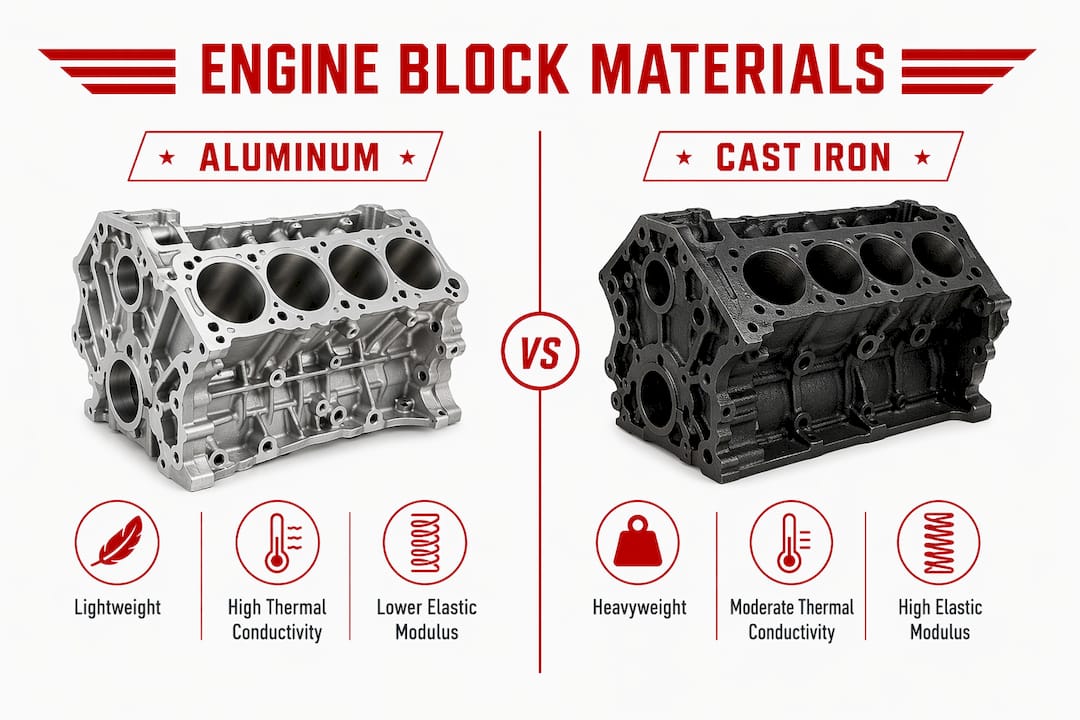
Aluminum blocks deliver a 30–50% weight reduction compared to cast iron equivalents. That reduction translates directly into a lower front axle load, which improves steering response and allows suspension geometry to work as designed. Fuel efficiency also improves because the drivetrain carries less dead weight through every acceleration cycle.
The practical difference is measurable in real builds. A cast iron V8 block can weigh over 100 lbs on its own. Swapping to an aluminum equivalent in the same displacement range can shed 40–60 lbs from the nose of the vehicle. That shift alone changes how the car rotates through corners.
- Weight savings: Aluminum blocks weigh 30–50% less than cast iron, reducing front axle load and improving balance.
- Fuel efficiency: Lower block weight reduces the energy required to accelerate the vehicle, improving fuel economy across all driving conditions.
- Handling dynamics: A lighter front end allows suspension tuning to target neutral balance rather than compensating for nose-heavy weight distribution.
- Track applications: Road racing and autocross builds consistently favor aluminum for its weight advantage, where every pound removed from the front axle improves lap times.
Pro Tip: If you are building a performance truck or off-road rig where towing capacity matters, factor in that cast iron’s added weight can actually help front axle stability under heavy tongue loads. Weight is not always the enemy.
Builders focused on fuel system upgrades for performance will find that block weight reduction compounds the efficiency gains from improved fueling. Less mass to move means the fuel system works less to maintain target air-fuel ratios under load.
What are the thermal management properties of engine block materials?
Thermal management is where the differences between aluminum and cast iron become most consequential for high-performance applications. Heat is the primary enemy of engine longevity, and the block material determines how quickly that heat moves away from combustion chambers and cylinder bores.
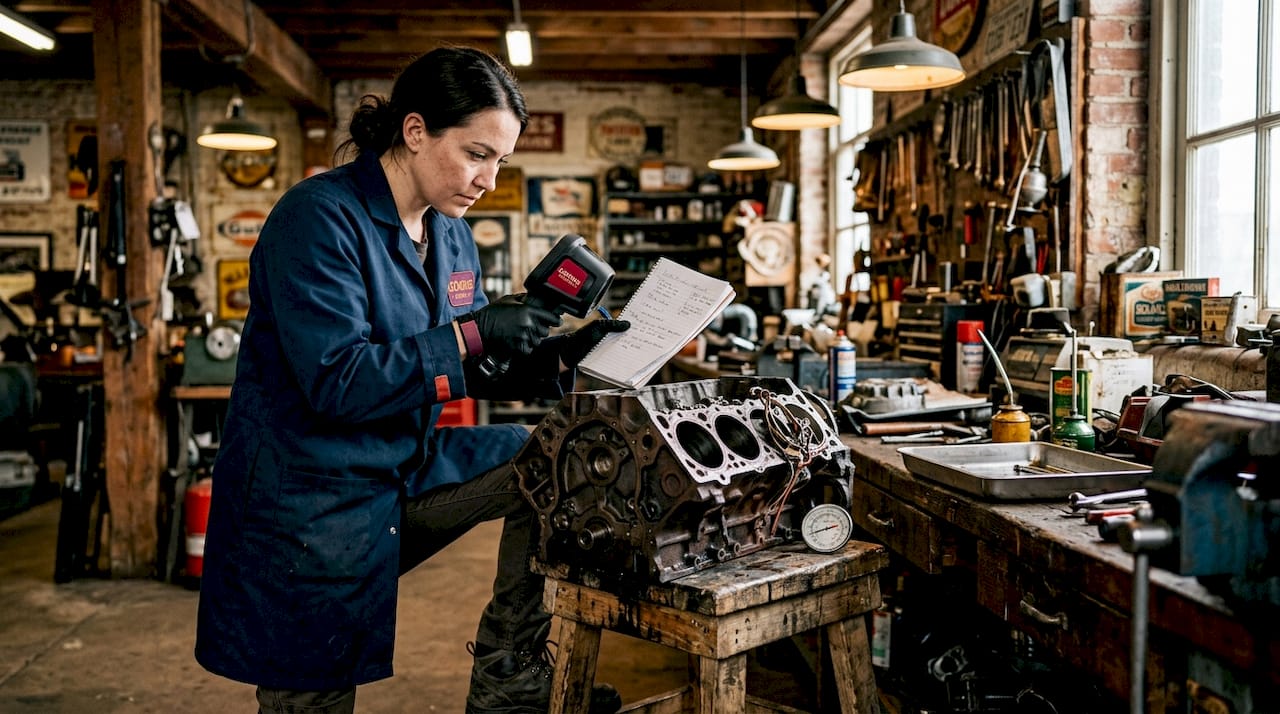
Aluminum dissipates heat 3–4 times more effectively than cast iron, which helps manage thermal gradients across the block. That faster heat rejection keeps cylinder temperatures more uniform, reducing the risk of hot spots that warp bores or crack heads. The tradeoff is that aluminum’s higher thermal expansion rate creates design complexity that cast iron simply does not require.
The thermal stakes are not abstract. A combustion temperature rise from 400°C to 800°C reduces fatigue safety factor by 39%. That means a block running hotter than designed does not just wear faster. It fails structurally at a rate that compounds with every heat cycle.
Engineers address aluminum’s thermal expansion challenges through several design adaptations:
- Cast-in iron cylinder liners maintain bore geometry as the aluminum block expands and contracts around them.
- Torque-to-yield head bolts accommodate the differential expansion between the aluminum block and the iron or steel head.
- Sophisticated cooling jacket geometry routes coolant more precisely around combustion chambers to prevent localized overheating.
- Higher-capacity cooling systems compensate for aluminum’s greater sensitivity to coolant loss or degradation.
| Property | Aluminum | Cast Iron |
|---|---|---|
| Thermal conductivity | High (3–4x cast iron) | Moderate |
| Thermal expansion | High (requires design compensation) | Low (more stable) |
| Fatigue risk at high temps | Elevated | Lower |
| Cooling system demands | High | Moderate |
Pro Tip: Aluminum blocks are particularly vulnerable to localized overheating even when the temperature gauge reads normal. A failing water pump or partially blocked coolant passage can cause head gasket failure before the dashboard shows any warning. Inspect the cooling system at every service interval.
Builders running forced induction should pay close attention to intercooler selection. Thermal load on the block increases significantly with boost, and the aftermarket intercooler options available in 2026 can meaningfully reduce charge air temperatures before they reach the combustion chamber.
How does engine block material comparison reveal durability differences?
Mechanical strength and long-term durability separate the materials in ways that weight and thermal data alone do not capture. The key metric is elastic modulus, which measures how much a material resists deformation under load.
Aluminum’s elastic modulus sits at approximately 70 GPa, compared to 110–170 GPa for cast iron. That gap means aluminum deflects more under cylinder pressure, which creates bore distortion. Bore distortion accelerates ring wear, increases blowby, and shortens the service life of the entire rotating assembly. Engineers counter this with cast-in iron liners and ribbed block geometries, but those solutions add cost and complexity.
Cast iron’s stiffness advantage makes it the preferred choice for maximum-effort power builds. Cast iron reduces total build costs by at least 40% compared to aluminum for high-performance applications while delivering superior rigidity. For a drag racing engine making 1,000+ horsepower, that combination of lower cost and higher stiffness is difficult to argue against.
CGI occupies a specialized position in the engine block material comparison:
- Strength-to-weight ratio: CGI offers stiffness closer to cast iron with weight approaching aluminum, making it attractive for turbocharged diesel and heavy-duty applications.
- Machining requirements: CGI requires OEM-grade machining due to its hardness and stiffness, which limits its use in typical aftermarket rebuilds.
- Cost: CGI manufacturing costs exceed both aluminum and cast iron, restricting it to applications where the performance premium is justified.
- Availability: CGI blocks are rarely available through aftermarket channels, making them a factory-spec material rather than a builder’s choice.
| Material | Elastic Modulus | Best Application | Rebuild Accessibility |
|---|---|---|---|
| Aluminum | ~70 GPa | Street performance, weight-sensitive builds | High |
| Cast Iron | 110–170 GPa | High-power, drag, towing | High |
| CGI | Intermediate | Turbo diesel, heavy-duty OEM | Low |
The durability picture for aluminum has improved significantly. Modern aluminum blocks with iron liners and proper cooling can achieve durability comparable to cast iron in most street and track applications. The key phrase is “proper cooling.” Strip that away and the durability gap reopens fast.
What engineering trade-offs and maintenance factors come with each material?
Every engine block material choice carries maintenance implications that show up years after the build is complete. Understanding those trade-offs before you commit to a material saves significant cost and frustration down the road.
Aluminum demands precision at every stage of assembly and maintenance. Aluminum’s higher thermal expansion creates sensitivity to mechanical and thermal stresses, meaning torque specs are not suggestions. An undertorqued head on an aluminum block will leak. An overtorqued fastener will pull threads. Cast iron tolerates minor assembly errors that would cause immediate problems in aluminum.
- Aluminum maintenance priorities: Cooling system condition is non-negotiable. Degraded coolant accelerates corrosion in aluminum blocks. Flush intervals should be shorter than manufacturer minimums in high-performance applications.
- Cast iron maintenance priorities: Weight and corrosion are the primary concerns. Cast iron rusts when coolant is neglected, and the added mass stresses motor mounts and drivetrain components over time.
- Repair costs: Aluminum blocks can be welded and re-sleeved, but the process requires skilled labor and specialized equipment. Cast iron welding is more accessible but requires preheat procedures to avoid cracking.
- Thread repair: Aluminum threads strip more easily than cast iron. Helicoil inserts are standard practice in aluminum blocks for any fastener that sees repeated removal.
Pro Tip: For any aluminum block build, use a quality coolant with aluminum-compatible inhibitors and change it every two years regardless of mileage. The cost of a coolant flush is a fraction of the cost of a corroded water jacket.
Cast iron is more forgiving of assembly errors and minor thermal fluctuations, which makes it the practical choice for builders who prioritize reliability over weight savings. That forgiveness has real value in a daily driver or a tow rig that sees varied conditions and infrequent professional maintenance.
Key Takeaways
Engine block material selection determines the structural integrity, thermal behavior, and long-term durability of any performance build, with aluminum, cast iron, and CGI each serving distinct applications based on weight, stiffness, and heat management requirements.
| Point | Details |
|---|---|
| Aluminum dominates by market share | Aluminum holds 65% market share in 2026, driven by its 30–50% weight advantage over cast iron. |
| Thermal management is material-dependent | Aluminum dissipates heat 3–4x faster than cast iron but requires more sophisticated cooling system design. |
| Stiffness favors cast iron for big power | Cast iron’s elastic modulus of 110–170 GPa resists bore distortion better than aluminum’s ~70 GPa. |
| CGI is a niche OEM material | CGI offers the best strength-to-weight ratio but requires OEM-grade machining, limiting aftermarket use. |
| Aluminum needs precise maintenance | Cooling system condition and correct torque specs are critical to aluminum block longevity. |
What I have learned building with every block material
After years of working with performance builds across truck, track, and off-road applications, the most persistent misconception I encounter is that aluminum is inherently fragile. It is not. What aluminum is, is unforgiving of neglect. A cast iron block will survive a slow coolant leak that would destroy an aluminum block in the same scenario. That difference is not a flaw in aluminum. It is a design characteristic that demands respect.
The builders who get the most out of aluminum are the ones who treat the cooling system as a primary performance component, not an afterthought. They run quality coolant, inspect hoses and the water pump at every service, and never skip a thermostat check. Those builders run aluminum blocks for hundreds of thousands of miles without incident.
For maximum-effort drag builds or heavy towing applications, cast iron remains the material I recommend without hesitation. The stiffness advantage under extreme cylinder pressure is real, and the 40% cost reduction over aluminum in high-performance configurations matters when you are building on a budget. CGI is genuinely impressive engineering, but its machining requirements put it out of reach for most enthusiasts outside of factory-spec diesel applications.
The honest answer is that no single best engine block material exists. The right choice depends on your duty cycle, your maintenance habits, and what you are asking the engine to do. Match the material to the mission, and either aluminum or cast iron will serve you well for a long time.
— Ozkonic Kustomz
Performance hardware to complement your engine build
Building around the right engine block material is only part of the equation. The hardware connecting your engine to the rest of the vehicle needs to match the same performance standard.
Ozkonickustomz sources performance automotive hardware directly from vetted manufacturers, which means every component meets strict fitment and quality standards before it ships. Whether you are reinforcing an aluminum block build with precision fastener hardware or upgrading the underhood components on a cast iron powerplant, the automotive wiring and hardware kits available through Ozkonickustomz are built to the same standard your engine deserves. Truck owners and performance builders can also find hood hardware and exterior components, including the universal tilt hood kit, that complement underhood access for serious build work. Fast shipping and guaranteed compatibility back every order.
FAQ
What is the primary role of engine block material?
Engine block material provides structural integrity, thermal management, and weight distribution for the entire engine. The material choice determines how well the engine handles heat, resists bore distortion, and contributes to vehicle dynamics.
Why do most modern engines use aluminum blocks?
Aluminum blocks hold 65% market share because they weigh 30–50% less than cast iron, improving fuel efficiency and handling. Modern aluminum blocks with iron liners match cast iron durability in most street and track applications.
Is cast iron better than aluminum for high-performance builds?
Cast iron offers superior stiffness (110–170 GPa elastic modulus) and resists bore distortion better under extreme cylinder pressure. It also costs at least 40% less than aluminum for high-performance configurations, making it the preferred choice for maximum-power drag and towing builds.
What is CGI and when should you use it?
CGI (compacted graphite iron) offers strength between cast iron and aluminum with better weight efficiency, making it ideal for turbocharged diesel and heavy-duty OEM applications. Its machining requirements limit availability in aftermarket rebuilds.
How does engine block material affect maintenance requirements?
Aluminum requires stricter torque specs, aluminum-compatible coolant, and more frequent cooling system inspections due to its higher thermal expansion. Cast iron is more forgiving of minor assembly errors and thermal fluctuations but is vulnerable to corrosion when coolant is neglected.
Recommended
- The Role of Performance Camshaft in Engine Power – Ozkonic Kustomz LLC
- Small Block Chevy Performance Upgrades: Top 7 Ways to Boost Horsepower – Ozkonic Kustomz LLC
- What Is Engine Displacement? A Guide for Enthusiasts – Ozkonic Kustomz LLC
- Unleash the Beast: Essential Small Block Chevy Performance Parts Upgra – Ozkonic Kustomz LLC
