

Engine displacement is the total volume swept by all pistons inside an engine’s cylinders during one complete cycle, excluding the combustion chambers. Every time you see a badge reading “5.0L” on a Ford Mustang or “6.2L” on a Chevy Corvette, that number describes displacement. It tells you how much air and fuel the engine can theoretically pull in per cycle, making it the single most common shorthand for engine size. Displacement is expressed in liters, cubic centimeters (cc), or cubic inches (CID), depending on the region and application.
What is engine displacement and how is it calculated?
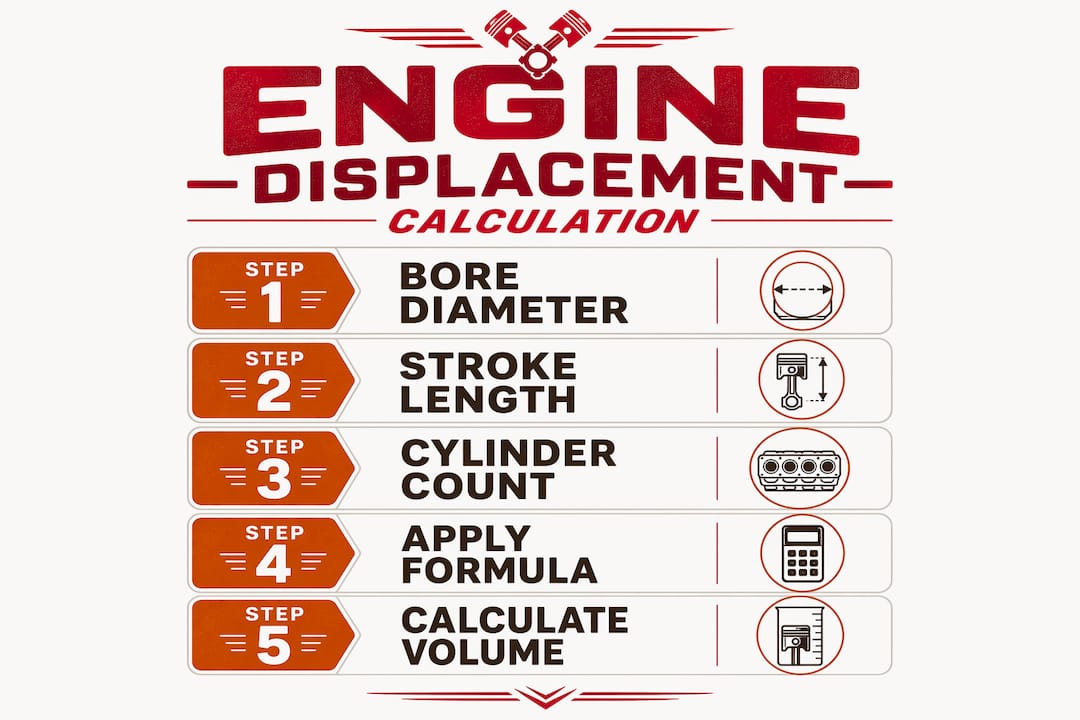
Engine displacement is calculated from three specs: bore, stroke, and cylinder count. Bore is the diameter of each cylinder. Stroke is the distance the piston travels from its lowest point (bottom dead center) to its highest point (top dead center). Multiply those together with pi and the number of cylinders, and you get total swept volume.

The displacement formula is:
Displacement = stroke length × π × (bore ÷ 2)² × number of cylinders
Here is a practical example. A 4-cylinder engine with a bore of 86mm and a stroke of 86mm produces:
- Convert bore and stroke to consistent units: 86mm = 0.086 meters (or keep in mm for cc results).
- Calculate the area of one cylinder bore: π × (43mm)² = 5,808.8 mm².
- Multiply by stroke: 5,808.8 × 86mm = 499,556 mm³ per cylinder.
- Convert to cc: 499,556 mm³ ÷ 1,000 = 499.6 cc per cylinder.
- Multiply by 4 cylinders: 499.6 × 4 = 1,998.4 cc, or roughly 2.0 liters.
That math explains why a “2.0L” badge exists on so many compact cars. The number is a rounded marketing label, not always the exact swept volume.
One critical point: displacement does not include the combustion chamber volume above the piston at top dead center. Students commonly confuse swept volume with total cylinder volume. Swept volume is the space the piston actually travels through. Combustion chamber volume is separate and factors into compression ratio instead.
You never physically measure displacement on an assembled engine. Manufacturer specs or service manuals provide the bore and stroke dimensions needed for calculation. For a Chevy LS engine, for example, the factory service manual lists exact bore and stroke figures that feed directly into this formula.
Pro Tip: Always pull bore and stroke specs from the manufacturer’s datasheet rather than a parts catalog. Two engines with the same nominal displacement can have different bore and stroke combinations, which affects torque characteristics and rod ratio.
Why does engine displacement matter for performance and efficiency?
Displacement sets the ceiling for how much air and fuel an engine can ingest per cycle. A larger displacement engine can move more air-fuel mixture, which means more potential energy released per combustion event. That is why a 6.2L V8 in a Chevrolet Camaro ZL1 makes far more power than a 1.5L four-cylinder in a Honda Civic.
The word “potential” matters here. Power output depends on far more than displacement alone. Airflow, compression ratio, camshaft timing, and engine internals all determine how much of that potential gets converted into actual horsepower and torque. A turbocharged 2.0L engine can outpower a naturally aspirated 3.5L engine because forced induction pushes more air into the same swept volume.
Key factors that work alongside displacement to determine real-world output:
- Volumetric efficiency: How effectively the engine fills its cylinders with the air-fuel charge. A high-revving Honda S2000 F20C achieves exceptional volumetric efficiency through aggressive valve timing.
- Compression ratio: Higher compression extracts more energy from each combustion event. Engines like the Ford Coyote 5.0L run relatively high compression to maximize output.
- Forced induction: Turbochargers and superchargers on engines like the 3.5L EcoBoost in the Ford F-150 effectively multiply the air-fuel charge beyond what displacement alone allows.
- Mean effective pressure: BMEP and IMEP metrics normalize engine performance relative to displacement. Two engines with identical displacement can produce very different power outputs based on combustion efficiency.
- Engine speed (RPM): Displacement is a per-cycle measurement. Higher RPM means more cycles per minute, multiplying the effective output.
Fuel consumption follows a similar pattern. Larger displacement generally burns more fuel because more mixture is consumed per cycle. However, modern downsized turbocharged engines like the 1.5L unit in the Honda CR-V can match the fuel economy of older, larger naturally aspirated engines under light loads.
Pro Tip: Never use displacement as the only metric when comparing engines. A 5.7L Hemi and a 5.7L LS engine share the same displacement but differ significantly in power, efficiency, and character due to design differences.
How do displacement units compare across regions?
Displacement is expressed in liters, cubic centimeters, or cubic inches depending on where you are and what you are working on. The units represent the same physical volume at different scales. One liter equals 1,000 cc. One cubic inch equals approximately 16.387 cc.
The United States historically used cubic inches (CID) for American muscle cars. A classic Chevrolet 350 small-block is 350 CID. Metric countries use liters or cc, which is why a Japanese Honda CBR600RR motorcycle is described as 599 cc. Modern American automotive marketing shifted to liters, but CID still appears in hot rod and classic car culture.
| Engine | Liters | Cubic Centimeters (cc) | Cubic Inches (CID) |
|---|---|---|---|
| Honda Civic 1.5T | 1.5L | 1,498 cc | 91.4 CID |
| Ford Mustang 5.0 Coyote | 5.0L | 4,951 cc | 302 CID |
| Chevrolet 350 Small-Block | 5.7L | 5,736 cc | 350 CID |
| Dodge Viper V10 | 8.4L | 8,382 cc | 511 CID |
| Kawasaki Ninja 400 | 0.4L | 399 cc | 24.3 CID |
Marketing labels like “2.0L” are often rounded values. The actual calculated displacement from exact bore and stroke specs may be 1,998 cc or 2,003 cc. For casual reference, the rounded label works fine. For precision tuning or engine building, always use the exact figures from the factory service manual.
How do non-standard engines handle displacement measurement?
Standard displacement formulas assume a reciprocating piston moving in a round cylinder. Not every engine fits that model. Wankel rotary engines and oval-piston designs require specialized nominal displacement measurements because the standard formula produces misleading results.
Key considerations for non-standard engine types:
- Wankel rotary engines: The Mazda RX-7 and RX-8 use rotary engines where a triangular rotor spins inside an epitrochoidal housing. The swept volume per rotor is calculated differently from a piston engine. Regulators often apply a multiplier to the nominal displacement for tax and racing class purposes, which is why the RX-8’s 1.3L nominal displacement was treated as 2.6L in some racing regulations.
- Oval-piston engines: Honda developed the NR series motorcycle engines with oval pistons and eight valves per cylinder. The oval bore geometry makes the standard circular bore formula inapplicable. Honda used nominal displacement figures for regulatory compliance.
- Two-stroke engines: A two-stroke engine fires every revolution rather than every other revolution. Regulators sometimes apply a multiplier when comparing two-stroke displacement to four-stroke displacement for racing classes.
- Misleading direct comparisons: Comparing a Wankel rotary’s nominal displacement to a piston engine’s displacement is not an apples-to-apples comparison. The rotary’s power delivery, efficiency, and character differ fundamentally from a piston engine of the same nominal size.
The takeaway for enthusiasts is straightforward. Standard displacement formulas work reliably for conventional reciprocating piston engines. For anything outside that category, check the manufacturer’s regulatory classification and understand that the number on the spec sheet may reflect a nominal or adjusted figure rather than a direct geometric calculation.
Key Takeaways
Engine displacement is a baseline measure of potential air-fuel volume per cycle, not a direct measure of power, and accurate calculation requires exact bore, stroke, and cylinder count from manufacturer specs.
| Point | Details |
|---|---|
| Displacement definition | Total swept volume of all pistons per cycle, excluding combustion chambers. |
| Calculation formula | Displacement = stroke × π × (bore ÷ 2)² × number of cylinders. |
| Units vary by region | Liters, cc, and CID describe the same volume; use exact specs for precision work. |
| Displacement vs. power | Larger displacement raises power potential, but turbocharging, compression, and design determine actual output. |
| Non-standard engines | Wankel rotaries and oval-piston engines use nominal displacement figures, not standard piston formulas. |
Displacement is a starting point, not the finish line
After years of working with engine swaps, builds, and performance upgrades, the biggest misconception I see from students and new enthusiasts is treating displacement as a power number. A 5.0L engine sounds impressive. But a stock 5.0L with a restrictive intake, low compression, and a mild camshaft will lose to a well-built 3.5L with forced induction and proper tuning every single time.
Displacement tells you the size of the room. What you do inside that room determines the result. I have seen 383 stroker small-blocks make 500 horsepower and I have seen the same displacement make 280 horsepower with different heads and a lazy cam. The displacement was identical. The engines were completely different machines.
The other thing worth understanding is that volumetric efficiency and combustion quality are what separate a great engine from a mediocre one at the same displacement. When you are evaluating an engine for a swap or a build, look at the bore-to-stroke ratio, the head flow numbers, and the compression ratio alongside displacement. Those details tell the real story.
For anyone doing an LS swap or building a stroker, the engine oil dipstick specs matter too. Small details like correct dipstick fitment for your specific bore and stroke combination keep your build clean and functional.
— Ozkonic Kustomz
Parts that match your engine knowledge
Understanding displacement is the foundation. Putting that knowledge to work on an actual build requires the right hardware.

Ozkonickustomz carries a full range of aftermarket components sourced directly from vetted manufacturers, so every part fits your specific engine configuration without guesswork. For enthusiasts working on electrical systems alongside engine upgrades, the Highway 22 modular wiring kit from American Autowire is a reliable choice for truck builds where engine swaps demand updated wiring. Ozkonickustomz backs every order with expert fitment support, fast shipping, and a straightforward return policy, so you spend more time building and less time troubleshooting compatibility issues.
FAQ
What is engine displacement in simple terms?
Engine displacement is the total volume all pistons sweep inside the cylinders during one full engine cycle. It excludes the combustion chamber volume and is the standard measure of engine size.
How do you calculate engine displacement?
Use the formula: Displacement = stroke length × π × (bore ÷ 2)² × number of cylinders. Bore and stroke specs come from the manufacturer’s service manual, not physical measurement on an assembled engine.
Does higher displacement always mean more power?
No. Higher displacement raises the ceiling for potential power, but actual output depends on compression ratio, airflow, forced induction, and engine design. A turbocharged 2.0L engine can outpower a naturally aspirated 3.5L engine.
What is the difference between liters, cc, and cubic inches?
All three units measure the same swept volume at different scales. One liter equals 1,000 cc. One cubic inch equals approximately 16.387 cc. The U.S. historically used cubic inches for muscle cars, while metric markets use liters or cc.
Why do Wankel rotary engines use a different displacement measurement?
Wankel rotary engines use a triangular rotor instead of a reciprocating piston, so the standard circular bore formula does not apply. Regulators assign a nominal or adjusted displacement figure to allow fair comparisons with piston engines in tax classifications and racing rules.