

Aftermarket intercoolers are specialized heat exchangers that cool compressed intake air in turbocharged or supercharged engines, with the two primary categories being air-to-air and air-to-water systems. Choosing between the types of aftermarket intercoolers matters because charge air temperature directly controls air density, and denser air means more oxygen per combustion cycle and more power. Within those two categories, core construction splits further into bar-and-plate and tube-and-fin designs, each with real trade-offs in weight, durability, and thermal efficiency. Brands like Garrett have built reputations on verified efficiency data, and billet aluminum cores have become the benchmark for high-performance intercoolers in serious builds.
1. What are the main types of aftermarket intercoolers?
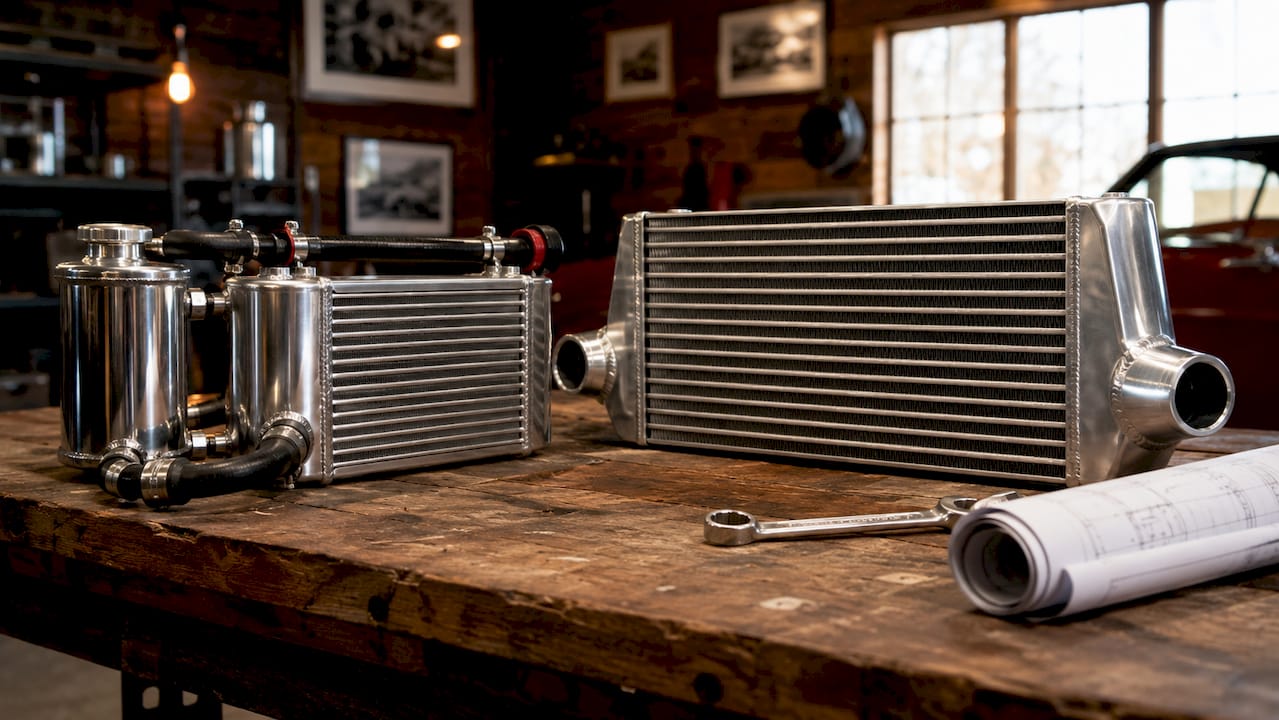
The two fundamental aftermarket intercooler options are air-to-air and air-to-water systems. Air-to-air units pass hot compressed air through a core cooled by ambient airflow, while air-to-water units circulate liquid coolant through the core to absorb heat. Both types then break down further by core construction: bar-and-plate or tube-and-fin. Your choice between these four variables determines how well your system handles heat under your specific driving conditions.
2. Air-to-air intercoolers: how they work and when to use them
Air-to-air intercoolers are the most common choice for street and track builds because they excel in reliability and simplicity, requiring no pumps, no coolant reservoir, and no extra plumbing. Ambient air passes over the core fins and pulls heat out of the compressed charge air moving through the tubes inside. The result is a system with almost no maintenance overhead and a straightforward installation path.
Mounting location matters a lot with air-to-air units. Front-mount intercoolers (FMICs) sit ahead of the radiator and get the best airflow at speed, making them the go-to for road racing, drag-and-drive events, and diesel towing. Top-mount intercoolers sit directly above the engine and reduce charge pipe volume, which improves throttle response. However, top-mount placement risks heat soak from radiated engine heat when the car sits still.
Advantages of air-to-air:
- No moving parts or secondary fluid circuits
- Lower upfront cost and easier installation
- Excellent for steady-speed applications like highway pulls and road courses
- Works well with good front ducting on street performance builds
Disadvantages of air-to-air:
- Cooling drops in stop-and-go traffic or high ambient temperatures
- Longer charge pipes on front-mount setups add lag and volume
- Heat soak builds quickly when airflow stops between runs
Pro Tip: If you run a front-mount air-to-air setup, pair it with a dedicated intercooler spray kit or a programmable cooling fan. A programmable fan controller keeps airflow moving across the core even at idle, which directly reduces heat soak between pulls.
3. Air-to-water intercoolers: when complexity pays off
Air-to-water intercoolers, also called water-to-air intercoolers in industry terminology, use a liquid coolant circuit to transfer heat away from the compressed charge air. The core sits in the intake path, and coolant circulates through it continuously, carrying heat to a separate heat exchanger or ice reservoir. This design provides thermal buffering and packaging flexibility that air-to-air systems cannot match.
The biggest practical advantage is consistency. Water-to-air systems maintain cooling regardless of vehicle speed because the coolant circuit keeps working whether the car is moving or sitting in the staging lanes. That makes them the preferred choice for drag racing, where repeated back-to-back runs demand repeatable charge temperatures. Mid-engine cars and builds with crowded engine bays also benefit because the core can be placed directly in the intake manifold, cutting charge pipe length to nearly zero.
Advantages of air-to-water:
- Consistent cooling across varied driving conditions and speeds
- Compact core placement close to the engine reduces piping volume
- Thermal buffering handles repeated runs without significant heat soak
- Compatible with ice water for maximum charge cooling at the strip
Disadvantages of air-to-water:
- Higher cost due to pump, reservoir, and secondary heat exchanger
- More plumbing means more potential leak points
- Requires periodic maintenance of the coolant circuit
Pro Tip: For drag racing applications, run a dedicated ice chest reservoir in the coolant circuit. Dropping coolant temperature to near freezing between runs gives you consistent charge air temps on every pass, which makes tuning far more predictable.
4. Bar-and-plate vs. tube-and-fin: which core fits your build?
The core construction of an intercooler determines its durability, weight, pressure drop, and thermal efficiency. These two designs appear across both air-to-air and air-to-water intercooler types, so understanding them is part of any serious buying guide for intercoolers.
Bar-and-plate cores are widely favored for durability and abuse tolerance. They are built from stacked layers of flat bars and corrugated plates brazed together, creating a dense, strong structure. That construction handles repeated high-boost pulls, stone impacts, and track abuse without deforming. The trade-off is weight. Bar-and-plate cores are heavier than tube-and-fin units of the same size, which matters for weight-sensitive builds.
Tube-and-fin cores are typically lighter and can offer lower pressure drop, but thermal efficiency varies widely depending on manufacturing quality. A well-engineered tube-and-fin core from a reputable supplier performs well, but budget units often sacrifice fin density and wall thickness to cut costs. Many experienced tuners prefer bar-and-plate for stability after multiple pulls precisely because quality control is more consistent across the market.
| Feature | Bar-and-plate | Tube-and-fin |
|---|---|---|
| Weight | Heavier | Lighter |
| Durability | High, handles abuse well | Moderate, varies by quality |
| Thermal efficiency | Consistent and strong | Variable, quality-dependent |
| Pressure drop | Slightly higher | Potentially lower |
| Best use | Street, drift, track abuse | Weight-sensitive builds, OEM-style replacement |
| Cost | Moderate to high | Budget to moderate |
One factor that gets overlooked in both core types is end tank design. Poor end tanks cause large performance differences between intercoolers with identical core dimensions. Sharp internal transitions, weak welds, and lazy shaping restrict airflow before it even reaches the core. Two intercoolers with the same bar-and-plate core can perform very differently if one has a well-engineered end tank and the other does not.
5. How to choose the right intercooler type for your vehicle
Matching the intercooler type to your driving conditions is the single most important decision in this buying guide for intercoolers. The best intercooler type is dictated by matching heat rejection to driving duty, with air-to-air excelling under steady airflow and water-to-air allowing repeatable runs and tight packaging.
Start with your vehicle layout. A car with a long front section and good front airflow is a natural candidate for a front-mount air-to-air setup. A mid-engine build or a car with a cramped engine bay points toward air-to-water, where the compact core can sit directly in the intake path. Proper sizing according to realistic power targets is equally critical. Oversizing an intercooler adds unnecessary volume and slows throttle response. Undersizing it causes heat soak under sustained load.
Key selection criteria:
- Driving style: Street and road course builds favor air-to-air for simplicity. Drag racing and repeated-run scenarios favor air-to-water for thermal consistency.
- Engine bay space: Tight bays with limited front airflow favor air-to-water. Open bays with clear front ducting favor air-to-air.
- Power target: Size the core to your realistic peak power, not a theoretical future number. Oversized cores hurt response.
- Budget: Air-to-air systems cost less upfront. Air-to-water systems cost more but deliver better consistency in demanding applications.
- Maintenance tolerance: If you want a set-it-and-forget-it system, air-to-air wins. If you are willing to maintain a coolant circuit for better performance, air-to-water is worth it.
Pro Tip: After any intercooler upgrade, log intake air temperatures across multiple pulls using a wideband data logger or your ECU’s data stream. Charge temps that climb steadily between runs signal heat soak, which means your core is undersized or your airflow path needs improvement.
6. Side-by-side comparison of intercooler types and core designs
Choosing between high-performance intercoolers comes down to understanding four variables: cooling method, core construction, packaging, and maintenance. This summary comparison covers the most common combinations you will encounter when shopping aftermarket intercooler options.
| Category | Air-to-air | Air-to-water |
|---|---|---|
| Cooling consistency | Speed-dependent | Consistent at all speeds |
| Complexity | Low | High |
| Maintenance | Minimal | Coolant circuit upkeep |
| Packaging | Needs front airflow path | Flexible, fits tight bays |
| Best application | Street, road course, diesel | Drag racing, mid-engine, repeated runs |
| Cost | Lower | Higher |
Beyond the cooling method, core construction and end tank quality impact efficiency as much as core style itself. A bar-and-plate core with a well-designed end tank outperforms a tube-and-fin core with a poorly shaped one, even if the tube-and-fin unit has lower pressure drop on paper. When evaluating repeated pulls for thermal stability, water-to-air systems hold a clear advantage over air-to-air units that risk heat soak when airflow stops.
Lesser-known but important considerations include weld quality at the core-to-end-tank joint, internal baffling inside end tanks, and whether the core fin density matches your airflow volume. Budget intercoolers often cut corners on all three. Spending more on a verified unit from a reputable supplier pays back in consistent charge temperatures and longer service life.
Key takeaways
The most effective aftermarket intercooler choice combines the right cooling method, a quality core construction, and sizing matched to your actual power target and driving conditions.
| Point | Details |
|---|---|
| Match type to duty | Air-to-air suits steady airflow; air-to-water suits repeated runs and tight packaging. |
| Core construction matters | Bar-and-plate offers durability; tube-and-fin saves weight but varies in quality. |
| End tanks are critical | Poor end tank design reduces efficiency as much as a mismatched core size. |
| Size to realistic power | Oversized cores hurt throttle response; undersized cores cause heat soak under load. |
| Monitor after install | Log intake air temperatures across pulls to confirm your upgrade is working as expected. |
What I have learned after years of intercooler installs
The conversation around intercooler types almost always focuses on air-to-air versus air-to-water, and that debate matters. But in my experience, the builds that underperform after an intercooler upgrade almost never chose the wrong type. They chose the wrong size, or they ignored end tank quality, or they ran charge pipes that were too long and too full of unnecessary bends.
I have seen bar-and-plate front-mount setups on street cars that worked perfectly for years with zero issues. I have also seen the same setup on a drag car that heat-soaked on the second pass because nobody thought about what happens when the car sits in the staging lanes for 20 minutes. That is a duty-cycle problem, not a core-type problem.
My honest recommendation is this: buy from a supplier with published efficiency data, not just marketing claims. Verify that the end tanks are properly shaped and welded. Size the core to the power you are actually running today, not the power you might run in two years. And after the install, log your intake temps. The data will tell you everything the spec sheet cannot.
If you are building a daily driver with a moderate power bump, a quality front-mount air-to-air unit with a bar-and-plate core is the right call. If you are chasing consistent quarter-mile times or building a mid-engine car, air-to-water is worth every dollar of added complexity. The intercooler type is the starting point. The details are where the performance actually lives.
— Ozkonic Kustomz
Upgrade your build with parts from Ozkonickustomz
Getting the right intercooler type is only part of the equation. Reliable mounting hardware and quality components make the difference between an install that holds up and one that fails under boost.
Ozkonickustomz carries a range of performance automotive hardware suited for intercooler builds and related upgrades, from solenoids to mounting components. Whether you are finalizing a front-mount install or wiring up a cooling fan circuit, the right hardware keeps your system running clean. Check out the 50lb solenoid with bracket for reliable actuation in your build, and browse the full catalog for parts that match your performance goals.
FAQ
What are the two main types of aftermarket intercoolers?
The two main types are air-to-air and air-to-water intercoolers. Air-to-air units use ambient airflow to cool the charge, while air-to-water units circulate liquid coolant through the core for consistent thermal performance.
Which intercooler core design is more durable?
Bar-and-plate cores are more durable than tube-and-fin designs and handle repeated high-boost pulls and track abuse better. They are heavier but offer more consistent thermal performance across demanding conditions.
When should I choose air-to-water over air-to-air?
Choose air-to-water when your build involves repeated runs, a tight engine bay, or limited front airflow. Water-to-air systems maintain consistent cooling regardless of vehicle speed, making them ideal for drag racing and mid-engine layouts.
Does end tank design really affect intercooler performance?
Yes. End tank design significantly impacts efficiency, and poor internal shaping can reduce airflow and cooling performance even in a correctly sized core. Always verify end tank quality before purchasing.
How do I know if my intercooler is heat-soaking?
Log your intake air temperatures across multiple consecutive pulls using your ECU data stream or a standalone data logger. Charge temperatures that climb steadily between runs confirm heat soak, which points to an undersized core or inadequate airflow to the intercooler.