
Engine internals upgrades are defined as the replacement of factory engine components with stronger, performance-oriented parts to increase power output and long-term durability. The most critical engine internals upgrade examples include forged pistons, upgraded connecting rods, performance camshafts, and ARP head studs. These are not bolt-on modifications. They require machining, precise assembly, and a system-level approach to deliver reliable gains. Builders targeting 350+ wheel horsepower (WHP) consistently find that factory cast components become the first point of failure, making internal upgrades the true foundation of any serious performance build.
1. Engine internals upgrade examples: forged pistons and connecting rods
Forged pistons are the single most common starting point for performance engine builds. Factory cast pistons, like those found in the Subaru EJ257, limit reliable power to about 350 WHP before their ringlands crack under detonation or boost pressure. Forged pistons use a high-pressure manufacturing process that produces a denser grain structure, making them up to 40% stronger than cast equivalents. That strength allows forged pistons to support over 600 horsepower reliably in properly built engines.
Connecting rods carry the load between the piston and crankshaft on every combustion event. Quality billet connecting rods undergo multi-stage heat treatment and are machined to tolerances as tight as 0.0002 inches to prevent failure under track conditions. That level of precision is what separates a reliable high-output engine from one that grenades at the worst possible moment.
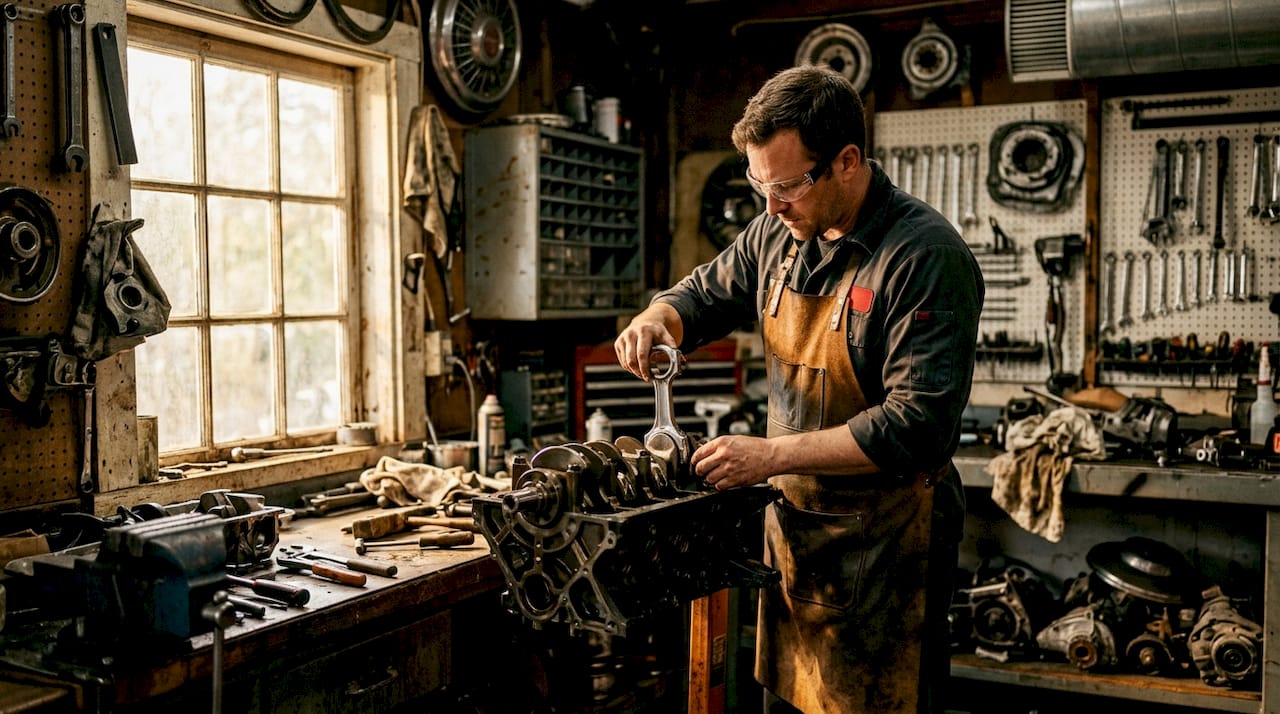
One technical detail builders often overlook is piston-to-wall clearance. Forged pistons expand more at operating temperature than cast units, so the bore must be machined to a wider clearance spec. Get this wrong and you risk piston seizure. Get it right and the engine runs cleanly across a wide temperature range.
Key considerations for this upgrade:
- Power threshold: Plan for forged pistons and rods at 350–400 WHP and above.
- Alloy choice: 4032 alloy pistons suit daily drivers; 2618 alloy handles extreme heat and boost better.
- Supporting work: Cylinder boring, honing, and professional assembly are required, not optional.
- Rod bolts: Always replace rod bolts with ARP fasteners when installing new rods.
Pro Tip: Have your machine shop check bore taper and roundness before ordering pistons. A worn bore will kill a new forged piston set faster than the old cast ones.
2. High-performance camshaft upgrades and supporting modifications
A camshaft controls when intake and exhaust valves open and close, directly shaping the engine’s power band. A Stage 2 camshaft upgrade, combined with matching valve springs and ECU tuning, can produce 40–70 horsepower gains on engines like the GM LS and Ford Windsor. That range reflects real-world shop results, not dyno sheet optimism.
The critical mistake builders make is installing a performance cam without the supporting modifications. Camshaft upgrades require valve springs and ECU recalibration to function correctly. Without stiffer valve springs, the stock units float at high RPM, causing misfires and potential valve-to-piston contact. Without ECU tuning, the engine’s fuel and ignition maps fight the new cam profile instead of working with it. You can read more about cam and ECU interaction to understand why tuning is non-negotiable.
Automatic transmission owners face an additional consideration. High-lift cams shift the power band higher in the RPM range. A stock torque converter stalls too low to keep the engine in that band, so upgrading the torque converter stall speed is necessary to maintain drivability and extract the full power gain.
Required supporting modifications for a camshaft upgrade:
- Valve springs: Match spring rate to cam lift and duration specs.
- Pushrods (OHV engines): Heavier-wall pushrods prevent flex at high RPM.
- ECU tuning: Recalibrate fuel, ignition, and idle tables for the new cam profile.
- Torque converter (automatics): Upgrade stall speed to match the cam’s power band.
- Intake and exhaust: Camshaft upgrades work best when paired with free-flowing intake and exhaust systems.
3. Head studs, gaskets, and reliability in high-output builds
Factory head bolts stretch under repeated heat cycles. In high-output builds, that stretching allows cylinder head lift, which causes head gasket failure and coolant or combustion gas intrusion. ARP head studs replace factory bolts with a fastener designed to clamp the head evenly and resist stretching under sustained high cylinder pressure. This is one of the most cost-effective reliability upgrades available for any turbocharged or high-compression engine.
The 6.0L Powerstroke diesel is the most cited example of this upgrade’s value. Bulletproofing a 6.0L Powerstroke with ARP head studs and upgraded coolers typically costs $5,000–$8,000 and supports 500–600 horsepower reliably. That cost covers not just the studs but the oil cooler and EGR cooler replacements that address the root causes of the engine’s known failure points.
| Upgrade | Factory part | Aftermarket upgrade | Primary benefit |
|---|---|---|---|
| Head fasteners | Torque-to-yield bolts | ARP head studs | Prevents head lift and gasket failure |
| Head gasket | Multi-layer steel (OEM) | Upgraded MLS gasket | Higher clamp load tolerance |
| Oil cooler | Factory unit | Upgraded external cooler | Prevents coolant contamination |
| EGR cooler | Factory unit | Upgraded or deleted unit | Eliminates coolant failure point |
Pro Tip: Always replace head studs with a fresh head gasket and resurface the deck if needed. Installing new studs on a warped deck wastes the upgrade entirely.
4. Supporting internals and systems for a balanced build
Bottom-end engine internals are the foundation for all future power and reliability. Neglecting supporting components while chasing peak horsepower numbers causes failures that no amount of tuning can prevent. The most overlooked supporting upgrades are bearings, oiling, fueling, and cooling.
Main and rod bearings wear faster under increased cylinder pressure and higher oil temperatures. Upgraded bearings with tighter tolerances and better surface coatings extend engine life significantly in performance builds. Pair them with a professional engine balance job, which removes rotational imbalance from the crankshaft, rods, and pistons as an assembly.
The oiling system is equally critical. Upgraded oil pickups and baffles prevent oil starvation during high-G cornering or hard acceleration. Oil starvation kills main and rod bearings within seconds. A windage tray and baffled oil pan keep oil at the pickup under load.
Fueling must keep pace with power. Upgraded fuel pumps and injectors are necessary above 400 WHP to maintain the correct air-fuel ratio. A lean condition at high power destroys pistons faster than any mechanical failure. For a detailed breakdown of fuel system modifications, the guide on fuel system upgrades covers injector sizing, pump selection, and return-line requirements.
Supporting upgrades to include in every serious build:
- Upgraded bearings: Tighter tolerances and better coatings for main and rod journals.
- Baffled oil pan or windage tray: Prevents oil starvation under hard driving.
- High-volume oil pump: Maintains pressure at high RPM.
- Upgraded fuel pump and injectors: Required above 400 WHP to avoid lean conditions.
- Intercooler or upgraded radiator: Keeps intake and coolant temperatures in a safe range.
5. Choosing the right upgrades for your build goals
The right internal upgrades depend on your power target, how you use the vehicle, and your budget. Not every build needs billet connecting rods and a closed-deck block. Matching parts to goals prevents overspending and avoids reliability problems from mismatched components.
For street builds targeting 400–500 WHP, forged pistons in 4032 alloy, upgraded connecting rods, and ARP head studs cover the core requirements. The 4032 alloy runs tighter piston-to-wall clearances, which reduces cold-start noise and suits daily driving. For track or drag builds above 600 WHP, 2618 alloy pistons handle the additional heat and detonation stress, and a closed-deck block conversion prevents cylinder wall distortion under extreme boost.
Billet crankshafts enter the picture above 800 WHP or in applications with extreme RPM demands. They are machined from a single piece of steel and offer superior strength compared to cast or forged cranks, but the cost is substantial. Most street performance builds never need one.
The most common mistake is building the engine in isolation. Precision and quality control in forged components differentiate reliable high-performance engines from those prone to failure. Pair your internal upgrades with matching bolt-on performance upgrades to build a system that delivers power consistently rather than just on paper.
Key Takeaways
The most reliable performance engine builds treat internal components as an integrated system, not a list of individual parts to swap in sequence.
| Point | Details |
|---|---|
| Forged pistons and rods | Required above 350–400 WHP; forged parts offer up to 40% more strength than cast equivalents. |
| Camshaft upgrades need support | Valve springs, ECU tuning, and intake/exhaust work are required to realize 40–70 HP gains. |
| Head studs prevent failure | ARP head studs replace stretch-prone factory bolts and prevent head lift in high-pressure builds. |
| Oiling and fueling must scale | Upgraded oil pickups, baffles, fuel pumps, and injectors protect internals above 400 WHP. |
| Match parts to power goals | 4032 alloy suits street builds; 2618 alloy and closed-deck blocks serve extreme power applications. |
What I’ve learned from watching builds fail from the inside out
The most expensive engine failures I’ve seen share one thing in common: the builder upgraded power before upgrading the foundation. A turbo kit goes on a stock bottom end, the tune pushes 420 WHP, and three months later the ringlands crack on a cast piston that was never designed for that load. The repair costs more than the original build.
My honest recommendation is to sequence your build correctly. Fix the internals first. Forged pistons, upgraded rods, ARP head studs, and a proper bearing set cost a fraction of a rebuild. They also let you tune aggressively without lying awake wondering if today is the day something lets go.
The other thing I’ve learned is that cheap parts in the bottom end are a false economy. A connecting rod that fails at 7,000 RPM doesn’t just break. It exits the block. The difference between a quality forged rod and a budget unit is measured in tenths of a cent per mile over the life of the engine. Spend the money once and spend it on parts with documented tolerances and heat treatment specs.
Build the engine as a system. The cam, the fuel system, the cooling, and the tune all need to match the internals. A well-matched build at 450 WHP is more reliable and more satisfying than a poorly matched build chasing 600 WHP on parts that don’t belong together.
— Ozkonic Kustomz
Quality hardware for your next engine build
Building a high-output engine means every fastener, fitting, and bracket needs to hold up under real stress. Ozkonickustomz sources directly from vetted manufacturers to give performance builders access to hardware that meets the demands of serious builds, without the risk of counterfeit parts or wrong fitments.
From modular wiring kits that keep your engine bay organized after a full internal build to fluid fittings compatible with performance engine plumbing, Ozkonickustomz carries the supporting hardware that builders need but often struggle to source reliably. Fast shipping, guaranteed fitment, and expert support make it easier to finish your build right the first time.
FAQ
What are the first engine internals to upgrade for more power?
Forged pistons and connecting rods are the first internal upgrades for any build targeting above 350–400 WHP. They replace the weakest factory components and form the foundation for all further power increases.
Do camshaft upgrades work without other modifications?
No. Camshaft upgrades require matching valve springs, ECU recalibration, and supporting intake and exhaust work to deliver power gains. Installing a cam without these modifications risks valve float and engine damage.
What does bulletproofing a diesel engine involve?
Bulletproofing a diesel engine like the 6.0L Powerstroke involves replacing factory head bolts with ARP head studs and upgrading the oil and EGR coolers. This process typically costs $5,000–$8,000 and supports 500–600 horsepower reliably.
When do I need a billet crankshaft?
A billet crankshaft becomes necessary above 800 WHP or in high-RPM applications where a cast or forged crank cannot handle the rotational stress. Most street performance builds do not require one.
What happens if I skip the fuel system upgrade on a high-power build?
Running a lean air-fuel mixture at high power destroys pistons rapidly. Upgraded fuel pumps and injectors are required above 400 WHP to maintain the correct mixture and protect the engine internals you just installed.
Recommended
- Best Examples of Bolt-On Upgrades for Car Enthusiasts – Ozkonic Kustomz LLC
- Types of Fuel System Upgrades for Performance Builds – Ozkonic Kustomz LLC
- Performance Parts for Daily Drivers: 2026 Guide – Ozkonic Kustomz LLC
- Performance Chip Explained: What It Does and What to Expect – Ozkonic Kustomz LLC
