
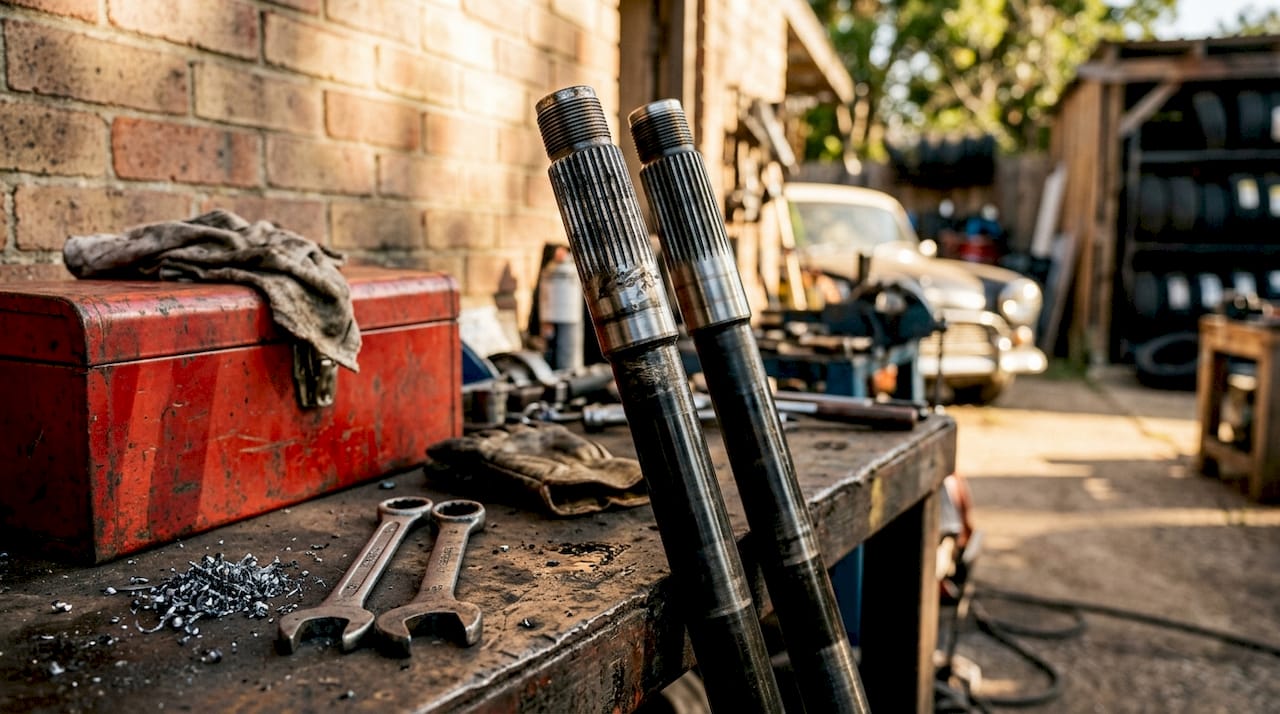
An axle shaft upgrade is defined as the process of replacing your vehicle’s factory axle shafts with stronger, higher-grade components engineered to handle greater torque, larger tires, and the punishment of off-road driving. Stock shafts are built for average use. Once you add a lift kit, run 35-inch tires, or push your engine past its factory output, those stock shafts become the weakest link in your drivetrain. The industry term for this modification is a “performance axle shaft replacement,” and understanding what separates a good upgrade from a wasted investment starts with knowing your materials, your U-joints, and your drivetrain as a whole.
What is an axle shaft upgrade, and how does it work?
An axle shaft upgrade replaces your vehicle’s original shafts with components made from stronger alloys, built to tighter tolerances, and matched to heavier-duty U-joints. The factory shafts in most trucks and SUVs are medium carbon steel. That material works fine for commuting. It does not work fine for rock crawling, towing at max capacity, or running a built motor with 150 extra horsepower.
The most common upgrade path involves switching to chromoly 4340 alloy shafts. These shafts carry a higher tensile and yield strength than OEM carbon steel, making them the right choice for aggressive off-roading and modified vehicles. The trade-off is real: chromoly alloy offers higher strength but less compliance than OEM steels, which means the ride can feel stiffer under normal conditions.
U-joint size is the other half of the equation. Older axle designs use the 297x U-joint. Modern performance upgrades often spec the larger 760x U-joint. The 760x U-joint outlasts the 297x in cyclic bench testing by a factor of 10. That number is not a marketing claim. It comes from controlled durability testing, and it reflects the real-world difference you feel after a full day on the trail.
Why chromoly steel is the preferred material for axle upgrades
Chromoly 4340 is the standard material for performance axle shafts because it combines high tensile strength with enough ductility to resist catastrophic snapping. OEM shafts use medium carbon steel, which flexes under stress and prolongs bearing life during normal driving. That compliance is a feature for daily drivers. For off-road builds, it becomes a liability.
High-quality chromoly shafts feature a hard, abrasion-resistant surface with a ductile core. The surface resists wear. The core absorbs shock without fracturing. Not every manufacturer achieves this balance equally, which is why sourcing from vetted suppliers matters as much as choosing the right alloy.
Manufacturing process separates good chromoly shafts from great ones. Cold roll forming rearranges metal grain structure to produce consistent hardness across every spline tooth. Cut or extruded splines cannot match that uniformity. Induction hardening adds another layer of surface toughness without making the shaft brittle through its full cross-section.
Key material properties to evaluate when choosing an upgrade shaft:
- Tensile strength: Chromoly 4340 significantly exceeds medium carbon OEM steel, handling higher peak loads before deformation.
- Yield strength: The point at which the shaft permanently bends. Higher yield strength means more abuse before damage.
- Surface hardness: Achieved through induction hardening. Resists spline wear and corrosion.
- Core ductility: Prevents the shaft from snapping clean under sudden shock loads, like a wheel dropping into a hole at speed.
- Spline manufacturing method: Cold roll forming produces the most uniform and fatigue-resistant spline teeth.
Pro Tip: Ask your supplier specifically whether splines are cold roll formed or cut. Cut splines are cheaper to produce but wear faster under cyclic loading. This single detail can determine how long your upgrade actually lasts.
When should you upgrade your axle shafts?
Axle shaft upgrades are not for every vehicle. They are for vehicles that have outgrown their factory drivetrain. The clearest signals that an upgrade is justified:
- Tire size increase beyond two sizes over stock. Larger tires create more leverage on the axle shaft with every rotation. A Dana 44 shaft that handled 31-inch tires reliably will see dramatically higher stress loads under 37-inch tires.
- Significant horsepower gains. Engine builds, superchargers, and turbo kits push more torque through the drivetrain. Stock shafts were not designed for that output.
- Lift kits and altered suspension geometry. A suspension lift changes the operating angle of your U-joints. Steeper angles increase stress on both the joint and the shaft, especially during articulation.
- Extreme off-road use. Rock crawling, mud bogging, and high-speed desert running all subject axle shafts to shock loads that exceed what normal driving produces.
- A previously broken shaft. One failure is a warning. The second failure will happen faster because the surrounding components absorbed stress during the first break.
- High-mileage vehicles with worn drivetrain components. Worn shafts on high-mileage performance builds benefit from a full drivetrain refresh rather than a single part swap.
The decision is not just about strength. It is about matching your drivetrain to the demands you actually place on it. Upgrading axle shafts on a stock daily driver with no modifications is unnecessary. Upgrading them on a built truck with 40-inch tires is not optional.
Compatibility and installation: what gets overlooked
Stronger shafts do not exist in isolation. Upgrading axle shafts without matching drivetrain components causes stress to transfer to the next weakest point. That means your hubs, differential carrier, or ring and pinion become the new failure point. A comprehensive approach to drivetrain upgrades prevents this stress migration.
U-joint compatibility is non-negotiable. If your new shafts spec a 760x U-joint, your yokes and differential flanges must accept that size. Mixing a 760x shaft with 297x-spec yokes is not a workaround. It is a failure waiting to happen.
Installation details that directly affect upgrade longevity:
- Torque specs: Over-torquing flange bolts is one of the most common installation errors. Incorrect torque causes premature fatigue cracks that appear within the first few hundred miles.
- C-clip seating: On C-clip axle designs, the clip must seat fully in its groove. A partially seated C-clip allows the shaft to walk outward under load, destroying the bearing and seal.
- Seal condition: Always replace axle seals during an upgrade. A leaking seal contaminates the differential fluid and accelerates wear on the new shaft.
- Bearing preload: Incorrect preload on tapered roller bearings causes uneven shaft loading and shortens bearing life.
- Break-in period: Metal components settle after installation, and micro-stresses from torquing need time to normalize. Drive conservatively for the first 500 miles after installation.
Pro Tip: After installation, check your differential fluid at 500 miles. Metal particles in fresh fluid indicate a seating or preload issue that needs correction before it becomes a catastrophic failure.
What performance and durability gains can you realistically expect?
The most dramatic gain from an axle shaft upgrade comes from U-joint selection. The 760x cold-forged U-joint vastly outperformed the heat-forged 297x in controlled durability testing, with a 10x lifespan advantage under cyclic loading. That is the kind of gain that changes how you drive on the trail.
| Upgrade Element | Expected Gain | Trade-off |
|---|---|---|
| Chromoly 4340 shaft | Higher torque capacity, fracture resistance | Stiffer ride, higher cost |
| 760x U-joint | Up to 10x longer cyclic lifespan vs. 297x | Requires compatible yokes and flanges |
| Cold roll formed splines | Uniform hardness, better fatigue resistance | Not all suppliers offer this process |
| Induction hardened surface | Reduced spline wear, longer service life | Brittle if hardening depth is excessive |
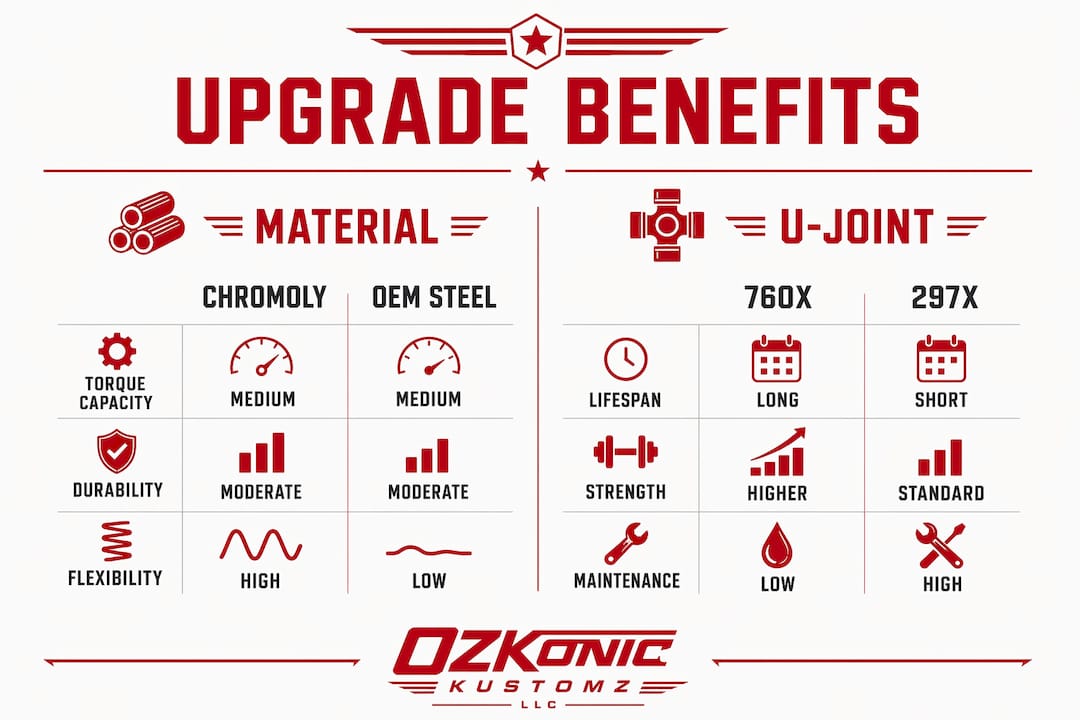
Torsional strength improves across the board with chromoly shafts. The shaft resists twisting under high torque loads, which matters most during low-speed, high-load situations like rock crawling or pulling a trailer up a grade. Fatigue resistance improves because the grain structure of properly manufactured chromoly is more uniform than cast or cut OEM steel.
The one honest trade-off is ride quality. OEM shafts flex under stress, which prolongs bearing life and softens the feel of rough terrain. Chromoly shafts transmit more vibration. On a dedicated off-road build, that is acceptable. On a truck you drive daily on pavement, it is worth factoring into your decision.
Manufacturing processes like cold roll forming and induction hardening are as important as material choice. Two shafts made from the same 4340 alloy can perform very differently depending on how they were manufactured. This is the detail most buyers miss.
Key takeaways
An axle shaft upgrade delivers real durability and torque capacity gains, but only when the right material, U-joint size, and installation practices are matched to your specific build.
| Point | Details |
|---|---|
| Material matters most | Chromoly 4340 outperforms OEM carbon steel in torque capacity and fracture resistance for modified vehicles. |
| U-joint size drives durability | The 760x U-joint lasts up to 10 times longer than the 297x under cyclic testing conditions. |
| Drivetrain balance is required | Stronger shafts shift stress to weaker components; upgrade hubs and differentials together. |
| Installation errors cause early failures | Over-torqued bolts and improperly seated C-clips cause cracks within the first few hundred miles. |
| Break-in period protects your investment | Drive conservatively for the first 500 miles and check differential fluid for metal particles. |
The misconception that costs enthusiasts the most money
Many enthusiasts treat an axle shaft upgrade as a performance boost, like adding a cold air intake or a tune. Experts stress reliability and drivetrain balance as the primary benefits, not raw speed. That distinction changes how you should budget and plan.
At Ozkonickustomz, we see this mistake regularly. A builder drops chromoly shafts into a rig with stock hubs and a worn differential, then wonders why something else breaks six months later. The shaft did its job. The rest of the drivetrain was not ready for the load it now had to handle. Upgrading axle shafts without addressing the surrounding components is like putting race tires on a car with worn suspension. You moved the weak point. You did not eliminate it.
The metallurgy differences between manufacturers are also real and underappreciated. Not every chromoly shaft is built the same way. Surface hardness depth, core ductility, and spline manufacturing method vary significantly. We have seen shafts marketed as 4340 chromoly that showed inconsistent hardness across the spline teeth, which is exactly what cold roll forming is supposed to prevent. Source from suppliers who can tell you specifically how their shafts are manufactured, not just what alloy they use.
Installation is where most upgrades succeed or fail. The break-in period is not optional. Torque specs are not suggestions. A $400 shaft ruined by a $0.50 C-clip seated incorrectly is a painful lesson that experienced builders learn once and never repeat.
— Ozkonic Kustomz
Upgrade your drivetrain with the right parts and support
Axle shaft upgrades require more than just the right shaft. They require quality hardware, proper tools, and components that meet the same standards as the shafts themselves.
Ozkonickustomz sources directly from vetted manufacturers, so every part you receive meets stringent standards for quality and fitment. Whether you need automotive-grade hardware to support your build or a professional crimper set for wiring tasks during installation, Ozkonickustomz carries the components that serious builders rely on. Fast shipping, straightforward returns, and expert support mean you spend less time waiting and more time wrenching. Visit Ozkonickustomz to find parts matched to your specific build.
FAQ
What is an axle shaft upgrade?
An axle shaft upgrade replaces factory axle shafts with stronger components, typically chromoly 4340 alloy, designed to handle higher torque, larger tires, and off-road stress that stock shafts cannot manage reliably.
How much stronger is a chromoly shaft than a stock shaft?
Chromoly 4340 alloy offers significantly higher tensile and yield strength than OEM medium carbon steel. The performance gap becomes most apparent under high torque loads and repeated stress cycles common in off-road driving.
Do I need to upgrade other parts when I upgrade my axle shafts?
Yes. Stronger shafts shift the failure point to the next weakest drivetrain component. Plan to evaluate hubs, U-joints, and differential components at the same time.
What is the difference between a 760x and a 297x U-joint?
The 760x is a larger, cold-forged U-joint that lasts up to 10 times longer than the 297x under cyclic bench testing. It requires compatible yokes and flanges, so confirm fitment before purchasing an upgrade shaft that specs this joint.
How long does an axle shaft upgrade take to install?
Installation time varies by vehicle and experience level, but most axle shaft replacements take 2–4 hours per side for a prepared builder with the correct tools. A proper break-in period of at least 500 miles follows before the upgrade is considered fully settled.