

A fuel pump upgrade is the process of replacing a factory fuel pump with a higher-flow unit capable of delivering more fuel volume at stable pressure to meet increased engine demand. Every serious performance build reaches a point where the stock pump becomes the weakest link. Whether you are running a turbo kit, larger injectors, or switching to E85, understanding why upgrade fuel pump decisions matter can save your engine and your build budget.
Why upgrade your fuel pump: the core case
An upgraded fuel pump delivers higher fuel volume safely to support larger injectors, boosted intake systems, and ethanol conversions. Without adequate flow, engines experience fuel starvation, hesitation, and poor throttle response under load. The fuel pump does not directly add horsepower. It enables every other performance modification to work correctly by ensuring the engine never runs lean.
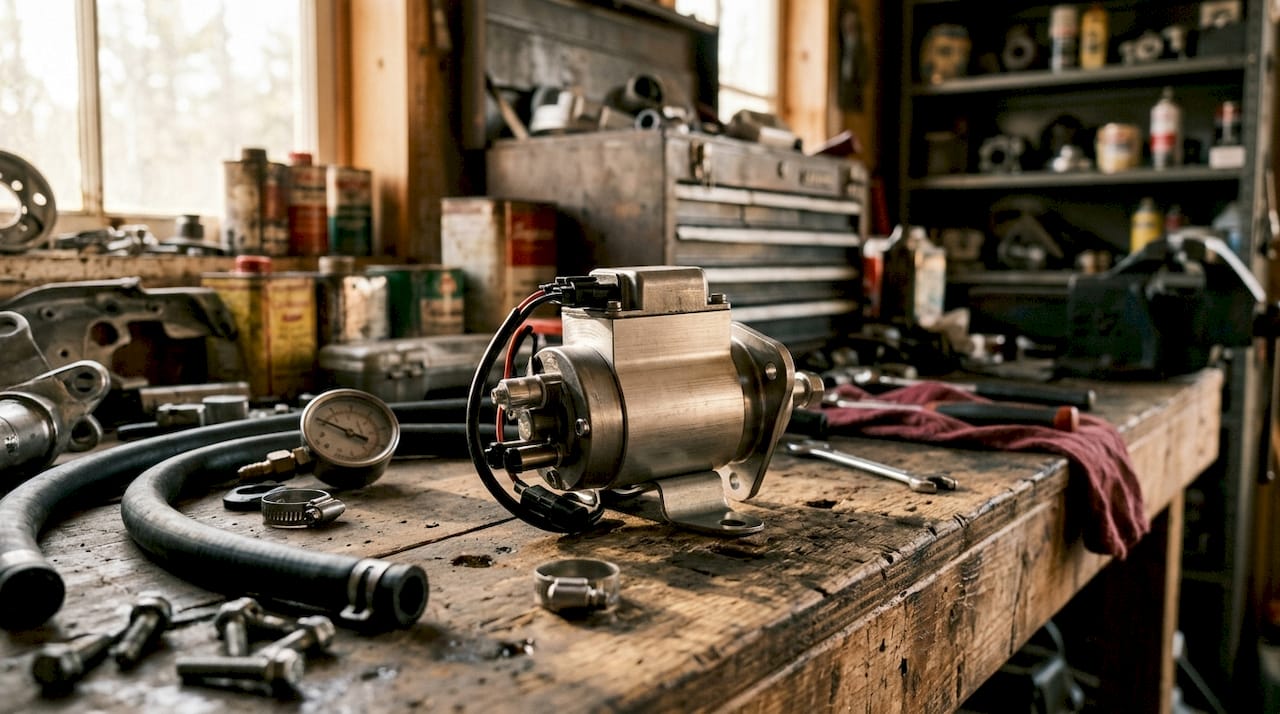
Stock pumps are engineered to meet factory fuel demand with a small safety margin. That margin disappears fast when you add a turbocharger, a supercharger, or high-flow injectors. The pump becomes a bottleneck, and a lean condition at wide-open throttle is one of the fastest ways to destroy pistons and rods.
Pro Tip: Before ordering a pump, calculate your target horsepower and fuel type. A 255 LPH pump handles most naturally aspirated builds under 400 horsepower on pump gas, while E85 builds typically require 30–40% more fuel volume for the same power level.
How do upgraded fuel pumps improve engine performance?
More air entering an engine requires proportionally more fuel. When you add forced induction or increase displacement, the fuel system must scale up to match. An upgraded pump maintains stable fuel pressure across the full RPM range, which prevents lean conditions that rob power and risk engine damage.
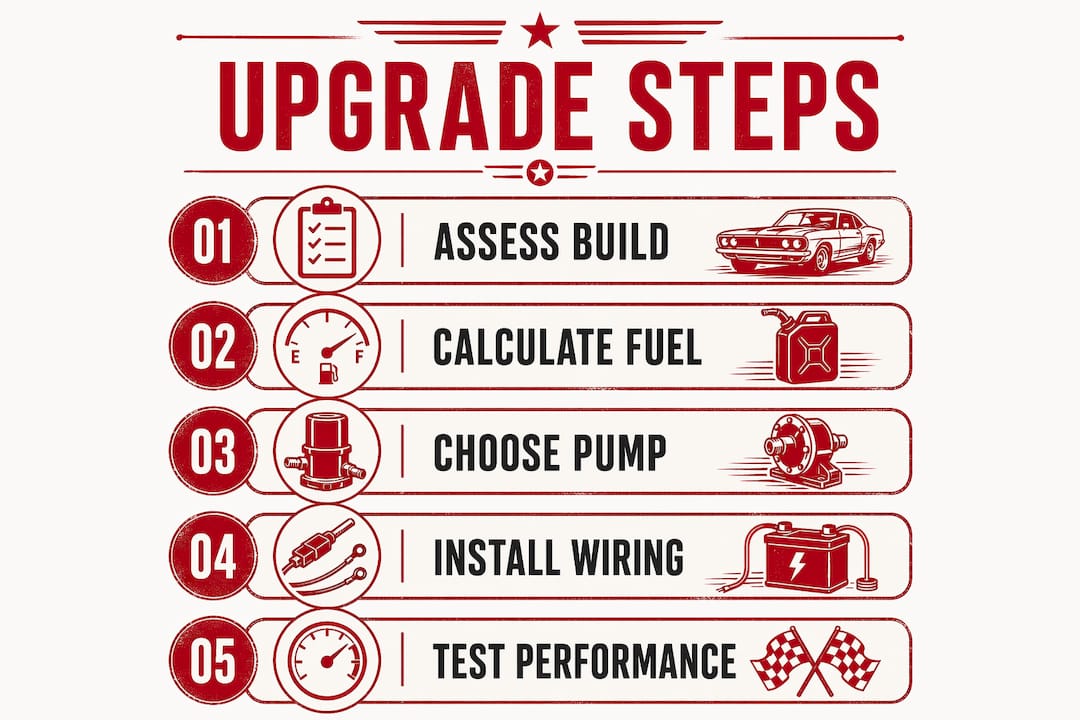
The performance gains from a pump upgrade are not measured in horsepower directly. They show up as consistent throttle response, eliminated hesitation under hard acceleration, and the ability to hold power at redline without fuel pressure dropping. Fuel pumps serve as support mods that enable other upgrades to perform at their rated capacity.
Consider a turbocharged build targeting 500 horsepower on E85. The injectors, tune, and intercooler all depend on the pump delivering enough fuel volume at the right pressure. If the pump cannot keep up, the tune pulls timing, power drops, and the engine runs hot. The pump upgrade is what makes every other component perform as designed.
Key performance benefits of a pump upgrade include:
- Stable fuel pressure under full load, preventing lean misfires
- Consistent delivery to high-flow injectors without pressure drop
- Support for E85 and other high-volume fuel types
- Elimination of hesitation and stumble during hard acceleration
- Protection of downstream components like injectors and the high-pressure fuel pump
Brushless fuel pump technology adds another layer of performance reliability. Brushless designs reduce internal heat and wear, delivering more stable pressure and quieter operation compared to traditional brush-type motors. Brushless pumps are becoming the industry standard in performance builds for exactly this reason.
When do you need to upgrade beyond factory fuel pumps?
Stock pumps become bottlenecks early in heavily modified builds. The triggers are predictable, and recognizing them before fuel starvation damages other components is the goal.
- Turbo or supercharger installation. Forced induction dramatically increases air volume entering the engine. Fuel delivery must match that increase or the engine runs lean under boost.
- High-flow injector upgrade. Larger injectors need adequate fuel supply pressure to operate at their rated flow. A stock pump cannot always maintain pressure when feeding injectors sized for 600-plus horsepower.
- E85 conversion. Ethanol fuel requires significantly more volume than pump gasoline for the same power output. A pump that was adequate on 93 octane will starve the engine on E85.
- Symptoms of pump inadequacy. Hesitation on acceleration, a whining noise from the tank under load, and stalling at high RPM all signal that the pump is struggling. Fuel pressure testing is the most reliable diagnostic to confirm pump issues before replacement, and loaner testing tools are often available at no cost.
- Protecting other components. Fuel starvation does not just hurt performance. On diesel platforms, for example, an upgraded lift pump for the Cummins 6.7L prevents cavitation and high-pressure fuel pump failure, with replacement costs under $1,000 compared to a failed HPFP repair that can run several times that amount.
The rule is simple: upgrade the pump before symptoms appear, not after. Fuel starvation at wide-open throttle is a parts-destroying event.
What electrical and fitment factors affect a pump upgrade?
Electrical preparation is where most DIY pump upgrades fail. Higher-flow pumps draw significantly more current than stock units. Running that current through factory wiring causes voltage drops that reduce pump speed and flow, negating the upgrade entirely.
Dedicated relay wiring kits are critical for high-flow fuel pumps. A relay kit pulls power directly from the battery, bypassing the factory harness and delivering full voltage to the pump. Without proper wiring, an upgraded pump may underperform despite its advertised flow rating. Wiring damage from excessive current draw is also a real risk.
Pro Tip: Install a dedicated fuel pump relay and use wire gauge rated for the pump’s current draw. Most high-flow pumps require 10-gauge wire minimum. Undersized wire creates resistance, heat, and eventual failure.
Fitment is the second major consideration. In-tank pumps use a hanger assembly that varies by vehicle. Lock rings, connector types, and hanger dimensions differ across makes and models. Proper preparation before installation reduces installation issues and prevents returns. Check the fuel tank condition while the pump is out, since debris or rust in the tank will destroy a new pump quickly.
External inline pumps offer more flexibility for custom builds but require additional plumbing, mounting, and heat management. Pump placement matters because heat is the enemy of fuel pump longevity. Mounting an external pump near exhaust components accelerates wear and increases vapor lock risk.
Oversizing a fuel pump creates its own problems. Excess fuel recirculates through the system, heating the fuel in the tank and engine bay. That heated fuel causes vapor lock and drivability issues, particularly in street-driven cars that spend time idling in traffic. Bigger is not always better.
How do you maintain fuel pump reliability after upgrading?
A quality pump upgrade is only as good as the habits that follow it. Reliability depends on fuel quality, tank management, and filter maintenance.
- Keep the tank above half full. Running the tank low causes the pump to overheat because fuel acts as a coolant for in-tank units. Low fuel also increases debris intake from tank sediment.
- Use clean, quality fuel. Contaminated fuel clogs the pump inlet filter and forces the motor to work harder, accelerating wear. Ethanol blends attract water, so storage vehicles need fuel stabilizer.
- Replace the fuel filter on schedule. A clogged filter restricts flow and forces the pump to work against increased resistance. This shortens pump life and reduces delivery pressure.
- Inspect the pre-filter sock at installation. The strainer on the pump inlet catches large debris. If the old pump failed from contamination, the tank needs cleaning before the new pump goes in.
- Monitor fuel pressure regularly. A pressure gauge or data log from your ECU tuning software shows pump health trends before a failure becomes a roadside event.
These habits apply to high-mileage performance vehicles just as much as fresh builds. Consistent maintenance protects the investment in a quality pump upgrade.
How do you match a fuel pump upgrade to your build and goals?
Selecting the right pump starts with two numbers: your horsepower target and your fuel type. Every other decision flows from those two inputs.
- Define your power target. A street build at 350 horsepower on pump gas has very different pump requirements than a race build at 800 horsepower on E85. Size the pump for your actual goal, not your aspirational ceiling.
- Match your fuel system type. Return-style fuel systems and returnless systems handle excess fuel differently. A pump sized for a return system in a returnless application will cause pressure regulation problems. Confirm your system type before selecting a pump.
- Avoid oversizing for street use. A pump rated for 1,000-plus horsepower in a 400-horsepower street car recirculates excess fuel constantly, heating the tank and degrading drivability. Right-sized pumps improve reliability and fuel economy on the street.
- Plan supporting modifications together. A pump upgrade without a matching fuel pressure regulator, updated fuel filter, and proper wiring is an incomplete system. The fuel system upgrade works as a whole, not as isolated parts.
- Account for tuning. Any significant fuel system change requires a tune adjustment. The ECU must know the new fuel delivery parameters to set correct injector pulse width and timing. An untuned pump upgrade can cause rich conditions and fouled plugs.
The decision between OEM replacement and aftermarket upgrade depends entirely on your build goals. A stock replacement suits a daily driver with no modifications. A performance build needs a pump matched to its actual fuel demand.
Key Takeaways
A fuel pump upgrade is a support modification that enables every other performance part to work at full capacity by delivering the correct fuel volume at stable pressure.
| Point | Details |
|---|---|
| Pumps enable other mods | Upgraded pumps support injectors, turbos, and E85 conversions by preventing fuel starvation. |
| Electrical prep is critical | Dedicated relay wiring kits prevent voltage drops that cause upgraded pumps to underperform. |
| Right-sizing beats oversizing | Pumps too large for the build cause fuel overheating, vapor lock, and poor drivability. |
| Maintenance protects the investment | Keeping the tank above half full and replacing filters on schedule extends pump life significantly. |
| Match pump to build goals | Horsepower target and fuel type determine the correct pump; system type determines compatibility. |
What I’ve learned from watching pump upgrades go wrong
Most pump upgrade failures are not pump failures. They are electrical failures or fitment failures that get blamed on the pump. I have seen builders spend money on a quality high-flow unit and then run it through the factory wiring harness, wonder why it underperforms, and return the pump. The pump was fine. The wiring was the problem.
The second most common mistake is buying the biggest pump available because it feels like more headroom. On a street car, that logic backfires. Fuel overheating from constant recirculation is a real problem, and it creates symptoms that are genuinely hard to diagnose if you do not know what you are looking for.
The builds that go smoothly are the ones where the builder treats the fuel system as a complete system. Pump, regulator, filter, wiring, and tune all get addressed together. Skipping any one of those steps creates a weak point that shows up at the worst possible moment, usually at full throttle on a hot day.
My honest advice: start with your power target, work backward to the pump specification, and then budget for the wiring and tuning before you order the pump. The pump is often the cheapest part of a proper fuel system upgrade. The supporting work is where the real cost and the real reliability live.
— Ozkonic Kustomz
Fuel pump upgrades done right with Ozkonickustomz
Ozkonickustomz stocks the wiring components that make pump upgrades work correctly, not just the pumps themselves.
The American Autowire modular wiring kit is built for truck-mount applications and delivers clean, dedicated power routing for high-flow fuel pump installations. Pair it with a quality relay kit and you eliminate the voltage drop problems that cause most upgraded pumps to underperform. Ozkonickustomz sources directly from vetted manufacturers, so every part arrives with guaranteed fitment and compatibility. Fast shipping, straightforward returns, and real support from people who build are part of every order. Check the full catalog at Ozkonickustomz and get your fuel system right the first time.
FAQ
Why upgrade a fuel pump instead of just replacing it?
A stock replacement restores factory performance. An upgrade increases flow capacity to support aftermarket modifications like turbos, larger injectors, or E85 conversions that exceed factory fuel demand.
What symptoms indicate a fuel pump needs upgrading?
Hesitation under hard acceleration, a whining noise from the fuel tank, and stalling at high RPM all signal that the pump cannot meet fuel demand. Fuel pressure testing confirms the diagnosis before replacement.
Do I need new wiring when upgrading a fuel pump?
Yes. High-flow pumps draw more current than factory wiring handles safely. A dedicated relay wiring kit prevents voltage drops that cause upgraded pumps to underperform and protects the harness from heat damage.
Can a fuel pump upgrade hurt drivability on a street car?
Oversizing a pump for a street build causes excess fuel to recirculate and heat up, creating vapor lock and rough idle. Matching pump flow to your actual horsepower target prevents these issues.
Does a fuel pump upgrade require a tune?
Any significant change to fuel delivery requires a tune adjustment. The ECU must be calibrated to the new fuel system parameters to maintain correct air-fuel ratio and prevent rich or lean conditions.