
The fastest way to find a verified veteran owned auto parts business is to run a VetCert search through the SBA, then cross-check the result on SAM.gov. Both databases are free, public, and updated regularly. Here is what to do right now:
- Look first at SBA VetCert. Search by NAICS code 441310 (auto parts stores) or 423120 (motor vehicle supplies and new parts). Certified businesses carry VOSB or SDVOSB status, which means 51% veteran ownership and proof of daily operational control.
- Verify on SAM.gov. Pull the business’s SAM entity record and confirm the registration is active, the NAICS codes match auto parts, and the veteran-owned flag is checked.
- Contact the seller directly. Ask for their VetCert certificate number or SAM entity ID. A legitimate business will share both without hesitation.
Table of Contents
- Where to find veteran-owned auto parts businesses in the U.S.
- How to verify a seller is genuinely veteran-owned
- What to check before buying auto parts from a veteran-owned seller
- Tax breaks, state programs, and what certification actually does
- What trustworthy veteran-owned auto parts suppliers look like
- How to support veteran-owned auto parts sellers when you shop
- Key Takeaways
- Why the “veteran-owned” label deserves more scrutiny than it gets
- Parts with guaranteed fitment, no guesswork required
- Authoritative sources and next steps
Where to find veteran-owned auto parts businesses in the U.S.
These are the most reliable national and state resources for locating military veteran auto parts sellers, ranked by how much verification they actually provide.
- SBA VetCert database — the gold standard. Certified Veteran-Owned Small Businesses (VOSBs) and Service-Disabled Veteran-Owned Small Businesses (SDVOSBs) are listed here after rigorous ownership review. Search by state, NAICS code, or keyword.
- SAM.gov — every business that holds a federal contract or VetCert registration must maintain an active SAM.gov profile. The profile shows NAICS codes, business size, and veteran-owned status flags.
- SBA Veterans Business Outreach Centers (VBOCs) — VBOCs offer free workshops, mentorship, and local referrals. If you need help finding a certified auto parts seller in your region, a VBOC counselor can point you to local certified firms.
- State veteran business directories — Texas, Virginia, California, and several other states maintain their own veteran business registries, often tied to procurement programs. Search “[your state] veteran business directory” alongside the state’s department of veterans affairs website.
- Nonprofit and industry directories — organizations like the National Veteran-Owned Business Association (NaVOBA) and HireVeterans.com maintain searchable directories that tag veteran ownership, including some auto parts and accessories sellers.
Pro Tip: When browsing any directory, filter by NAICS code before you filter by state. Auto parts retail (441310) and wholesale motor vehicle supplies (423120) are the two codes most relevant to parts sellers. Starting with the code narrows a national list to a workable shortlist fast.
How to verify a seller is genuinely veteran-owned
Not every business that calls itself veteran-owned has the paperwork to back it up. Here is a practical, ordered process.
-
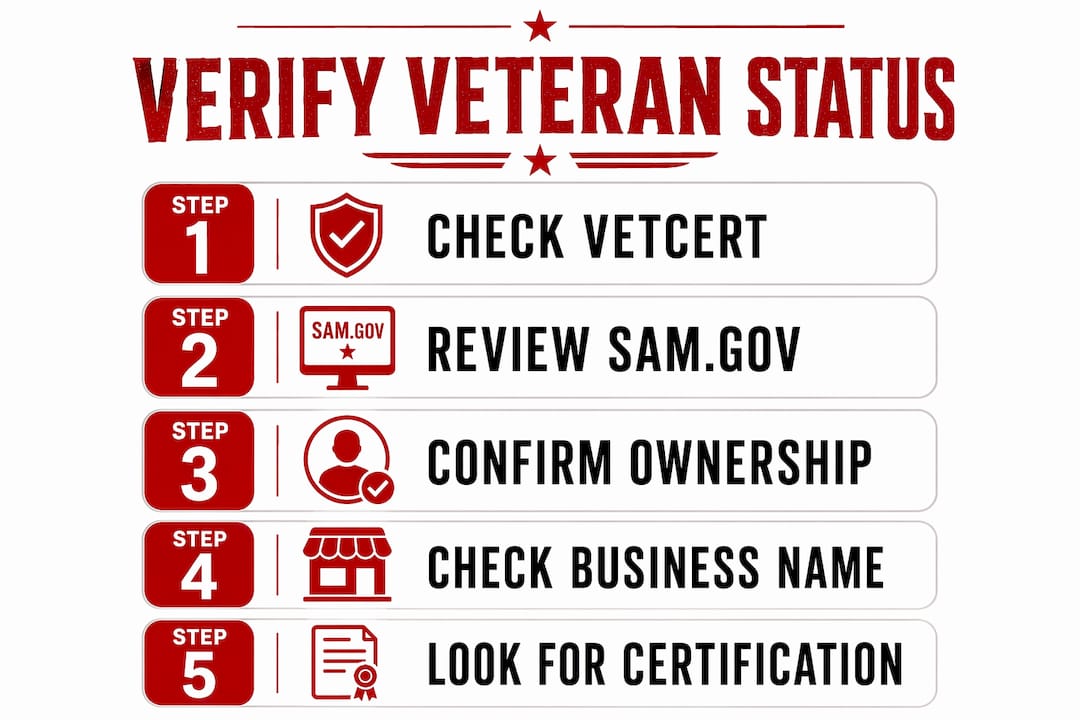
Check VetCert status. Go to veterans.certify.sba.gov and search the business name or DUNS/UEI number. A certified firm will show an active VOSB or SDVOSB designation. SBA VetCert requires proof of ownership and active control, not just a self-declaration, so a listing here carries real weight.
-
Pull the SAM.gov entity record. Search sam.gov by the business’s legal name or UEI. Confirm the registration is current (not expired), the veteran-owned checkbox is marked, and the listed NAICS codes include auto parts. An expired SAM record is a yellow flag.
-
Ask the seller for documentation. Request the VetCert certificate number, the SAM entity page screenshot, and, if you want to go deeper, the business’s operating agreement or corporate bylaws showing veteran ownership percentage. SBA VetCert reviews corporate bylaws, meeting minutes, and payroll records during certification, so a legitimate business will have these on file.
-
Cross-check basic trust signals. Confirm a working phone number, a physical business address, a clear returns policy, and sourcing transparency (OEM or named manufacturer). These do not prove veteran ownership, but their absence alongside evasive answers about certification is a red flag.
Red flags to watch for: no VetCert or SAM record when you ask, inconsistent business names across platforms, a seller who claims veteran-owned status but cannot produce a certificate number, and a website with no physical address or contact phone.
Pro Tip: Federal contracting certification and a consumer-facing “veteran-owned” label are different things. A business can be certified for federal set-aside contracts without advertising to retail buyers, and a business can advertise veteran ownership without any certification. Always ask which applies.

What to check before buying auto parts from a veteran-owned seller
Smaller veteran-owned sellers often run lean operations. That is not a problem, but it does mean you need to do a bit more homework before you order.
Fitment and part numbers. Confirm the part number against your vehicle’s year, make, model, and engine trim. Ask the seller directly if you are unsure. Guaranteed fitment policies, where the seller takes responsibility if a part does not fit, are a strong trust signal. Our guide on buying performance parts online walks through how to match part numbers correctly.
- Authenticity: Ask whether parts are sourced from OEM manufacturers or named aftermarket brands. Request an invoice or sourcing document if the price seems unusually low. Counterfeit auto parts are a real problem in online retail; knowing how to spot fakes before you buy saves a costly return.
- Returns and restocking fees: Read the return policy before checkout. Some small sellers charge restocking fees of 15–25% on electrical or special-order parts. Confirm whether returns require the original packaging and what the window is.
- Shipping and lead times: Two-day nationwide delivery is now the standard consumer expectation in parts retail. Small veteran-owned sellers may not always match that pace, especially on specialty or low-volume parts. Ask for an estimated ship date before you pay.
- Payment protections: Pay with a credit card or PayPal Goods and Services rather than wire transfer or Zelle. Buyer protection matters most when dealing with smaller, less-established sellers.
Tax breaks, state programs, and what certification actually does
There is no universal federal income tax break for owning a veteran-owned business. That is the single most common misconception in this space, and it is worth stating plainly.
Tax benefits are state-specific and conditional. Texas, for example, offers a five-year franchise tax exemption for qualifying new veteran-owned businesses. To claim it, the business must request a veteran verification letter from the Texas Veterans Commission and file Form 05-904 with the Texas Comptroller. Other states take different approaches: some offer hiring credits for businesses that employ veterans, others provide property tax exemptions for disabled veterans, and a few offer fee waivers on business licenses. The VA’s state-by-state breakdown is the most current reference for what each state actually provides.
| State program type | What it covers | Who qualifies |
|---|---|---|
| Texas franchise tax exemption | Time-limited exemption from state franchise tax | New veteran-owned businesses meeting state criteria |
| Hiring credits (select states) | Credits for employing veterans | Businesses hiring qualifying veteran employees |
| Property tax exemptions | Reduced or waived property taxes | Disabled veterans (personal property, varies by state) |
| Business license fee waivers | Reduced startup fees | Newly formed veteran-owned businesses (state-specific) |
VetCert and SAM.gov certification open doors to federal set-aside contracts, VA procurement programs, and surplus federal property access. For a consumer-facing auto parts seller, the practical value is credibility and visibility, not a direct tax break.
Pro Tip: A proposed federal bill (S. 2443, 119th Congress) would create a startup tax credit for veteran-owned businesses in underserved communities, but it has not been enacted. Do not plan around it until it becomes law.
What trustworthy veteran-owned auto parts suppliers look like
The strongest signal a parts seller can send is not a flag on their website. It is a combination of verifiable records and clear policies that hold up when you check them.
| Trust signal | What it shows | Where to confirm |
|---|---|---|
| Active VetCert / SAM.gov listing | Verified 51%+ veteran ownership and control | veterans.certify.sba.gov / sam.gov |
| Named OEM or brand sourcing | Parts come from identifiable manufacturers | Ask for invoice or brand documentation |
| Guaranteed fitment policy | Seller takes responsibility for compatibility | Published on product or returns page |
| Working phone and physical address | Real, reachable business | Google Maps, state business registry |
| Clear returns policy with timeframes | Buyer protection in writing | Website footer or product page |
| Realistic shipping disclosures | Honest about lead times | Product page or order confirmation |
Ozkonickustomz sources directly from vetted manufacturers, publishes guaranteed fitment standards, and maintains clear return and shipping policies. For buyers evaluating reputable aftermarket parts brands, those are the benchmarks worth measuring any seller against. You can also compare how different aftermarket marketplaces handle fulfillment and returns by reviewing vendor alternatives in the auto parts space.
How to support veteran-owned auto parts sellers when you shop
Supporting veteran entrepreneurs in the auto parts industry does not require a big purchase. Small, consistent actions add up.
- Use search filters. On SAM.gov and VetCert, filter specifically for VOSB or SDVOSB status before you browse. On general marketplaces, search “veteran-owned” alongside your part number, then verify the claim before you buy.
- Consolidate orders. Small sellers absorb shipping costs differently than large warehouses. Bundling a few parts into one order reduces their fulfillment overhead and often gets you a better deal on shipping.
- Leave specific, detailed reviews. A review that names the part, the vehicle, and the fitment outcome is far more useful to the next buyer than a five-star rating with no text. It also helps the seller’s search visibility.
- Refer them by name. If a veteran-owned seller delivers, mention them by name in forums, Facebook groups, or Discord servers where your vehicle community hangs out. Word-of-mouth referrals from enthusiast communities carry real weight for small sellers.
- Do not publicly call out unverified claims. If you suspect a seller’s veteran-owned claim is false, contact the SBA or file a concern through SAM.gov rather than posting accusations publicly. Let the verification system do its job.
Key Takeaways
Verified veteran-owned auto parts businesses are findable through SBA VetCert and SAM.gov, but buyers must check certification status, fitment policies, and sourcing transparency before placing any order.
| Point | Details |
|---|---|
| Start with VetCert and SAM.gov | Search by NAICS code 441310 or 423120 to find certified veteran-owned auto parts sellers. |
| Certification means ownership, not just a label | VetCert requires 51%+ veteran ownership and proof of daily operational control, not self-declaration. |
| No universal federal tax break | Tax benefits for veteran-owned businesses are state-specific; Texas offers a franchise tax exemption as one example. |
| Check fitment, sourcing, and returns first | Confirm part compatibility, OEM sourcing, and return policy before paying any seller, veteran-owned or not. |
| Ozkonickustomz as a verified fallback | Ozkonickustomz sources from vetted manufacturers with guaranteed fitment and clear return policies for buyers who need reliable parts fast. |
Why the “veteran-owned” label deserves more scrutiny than it gets
The label gets used loosely, and that is a problem for buyers who genuinely want to support veteran entrepreneurs. A business can put “veteran-owned” in its name, its social media bio, and its product listings without ever filing for VetCert or maintaining a SAM.gov record. That is not fraud in every case, but it is not verification either.
What actually matters is whether the veteran has operational control, not just a title. SBA VetCert examines corporate bylaws, meeting minutes, and payroll records precisely because ownership on paper and ownership in practice are not always the same thing. Buyers who skip the verification step and rely on a flag graphic are trusting marketing, not documentation.
The auto parts space has another wrinkle: many parts sellers are resellers, not manufacturers. A veteran-owned reseller is still a legitimate veteran-owned business, but buyers should still ask about sourcing. Knowing whether parts come from a named OEM supplier or an unnamed overseas distributor matters for quality, warranty, and fitment, regardless of who owns the business.
Parts with guaranteed fitment, no guesswork required
Ozkonickustomz does not claim every product in its catalog comes from a veteran-owned manufacturer. What it does guarantee is that every part is sourced directly from vetted manufacturers, meets strict fitment standards, and ships with a clear return policy behind it.
If you have searched VetCert and SAM.gov and still cannot find a verified veteran-owned auto parts seller for your specific vehicle, Ozkonickustomz is a reliable fallback. Browse the modular wiring kit for truck builds, the rear suspension kit for Chevy 4x4, or the full catalog at ozkonickustomz.com for guaranteed-compatible parts with expert support behind every order.
Authoritative sources and next steps
- SBA VetCert — search for certified VOSB and SDVOSB businesses; start here for any verification.
- SAM.gov — confirm active registration, NAICS codes, and veteran-owned status flags for any business.
- SBA Veterans Business Outreach Centers — find your regional VBOC for local referrals, certification guidance, and mentorship.
- Texas Comptroller — Veteran Franchise Tax Exemption — the clearest state-level example of how veteran business programs work in practice; use as a model for researching your own state.
- VA News — Veteran Tax Exemptions by State — the most current federal summary of state-by-state veteran tax benefits.
This article is general information, not legal or tax advice. Confirm current certification requirements and state program eligibility with the SBA, your state’s veterans affairs office, or a qualified professional for your specific situation.