
Aero performance upgrades are specialized components designed to control airflow around a vehicle, generating downforce and reducing drag to improve stability, handling, and fuel efficiency. The best examples of aero performance upgrades, including front splitters, rear diffusers, spoilers, and side skirts, produce measurable results at highway and track speeds. Aerodynamic effects become measurable above 62–75 mph, which means these parts earn their keep on real roads, not just race circuits. The industry term for this discipline is automotive aerodynamics, and understanding it separates builders who gain real performance from those who buy styling pieces.
1. What are examples of aero performance upgrades for front splitters?
Front splitters are the most direct examples of aero performance upgrades you can bolt onto a street or track car. A splitter mounts below the front bumper and creates a high-pressure zone above it and a low-pressure zone below. That pressure difference pushes the nose down, reducing front lift and sharpening steering response.
The numbers back this up. A vent front splitter with an extension plate can increase downforce by 125% and reduce drag by 1.2%. That is not a marginal gain. It is the kind of result that changes how a car feels through a fast corner.
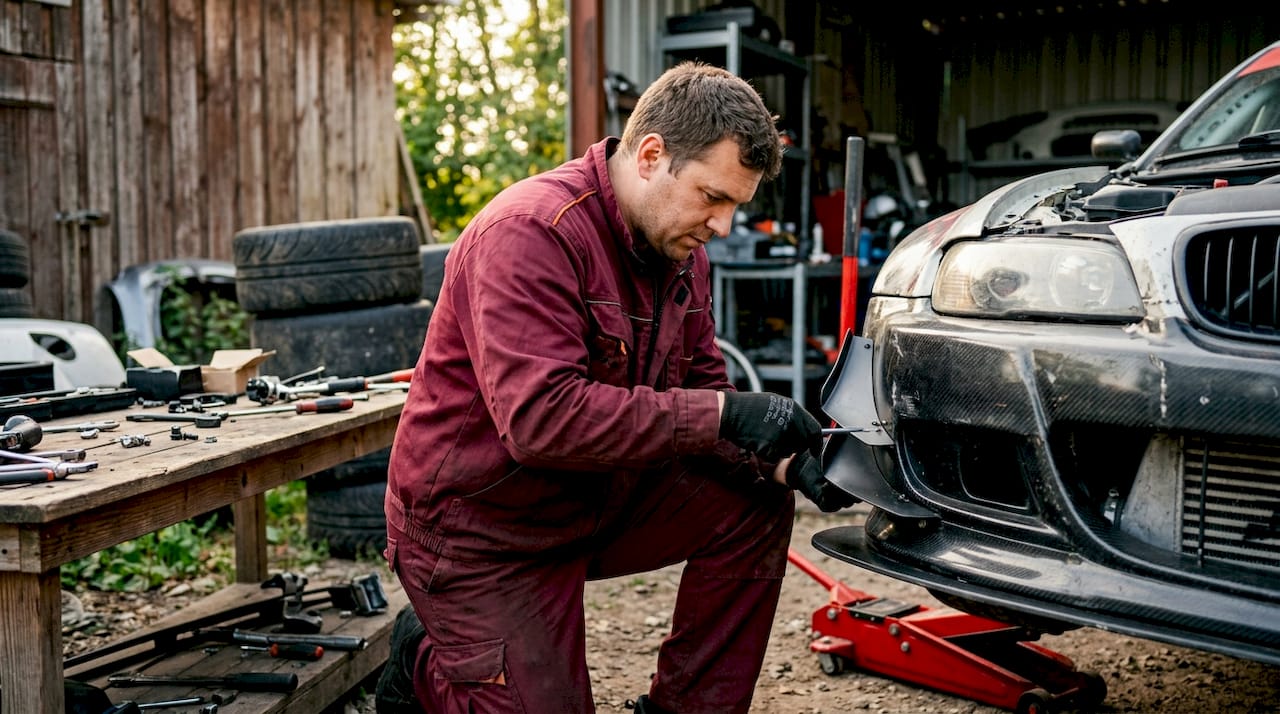
At speeds above 100 mph, a well-designed front splitter generates 30–50 lbs of front downforce, improving steering and lane stability. For street builders, splitter length and ground clearance matter as much as downforce numbers. A splitter set too low will scrape on every driveway and speed bump.
Key design factors for front splitters:
- Length: Longer splitters generate more downforce but increase scrape risk on public roads.
- Height: Air dam height affects drag sensitivity more than raw downforce output.
- Ground clearance: Street builds need at least 4–5 inches of clearance for daily use.
- Material: Carbon fiber saves weight; polyurethane absorbs impacts better on street cars.
Pro Tip: If you drive the car daily, choose a splitter with adjustable end plates. You get track-day downforce without permanently sacrificing street clearance.
2. How do rear spoilers, wings, and diffusers contribute to vehicle stability?
Rear aero components work as a system, and each piece plays a different role. Understanding those roles prevents the common mistake of bolting on a large wing and expecting balanced performance.
Rear spoilers disrupt the airflow separating off the trunk or roofline, reducing rear lift with a minimal drag penalty. A basic lip spoiler adds 20–40 lbs of downforce at 70–80 mph with a typical drag penalty of only 0.01–0.02 Cd. That makes lip spoilers one of the best aerodynamic tuning options for street-focused builds.
Rear wings generate significantly more downforce than spoilers, but they create more drag. Wings work best on dedicated track cars where the speed range justifies the drag trade-off. A large wing without matching front aero creates front axle lift, which worsens handling stability rather than improving it.
Diffusers accelerate underbody airflow to create a low-pressure zone that pulls the car downward. The catch is significant. Diffusers only work with sealed or smooth undertrays. On a car with an open, uneven underbody, an aftermarket diffuser is mostly decorative.
Combining rear components delivers the biggest gains. A package of rear spoiler, diffuser, and roof-side vortex generator reduces drag by 20% and improves fuel consumption by 10%. Reduced drag at that level also extends component service life by approximately 35,000 km. That is a real-world benefit most builders overlook when calculating the value of rear aero.
3. What role do side skirts, vents, and canards play in an aero upgrade package?
Side skirts, vents, and canards are the fine-tuning layer of an aero package. They rarely produce dramatic results on their own, but they complete the airflow picture when paired with front and rear components.
Side skirts channel air along the lower flanks of the car, preventing high-pressure air from spilling under the vehicle and disrupting underbody flow. They work best as part of a full kit. A standalone side skirt on a car with no front splitter or rear diffuser delivers minimal measurable benefit.
Vents in the hood, fenders, or front bumper manage pressure buildup and heat dissipation. Hood vents reduce the high-pressure zone that builds above the engine bay, which can improve front downforce marginally. Fender vents relieve wheel-well pressure, reducing drag around the front tires.
Canards and dive planes mount on the front bumper corners and generate small amounts of front downforce while directing airflow around the front wheels. They are most effective on dedicated track builds running at sustained high speeds. On a street car doing occasional canyon runs, their contribution is minor.
Key considerations for these components:
- Side skirts add the most value when the full kit includes a splitter and diffuser.
- Canards require precise angle adjustment. The wrong angle adds drag without meaningful downforce.
- Universal fit vents often require cutting and fitting. Poor installation creates turbulence rather than reducing it.
Pro Tip: Before adding canards or vents, photograph your car’s front end at speed using a GoPro mounted low. You can see airflow disturbances in dust and debris patterns, which tells you where pressure management is actually needed.
4. How to select the right aero upgrade category for your build
Choosing the right aerodynamic tuning options depends on your speed range, driving environment, and how the parts interact with each other. Shape optimization and advanced materials reduce aerodynamic drag by 15–25%, saving 5–12% in fuel under highway conditions. Those gains only appear when the components are matched to the chassis and driving conditions.
| Component | Primary function | Speed threshold | Best for |
|---|---|---|---|
| Front splitter | Front downforce | Above 60 mph | Street and track |
| Lip spoiler | Rear lift reduction | Above 65 mph | Street builds |
| Rear wing | High downforce | Above 80 mph | Track focused |
| Diffuser | Underbody suction | Above 70 mph | Track with sealed undertray |
| Side skirts | Airflow channeling | Above 60 mph | Full kit builds |
| Canards | Front balance tuning | Above 80 mph | Dedicated track cars |
The table shows a clear pattern. Street builders get the most value from front splitters and lip spoilers. Track builders need the full package, including a wing, diffuser, and sealed undertray, to see the gains that justify the cost and complexity.
Add-on aero parts affect flow separation, wake structure, and drag reduction based on Reynolds number, ground effect, and component interactions. That means a part that works on one chassis may underperform or create drag on another. Vehicle-specific design is not optional for serious builders.
Budget also shapes the upgrade path. Builders working with limited funds should start with a front splitter and lip spoiler, then add rear and underbody components as the budget grows. Ozkonickustomz stocks performance components sourced directly from vetted manufacturers, which removes the fitment guesswork that derails many builds. For builders looking at cost-effective performance improvements, a staged approach consistently outperforms buying a full universal kit at once.
5. How to improve aero efficiency: practical tips and common pitfalls
Improving aero efficiency requires more than buying parts. Installation quality, component integration, and realistic expectations all determine whether you gain performance or just add weight.
- Avoid universal kits. Universal wide-body aero kits often increase drag and fuel consumption by adding frontal area without smoothing airflow. Real aero gains require chassis-specific geometry and validation.
- Seal the undertray before adding a diffuser. An open underbody makes rear diffusers decorative. Foam or rubber sealing strips between body panels and the undertray cost very little and make the diffuser functional.
- Match front and rear aero. A large rear wing without front downforce creates front lift at speed. Balance is the goal, not maximum numbers on one end.
- Integrate with suspension. Lowering the ride height reduces the gap between the car and the road, which improves underbody airflow. Performance springs paired with aero upgrades produce better results than either modification alone.
- Choose materials deliberately. Carbon fiber reduces weight but costs more and cracks under impact. Polyurethane flexes and survives parking lot contact. Fiberglass sits in the middle on both cost and durability.
- Use CFD simulation or professional measurement for serious builds. CFD modeling and wind tunnel testing validate aero modifications and confirm drag reduction before you commit to fabrication or purchase.
- Test at relevant speeds. Aero parts produce no measurable benefit at 30 mph. If your driving is mostly city traffic, the return on investment is low. Highway and track driving justify the investment.
A staged upgrade approach combined with suspension and engine tuning delivers balanced performance improvements. Excessive or unbalanced aero worsens handling and drivability. Build in order, test at each stage, and adjust before adding the next component.
Key takeaways
Engineered, vehicle-specific aero upgrades deliver measurable gains in downforce and drag reduction above 60 mph, while generic universal kits frequently add drag without improving performance.
| Point | Details |
|---|---|
| Front splitters deliver the most value | A vent splitter with extension plate increases downforce by 125% and cuts drag by 1.2%. |
| Rear aero works as a system | Spoiler, diffuser, and vortex generator together reduce drag by 20% and improve fuel economy by 10%. |
| Diffusers need a sealed undertray | Without a smooth underbody, aftermarket diffusers produce no meaningful downforce. |
| Match front and rear components | Unbalanced aero creates axle lift and handling instability rather than improved grip. |
| Stage your build | Start with a splitter and lip spoiler, then add rear and underbody components as budget allows. |
What I’ve learned building aero packages that actually work
Most builders I talk to make the same mistake. They buy the biggest wing they can find, bolt it on, and wonder why the car feels worse at speed. The problem is not the wing. The problem is that a large rear wing without matching front downforce creates front lift, not front grip. The car pushes wide in fast corners because the nose is floating.
The other misconception is that more aero always means more speed. Engineered aero packages yield significant lap time gains by improving grip without adding weight, which outperforms equivalent power upgrades in many cases. But that only holds when the package is designed for the specific chassis and tested at the speeds where it operates. A wing tuned for 120 mph creates unnecessary drag at 80 mph and hurts your fuel economy on the highway without giving you the downforce it was designed to produce.
My honest recommendation is to start smaller than you think you need. A well-fitted front splitter and a quality lip spoiler will transform how a street car feels at highway speeds. Add the diffuser and undertray sealing next. Save the wing for when you are actually running track days at speeds where it earns its drag penalty. That staged path costs less, installs cleaner, and produces results you can feel and measure at every stage.
— Ozkonic Kustomz
Ozkonickustomz performance parts for your aero build
Building an aero package that performs requires parts that fit correctly the first time. Ozkonickustomz sources directly from vetted manufacturers, so every component meets strict standards for quality and fitment before it ships to you.

For builders working on suspension integration alongside aero upgrades, the Air Lift rear kit provides the ride height control that makes underbody aero components function as designed. Ozkonickustomz also offers expert support to help you select parts that work together for your specific vehicle, not just parts that look good in a catalog. Fast shipping and straightforward returns mean you can build with confidence and focus on performance, not logistics.
FAQ
What is the most effective aero upgrade for a street car?
A front splitter paired with a lip spoiler delivers the best balance of downforce gain and street drivability. Both components produce measurable results above 60 mph without requiring undertray modifications.
Do rear diffusers work on stock street cars?
Rear diffusers only work effectively with a sealed or smooth undertray. On a stock car with an open underbody, an aftermarket diffuser is primarily cosmetic and produces no meaningful downforce.
At what speed do aero upgrades start making a difference?
Aerodynamic effects become measurable above 62–75 mph. Below that threshold, most aero components produce too little force to affect handling or stability in a way you can feel.
Are universal aero kits worth buying?
Universal aero kits frequently increase drag and fuel consumption by adding frontal area without managing airflow correctly. Vehicle-specific kits validated for your chassis geometry deliver real performance gains.
How do I balance front and rear aero?
Match front downforce to rear downforce so neither axle lifts at speed. A large rear wing without a front splitter creates front lift and handling instability. Build front and rear aero together, not independently.