
For most drivers, high-carbon vented rotors deliver the best mix of durability, quiet operation, and resistance to thermal cracking. Towing rigs and track builds benefit more from two-piece or engineered slotted designs. Ozkonic Kustomz stocks fitment-checked options across both categories, but the right pick still depends on your driving load and how well the rotor pairs with your pads.
TL;DR:
- Vented rotors are ideal for daily driving due to their efficient heat dissipation, while high-carbon rotors outperform standard cast iron in high-thermal loads.
- Drilled rotors are mainly cosmetic on street cars and can crack under repeated high heat, making slotted or high-carbon designs better choices for hard braking.
- Two-piece rotors are best suited for track use or extreme heat cycling, as they reduce stress on wheel bearings and improve heat management.
- Proper fitment, material choice, and understanding your vehicle’s thermal demands are critical, with metallurgy and internal ventilation geometry having the greatest impact on performance.
- Upgrading to high-quality, verified-fitment rotors with better metallurgy delivers lasting benefits, especially when paired with matching pads and well-maintained calipers.
Table of Contents
- What Are the Best Brake Rotors for Your Vehicle Type?
- Why Metallurgy Matters More Than Surface Patterns
- How to Choose the Right Brake Rotors for Your Vehicle
- How Long Do Brake Rotors Last, and When Should You Replace Them?
- Sourcing, Fitment Checks, and Support You Can Verify
- Comparing Rotor Categories Across the Market
- Installing Brake Rotors: What the Job Actually Requires
- Rotors Don’t Work Alone: Pads and Calipers in the Equation
- Our Take: Buy for the Metal, Not the Pattern
- Shop Vetted Rotor Options at Ozkonic Kustomz
- Sources
What Are the Best Brake Rotors for Your Vehicle Type?
Choosing among the best brake rotors starts with understanding what each design actually does, mechanically, under heat. Rotors are not interchangeable metal discs with different patterns cut for style. Each type manages heat and gas buildup differently, and that difference shows up in how your brakes feel, how long they last, and how much noise they make.
Solid rotors are a single flat disc of metal, usually found on lighter vehicles or rear axles where heat load is lower. They’re simple, strong, and resistant to cracking, but they shed heat slower than vented designs, which limits them to lower thermal demand.
Vented rotors have internal vanes between two friction surfaces, letting air flow through the middle to pull heat away faster. This is the standard front-axle design on nearly every modern car and truck because it handles daily heat cycles without drama.
Drilled rotors add holes through the face, originally intended to let gas and dust escape from the pad-rotor interface. On a street car with modern pad compounds, that gas evacuation matters much less than it did decades ago, and the holes create stress points. Independent guidance on rotor selection warns that continuous high heat can cause cracks to propagate from those drilled edges.
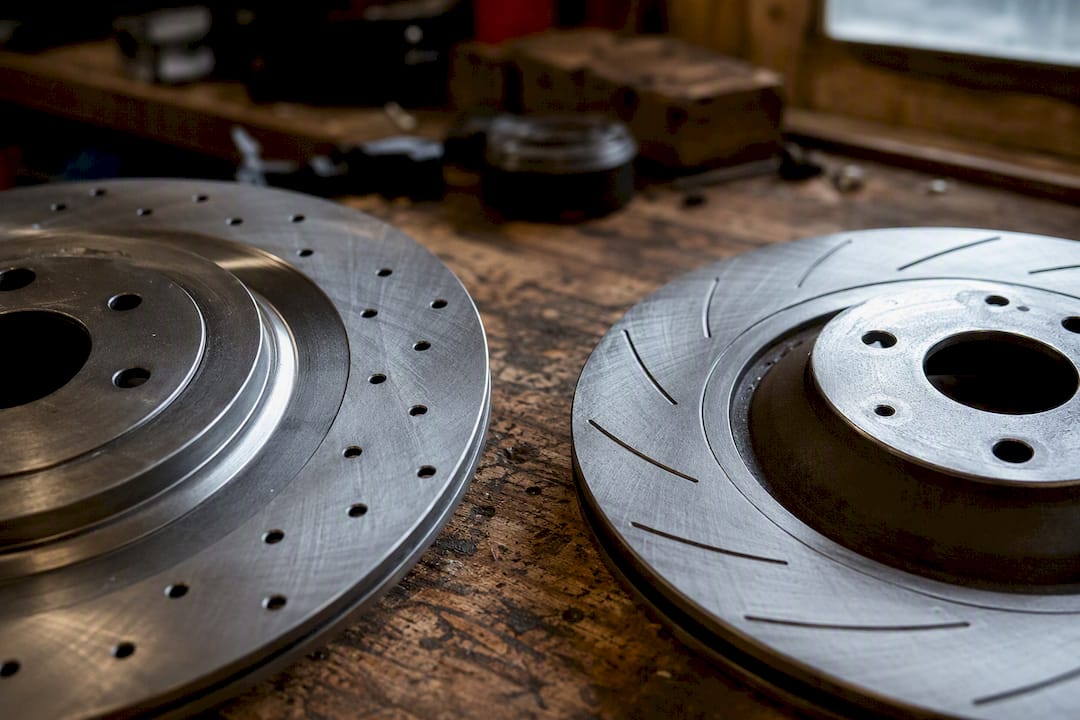
Slotted rotors cut shallow channels across the face instead of drilling through it. Slots evacuate gas and shave off a glazed pad layer with every rotation, which keeps bite consistent under repeated hard stops. The trade-off is faster pad wear, since the slot edges are mildly abrasive.
Two-piece rotors bolt an aluminum hat to a separate iron or steel rotor ring, cutting unsprung weight and isolating heat from the wheel bearing. They cost more and are rarely necessary outside performance or track applications.
Here’s the practical read on where each type belongs:
- Solid and vented rotors: correct choice for the vast majority of daily-driven vehicles.
- Drilled rotors: mostly cosmetic on street cars; skip them for towing or repeated hard braking.
- Slotted rotors: worthwhile for drivers who brake hard and often, provided pad wear is an acceptable trade.
- Two-piece rotors: justified only when unsprung weight or extreme heat cycling is a real concern.
Why Metallurgy Matters More Than Surface Patterns
Rotor material determines how much heat a rotor can absorb before it fades, cracks, or warps, and that matters more than any drilled or slotted pattern on the surface. Cut patterns affect airflow at the margins. Metallurgy determines the ceiling.
Grey cast iron remains the industry default because it holds a stable coefficient of friction across a wide temperature range. A dynamometer comparison between aluminum matrix composite (Al-MMC) rotors and gray cast iron found that while Al-MMC rotors cut weight dramatically (roughly 2.8 g/cm³ versus 7.2 g/cm³ for cast iron) and reduce particulate wear, gray cast iron kept a more stable friction coefficient at extreme temperatures. Composite rotors are promising for lightweight or lower-heat applications, but they’re not yet the safer bet for sustained hard braking.
High-carbon iron takes that base alloy and increases carbon content, improving thermal conductivity and vibration damping. Market data on the aftermarket segment credits high-carbon formulations with thermal conductivity gains near 15% and damping improvements around 20% compared to standard iron, which is why they’re increasingly the standard for performance-oriented builds rather than a niche upgrade.
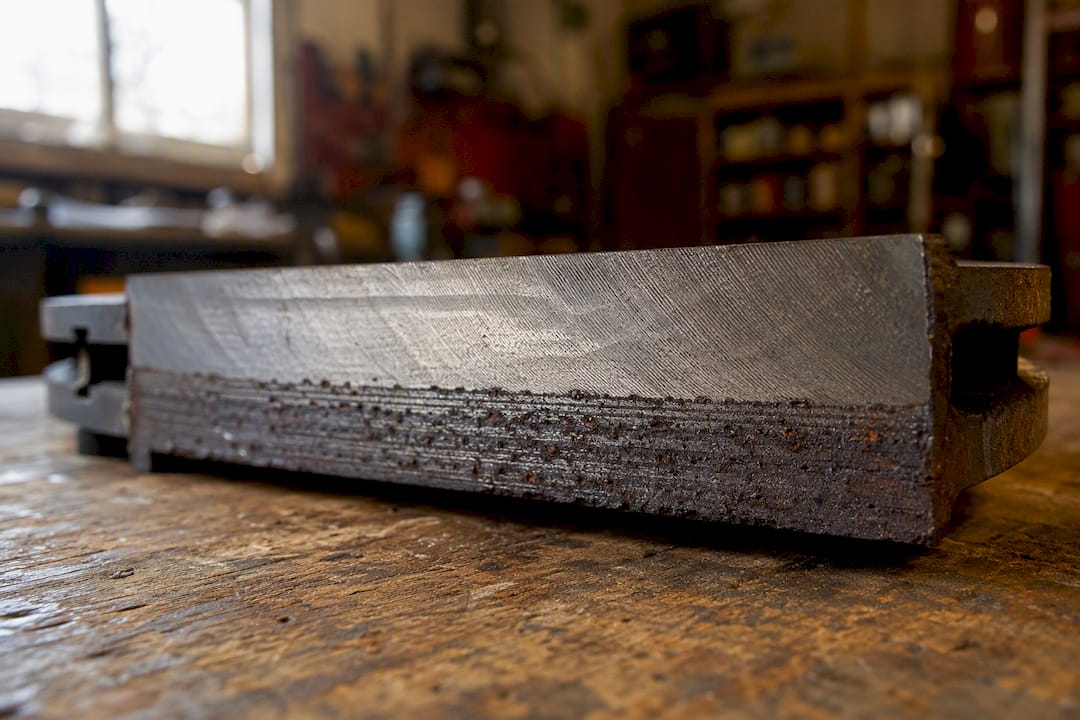
Ventilation geometry compounds those material gains. Brembo’s own technical documentation on vane versus pillar ventilation designs shows that pillar-style internal supports resist thermal cracking better than straight vanes because they distribute stress more evenly as the rotor heats and cools. A 2026 dynamometer and finite-element study reached a similar conclusion from a different angle: optimized cut and vane patterns measurably improved heat dissipation over baseline designs, but the effect came from engineering the internal structure, not from drilling holes in the face.
Two-piece construction adds one more variable: it separates the friction ring from the mounting hat, so heat from hard braking doesn’t transfer as directly into the wheel bearing and hub assembly. That’s a real advantage for track use, and mostly wasted money for a commuter.
How to Choose the Right Brake Rotors for Your Vehicle
Picking rotors gets simple once you work through it in order instead of shopping by looks.
- Identify your vehicle’s factory spec. Note rotor diameter, minimum thickness, and whether your car uses a single-piston or multi-piston caliper.
- Match rotor type to your use case. Daily commuting calls for solid or vented cast iron. Towing or mountain driving benefits from slotted, high-carbon rotors. Track days justify two-piece rotors paired with aggressive pads.
- Select material based on thermal load, not budget alone. A high-carbon rotor that costs more upfront often outlasts a cheap iron rotor that warps within a year of hard use.
- Confirm fitment and thickness before checkout. Cross-reference the exact part number for your trim and year. Undersized rotors are a common return.
- Weigh coatings and warranty. Zinc or E-coated rotors resist rust longer in wet climates; check whether the warranty covers cracking versus normal wear.
Fitment mistakes are the single most common reason rotors get returned. Before you check out, confirm the hat design matches your hub, the bolt pattern lines up, and the rotor’s minimum thickness spec leaves enough margin for at least one resurfacing down the line. A guide to why brake upgrades improve safety and performance walks through how rotor upgrades interact with pad and caliper choices if you’re upgrading more than one component at once.
Pro Tip: Budget rotors in the $40 to $80 range per axle set usually run vented cast iron with no coating. High-carbon or coated options land in the $100 to $250 range, and two-piece performance rotors can exceed $400 per pair. Pay for the material upgrade before you pay for a coating upgrade.
How Long Do Brake Rotors Last, and When Should You Replace Them?
Rotor lifespan varies widely under normal driving, with demanding conditions like towing, mountain routes, and track use significantly reducing longevity. Climate plays a role too. Rotors in wet or salted regions rust and pit faster along the outer edge, even when the friction surface is otherwise healthy.
Watch for these warning signs:
- Pulsation through the brake pedal or steering wheel, usually pointing to warping from uneven heat distribution.
- Visible scoring or grooves deep enough to catch a fingernail, which accelerates pad wear.
- Blueing or discoloration on the rotor face, a sign the metal has been overheated past its normal operating range.
- Thickness below the minimum stamped on the rotor hat, which is a hard replacement threshold, not a suggestion.
If a rotor shows light scoring but sits well above minimum thickness, machining can restore a smooth surface. Once thickness gets close to spec, resurfacing removes too much material and replacement becomes the only safe option. If you’re chasing intermittent pulsation or a burning smell under hard braking, the diagnostic steps in Ozkonic Kustomz’s brake fade guide walk through separating a rotor problem from a fluid or pad problem.
Sourcing, Fitment Checks, and Support You Can Verify
Buying rotors online carries a real risk: wrong hat design, incorrect thickness, or a counterfeit part sold under a familiar brand name. Ozkonic Kustomz sources rotors directly from vetted manufacturers and runs every listing through a fitment check tied to exact part numbers, not just vehicle year and model.
That matters because a “compatible” rotor sold by year and trim alone can still miss on hat height or bolt spacing across different factory brake packages. Every product page lists the confirmed fitment data upfront, and the team is available to verify a match before you order rather than after a return request.
For readers piecing together a full brake upgrade rather than a rotor swap alone, the breakdown of performance kits under $500 shows how rotors, pads, and hardware come together at a reasonable price point. Fast shipping and a straightforward return policy back every order, so a fitment issue does not turn into a drawn-out dispute. That combination, direct manufacturer sourcing plus a verified fitment step, is the difference between guessing online and buying with actual confidence.
Comparing Rotor Categories Across the Market
Rather than ranking specific companies, it’s more useful to compare the categories of rotors you’ll actually encounter while shopping, since most brands compete within the same tiers.
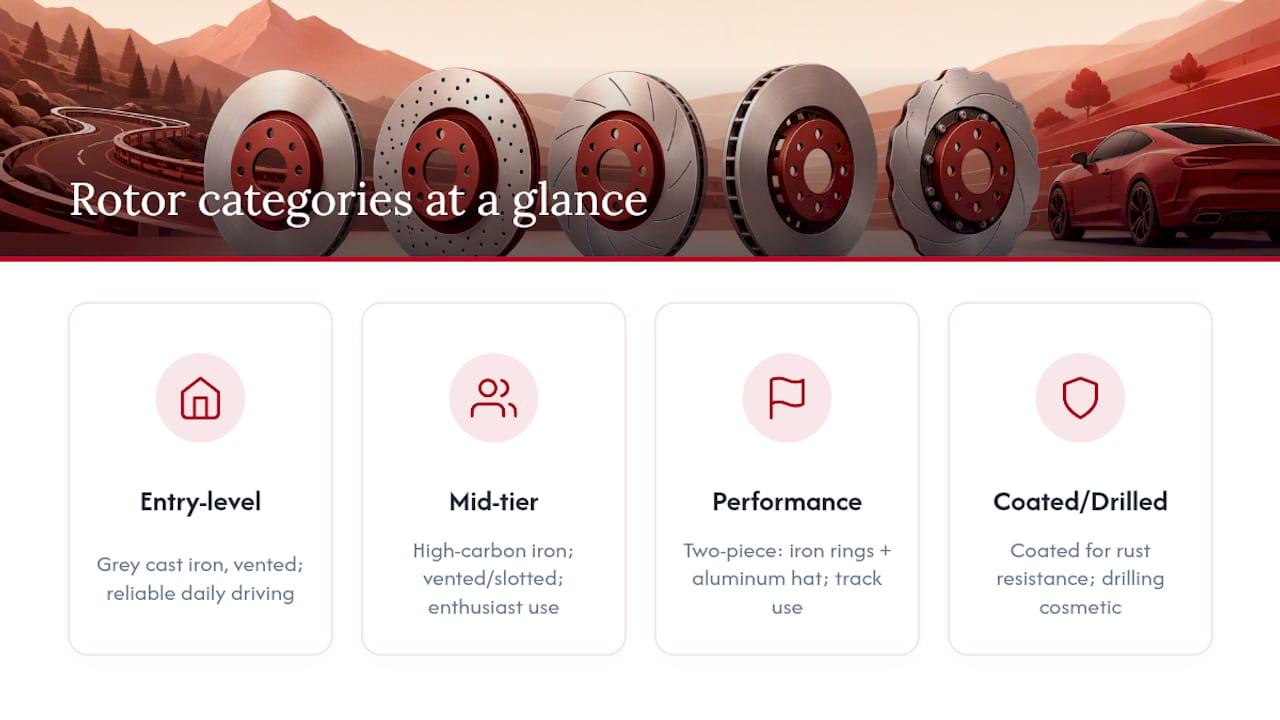
Entry-level OE-replacement rotors are grey cast iron, vented on the front axle, and built to match factory specs exactly. These are the right call for daily drivers who want reliable, predictable braking without a performance premium.
Mid-tier high-carbon rotors step up the metallurgy while keeping a standard vented or slotted design. This tier is where most enthusiasts land, since the carbon content gains in thermal conductivity and damping without the cost jump of a full two-piece setup.
Performance and track-oriented two-piece rotors sit at the top, combining high-carbon or specialized iron rings with aluminum hats. Expect a real price jump here, but also a real capability jump for anyone doing repeated hard stops at speed.
Coated and cosmetic-drilled rotors occupy a separate lane entirely. The coating adds rust resistance, which matters in wet climates. However, the drilling itself is largely a styling choice on modern pad compounds. Weigh that tier on looks and corrosion resistance, not on any claimed performance gain.
Match the tier to your actual driving pattern, not your budget ceiling. A track-tier rotor on a commuter car wastes money; an OE-tier rotor on a towing rig wears out fast.
Installing Brake Rotors: What the Job Actually Requires
Rotor swaps are straightforward mechanically, but skipping a step turns a one-hour job into a comeback repair. You’ll need a floor jack and stands, a lug wrench or impact driver, a C-clamp or piston tool to retract the caliper, a torque wrench, and brake cleaner.
Start by breaking the lug nuts loose before lifting the vehicle, then support it securely on stands rather than the jack alone. Remove the caliper and bracket, retract the piston, and inspect the pads while you’re in there since a rotor swap is the easiest time to replace worn pads too. Once the old rotor is off, clean the hub face of rust and debris. A rotor mounted against a corroded hub will run out of true and cause the pulsation you were trying to fix.
New rotors ship with a light protective coating on the friction surface. Wipe it down with brake cleaner before installation, since skipping this step leaves a film that reduces initial bite and can cause an odd smell on the first few stops.
Torque the lug nuts to the manufacturer’s spec in a star pattern, never a single spiral direction. Uneven torque is one of the most common causes of rotor warping within the first few thousand miles, and it has nothing to do with the rotor itself. Finish with 200 to 300 miles of moderate driving to bed the new pads against the new rotor surface before any hard stops.
Rotors Don’t Work Alone: Pads and Calipers in the Equation
A rotor is only as good as the pad and caliper working against it, so this comes down to matching all three, not upgrading one part in isolation. Pad compound determines how much friction and heat gets generated against the rotor face, and mismatched pairings cause premature wear on both ends.
Soft ceramic pads run cooler and quieter but glaze faster against an aggressive slotted rotor, since the slots are designed to work with a firmer pad compound. Semi-metallic pads handle heat better and pair well with high-carbon or slotted rotors under hard use, but they’re noisier and dustier on a rotor built for daily comfort. Mismatch a track-oriented pad with a soft daily rotor, and you’ll cook that rotor faster than its rated thermal range suggests.
Caliper condition matters just as much. A sticking caliper piston keeps a pad pressed against the rotor even after you release the brake, generating constant low-grade heat that accelerates warping regardless of how good the rotor is. If you’re replacing rotors on a vehicle with 60,000-plus miles, inspect the caliper slides and piston seals at the same time. A worn caliper will undo the benefit of even the best rotor within a few thousand miles.
This is why a rotor upgrade rarely happens in isolation among experienced builders. Pads, rotors, and calipers form one working system, and the weakest link sets the ceiling for how the whole setup performs.
Our Take: Buy for the Metal, Not the Pattern
The dynamometer and finite-element research on rotor design keeps pointing to the same conclusion: metallurgy and engineered ventilation geometry drive performance, while surface drilling is mostly aesthetic on street applications. That runs against a lot of forum wisdom, where drilled rotors get treated as an automatic performance upgrade. They’re not. On a daily driver, they’re a cosmetic choice with a small added crack risk under sustained heat.
Where conventional advice really falls short is treating rotor selection like a style decision instead of an engineering one. The reader’s actual first question should never be “drilled or slotted?” It should be “what’s my thermal load, and what pad am I running?” Answer that, and the type and material choice follow almost automatically.
If there’s one priority worth acting on, it’s this: buy the metallurgy upgrade before the surface treatment, and buy from a source that verifies fitment before shipping. Everything else, the coating, the slot pattern, the badge, is secondary to those two decisions.
— Ozkonic Kustomz
Shop Vetted Rotor Options at Ozkonic Kustomz
Skip the guesswork of cross-referencing three different fitment charts across three different retailers. Ozkonic Kustomz verifies fitment against exact part numbers before a rotor kit ships, so what lands on your doorstep actually bolts up to your hub without a return trip.
Our catalog spans the range covered here: OE-equivalent vented rotors for daily drivers, high-carbon slotted options for towing rigs and mountain routes, and two-piece performance rotors for track builds. If you’re building out a full brake refresh rather than swapping rotors alone, our guide to performance kits under $500 pairs rotors with compatible pads and hardware at a sane price point. Every order ships fast, and returns are handled without the runaround, so a fitment question gets solved before it becomes a headache.
Not sure which rotor tier fits your truck or build? Browse the current wiring and hardware components alongside our brake catalog, or reach out through the product page for a fitment check before you commit.
Sources
Our claims about rotor thermal behavior, metallurgy, and crack resistance draw from independent testing and manufacturer documentation. The finite-element and dynamometer study on brake disk design informed the heat dissipation and cut-pattern analysis. The Al-MMC versus gray cast iron dynamometer comparison grounded the composite materials discussion. Brembo’s technical notes on vane versus pillar ventilation supported the ventilation geometry claims, and the brake disc material guide provided the material-to-use-case mapping throughout.
- mechanical coupled analysis of brake disk rotor. Heat Mass Transfer. 2026 DOI study