

Wheel spacers can be safe, but only under specific conditions: hub-centric design, forged 6061-T6 or 7075-T6 aluminum, correct thread engagement, and proper torque procedure. Skip any one of those, and you’re gambling with stud shear, bearing fatigue, or a wheel that departs the vehicle at speed. Cheap universal lug-centric spacers, undersized hardware, and impact-gun torque jobs are where the real safety concerns with wheel spacers live.
TL;DR:
- Using hub-centric spacers with proper forged aluminum and correct torque procedures is essential for safe wheel spacer installation and long-term durability.
- Distance changes caused by spacers notably increase scrub radius, bearing fatigue, and shear stress on studs, especially beyond 15mm thickness.
- Installing spacers with incorrect hardware, poor fitment, or inadequate thread engagement significantly raises the risk of vibration, stud failure, or wheel detachment.
- Thicker spacers over 20mm should be replaced with designed wheels or bolt-on adapters to prevent safety and handling issues.
- Regular inspection for signs of wear, cracks, or looseness is crucial to identify spacer failure before dangerous driving conditions occur.
Table of Contents
- What Wheel Spacers Are and the Main Types
- How Do Spacers Change the Forces on Your Vehicle?
- What Should You Look for When Buying Spacers?
- Installing and Maintaining Spacers Correctly
- How Thick Is Too Thick?
- Signs of a Bad Spacer or Installation
- How Ozkonic Kustomz Approaches Fitment
- When We Recommend Spacers, and When We Don’t
- Get Vehicle-Specific Spacers, Studs, and Fitment Support
- Sources
What Wheel Spacers Are and the Main Types
A wheel spacer is a disc of metal that mounts between the wheel hub and the wheel itself, pushing the wheel outward to increase track width or correct offset. That extra distance changes leverage on every rotating component behind it, which is why the type of spacer you choose matters more than most buyers realize.
Two design categories dominate the market:
- Hub-centric spacers feature a machined lip that seats directly against the vehicle’s hub, transferring vertical load through the hub itself rather than the studs.
- Lug-centric spacers rely on the wheel studs alone to center the wheel and carry the car’s weight, which puts shear stress on hardware never engineered for that job.
Within those categories, you’ll also see two mounting styles. Slip-on spacers are thin (typically 3mm to 12mm), sit over the existing studs, and reuse the factory lug nuts. Bolt-on adapters are thicker units that bolt to the hub independently and provide their own studs for the wheel, essentially acting as a second hub. Slip-on spacers work for minor clearance fixes; bolt-on adapters handle larger offset changes or bolt-pattern conversions.
How Do Spacers Change the Forces on Your Vehicle?
Push a wheel outward and you change three things at once: scrub radius, bearing moment, and stud loading. Understanding these three explain almost every safety concern with wheel spacers you’ll read about.
Scrub radius is the distance between the steering axis and the tire’s contact patch. Widening track width increases that distance, and suspension engineers identify this shift as the single most significant handling-related risk spacers introduce, because it amplifies steering kickback and braking forces transmitted back through the rack. You’ll feel it as more wheel tug over bumps and heavier steering under hard braking, even with power steering smoothing things over.
The wheel bearing faces a similar problem. Moving the wheel’s contact patch farther from the hub increases the moment arm the bearing has to resist with every turn and every bump. Over thousands of miles, that added leverage accelerates fatigue, particularly with spacers in the 25mm-plus range.
Lug-centric designs compound both problems by forcing studs to do a job they weren’t designed for: centering the wheel under load. Studs are engineered for clamping force, not lateral shear. Ask them to do both long enough, and you get elongated bolt holes, loosening, or outright stud failure.
What Should You Look for When Buying Spacers?
Material and machining quality separate a safe spacer from a liability. Forged billet aluminum has a tighter, more consistent grain structure than cast aluminum, which means fewer internal voids and far better fatigue resistance under repeated load cycles. Cast spacers are cheaper for a reason: they crack under stress that forged 6061-T6 or 7075-T6 aluminum shrugs off.
Beyond raw material, check these before you buy:
- Hub-centric lip with tight tolerances. The center bore should match your hub diameter almost exactly, with minimal slop.
- Precise bolt circle and PCD. Loose fitment tolerances here cause runout that shows up as vibration within a few hundred miles.
- Hardware grade. Look for Grade 10.9 or 12.9 studs and bolts. Anything unmarked or unlabeled is a red flag.
- Included, matched hardware. A spacer sold without proper studs, bolts, or lug nuts for your exact application is asking you to guess.
Getting the bolt pattern and center bore right isn’t optional. Ozkonickustomz’s breakdown of wheel bolt pattern fitment covers the numbers you need before ordering anything.
Pro Tip: If a listing doesn’t specify the aluminum grade or hardware rating, assume it’s cast and unrated until proven otherwise. Reputable manufacturers advertise this information because it’s their selling point, not because they’re required to.
Installing and Maintaining Spacers Correctly
Most spacer failures trace back to installation error, not a flawed concept, and poor torque procedure combined with insufficient thread engagement tops the list of causes.
- Check thread engagement first. Practitioners recommend verifying a minimum number of full turns of thread engagement that meets or exceeds industry safety standards once the spacer and wheel are mounted. If a slip-on spacer eats into that margin, switch to extended studs rather than accepting fewer turns.
- Torque by hand, in sequence. Use a calibrated torque wrench and a star pattern, following the manufacturer’s spec exactly. Never finish the job with an impact gun; it’s fast but notoriously inconsistent for final clamping force.
- Re-torque after the break-in period. Recheck every fastener after the initial break-in period of driving. Initial seating and thermal cycling can loosen hardware that felt perfectly tight on installation day.
- Clean mating surfaces. Wire-brush any corrosion off the hub face and spacer before mounting; debris there creates the runout that causes vibration later.
- Inspect periodically. Every few thousand miles, check for rust streaks around lug holes, hairline cracks, and any play when you rock the wheel by hand.
Pro Tip: Skip anti-seize on the wheel studs unless the manufacturer specifically calls for it. Anti-seize reduces friction, which means your torque wrench reading won’t reflect the actual clamping force. If you use it, reduce torque spec accordingly or you’ll overclamp the joint.
How Thick Is Too Thick?
Spacer thickness is where risk scales, not where it flips on or off. Spacers in the 5mm to 15mm range typically produce negligible additional bearing wear on most modern vehicles. Between 15mm and 25mm, you’re in a gray zone where scrub radius changes become noticeable and bearing loads start climbing. Past 25mm, leverage on bearings and suspension grows sharply, and the vehicle can start feeling softer than it was designed to, sometimes demanding supporting suspension upgrades to compensate.
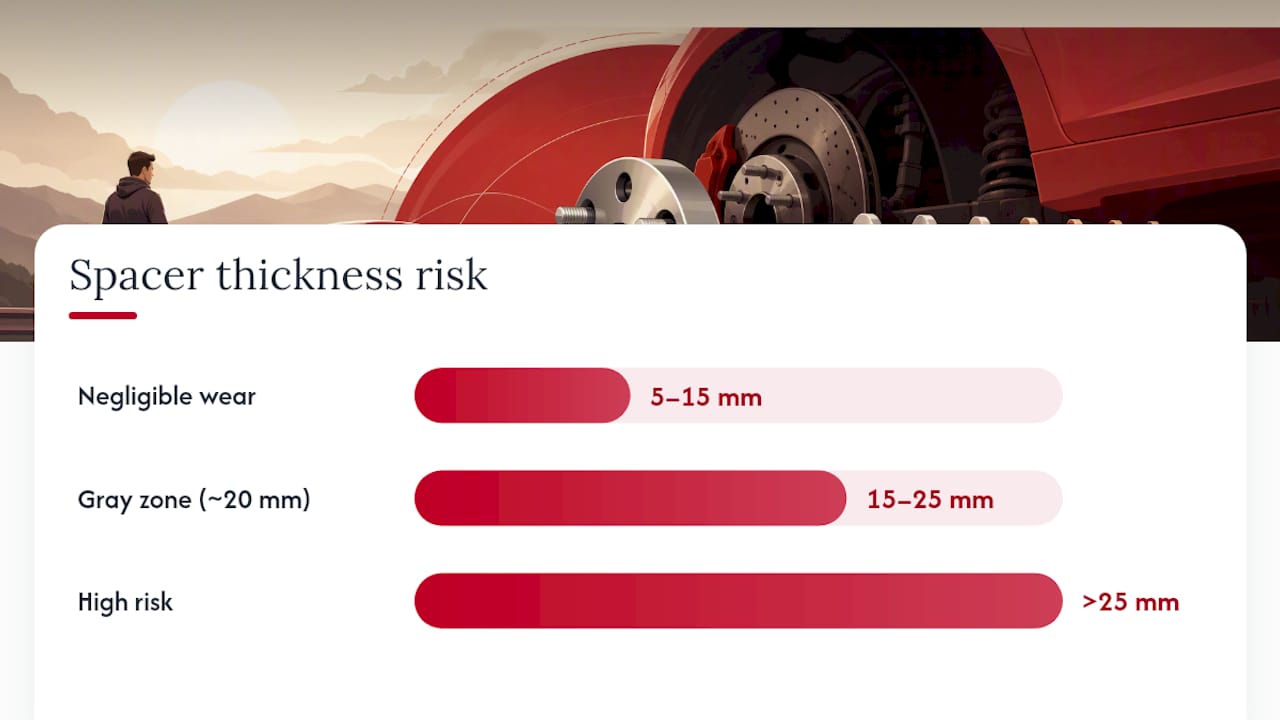
If you need more than roughly 20mm to hit your fitment goal, a bolt-on adapter with its own extended studs is safer than stacking thin slip-on spacers. Past that threshold, ask whether new wheels with the correct offset would solve the problem outright, and get an alignment check. Ozkonickustomz’s guide to wheel offset walks through when a wheel swap beats a spacer.
Signs of a Bad Spacer or Installation
Catching a failing spacer early is the difference between a shop visit and a roadside emergency. Watch for:
- Vibration that builds with speed, especially between 50 and 70 mph.
- Steering kickback or looseness that wasn’t there before.
- Clicking or clunking over bumps, particularly on turns.
- Visible gaps between the spacer and wheel, or rust-colored streaks bleeding from the lug holes.
If you notice any of these, stop driving and check torque on every lug immediately. Pull the wheel if anything looks off. When in doubt, a shop can check runout with a dial indicator and verify hub-centric seating in minutes.
How Ozkonic Kustomz Approaches Fitment
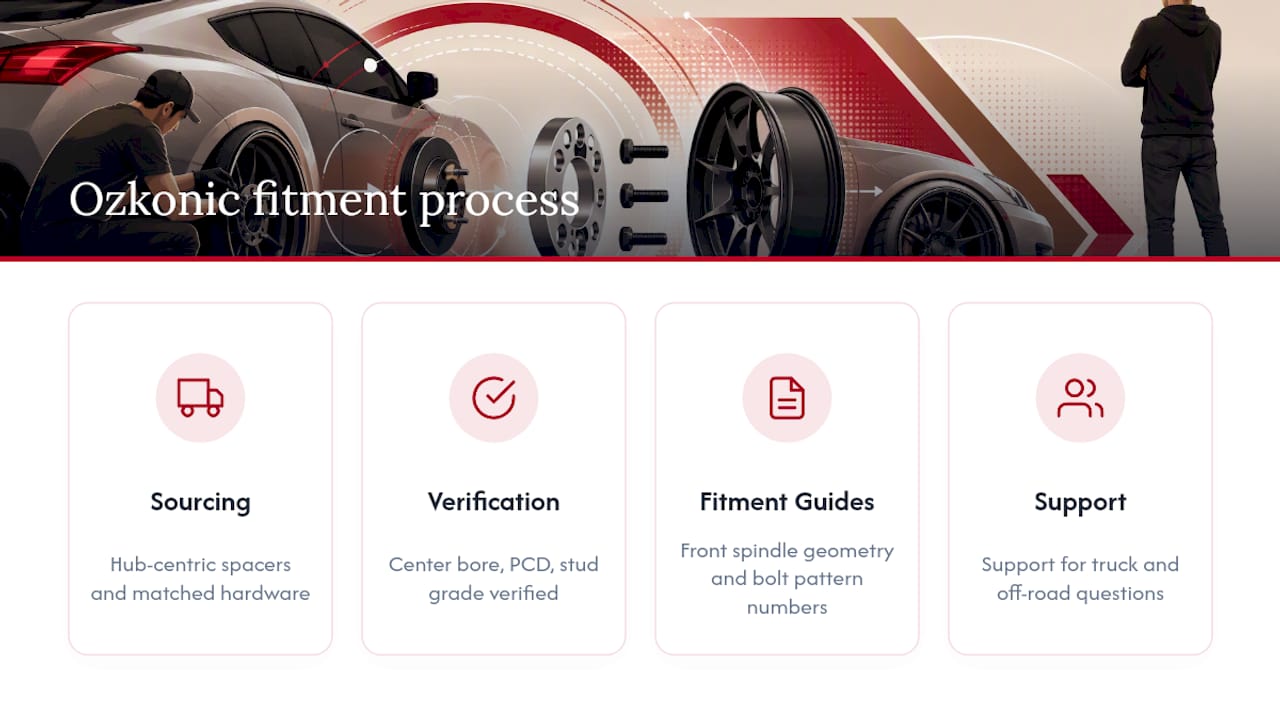
Ozkonickustomz sources hub-centric spacers and matched hardware directly from vetted manufacturers, so center bore, PCD, and stud grade are verified before a part ever ships. Fitment guides on front spindle geometry and bolt pattern give builders the reference numbers to confirm compatibility before they buy, backed by support for questions on specific truck and off-road applications.
When We Recommend Spacers, and When We Don’t
Spacers earn their place for minor offset correction, brake caliper clearance, or fine-tuning stance on a build that’s otherwise dialed in. They’re the wrong tool when you need more than 20mm of correction or you’re trying to patch a fitment problem that new wheels would solve cleanly. The rule that matters most: buy hub-centric, buy forged, and install it correctly every single time.
— Ozkonic Kustomz
Get Vehicle-Specific Spacers, Studs, and Fitment Support
Skip the guesswork on center bore and bolt pattern. Ozkonickustomz sources hub-centric spacers and Grade 10.9/12.9 hardware directly from vetted manufacturers, matched to your exact truck, car, or off-road build before it ships.
Beyond spacers, Ozkonickustomz stocks the latch and hardware kits and wiring components that keep the rest of a build fitment-correct, all backed by the same compatibility guarantee and fast shipping. Precise CNC tolerances matter here the same way they matter in motorsport-grade machining, where a fraction of a millimeter separates a clean fit from a vibration problem. If corrosion at the hub face is a concern in your climate, a ceramic coating on the mating surfaces helps prevent seizure between service intervals. Browse the current fitment catalog and get your bolt pattern and center bore confirmed before you order.
Sources
- Wheel spacers safety explained - Jalopnik
- Engineerskill
- Suspension engineer opinion on wheel spacers - The Autopian