
Match your Tundra’s model year and intended use before you order a single part. For safety-critical replacements like ball joints and tie rods, stick with OEM or parts from vetted aftermarket suppliers with a fitment guarantee. For performance upgrades, shocks, coilovers, and lift kits are all fair game once you’ve confirmed whether your truck runs the pre-2022 leaf-spring rear or the 2022+ coil-spring multi-link setup. Ozkonickustomz sources directly from vetted manufacturers and offers fitment support, so you can confirm compatibility by VIN before anything ships. Factory shocks typically last a range of miles depending on how hard you drive, but that number means little without a physical inspection first.
Table of Contents
- What Tundra suspension parts do you actually need?
- How does your Tundra’s model year change what fits?
- Which suspension upgrade path fits your driving style?
- How to choose the right parts before you buy
- Installation tips, maintenance checks, and how long parts last
- Why Ozkonickustomz is worth a look for your Tundra build
- Key Takeaways
- The mistakes Tundra owners keep making (and how to skip them)
- Get the right Tundra parts with fitment you can trust
- Useful sources for part numbers, diagrams, and deeper reading
What Tundra suspension parts do you actually need?
Every Tundra suspension system breaks down into the same core components, but what you need depends on whether you’re repairing wear, chasing a smoother ride, or building for off-road use.
Repair/replace (safety-critical):
- Ball joints (upper and lower) — connect the control arms to the steering knuckle; front lower ball joints are among the most common Tundra failure points. A failed ball joint can pop out at low speed and take the CV axle, brake line, and alignment with it.
- Tie rods and steering components — inner and outer tie rod ends transfer steering input; play in these causes wandering and uneven tire wear.
- Bushings — rubber or polyurethane sleeves at control-arm pivot points; torn or collapsed bushings cause clunking and vague steering.
- Sway bar end links — connect the sway bar to the suspension; worn links produce a knocking sound over bumps.
Mild upgrades:
- Shocks and struts / coilover assemblies — dampen spring oscillation; upgrading from worn OEM units to a performance shock noticeably tightens body roll and improves braking stability.
- Coil springs (front, 2022+ rear) — support vehicle weight and set ride height; stiffer springs improve load handling but can harden the daily ride.
- Leaf springs (pre-2022 rear) — multi-leaf packs carry payload and set rear ride height; sagging packs are a common issue on high-mileage trucks.
- Leveling kits — spacers or replacement struts that raise the front 1–2 inches to match the factory rake; the least invasive height change.
Heavy upgrades:
- Lift kits — body or suspension lifts of 2–6 inches; require alignment and often new UCAs, longer brake lines, and recalibration.
- Upper and lower control arms (UCAs/LCAs) — aftermarket UCAs with extended travel are common on lifted trucks to restore proper geometry.
- Air springs and compressors — load-leveling systems that adjust rear ride height on demand; relevant for towing builds and standard on certain 2022+ trims.
- Mounting hardware and U-bolts — often overlooked; replace U-bolts whenever you pull leaf springs, since reused hardware can loosen under load.
How does your Tundra’s model year change what fits?
This is the single most important filter when shopping for aftermarket Tundra suspension parts. The architecture changed completely in 2022, and parts from one generation will not cross over to the other.
| Model Years | Rear Suspension Type | Common Trims | Key Fitment Notes |
|---|---|---|---|
| 2000–2021 | Live axle, multi-leaf springs | SR5, Limited | Leaf-spring kits, U-bolts, add-a-leaf packs |
| 2007–2021 | Live axle, multi-leaf springs | SR5, TRD, Limited, Platinum | Wider aftermarket kit selection; TRD Pro adds Bilstein shocks |
| 2022+ | Coil-spring multi-link | SR, SR5, Limited, TRD Sport/Off-Road/Pro | Up to six distinct suspension configurations depending on trim and package |
| 2022+ (select trims) | Multi-link + air springs or AVS | Platinum, TRD Pro (AVS) | Air springs adjust rear ride height by a noticeable amount; AVS pairs only with specific trims |
The 2022 redesign moved to a multi-link rear with coil springs, which improves on-road ride quality and enables adaptive damping on premium trims. The trade-off is a more complex aftermarket picture. Many lift kits and add-a-leaf packs built for 2007–2021 trucks simply do not exist in a 2022+ version yet, and air-spring or AVS-equipped trucks need kits that account for the control module.
Before ordering, confirm all of these:
- Full VIN (encodes trim, drivetrain, and factory options)
- Trim package and any factory upgrade packages (TRD Off-Road, TRD Pro, Air Suspension, AVS)
- Drivetrain: 4WD vs. 2WD (front suspension geometry differs)
- Cab and bed configuration (affects rear spring rates on some kits)
- Whether the truck has factory air springs or AVS (limits aftermarket options)
Pro Tip: Run the OEM part number from Toyota’s parts catalog against your VIN before ordering any geometry-affecting part. A vendor fitment tool is a good first check, but the OEM number is the final word on whether a part was designed for your specific truck.
Which suspension upgrade path fits your driving style?
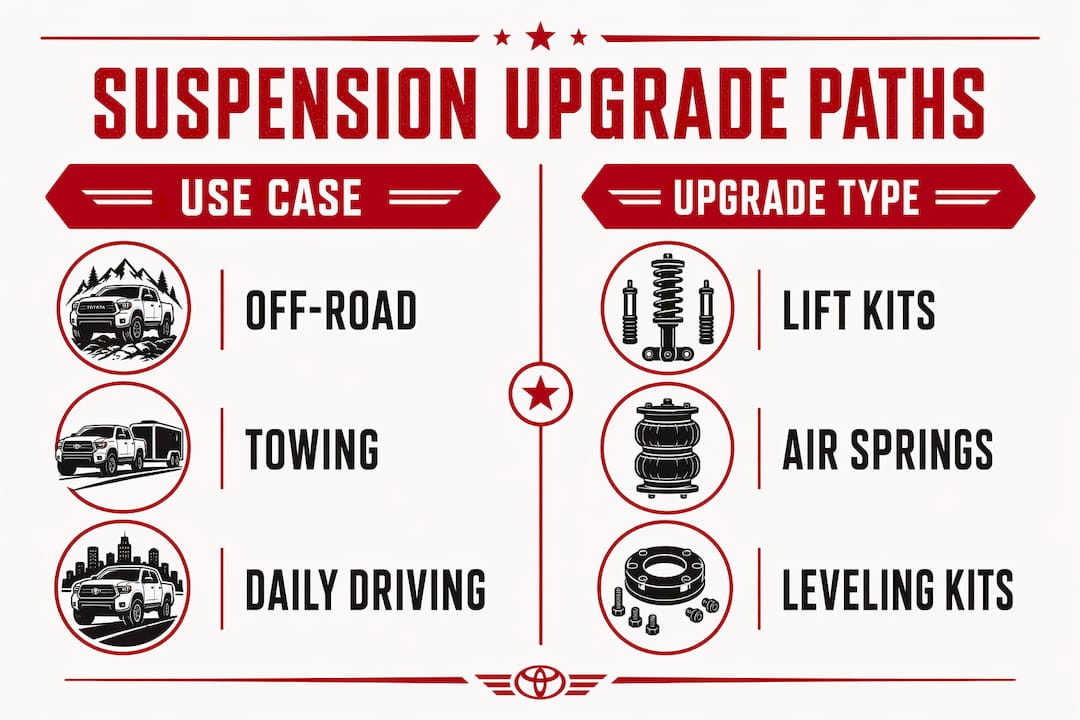
| Use Case | Recommended Upgrade | Ride/Handling Impact | Install Difficulty | Typical Cost Range |
|---|---|---|---|---|
| Daily driver, worn shocks | OEM-equivalent or performance shocks | Noticeably tighter, less body roll | DIY-friendly | $200+ (parts) |
| Level the front rake | Leveling kit (spacer or strut) | Minimal change to ride quality | DIY-moderate | $50+ |
| Mild off-road / trail use | 2–3 in. lift kit + UCAs | Improved clearance, some ride change | Shop recommended | $800+ |
| Aggressive off-road / rock crawl | Long-travel coilovers + UCAs/LCAs | Significant geometry change | Professional install | $2,500+ |
| Towing / payload leveling | Rear air spring kit | Levels load sag, adjustable | DIY-moderate | $300+ |
| 2022+ performance ride | Aftermarket AVS-compatible shocks | Improved damping without losing AVS | Shop recommended | $600+ |
A leveling kit is a common first modification as it corrects the factory nose-down rake, clears slightly larger tires, and maintains geometry near stock. For 2022+ owners with air springs, confirm the kit explicitly supports your setup. Air springs and AVS increase complexity for aftermarket upgrades, and some kits will require control-module changes. Any lift that alters ride height or control-arm angles needs a four-wheel alignment immediately after installation.
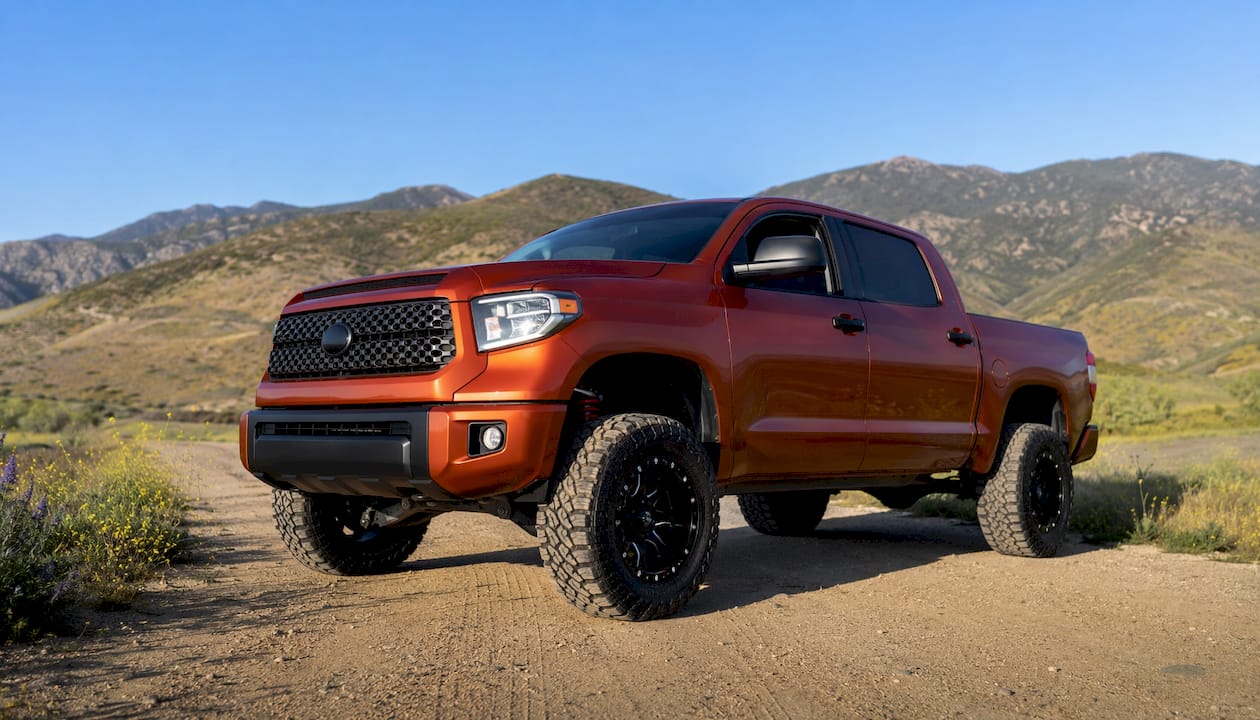
For coilover options, the coilovers vs. lowering springs guide at Ozkonickustomz walks through the performance trade-offs in detail.
How to choose the right parts before you buy
- Confirm year, trim, and VIN. Pull the full VIN and cross-reference it with the vendor’s fitment tool or OEM part catalog. Do not rely on “fits 2016–2021 Tundra” generic listings for ball joints or control arms.
- Define your use case. Towing daily? Daily commuting with occasional trails? Full off-road build? The answer changes everything from spring rate to shock valving.
- Decide OEM vs. aftermarket. OEM parts carry Toyota’s engineering tolerances and are the safest choice for safety-critical items. Aftermarket parts from vetted suppliers can match or exceed OEM quality for shocks and control arms, often at lower cost.
- Check warranty and return policy. A reputable supplier will offer a clear warranty on parts and a straightforward return process if fitment is wrong. Ask specifically: what does the warranty cover, and how long does it last?
- Ask about installation support. Does the supplier provide torque specs, diagrams, or a support line? For a lift kit or control-arm swap, having access to those details saves real time.
- Budget for alignment. After any geometry-affecting work (control arms, ball joints, springs, lift kits), a four-wheel alignment is not optional. Budget $100–$200 for the shop visit.
Questions worth asking your vendor or mechanic: Does this kit retain factory geometry at my lift height? Is it compatible with TRD Off-Road or TRD Pro factory tuning? Will it work with my air springs or AVS? What load ratings were tested, and under what conditions?
For towing-focused builds, the LoadLifter 7500 XL air spring kit at Ozkonickustomz is worth a look as a starting point for rear load-leveling options.
Installation tips, maintenance checks, and how long parts last
Safety first with springs. Dismantling front coil springs without a rated spring compressor is genuinely dangerous. Many home mechanics choose pre-assembled ready-strut or coilover units instead, which arrive with the spring already compressed and matched to the shock. It costs a bit more but removes the single biggest injury risk in a driveway suspension job.
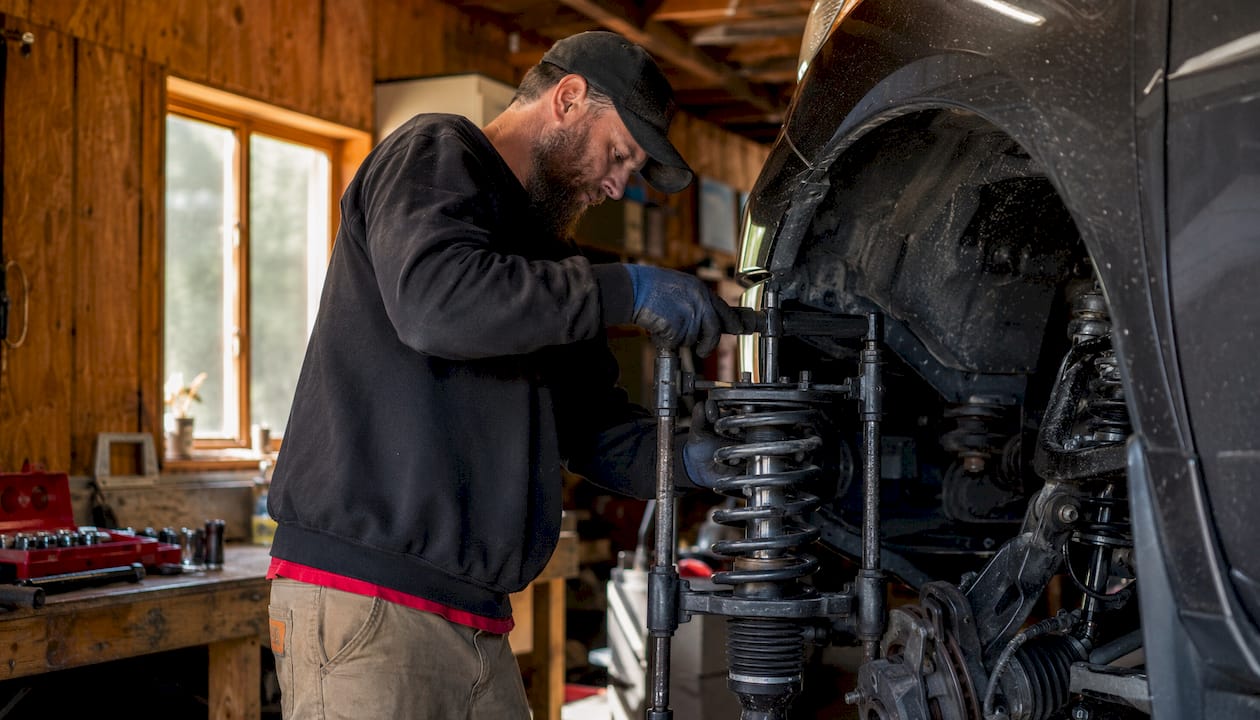
Apply penetrating oil to every bolt 24–48 hours before you start. Rusted threads on control-arm bolts and shock mounts are the most common reason a straightforward job turns into a half-day ordeal.
Routine inspection checklist:
- Shock absorbers: look for oil weeping down the body; bounce each corner and count rebounds (more than two means the shock is tired)
- Ball joints: grab the tire at 12 and 6 o’clock and try to rock it; any play is cause for immediate inspection
- Bushings: look for cracking, tearing, or visible metal-on-metal contact at pivot points
- Leaf springs (pre-2022): check for broken or shifted leaves, sagging ride height, and cracked U-bolt seats
- Coil springs (2022+ rear): inspect for cracks at the top and bottom coils
- Sway bar end links: listen for knocking over speed bumps; grab the link and check for looseness
Factory shocks typically hold up for 50,000–100,000 miles, but that range is wide for a reason. Tundra forum practitioners report OEM components lasting well past 150,000 miles under light use, while trucks driven hard off-road or with heavy towing loads may need shocks at 40,000 miles. Physical inspection beats any mileage rule.
Stop driving immediately if you notice: a loose or clunking ball joint, a broken coil or leaf spring, heavy shock fluid leaking, or a sudden change in steering feel. These are not “schedule it next week” problems.
Why Ozkonickustomz is worth a look for your Tundra build
Ozkonickustomz carries product categories directly relevant to Tundra owners: air spring kits, wiring and compressor accessories for active suspension setups, mounting hardware, and selected lift-kit components. Every part is sourced from vetted manufacturers, which means you’re not rolling the dice on a counterfeit shock or an undersized ball joint that looks right in the photo.
Key reasons Tundra owners shop here:
- Fitment guarantee: parts are matched to your VIN and trim before they ship
- Vetted-supplier sourcing: no gray-market or counterfeit components
- Straightforward returns: if a part doesn’t fit, the return process is clear and fast
- Fitment support: contact the team with your VIN and trim details and get a real answer before you order
- Install documentation: product pages include hardware lists and installation guidance where applicable
To confirm fitment, use the product fitment lookup on the site or reach out directly with your VIN, trim, drivetrain, and any factory package details (air suspension, AVS, TRD Off-Road). The wiring and hardware accessories available are particularly useful if you’re adding an air compressor or electronic suspension component to a 2022+ build.
Key Takeaways
Matching your Tundra’s model year and trim to the correct suspension architecture is the single most important step before buying any part or upgrade kit.
| Point | Details |
|---|---|
| Model year determines fitment | Pre-2022 trucks use leaf-spring rear; 2022+ use coil-spring multi-link with up to six trim configurations. |
| Safety parts need OEM or vetted aftermarket | Ball joints, tie rods, and bushings are safety-critical; never compromise on sourcing or fitment confirmation. |
| Shocks last 50,000–100,000 miles | Inspect physically at every service interval; mileage alone is not a reliable replacement trigger. |
| Alignment is mandatory after geometry work | Any lift, control-arm, or spring replacement requires a four-wheel alignment immediately after install. |
| Ozkonickustomz confirms fitment by VIN | Submit your VIN and trim for a fitment check before ordering air spring kits, hardware, or lift components. |
The mistakes Tundra owners keep making (and how to skip them)
The most expensive suspension mistake is ordering by year range instead of VIN. “Fits 2014–2021 Tundra” covers trucks with meaningfully different trim packages, spring rates, and factory shock suppliers. A ball joint that fits a base SR5 may not clear the geometry on a TRD Pro. Run the VIN every time.
Skipping alignment after a lift is the second most common error. Owners install a 2-inch level kit, notice the truck drives fine, and skip the alignment shop. Six months later they’re buying tires early because the front is wearing on the inside edge. The alignment cost is $150. New tires are $1,200.
Mixing components from different suppliers on a lift build is where things get genuinely expensive. If you want a 2-inch lift, a dedicated leveling kit that retains factory geometry is a far safer choice than pairing springs from one brand with shocks from another. Mismatched components can alter CV axle angles, stress ball joints unevenly, and void warranties on both parts.
Finally, underbudgeting installation is predictable and avoidable. A control-arm swap that looks like a two-hour job often turns into five hours once seized bolts, stripped threads, and a missing alignment slot are factored in. If you’re not set up for that, a shop install on geometry-affecting parts is money well spent.
Get the right Tundra parts with fitment you can trust
Sorting through suspension options for a truck with as many configurations as the Tundra takes more than a parts number and a prayer. Ozkonickustomz cuts through that by sourcing directly from vetted manufacturers and backing every order with a fitment guarantee. Submit your VIN and trim details, and the team confirms compatibility before anything ships.
Whether you need an air spring kit for a towing build, wiring accessories for an active suspension setup, or mounting hardware to finish a lift, Ozkonickustomz has the parts and the support to get it right the first time. Fast shipping, a clear returns policy, and real fitment help set this apart from generic online retailers. Head to ozkonickustomz.com and use the fitment lookup or contact the team directly with your VIN to get started.
Useful sources for part numbers, diagrams, and deeper reading
- Toyota OEM Parts Catalog — look up OEM part numbers by VIN and trim; use this to cross-reference aftermarket listings and confirm correct part marks for shocks, control arms, and coil springs.
- Tundra Suspension Inspection Guide (autoreviewnest.com) — covers 2000–2026 models with a detailed inspection checklist, priority-fix table, and alignment notes for post-install work.
- TundraSolutions Forum — Suspension Wear Discussion — practitioner-backed discussion on real-world component lifespan, inspection methods, and ball-joint failure warning signs.
- TundraTalk Forum — OEM Shock Lifespan — owner experiences with factory shock longevity, ready-strut options, and DIY cost breakdowns for a full front suspension refresh.
- Cars.com — 2022 Tundra Suspension Configurations — explains how Toyota expanded from four to six suspension options on the 2022 redesign; essential reading before ordering any 2022+ aftermarket kit.
- MotorTrend — 2022 Tundra Suspension Explainer — technical breakdown of the multi-link rear architecture and what it means for ride quality, towing, and aftermarket compatibility.