
For a daily driver, drop spindles are the safest bet. For a show truck, lowering springs or coilovers get you the stance without wrecking ride quality. For anything that still hauls or tows, air suspension wins because you can raise it back up when the bed’s loaded. Most owners land in the 2 to 4 inch range, which the Cars points to as the sweet spot between looks and drivability.
There’s no universal “best” kit. There’s a best kit for your truck, your suspension architecture, and what you actually do with the vehicle. That’s why Ozkonic Kustomz treats fitment verification as step one, not an afterthought. Roadworthiness matters too. NHTSA doesn’t ban lowering, but it does hold you to the same brake, headlight-aim, and stability standards as stock trucks, so any drop that changes geometry needs a real alignment afterward.
- Daily driver, mild drop: drop spindles, 1 to 2 inches
- Show truck, aggressive stance: lowering springs or coilovers
- Tow/haul but still want lower: air suspension
- Rear-only budget drop: shackles or blocks
Pro Tip: Before you buy anything, measure your current ride height and decide your target drop in inches, not vibes. “A little lower” gets you the wrong kit half the time.
Key Takeaways
The right truck lowering kit depends on suspension type and use case, not brand hype, and vetted fitment support prevents the most common and costly buying mistakes.
| Point | Details |
|---|---|
| Match kit to use case | Drop spindles for daily driving, coilovers for adjustable performance, airbags if you still haul. |
| Budget realistically | Basic bolt-on kits run $600 to $1,200; bigger drops cost considerably more in parts and labor. |
| Check availability early | New-model trucks can see kit availability lag by months after a platform redesign. |
| Never cut springs | Purpose-built lowering springs avoid the unpredictable ride that cut springs cause. |
| Buy from a vetted source | Ozkonic Kustomz verifies fitment before checkout and backs kits with warranty and return support. |
Table of Contents
- What Are the Different Types of Truck Lowering Kits?
- How Much Does It Cost to Lower a Truck?
- What Does Lowering Kit Installation Actually Involve?
- Does Lowering a Truck Hurt Ride Quality or Hauling Capacity?
- How Do You Choose the Right Lowering Kit for Your Truck?
- What Should You Never Do When Lowering a Truck?
- Where Should You Buy a Truck Lowering Kit?
- Sources
What Are the Different Types of Truck Lowering Kits?
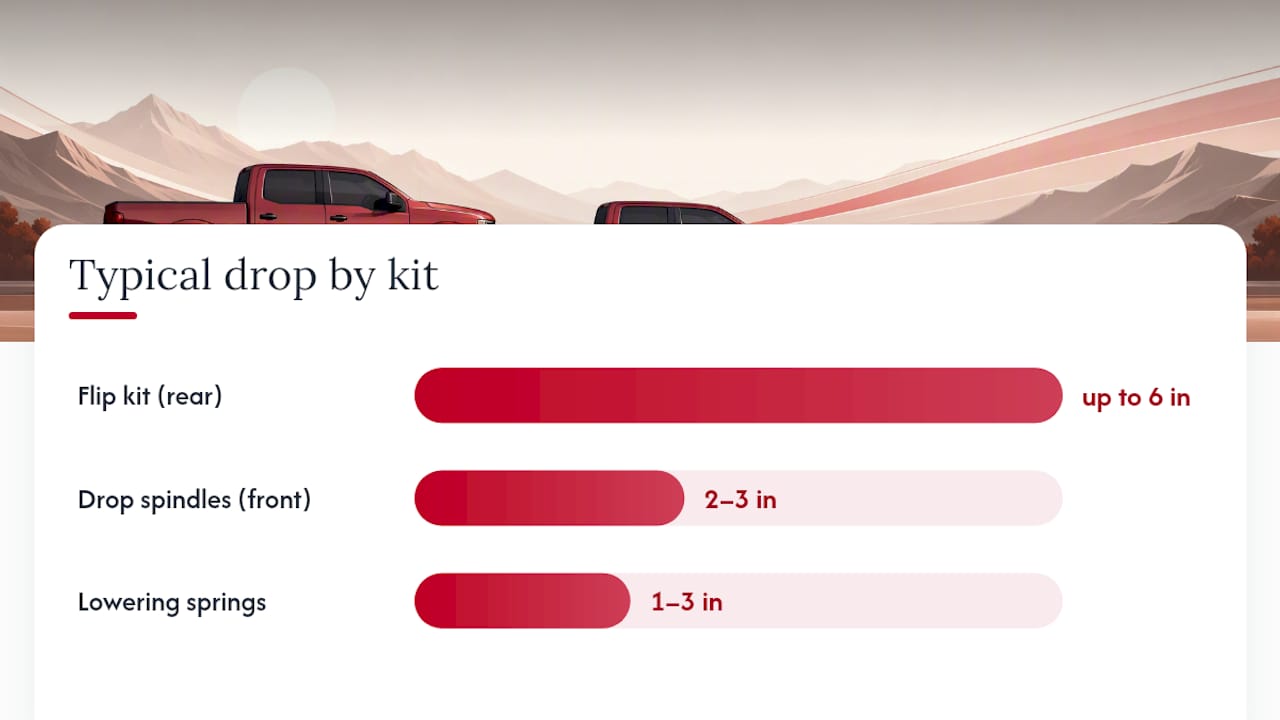
Every lowering kit changes ride height, but they get there differently, and that difference decides whether your truck rides great or rides rough. Drop spindles replace the factory spindle with one that repositions the wheel hub, producing a moderate front drop while keeping factory shocks and geometry mostly intact. They’re a favorite for daily drivers because they preserve most of the factory ride quality better than cutting or swapping springs.
Lowering springs compress the ride height by using a shorter, stiffer coil, usually good for 1 to 3 inches. Torsion key adjustments work on torsion-bar front ends (common on older GM and Dodge trucks) and let you dial in a drop without new springs at all, though there’s a ride-quality ceiling before you need spindles too. Coilovers are the adjustable, premium route: threaded bodies let you set ride height precisely and revisit it later, which is why performance builders lean on them despite the higher installation complexity.
On the rear end, leaf-spring or shackle swaps are the cheap, easy path for solid-axle trucks. Flip kits relocate the axle above the leaf springs for drops up to 6 inches, but they eat into ground clearance and load capacity fast. Airbags solve that problem by letting you air up for hauling and drop for cruising.
| Kit type | Typical drop | Best for |
|---|---|---|
| Drop spindles | 2 to 3 in (front) | Daily drivers, factory ride feel |
| Lowering springs | 1 to 3 in | Show trucks, moderate stance |
| Coilovers | Adjustable | Performance builds, resale flexibility |
| Flip kit | Up to 6 in (rear) | Aggressive stance, light hauling |
| Airbags | Adjustable | Trucks that still tow or haul |
Pro Tip: If your truck runs torsion bars, don’t assume lowering springs apply to you. Torsion keys and spindles are the front-end tools on those platforms.
How Much Does It Cost to Lower a Truck?
Budget for a wide range because the total depends entirely on how far you’re dropping and what your suspension needs to get there. A basic bolt-on kit with professional installation typically runs $600 to $1,200. Mid-range and premium builds, especially anything involving coilovers or air management, climb well past that once you add labor and alignment.
Going for a bigger drop changes the math fast. A 4-inch drop project commonly lands around $2,000 to $3,000 for a basic build, with premium coilover-and-fabrication jobs costing considerably more.
- Kit complexity (springs vs. coilovers vs. air) drives most of the cost swing
- Labor hours add up fast on flip kits and anything needing new control arms
- Alignment is not optional after a drop, budget for it separately
- Your local labor rate matters as much as the parts themselves
New-model trucks add a timing wrinkle. When suspension architecture changes on a fresh platform, like recent updates to the Silverado line, aftermarket kit availability can lag the new model by several months to a year. If you just bought a current-year truck, call ahead before assuming a kit exists.
What Does Lowering Kit Installation Actually Involve?
Installation is not a weekend bolt-on for most kits, especially anything touching the front end or requiring a flip kit. Here’s the general sequence:
- Disassemble the affected suspension corner (springs, spindles, or leaf pack)
- Install the new component (spindle, spring, coilover, or shackle)
- Verify shock length and travel against the new ride height
- Check bump stop clearance so the suspension doesn’t bottom out
- Reassemble, torque to spec, then get a full alignment
- Road test and recheck torque after the first few hundred miles
Common fitment pitfalls show up here, not on paper. Brake lines and wheel wells can rub after a drop that looked fine on a spec sheet. Wheel offset that worked stock can suddenly hit the fender. Steering geometry shifts enough on aggressive drops to introduce bump steer if nobody checks it.
- DIY works for basic spring swaps if you have a lift and alignment access
- Hire a pro for coilovers, flip kits, or anything touching steering geometry
- Ask any installer for their alignment specs and whether labor carries a warranty
Pro Tip: Always ask an installer if they’ll road test the truck before calling the job done. A five-minute drive catches clunks and bump steer that a static inspection misses.
Does Lowering a Truck Hurt Ride Quality or Hauling Capacity?
Yes, to a degree that scales with how far you drop. Less suspension travel means a stiffer ride and more bottoming-out risk over potholes. Camber and roll center shift, which can chew through tire shoulders faster than stock. Aggressive rear drops sometimes introduce bump steer if nobody corrects the geometry.
- Stiffer ride and reduced compliance over rough pavement
- Altered camber can accelerate uneven tire wear
- Less suspension travel means less capacity to absorb a heavy payload
Towing takes the biggest hit. Dropping the rear reduces the suspension’s remaining travel, so a loaded bed can bottom out on bumps that a stock truck shrugs off. Helper springs or airbags built for towing restore usable capacity without giving up the lowered look full time.
Pro Tip: If you tow even occasionally, don’t lower and forget. Pair the drop with helper bags from day one instead of retrofitting them after you’ve already scraped a hitch.
How Do You Choose the Right Lowering Kit for Your Truck?
Start with three questions: what’s your target drop in inches, what’s your suspension type (torsion bar, independent front suspension, or solid axle), and do you still need to haul or tow? Those three answers eliminate most of the wrong options before you even look at parts.
- Confirm your suspension architecture, torsion keys don’t work on coil-over-shock IFS trucks
- Pick a target drop in inches, not a vague “lower” goal
- Factor in your wheel and tire package, aggressive offsets need more clearance
- Decide if hauling or towing stays in the picture
When you’re talking to a seller or installer, ask directly: does this kit fit my exact model and year? What’s included, shocks, hardware, bump stops, or just the springs? What’s the return and warranty policy if fitment is wrong? Is professional installation required or recommended?
Watch for red flags. Vague fitment language (“fits most half-tons”) instead of your exact model and year is a warning sign. So is a kit with no shock recommendation, since mismatched shocks after a drop cause premature wear and a harsh ride. A quoted price that excludes hardware or shocks looks cheap until you’re back at the register buying the parts they left out.
| Buying signal | What it means |
|---|---|
| Vehicle-specific fitment tool | Kit is verified for your exact model and year |
| Clear parts list | You know if shocks and hardware are included upfront |
| Warranty and return policy | Protection if fitment or parts are wrong |
| Pro-install recommendation | Signals complexity and steers you toward a qualified shop |
A vehicle selector that confirms your exact year, trim, and drivetrain before checkout is the single best predictor of a kit that fits the first time.
What Should You Never Do When Lowering a Truck?
Never cut coil springs to save money. Cutting a spring changes its rate unpredictably and usually produces a harsh, unstable ride compared to a purpose-built lowering spring. Never ignore shock length after a drop, a shock that bottoms out internally will fail early and can hang the truck at the worst moment.
- Don’t cut springs, ever, use purpose-made components instead
- Don’t skip alignment after any drop, even a modest one
- Don’t guess on bump stops, verify they match your new ride height
- Match shock valving to your new spring rate before you drive it hard
Pro Tip: Chasing an extra half inch of drop rarely improves the look enough to justify the ride and resale trade-off. Build to a height you’ll actually enjoy daily.
A Straightforward Take From Ozkonic Kustomz
We vet every lowering kit component we sell and back it with real fitment support, not guesswork. If you’re unsure what fits your truck, use our selector or reach out, we’ll help you source the right parts the first time.
Where Should You Buy a Truck Lowering Kit?
Sourcing the wrong kit online is how most fitment nightmares start. Ozkonic Kustomz solves that by sourcing directly from vetted manufacturers, so what shows up on your porch actually matches your truck’s suspension architecture instead of a generic listing that “fits most” half-tons.
Every kit on the site runs through a fitment check before it reaches checkout, backed by a clear warranty and return policy if something doesn’t line up. Browse hardware and components like the modular wiring kit or check platform-specific guidance like the Ram 1500 fitment and install notes if you’re building that platform. Weighing air suspension for a truck that still hauls? The air ride suspension primer walks through the trade-offs. If you’re not sure what fits, run your truck through the vehicle selector or contact Ozkonic Kustomz directly before you buy, that one step prevents nearly every return.