
For most truck owners and RV users, adjustable air helper springs paired with towing-rated shocks give the best balance of sag control, ride quality, and daily drivability. That said, the right pick depends on how often you tow, what you’re pulling, and whether your load changes week to week.
Quick scenario guide:
- Light or occasional towing: Rubber jounce bumper kits (Timbren SES or SumoSprings) are low-maintenance, bolt-on solutions with no air lines to manage.
- Frequent heavy towing: Adjustable air helper springs with an onboard compressor give you on-the-fly pressure control as loads shift.
- Slide-in truck campers: Progressive overload leaf springs or SumoSprings handle constant, predictable loads without the complexity of an air system.
- Payload-limited trucks: Stick within OEM ratings first. Helper springs manage sag; they don’t expand your legal payload.
One safety rule applies to every scenario: the 80% towing rule recommends staying at or below 80% of your vehicle’s published tow rating, and tongue weight should land between 10–15% of the trailer’s gross vehicle weight. See the how-to-choose section below for the full checklist.
Key Takeaways
The most effective towing suspension upgrades pair adjustable air helper springs with towing-rated shocks for variable loads, or progressive overload leaf springs for constant heavy-duty use, always within OEM tow and payload ratings.
| Point | Details |
|---|---|
| Match upgrade to load pattern | Air springs for variable loads; overload leafs or rubber bumpers for constant, predictable loads. |
| Always pair springs with shocks | Adding spring support without upgrading shocks leaves handling unsettled and can worsen trailer sway. |
| The 80% rule applies to everyone | Tow at or below 80% of your published tow rating for better braking, less sway, and reduced wear. |
| Upgrades don’t raise official ratings | No suspension modification changes your GVWR, GCWR, or manufacturer tow rating — manage load within existing limits. |
| Ozkonickustomz for verified fitment | Ozkonickustomz sources direct from vetted manufacturers with confirmed year/make/model fitment and warranty coverage. |
Table of Contents
- Which upgrade fits your towing scenario?
- 1. Air helper springs (airbags)
- 2. Rubber spring / jounce bumper helper kits (Timbren SES, SumoSprings)
- 3. Overload / assist leaf springs
- 4. Helper coil springs
- 5. Upgraded shocks and struts (heavy-duty / towing-rated)
- 6. Weight-distribution hitch and sway-control systems
- How to choose the right upgrade for your truck or RV
- What installation costs and maintenance look like
- What suspension upgrades cannot do
- How Ozkonickustomz helps you order the right kit
- The upgrade most guides skip telling you
- Suspension parts that fit your truck, ready to ship
- Sources
Which upgrade fits your towing scenario?
Two trucks with identical tow ratings can behave very differently under load because suspension design, axle ratings, and chassis stiffness all shape real-world performance. This table maps common scenarios to practical upgrade options.
| Towing scenario | Top upgrade options | Primary benefit | Caution / compatibility note | Next step |
|---|---|---|---|---|
| Light / occasional towing | Timbren SES or SumoSprings | Sag reduction, zero maintenance | Leaf-spring platforms only for most kits | Measure tongue weight; confirm leaf vs coil platform |
| Frequent heavy towing | Adjustable air helper springs + towing shocks | Adjustability, ride quality | Requires air lines; leak risk if neglected | Check GVWR/payload; add compressor for convenience |
| Daily work truck, constant load | Overload / assist leaf springs | Mechanical durability, fixed support | Stiffer unloaded ride | Verify axle rating and spring pack compatibility |
| Slide-in truck camper | Progressive overload leafs or SumoSprings | Predictable support for fixed load | Confirm bed length and axle code before ordering | Weigh loaded camper; match spring rate to load |
| Travel trailer with sway concerns | Air springs + weight-distribution hitch + sway control | Stability, front-axle load restoration | WD hitch required when trailer unloads front axle | Measure tongue weight; consult installer for WD setup |
1. Air helper springs (airbags)
Air springs mount between the frame and axle and use pressurized air to support the rear suspension under load. Pressure adjusts from inside the cab or via a manual valve, making them the most flexible option for owners who tow varying loads week to week.
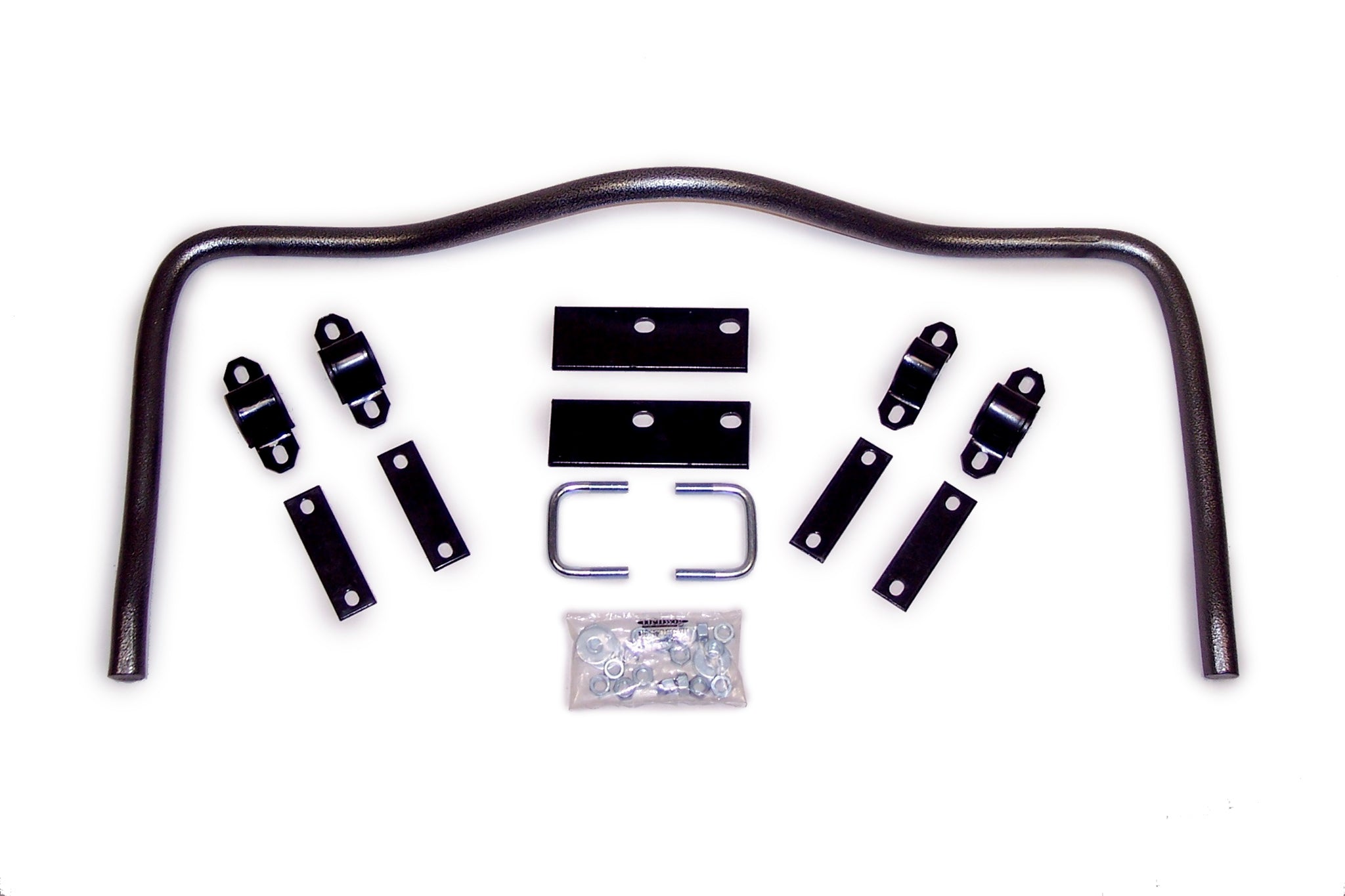
Pros: On-the-fly adjustability, excellent sag control, compatible with most leaf-spring and some coil-spring platforms, good ride quality when properly tuned.
Cons: Air lines and fittings can leak over time; compressors add cost and wiring complexity; periodic inspection required. An onboard compressor adds $150–$400 to the system cost but makes pressure adjustments far more practical.
Installation complexity: Moderate. Most kits are DIY-friendly with basic hand tools, but routing air lines and wiring a compressor benefits from shop experience.
Pro Tip: Never run air bags at maximum pressure as a substitute for staying within your payload rating. Overinflating to compensate for an overloaded truck masks the problem and can damage the bags and frame mounts.
2. Rubber spring / jounce bumper helper kits (Timbren SES, SumoSprings)
These kits replace or supplement the factory jounce bumpers with progressive-rate rubber or microcellular urethane springs. They engage only when the suspension compresses under load, so they’re completely passive — no air, no maintenance, no moving parts.
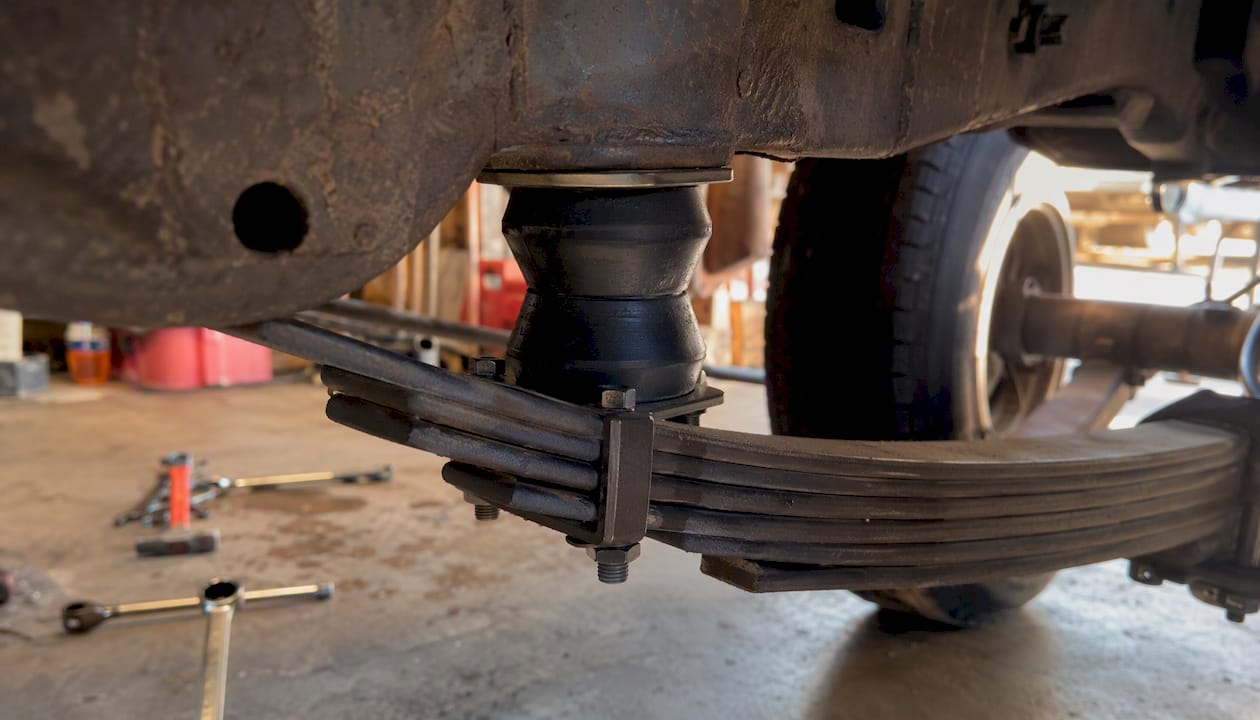
Pros: Zero maintenance, no leak risk, bolt-on installation (often under 30 minutes), good for predictable loads. Timbren SES and SumoSprings are the two most widely used options in this category.
Cons: Fixed rate means no adjustability; unloaded ride can feel slightly firmer depending on kit and vehicle. Not ideal if your towing weight changes significantly between trips.
Installation complexity: DIY-friendly. No drilling, no air lines, no special tools on most applications.
3. Overload / assist leaf springs
An add-a-leaf or overload spring pack adds one or more leaves to the existing rear spring pack, increasing the spring rate and load capacity. This is the traditional solution for work trucks that carry consistent, heavy loads.
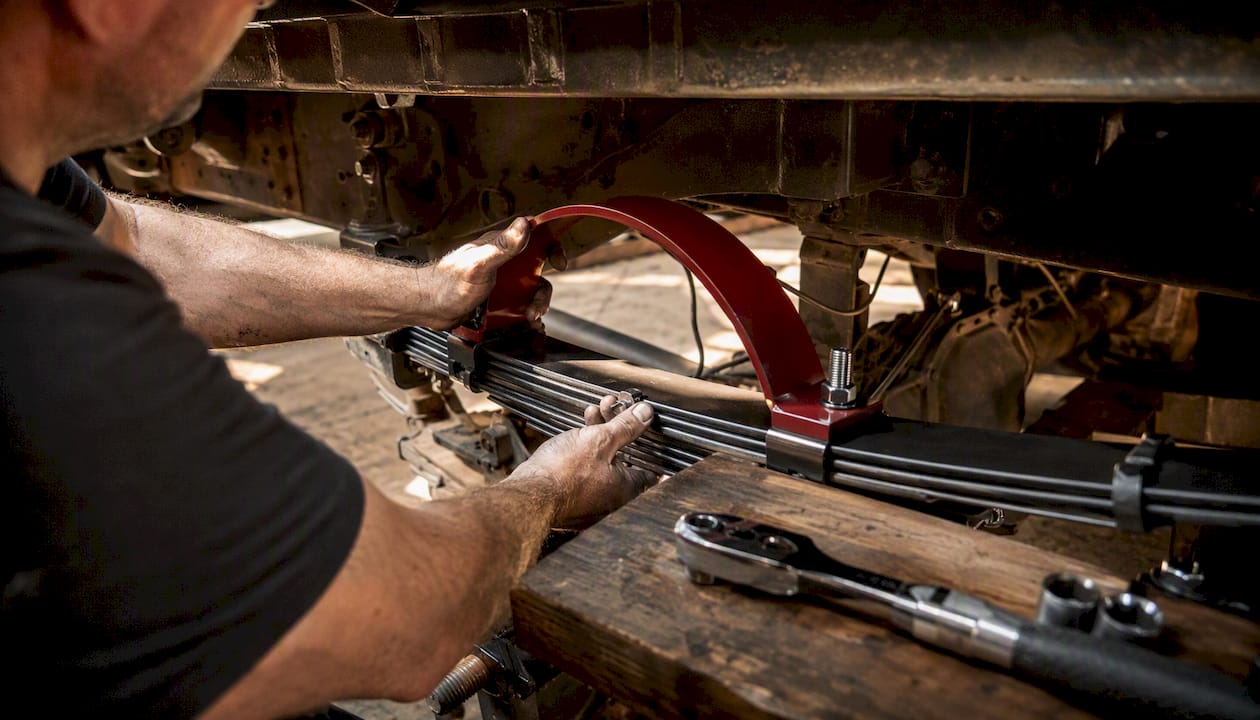
Pros: Mechanically simple, durable, no maintenance beyond periodic inspection, cost-effective for constant-load applications.
Cons: Stiff unloaded ride is the main complaint. Less adjustable than air springs. Diesel Army’s comparison notes that overload leafs can make daily driving noticeably harsher when the truck is empty.
Installation complexity: Moderate. Requires spring pack disassembly; most owners prefer a shop install to avoid alignment and torque issues.
4. Helper coil springs
For trucks on independent rear suspension or coil-spring rear setups, helper coil springs or coil spring spacers add rate without replacing the factory spring. Less common than leaf-spring solutions but relevant for certain half-ton platforms.
Pros: Works on coil-spring platforms where leaf options don’t apply; improves load capacity without full spring replacement.
Cons: Limited adjustability; compatibility is narrower than leaf-spring kits. Verify platform fitment carefully before ordering.
Installation complexity: Moderate to difficult. Coil spring compression is involved; professional installation is strongly recommended.
5. Upgraded shocks and struts (heavy-duty / towing-rated)
Adding spring support without upgrading the shocks is one of the most common mistakes in towing suspension upgrades. Spring support without matching damping leaves the truck bouncy and unsettled, especially on rough roads with a trailer attached. Heavy-duty or towing-rated shocks control the additional spring energy and keep the rear planted.
Pros: Dramatically improves handling, reduces trailer sway, extends tire life, and complements any spring upgrade. Brands like Bilstein 5100, Fox 2.0, and Rancho RS9000XL are widely used for towing applications.
Cons: Shocks alone don’t fix sag; they work best paired with a spring upgrade. Worn shocks are often overlooked until handling degrades noticeably.
Installation complexity: DIY-friendly on most trucks. Rear shock replacement typically takes 1–2 hours per side with basic tools.
6. Weight-distribution hitch and sway-control systems
A weight-distribution hitch (WD hitch) uses spring bars to redistribute tongue weight from the rear axle back to the front axle, restoring steering feel and braking balance. Sway-control bars or friction sway controls add resistance to trailer yaw. These are not suspension upgrades in the traditional sense, but pairing them with spring and shock upgrades is often the single biggest improvement in overall towing stability.
Pros: Restores front-axle load, reduces trailer sway, improves braking feel, required by many manufacturers when tongue weight exceeds a threshold.
Cons: Adds setup time at the hitch; requires correct adjustment for each trailer; not a substitute for staying within tow ratings.
Installation complexity: Moderate. Initial setup and spring bar tension adjustment benefit from professional guidance, especially for first-time users.
How to choose the right upgrade for your truck or RV
Follow these steps before ordering anything.
- Pull your vehicle’s ratings. Find GVWR, GAWR (front and rear), payload capacity, and published tow rating on the door-jamb sticker or owner’s manual. These are your hard limits.
- Weigh your actual load. Use a truck-stop scale or tongue-weight scale to measure loaded tongue weight and total trailer weight. Tongue weight should be 10–15% of trailer gross weight.
- Apply the 80% rule. Staying at or below 80% of your tow rating improves braking control, reduces sway risk, and reduces wear on drivetrain and suspension components.
- Choose adjustable vs. fixed. If your towing weight varies, go adjustable air springs. If you carry a consistent heavy load, overload leafs or rubber bumper kits are simpler and more durable.
- Inspect your shocks. If they’re original equipment past 50,000 miles or showing oil leaks, replace them with towing-rated units at the same time as any spring upgrade.
- Evaluate your hitch setup. If tongue weight exceeds your truck’s front-axle threshold or you notice the front end lifting under load, add a weight-distribution hitch and sway control.
- Confirm fitment before buying. Year, make, model, bed length, cab style, drivetrain, and axle code all affect which kit fits. A model-specific fitment check prevents the most common ordering mistakes.
Red flags to watch for: never assume a suspension upgrade raises your official tow rating (it doesn’t), avoid mismatched kits on lifted trucks without verifying geometry, and don’t use excessive air pressure to compensate for an overloaded truck.
What installation costs and maintenance look like
Professional installation is strongly recommended for coil spring work, any modification involving frame drilling, and initial WD hitch setup. Brake upgrades should be evaluated alongside suspension changes, since braking performance is often the first limiting factor when towing near capacity. For bolt-on upgrades like Timbren kits and rear shocks, most mechanically confident owners can handle the install at home.
What suspension upgrades cannot do
Suspension upgrades improve how your truck manages its rated load. They do not increase your vehicle’s GVWR, GCWR, or manufacturer-published tow rating. A truck rated to tow 10,000 lbs is still rated to tow 10,000 lbs after airbags are installed. The upgrade helps you use that capacity more safely and comfortably — it does not expand it.
Common misperceptions worth clearing up:
- “Airbags increase towing capacity.” No. They reduce sag and improve load leveling within existing ratings.
- “Bigger tires increase tow rating.” No. Tire load ratings affect payload math, but they don’t change the manufacturer’s tow rating.
- “A suspension lift increases what I can tow.” No. Suspension lift kits change geometry and can affect tongue-weight angles; always verify hitch height and ball mount drop after a lift.
Check your state’s DMV regulations if you’re altering vehicle height or axle configurations, since some modifications require re-inspection or affect registration class. Return to the how-to-choose checklist above to verify capacity and fitment before ordering.
How Ozkonickustomz helps you order the right kit
Fitment mistakes are the most expensive part of any suspension project. The wrong bracket type, a kit built for a stock truck on a lifted application, or a mismatched axle width can mean a return, a delay, and a truck that’s still sagging.
Before ordering, confirm: year, make, model, cab style, bed length, drivetrain (2WD vs 4WD), and rear axle code. Check whether the kit specifies stock ride height or lifted applications. Verify the warranty terms and materials — quality air bag kits use reinforced rubber or polyurethane bladders, and reputable spring kits specify steel grade and coating.
Pro Tip: Photograph your frame rails, axle mounting area, and existing spring pack before ordering. Measurements of the mounting hole spacing and available clearance take five minutes and prevent the most common fitment errors.
Ozkonickustomz sources directly from vetted manufacturers, so every part carries verified fitment data and real warranty coverage. If you’re unsure whether a kit fits your specific truck, their support team can confirm compatibility before you place the order — no guesswork, no counterfeit parts.
The upgrade most guides skip telling you
Most towing suspension content stops at “install airbags and upgrade your shocks.” That’s solid advice, but it misses the real decision most truck owners face: whether the upgrade they’re considering actually matches how they use their truck.
Adjustable air springs are genuinely the best all-around option for owners who tow different trailers at different weights. But for a contractor running a slide-in camper at near-max payload every single day, a simple set of progressive overload leafs or SumoSprings is more durable, lower maintenance, and frankly a better fit. The adjustability of air springs is only valuable if you actually use it.
The other thing most guides understate: the weight-distribution hitch is often more impactful than any spring upgrade for travel trailer owners. A WD hitch restores front-axle load, which directly improves steering response and braking feel. Spending $800 on a quality WD hitch and sway control will often do more for real-world towing safety than $600 in airbags alone — especially if the trailer is long and heavy.
Finally, shocks are chronically underrated. Owners spend money on spring support and then wonder why the truck still feels unsettled. The spring controls sag; the shock controls what happens after the spring compresses. Skip the shock upgrade and you’ve done half the job.
Suspension parts that fit your truck, ready to ship
Sorting through suspension kits online is straightforward until you hit the fitment wall: wrong axle code, wrong bracket for a lifted application, or a kit that technically “fits” your year but not your cab and bed combination.
Ozkonickustomz sources suspension components directly from vetted manufacturers, with fitment verified by year, make, model, drivetrain, and axle configuration. Every part ships with real warranty coverage, and if you’re not certain a kit fits your specific truck, support is available before you order. No returns from guessing wrong, no waiting on a part that never should have shipped. Browse the suspension catalog at Ozkonickustomz and find the kit built for your exact setup.
Sources
- What is the 80% rule for towing capacity? | Safe Towing Guide | Reese Hitches
- What is the 80 towing rule? | Chavez Towing
- Top Tow-Vehicle Suspension Upgrades for RVers - Camper Report
- Towing capacity guide | KBB
- Best Suspension Upgrade for Towing Loads - HCR Custom Fabrication
- Towing Suspension Upgrades: Pros And Cons Of Each Option | Diesel Army