

A tire’s load rating, called the load index, is a numeric code molded into the sidewall that tells you the maximum weight one tire can carry when inflated to its rated pressure. The practical rule is simple: never install a replacement tire with a lower load index than your vehicle’s placard requires. Match it or go higher. Going lower risks tire failure under normal driving weight.
TL;DR:
- Always verify that the replacement tire’s load index meets or exceeds your vehicle’s minimum rating, especially after adding aftermarket modifications.
- Keep in mind that the load capacity depends on proper inflation at maximum rated pressure; under-inflation reduces actual carrying ability.
- Be aware that higher load ranges indicate stronger casings and higher maximum pressures, but may result in a firmer ride and require compatible wheels.
- When towing or carrying extra weight, recalculating per-axle loads is essential to ensure tires can handle the increased load safely.
- Reassess your tire’s load and inflation specifications if you modify your vehicle’s weight distribution, suspension, or add heavy aftermarket accessories.
Table of Contents
- What Is a Tire Load Rating and How Do You Convert It to Pounds?
- Load Range vs. Load Index: What’s the Difference?
- How Do You Read the Sidewall and Vehicle Placard for the Right Rating?
- How Does Air Pressure Change What a Tire Can Actually Carry?
- When Do Upgrades or Towing Change Your Load Requirements?
- Can You Use a Higher Load Rating Than Your Vehicle Requires?
- Final Checklist Before You Buy Replacement Tires
- Why Aftermarket Upgrades Demand a Second Look at Your Tires
- Ozkonic Kustomz’s Take: Re-checking Load Ratings After You Modify Your Truck
- Sources
What Is a Tire Load Rating and How Do You Convert It to Pounds?
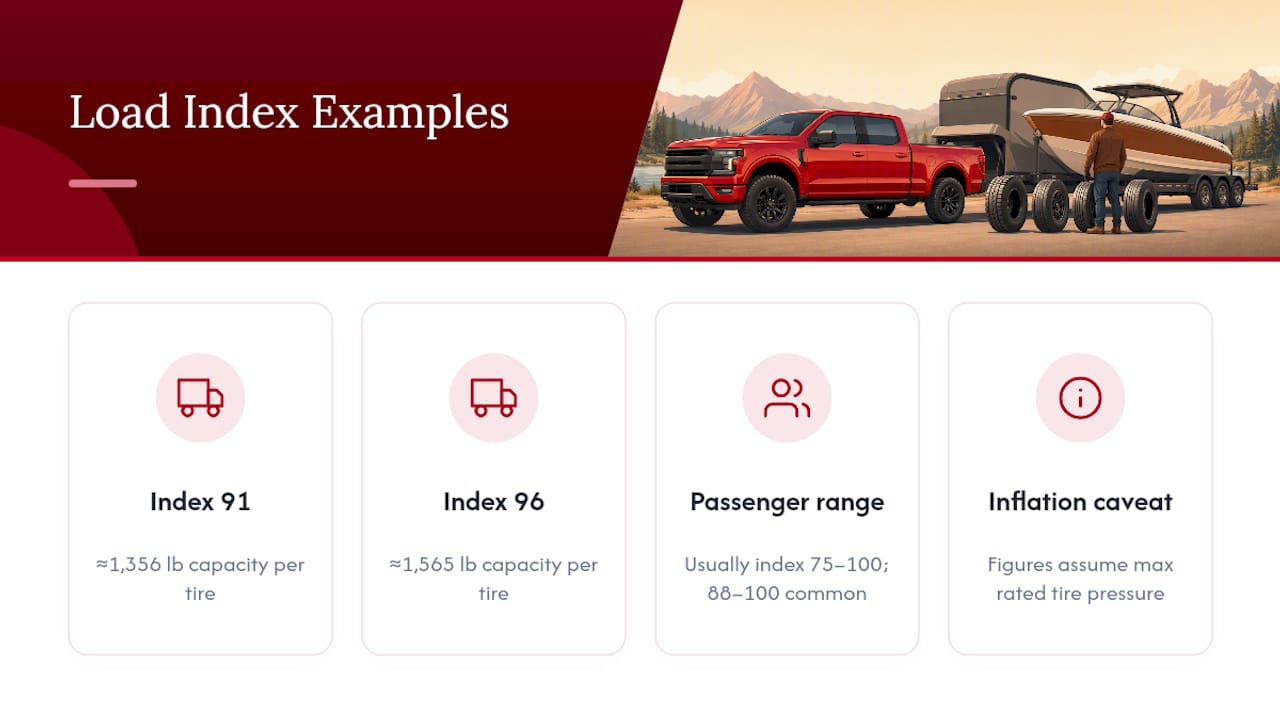
The load index isn’t a weight itself. It’s a code that points to a weight, and you need the standardized load index chart to translate it. A tire marked with load index 91, for example, corresponds to roughly 1,356 pounds of capacity per tire. Bump that to 96, and you’re at around 1,565 pounds. Passenger car tires typically fall somewhere between index 75 and 100, with most family sedans and crossovers landing in the 88 to 100 range.
Here’s the catch that trips people up: that weight figure only holds true when the tire is inflated to its maximum rated pressure, not whatever number happens to be in it right now. Michelin’s own guidance on this is blunt about it. Drop the pressure and you drop the real-world capacity, even though the sidewall number hasn’t changed.
Once you know your vehicle’s required index, this chart is the fastest way to check whether a tire you’re considering actually clears the bar.
Load Range vs. Load Index: What’s the Difference?
Load index gives you a precise number. Load range gives you a letter, and the two aren’t interchangeable shorthand for the same thing. Load range is a legacy ply-rating system that describes how strong a tire’s internal casing is and what maximum cold inflation pressure it’s built to handle.
- Load Range C typically tops out at a moderate maximum cold inflation pressure and shows up on lighter-duty light truck tires.
- Load Range D commonly runs to a higher typical inflation pressure, used on tires expected to carry moderate cargo or trailer weight.
- Load Range E is a common rating for three-quarter and one-ton trucks, with a higher maximum inflation pressure.
- Load Range F and above (including G and H) appear mostly on heavy commercial and RV applications, often with considerably higher maximum inflation pressures.
The comparison that trips owners up most is load range E vs. D: stepping up a letter buys you a stiffer casing and higher max pressure, which usually means real capacity gains for towing. But letters are comparative, not absolute. One brand’s Load Range E tire won’t necessarily match another’s pound for pound. Always check the manufacturer’s specific load and inflation table before assuming two tires with the same letter perform the same.
How Do You Read the Sidewall and Vehicle Placard for the Right Rating?
Every tire carries a service description string on its sidewall, something like “P225/65R17 102H” or “LT265/75R16 123/120S.” The number right before the speed symbol letter is your load index. On light truck (LT) tires, you’ll sometimes see two numbers separated by a slash, like 123/120.
- Find the size and service description on the tire’s sidewall, usually just after the size numbers.
- Identify the load index (the number) and the speed symbol (the letter that follows).
- If two numbers appear, note that the first is for single-wheel use and the second for dual-wheel axles.
- Check the max cold inflation pressure stamped near the load index, separate from the placard PSI.
- Compare that number against your vehicle’s placard, found on the driver’s door jamb or in the owner’s manual.
- Confirm the replacement’s index meets or exceeds the placard’s minimum requirement before buying.
Dual ratings matter because dual-wheel axles reduce per-tire allowable load, so mixing a tire with mismatched dual capacity onto a dually axle is a real hazard, not a technicality.
How Does Air Pressure Change What a Tire Can Actually Carry?
Load capacity and inflation pressure are directly linked, not loosely related. A tire’s rated capacity assumes it’s holding its maximum cold inflation pressure, and every PSI you’re running below that number chips away at how much weight the tire can safely support. That’s why Continental’s technical documentation treats under-inflation as a genuine safety issue rather than a minor efficiency loss.
Your vehicle’s door placard PSI is calibrated for normal daily driving, not maximum load. When you’re hauling a full bed, towing a trailer, or loading up for a long trip, you often need to run closer to the tire’s maximum cold PSI (never past it) to unlock the rated capacity. Exceeding the tire’s stamped max pressure is never the answer, regardless of load.
Pro Tip: Check pressure only when the tires are cold, meaning before the vehicle has been driven that day. Cross-reference your target PSI against the manufacturer’s load and inflation table for your exact tire model, then recheck pressure after the vehicle is loaded, since weight itself doesn’t change PSI but temperature and driving will.
When Do Upgrades or Towing Change Your Load Requirements?
Add a steel front bumper, a winch, a set of larger wheels, or a lift kit, and you’ve quietly shifted weight distribution across your axles. What fit comfortably within your original tire rating on the day you bought the truck might not anymore.
- Steel bumpers alone can add 100 to 200 pounds up front, shifting weight onto the front axle tires.
- Winches, roof racks, and long-range fuel tanks stack additional pounds that the factory tire spec never accounted for.
- Cargo and trailer tongue weight load the rear axle disproportionately during towing.
The math is straightforward: calculate your gross axle weight when fully loaded, meaning curb weight plus cargo, passengers, and gear, then divide by the number of tires on that axle. If that per-tire figure creeps past your current load index capacity, it’s time to size up. Consult the manufacturer’s load and inflation table for the specific model, weigh a higher load index or load range, and double check that your wheels are rated to handle it too.
Can You Use a Higher Load Rating Than Your Vehicle Requires?
Yes, and it’s often the smarter move if you tow regularly or haul heavy gear. The rule runs one direction only: higher load index is permitted, lower is not. Choosing a higher-rated replacement gives you margin, but it comes with trade-offs worth knowing before you buy.
- Expect a firmer ride, since higher load range tires typically run stiffer sidewalls and casings.
- Confirm your wheels are rim-width approved for the new tire, especially when jumping load ranges (like load range E vs. C).
- Check that the speed rating still matches or exceeds your vehicle’s requirement, since load range changes sometimes shift the speed symbol too.
- Verify single/dual compatibility if you’re running a dual-wheel axle.
Final Checklist Before You Buy Replacement Tires
Run through this before handing over payment, whether you’re at a counter or ordering online.
- Confirm the new tire’s load index meets or exceeds your vehicle’s door placard rating.
- Pull up the manufacturer’s specific load and inflation table for that exact tire model, not a generic chart.
- Check max cold inflation pressure and, on LT tires, both single and dual ratings if applicable.
- Verify your wheels carry the correct rim approval and that the speed rating still fits your driving needs.
- If you’ve added aftermarket weight or plan to tow, size up rather than match the minimum, and ask a tire professional when the numbers seem borderline.
Why Aftermarket Upgrades Demand a Second Look at Your Tires
Owners who bolt on a lift kit, a winch, or a heavy steel bumper rarely think to revisit their tire rating, but that’s exactly when it matters most. Added weight up front or in the bed shifts axle loads the factory spec never planned for.
Before your next trip, run the gross axle weight math, cross check it against your tire’s load index table, and confirm your wheels can handle any upgrade. If your suspension is sagging under the new load, a suspension upgrade paired with a higher-capacity air spring kit often solves the ride height problem while your tire choice handles the weight itself.
Ozkonic Kustomz’s Take: Re-checking Load Ratings After You Modify Your Truck
Most owners upgrade suspension, bumpers, or wheels without ever revisiting the tire math underneath them, and that’s the gap that causes trouble down the road. A lift kit changes geometry. A winch and steel bumper add real pounds to the front axle. None of that shows up until you’re loaded down on a highway grade and the tires are working harder than their rating allows.
Our honest read: if you’ve touched your truck’s weight distribution in any meaningful way, recalculate your per-axle load, pull the tire manufacturer’s inflation table, and confirm your wheels are rated for whatever tire you land on. Pairing the right performance tire with correctly matched suspension components isn’t optional once you’ve modified the truck. It’s the difference between a build that handles right and one that’s quietly overloaded.
— Ozkonic Kustomz
Sources
- Tire Load Rating & Speed Rating Explained – Michelin USA
- How to read tire load index – Pirelli
- Load Range vs Load Index: What’s the Difference? – TruckTireGuide
- Tire load index (LI): Everything you need to know – Continental