
Spray-in bedliners win on long-term protection and rust prevention. Drop-in bedliners win on upfront cost and the ability to pull them out and sell them separately. That’s the whole decision in one sentence, but two exceptions matter: a thick, vehicle-specific HDPE drop-in can absorb a hard impact better than a thin spray coat, and if you’re leasing, flipping trucks often, or running a fleet, a removable liner just makes more sense.
- Choose spray-in if: you keep trucks long-term and want bonded rust protection.
- Choose drop-in if: you want low upfront cost, easy removal, or you haul heavy, sharp-edged cargo that benefits from a thick cushioning layer.
Keep reading for the comparison table and the checklist that tells you exactly which one fits your situation.
Key Takeaways
Spray-in bedliners deliver better long-term rust protection through a bonded coating, while drop-in bedliners cost less upfront and offer easier removal for owners who don’t plan to keep their truck long-term.
| Point | Details |
|---|---|
| Rust prevention favors spray-in | The bonded coating seals out moisture, while drop-ins can trap water underneath without regular inspection. |
| Cost favors drop-in | Drop-ins typically run $50 to $400, versus $350 to $1,000 for a professional spray-in job. |
| Impact absorption depends on thickness | A thick, vehicle-specific HDPE drop-in can cushion heavy drops better than a thin spray coating. |
| Prep work determines spray-in success | Skipping sanding, degreasing, or masking steps leads to peeling and moisture problems down the line. |
| Layering adds protection | Combining a spray-in coating with a rubber mat gives bonded rust protection plus extra cushioning. |
Table of Contents
- Spray In vs Drop In Bedliner: The Comparison Table
- Why Do Spray-In and Drop-In Liners Perform So Differently?
- What Do Spray-In and Drop-In Bedliners Cost to Install?
- How Do You Choose Between Spray-In and Drop-In?
- Shop and Product Guidance Worth Knowing Before You Buy
- How Often Should You Inspect and Maintain a Bedliner?
- Verdict: Which Bedliner Should You Actually Buy?
- Environmental and Safety Considerations You Shouldn’t Skip
- What Actually Matters When You’re Picking a Bedliner
- Sources
Spray In vs Drop In Bedliner: The Comparison Table
| Factor | Spray-In | Drop-In |
|---|---|---|
| Upfront cost | Higher | Lower |
| Installation complexity | Professional prep required | Simple, drops straight in |
| Durability / abrasion resistance | Higher (bonded coating) | Moderate to high (depends on material) |
| Rust / moisture risk | Lower (sealed) | Higher (can trap water) |
| Removability | Bonded, not removable | Removable, reusable |
| Appearance / fit | Custom, seamless | Fit varies by model |
| Maintenance / lifespan | Low maintenance, long lifespan | Needs periodic removal and inspection |
Cost is where the two options split hardest. Drop-in liners typically run $50 to $400, while professional spray-in jobs usually land between $350 and $1,000 depending on your bed size and how much prep work the shop has to do.
Notice the pattern: drop-in wins on price and flexibility, spray-in wins almost everywhere protection is the concern. Neither one sweeps the board.
Why Do Spray-In and Drop-In Liners Perform So Differently?
The difference comes down to chemistry and physics, not marketing.
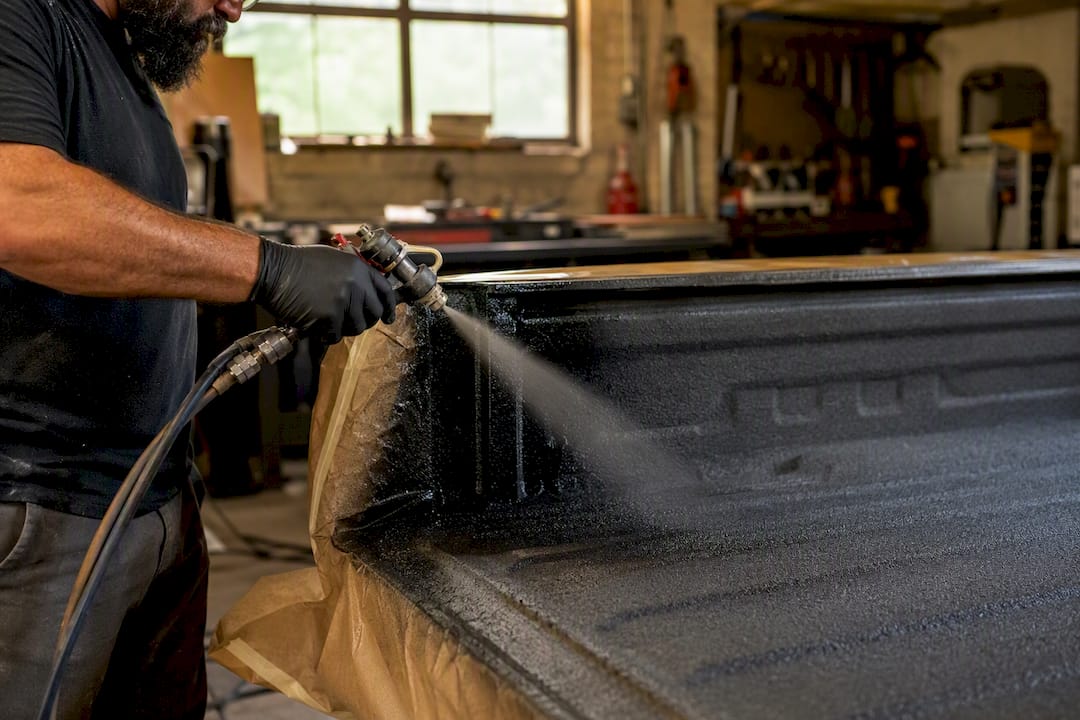
Spray-in liners are typically polyurea or polyurethane sprayed directly onto the bed, where they cure into a single bonded skin. There are no seams, no gaps, and nowhere for water to pool. That’s why spray-in coatings reduce hidden rust risk compared to many drop-in setups: moisture simply has nowhere to hide underneath.
Drop-in liners are usually molded HDPE plastic or heavy rubber, sitting on top of the bed rather than fused to it. That gap between liner and metal is the whole problem. Water, dirt, and salt work their way underneath, and if you never pull the liner to check, corrosion can spread for months before you notice. Drop-in owners who remove and inspect the liner once or twice a year catch this early. Owners who never look don’t.
Impact protection flips the script a bit, though. A thick, properly fitted HDPE drop-in can absorb and distribute puncture energy better than a thin spray coat in a hard drop scenario, since a spray-in transfers a lot of that shock straight into the bed’s sheet metal unless the formula includes an impact-absorbing blend.
Cargo handling has its own tradeoffs:
- Textured spray-in coatings grip cargo well but can chew up furniture edges or scuff softer materials during loading.
- Drop-ins tend to have a smoother surface, which is easier on cargo but lets heavier loads shift more in transit.
Pro Tip: If you haul plywood, drywall, or furniture regularly, test a scrap piece against a spray-in sample before committing. Texture that grips a toolbox can shred a moving box in one trip.
What Do Spray-In and Drop-In Bedliners Cost to Install?
| Item | Drop-In | Spray-In |
|---|---|---|
| Typical price range | $50 to $400 | $350 to $1,000 |
| Install time | Under an hour | Several hours to a full day |
| DIY feasible? | Yes, usually | Only with caution |
| Warranty common? | Sometimes, from manufacturer | Often, from installer |
Spray-in installs live or die on prep work. A shop that does it right will:
- Strip any old coating or liner off the bed completely.
- Sand or scuff the metal so the coating has something to grip.
- Degrease every surface to remove oil, wax, or residue.
- Mask the cab, tailgate seals, and trim before spraying.
Skip any of these steps and adhesion failure becomes far more likely, which means peeling, bubbling, or moisture creeping in behind the coating within a year or two. DIY spray-in kits can work fine for a garage-level job, but they rarely match a professional cure and thickness, so treat them as a budget option, not a shortcut to the same result.
How Do You Choose Between Spray-In and Drop-In?
Match the liner to how you actually use the truck, not to what sounds tougher.
- Heavy hauler or work truck: Go spray-in. Constant loading, tools, and gravel wear through anything less than a bonded coating, and rust prevention matters more the harder you work the bed.
- Occasional hauler or homeowner: A quality drop-in usually covers it. You’re not putting enough abuse on the bed to justify the spray-in premium.
- Fleet, lease, or resale-focused owner: Drop-in wins here too, since fleet operators often prefer removable liners that don’t permanently alter the truck before it goes back or gets sold.
- Appearance or restoration-focused owner: Spray-in, no contest. A seamless factory-look finish reads as intentional, not aftermarket.
Before you buy, answer four questions: What do you actually haul on a normal week? How long do you plan to keep this truck? What’s your real budget, not your ideal one? And do you want the option to swap or remove the liner later? Answer those honestly and the choice mostly makes itself. If you’re weighing this alongside other builds, our guide to truck restoration covers how bed protection fits into a broader resale strategy.
Shop and Product Guidance Worth Knowing Before You Buy
Some of the best protection isn’t either/or. Pairing a spray-in coating with a rubber bed mat gives you the sealed corrosion barrier of the coating plus extra cushioning for heavy or sharp cargo, at the cost of covering up some of that seamless finish.
A layered setup, bonded spray-in coating underneath and a rubber mat on top, preserves the corrosion protection while adding real impact cushioning for owners who haul heavy or abrasive loads regularly.
Before hiring a shop, ask three questions: what prep steps do they follow, is the material polyurea or polyurethane, and what thickness and warranty come with the job? Vague answers are a red flag. Fitment matters just as much on the drop-in side. A liner built for the wrong bed length or wheel-well shape rubs against paint and creates the exact rust problem you bought it to avoid, which is why vehicle-specific liners like SMARTLINER’s custom-fit line are worth the extra research over a generic universal fit.
How Often Should You Inspect and Maintain a Bedliner?
Drop-in liners need hands-on attention. Pull yours out once or twice a year, hose down both sides, and check the bed metal underneath for surface rust before it spreads. Spray-in coatings need less babysitting, but check for deep gouges after any heavy-duty use, since a cut through the coating exposes bare metal to moisture immediately.
- Rinse spills and road salt off both liner types as soon as possible.
- Watch for UV fading on drop-ins left in direct sun for years; it’s cosmetic but signals the material is aging.
- Patch small spray-in scratches with a touch-up kit; deep gouges down to metal need a professional recoat.
- Replace a drop-in once it’s cracked, warped, or no longer sits flush.
Neglect here is exactly how trapped moisture under a drop-in turns into hidden rust that you don’t discover until resale time.
Verdict: Which Bedliner Should You Actually Buy?
Spray-in for long-term protection and rust prevention. Drop-in for lower cost and removability. Now act on it: if you’re leaning spray-in, get 2 to 3 professional quotes and confirm their prep process before you sign anything. If you’re leaning drop-in, pick a vehicle-specific HDPE model and put biannual inspections on your calendar now. Either way, pairing your liner with the right accessories starts with parts that actually fit your truck, which is where Ozkonickustomz comes in.
Environmental and Safety Considerations You Shouldn’t Skip
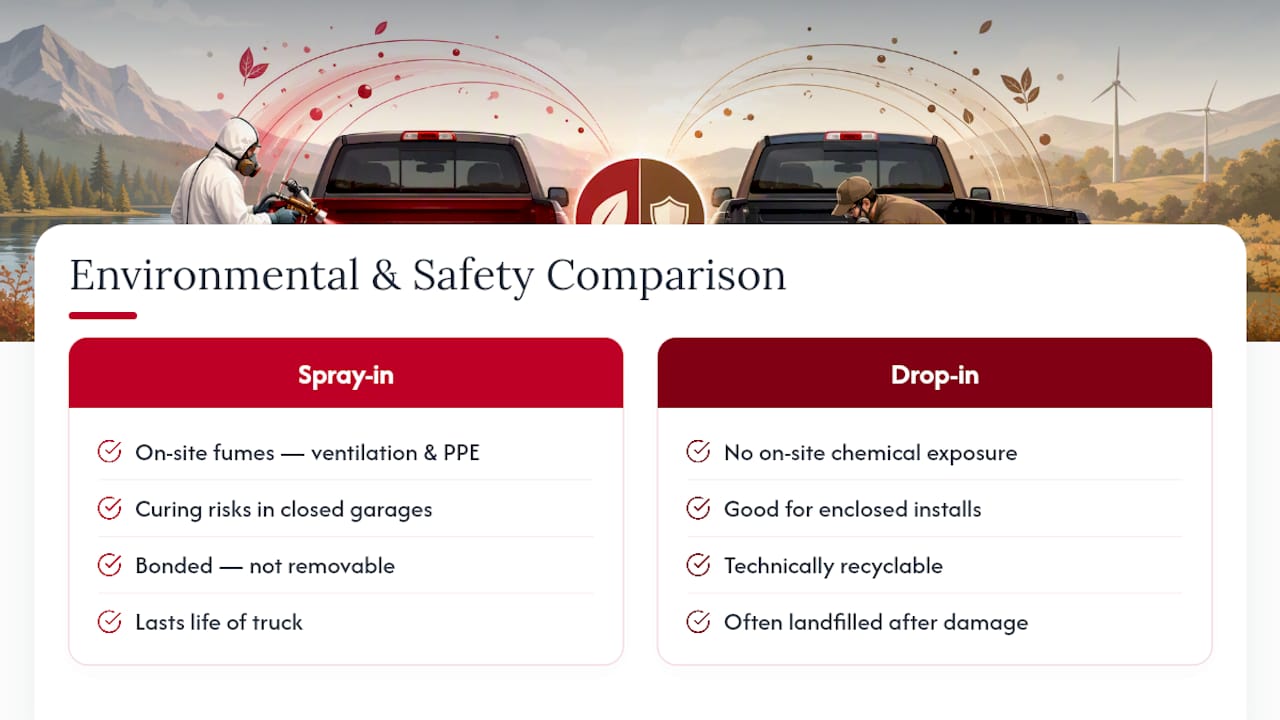
Spray-in coatings are applied wet, and the curing process releases fumes that require proper ventilation and protective gear during application. That’s a shop-safety issue more than a homeowner one, but it’s a real reason DIY spray-in kits deserve caution: a garage without good airflow isn’t the place to cure polyurea correctly, and improper cure can also mean weaker adhesion later.
Drop-in liners are molded plastic or rubber, manufactured off-site and shipped ready to install. There’s no on-site chemical exposure, which makes them the simpler choice if you’re installing in an enclosed space or don’t have spray equipment and ventilation available. The tradeoff shows up later in the product’s life instead of during install: HDPE and rubber liners are recyclable in theory, but most end up in landfill once cracked or replaced, since dedicated recycling streams for automotive plastic liners are limited.
Spray-in coatings, once bonded to the bed, don’t generate waste on their own timeline, they last as long as the truck’s ownership, but they’re also not something you can remove and recycle separately. If environmental footprint matters to your decision, weigh it against how long you’ll actually own the truck. A coating that lasts 10 years with no waste stream can outperform a liner that gets replaced twice in the same period, even if the liner itself is technically recyclable.
What Actually Matters When You’re Picking a Bedliner
Most bedliner content treats this like a durability contest, spray-in wins, case closed. That misses the point. The right liner depends on how long you’re keeping the truck and what you’re actually loading into it, not which material sounds tougher on paper.
The overrated factor is abrasion resistance in isolation. Plenty of owners obsess over which coating scratches least, then ignore rust risk entirely, which is the failure mode that actually costs money at resale. The underrated factor is installer quality. A mediocre spray-in job with rushed prep can underperform a well-fitted, well-maintained drop-in over five years, even though spray-in wins on paper almost every time.
If you take one thing from this, prioritize matching the liner to your ownership horizon before you compare specs. A homeowner keeping a truck for fifteen years and a fleet manager cycling trucks every three years should not be shopping the same way, even if they’re hauling identical cargo.
— Ozkonic Kustomz
Sources
- Spray Vs. Drop-In Bed Liner: Pros And Cons Every Truck Owner Should Know
- Drop-In Vs. Spray-In Truck Bedliner
- Best aftermarket bed liners: spray-on vs drop-in vs BedRug
Recommended
- Lowered Truck Suspension: The Practical Buyer’s Guide – Ozkonic Kustomz LLC
- Best Tacoma Suspension Upgrades by Use Case – Ozkonic Kustomz LLC
- Aftermarket Truck Wheels: Fitment-First Picks for Truck Owners – Ozkonic Kustomz LLC
- F-150 Suspension Upgrades: Picking the Right Tier for Your Truck – Ozkonic Kustomz LLC