
Yes, if you drive on gravel, forest roads, or anything rockier than a parking lot, skid plates are worth it. They stand between your oil pan, transmission, and fuel tank and a rock that costs a lot less to hit than to repair. Pavement-only drivers can usually skip them. The trade-offs are modest: added weight, a little corrosion risk, and periodic cleaning.
TL;DR:
- Skid plates are most valuable for drivers on gravel, forest, or rocky terrain, where impacts can damage critical underbody components like the oil pan and fuel tank.
- Prioritizing protection for the oil pan and fuel tank reduces repair costs and safety risks, especially on rough trails or job sites, rather than installing full coverage systems initially.
- Steel offers toughness and repairability at the cost of added weight, while aluminum reduces weight and corrosion but requires thicker material for equivalent strength, making material choice terrain-dependent.
- Proper fitment verification, considering vehicle specific geometry, drainage, and ventilation, ensures optimal protection and prevents gaps or rattling from universal or poorly fitted skid plates.
- Regular inspection, cleaning, and correct material selection extend skid plate lifespan, but weight and corrosion are trade-offs that must be managed based on driving conditions.
Table of Contents
- Skid Plates Worth It? It Depends on How You Drive
- What Skid Plates Actually Protect and What That’s Worth
- What Skid Plates Cost and How Installation Works
- Steel, Aluminum, or Plastic: Picking the Right Material
- The Trade-Offs Nobody Mentions at the Counter
- How to Prioritize Your Skid Plate Purchase
- Why Fitment Verification Matters More Than the Plate Itself
- The Verdict: Protect the Expensive Stuff First
- A Practical Way to Start: Fitment-Verified Underbody Protection
- Sources
- FAQ
Skid Plates Worth It? It Depends on How You Drive
Not every truck needs armor plating, and figuring out where you fall is the first real step. Your driving pattern determines your risk, and your risk determines your budget.
- Pavement-only commuters: Speed bumps and the occasional pothole rarely threaten ground clearance. Skid plates add weight without much payoff here.
- Gravel and forest-road drivers: Washboard roads throw up loose rock and unexpected ruts. A cracked oil pan on a logging road two hours from cell service is a real scenario, not a hypothetical.
- Overlanders and rock-crawlers: This is the group where protection stops being optional. Ledges, boulders, and deep ruts hit the belly of the truck directly, and factory ground clearance rarely survives a serious trail unscathed.
- Worksite and job-site trucks: Curb strikes, debris piles, and uneven lots wear on the underside just as much as a trail does, especially on lowered work trucks.
Check your own rig before deciding: a low-hanging oil pan, a plastic transmission pan, or visible daylight between the frame rails and the ground are all signs you are more exposed than you think.
What Skid Plates Actually Protect and What That’s Worth
Skid plates exist to keep a rock, stump, or curb from turning a five-minute obstacle into a five-hour recovery. The parts at risk are the oil pan, transmission pan, transfer case, fuel tank, and sometimes the differential or catalytic converter, all of which hang lower than most drivers realize.
Cost reality check: A cracked oil pan can mean an engine drained of oil before you notice, followed by a tow bill and a repair invoice that easily runs into four figures once labor and towing are added in. A punctured fuel tank is worse. It can mean a stranded vehicle, a fuel spill, and in rare cases, a fire risk, since many modern trucks run tanks that sit low and are made of thin plastic rather than steel.
Skid plates protect against exactly these outcomes, and the J.D. Power guide to skid plates frames them as a straightforward way to avoid costly repairs on vulnerable underbody components. There’s also a benefit that doesn’t show up on an invoice:
- Confidence to actually use your rig’s capability instead of babying it over every rock.
- A lower chance of being stranded somewhere a tow truck can’t easily reach.
- A subtle resale signal to a future buyer that the truck was built and maintained with intent.
What Skid Plates Cost and How Installation Works
Budgeting for underbody armor is straightforward once you know the ranges. A single engine plate commonly runs a few hundred dollars, while a full protection package covering the engine, transmission, and transfer case typically lands between roughly $900 and $1,300, with premium or fully custom systems pushing past $2,000.
- Engine plate only: The cheapest entry point and the highest-priority single purchase.
- Engine plus transfer case: A reasonable mid-tier build for regular gravel and moderate trail use.
- Full belly system: Engine, transmission, transfer case, and fuel tank covered in one continuous skid, best for serious overlanding or rock-crawling.
Professional installation on a bolt-on kit generally takes one to three hours of shop labor, though custom-fit systems with cutouts for exhaust or drivetrain components can take longer. Cost drivers beyond the plate itself include custom fitment versus universal fit, metal thickness, protective coatings, and whether the design includes modular panels for service access.
Steel, Aluminum, or Plastic: Picking the Right Material
Material choice comes down to a trade between weight and durability, and the two main options handle that trade differently. Steel resists gouging well and bends instead of cracking under a hard impact, which means a dented steel plate can often be pounded back into shape on the trail. Aluminum saves weight and resists corrosion better, but it needs to be noticeably thicker to match steel’s strength, since bending resistance scales with thickness in a way that isn’t linear. A jump from 3/16 inch steel to a comparable aluminum gauge illustrates the point: you don’t get steel-level toughness in aluminum without adding real bulk back.
- Steel: Heavier, tougher, repairable in the field, prone to rust without coating.
- Aluminum: Lighter, naturally corrosion-resistant, needs more thickness for equal strength, costs more per pound of protection.
- Factory splash shields: Plastic covers meant to manage airflow and light debris, not structural protection, and not a substitute for a true skid plate.
Fitment matters as much as material. A universal plate that doesn’t match your exact undercarriage geometry leaves gaps exactly where you need coverage most. Look for a full flat-belly design with drainage and service cutouts so you’re not pulling the whole plate every time you change oil.
Pro Tip: A well-vented skid plate generally does not trap enough heat to cause overheating. That myth comes mostly from cheap plastic covers with no airflow path, not properly designed steel or aluminum plates, according to Jalopnik’s breakdown of common skid plate myths.
The Trade-Offs Nobody Mentions at the Counter
Armor plating isn’t free, and pretending otherwise sets up bad expectations. Weight is the most obvious cost: a full belly system can add enough mass to eat into payload capacity, and most owners notice a small dip in fuel economy, though it’s rarely dramatic enough to change your fill-up schedule.
- Corrosion: Mud, road salt, and moisture get trapped between the plate and the vehicle body, which speeds up rust if drainage and coatings aren’t part of the design.
- Galvanic corrosion: Mixing steel plates with aluminum hardware, or vice versa, without isolation washers accelerates metal breakdown at the contact points.
- Inspection routine: Check for dents, cracked welds, or loosened hardware every few months of regular off-road use, and pressure-wash the underside after muddy trips to clear trapped debris before it sits and rusts.
A dented plate that still bolts on flat is fine. One that’s bowed inward toward the pan it’s supposed to protect needs replacement.
How to Prioritize Your Skid Plate Purchase
Buying armor in the right order matters more than buying all of it at once. Off-road builders consistently recommend making undercarriage protection an early modification, since it protects everything else you build and prevents the single-event failures that end a trip early.
- Assess your exposure. Match your driving bucket (gravel, overlanding, worksite) to your actual risk.
- Protect the oil pan first. It’s the single highest-consequence, lowest-cost item to armor.
- Add fuel tank and transfer case coverage. These come next in both cost and failure severity.
- Choose material by terrain. Rocky trails favor steel’s toughness; long-distance overlanding favors aluminum’s weight savings.
Budget tiers roughly break down as: starter (engine plate only), mid-tier (engine plus transfer case), and premium (full belly system). Before buying, ask any vendor about exact-fit compatibility for your model and year, whether the design includes service cutouts, what coating protects against rust, and what the warranty actually covers. If you’re planning a broader build, pairing skid plates with the right suspension setup keeps clearance and protection working together instead of against each other.
Why Fitment Verification Matters More Than the Plate Itself
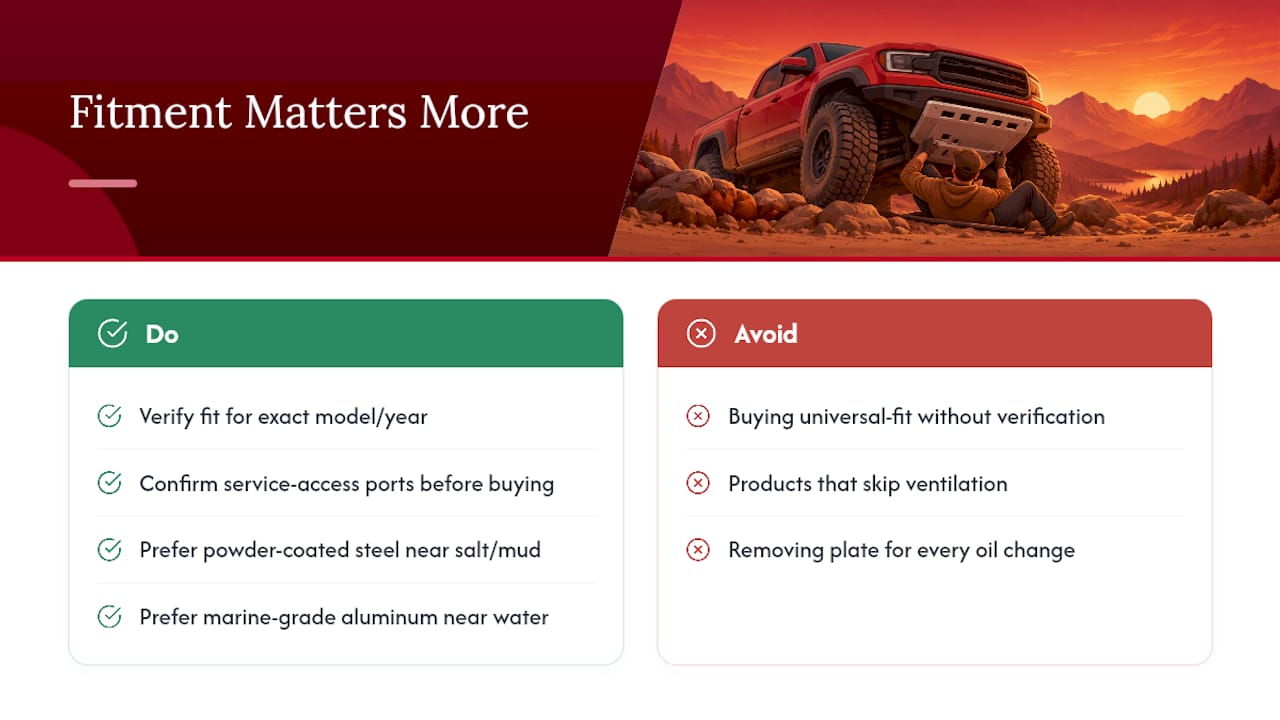
Some vendors sell universal-fit parts that technically bolt on but leave gaps in exactly the wrong places. Fitment verification against your specific model and year, not just your vehicle’s general class, is what separates a plate that actually protects your oil pan from one that looks right in a product photo and misses by an inch on your frame.
A few habits worth borrowing from experience: confirm service-access ports before you buy so you’re not removing the whole plate for an oil change, and lean toward powder-coated steel or marine-grade aluminum if you’re anywhere near salt, mud, or standing water regularly. Skip anything that skips ventilation.
The Verdict: Protect the Expensive Stuff First
The conventional advice on this topic tends to treat skid plates as a single yes-or-no purchase, and that’s the wrong frame. The real question isn’t whether to buy skid plates. It’s which components you protect first, because the cost of failure is not evenly distributed across your undercarriage.
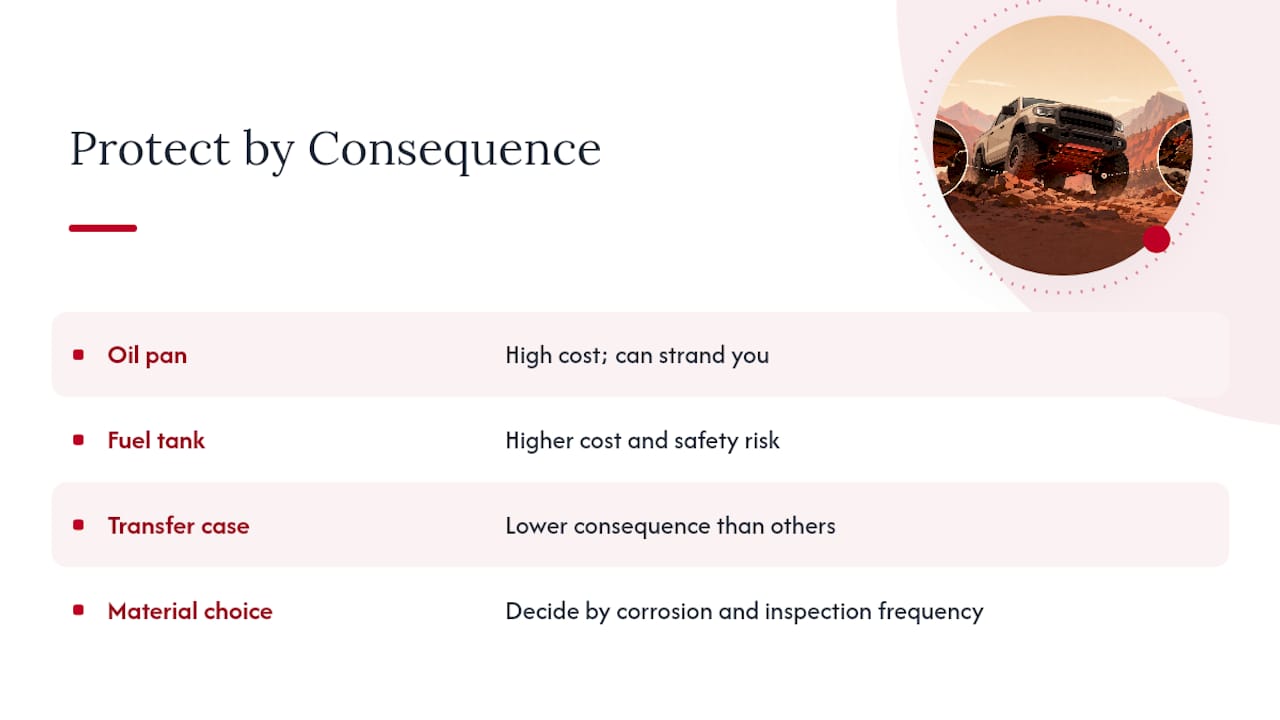
An oil pan puncture strands you and costs real money. A fuel tank puncture can strand you, cost more money, and introduce a genuine safety risk. A dinged transfer case housing is usually a lesser problem by comparison. Prioritizing coverage by consequence, not by what’s cheapest or easiest to bolt on, is the framework that actually holds up once you’re two hours down a forest road with no signal.
Where most buying guides fall short is treating steel and aluminum as a simple weight-versus-toughness coin flip. It’s really a question of what corrodes on your specific terrain and how often you’re willing to inspect and clean the underside. Buy for your actual driving pattern, not for the trail you wish you drove more often.
— Ozkonic Kustomz
A Practical Way to Start: Fitment-Verified Underbody Protection
Many suppliers provide parts sourced from vetted manufacturers, aiming for fitment verification and compatibility checks before parts ship, to avoid issues with universal plates. That eliminates the trial-and-error guessing that leads to gaps, rattling hardware, or plates that never quite seal against the frame.
Beyond underbody armor, most serious builds pair protection with a matched setup underneath. The Suspension & Chassis collection covers the components that determine how your rig sits over rough terrain, and a lift kit can restore clearance that a heavier plate system takes up. If you’re not sure which plate thickness or material fits your exact model and year, reach out to support teams for a model-specific fitment check before you order, not after.
Sources
For deeper reading on skid plate performance and myths, see Jalopnik’s rundown of common skid plate myths, J.D. Power’s overview of skid plate benefits, and Mountain Off Road’s breakdown of maintenance trade-offs. For engine bay corrosion prevention specifically, Diamondbrite’s cleaning guide is a solid reference.
- Why Off-Road Trucks Need Skid Plates (Despite Some Myths You’ve Heard)
- What are Skid Plates and are They Important? - J.D. Power
- Why skid plates first mod? (forum/guide summary)
FAQ
Do You Really Need Skid Plates?
If you drive on gravel, dirt, or anything rockier than pavement, skid plates meaningfully reduce your risk of a costly oil pan, transmission, or fuel tank failure. Pavement-only drivers generally can skip them, since ground clearance rarely comes into play on paved roads.
Do Skid Plates Improve Gas Mileage?
No, skid plates add weight rather than improving mileage, and most owners see a small dip in fuel economy rather than a gain. The trade-off is usually worth it against the cost of a single drivetrain repair avoided.
How Long Does a Skid Plate Last?
A well-maintained steel or aluminum skid plate can last the life of the vehicle if it’s inspected regularly and kept clean of trapped mud and salt. Corrosion and repeated hard impacts are what shorten that lifespan, not routine wear.
Is It Okay to Drive Without a Skid Plate?
On pavement, yes, driving without a skid plate carries little added risk. Off-road, especially on gravel, forest roads, or technical trails, skipping protection raises your odds of a punctured oil pan or fuel tank, which is the exact costly failure skid plates are designed to prevent.