
For most Silverado owners chasing a noticeably smoother ride without giving up towing capacity, the answer is simple: address tires first, then upgrade shocks. Swapping to monotube shocks like Bilstein or Fox improves how the truck absorbs potholes and cuts body roll, but that upgrade only pays off once your tires are set to the right pressure and your wheel size isn’t working against you.
If your goal is different, the priority shifts. Towing sag calls for helper springs or air springs. A rough trail run calls for a real lift with upper control arms. A lowered stance calls for a leveling kit paired with shocks tuned for the new geometry.
Here’s your mini action plan:
- Buy: monotube shocks (comfort) or a Timbren-style helper spring kit (towing).
- Check: tire pressure, wheel diameter, and whether your lift height crosses the 2.5 to 3 inch threshold that triggers a UCA requirement.
- Decide: DIY works for shocks and leveling kits with basic tools; anything involving UCAs, alignment, or IRS rear geometry is worth a shop’s time.
Key Takeaways
Matching the upgrade to your goal, and confirming UCA requirements past 2.5 to 3 inches of lift, prevents most of the wasted money and premature wear owners run into.
| Point | Details |
|---|---|
| Start with tires | Check pressure, balance, and wheel size before spending on shocks or springs. |
| Match upgrade to goal | Comfort favors shocks and smaller wheels; towing favors helper or air springs. |
| Respect the UCA threshold | Any lift over roughly 2.5 to 3 inches needs new upper control arms. |
| Know your generation | GMT900, K2XX, and T1XX each require different leveling and lift hardware. |
| Verify fitment before buying | Ozkonickustomz offers fitment-checked suspension parts, air systems, and UCAs with return support for incorrect fitment. |
Table of Contents
- Best Silverado Suspension Upgrades by Goal
- What Do Different Suspension Upgrades Actually Change?
- Does Your Silverado Generation Change Which Kit Fits?
- What Does a Suspension Install Actually Require?
- What Tire and Wheel Sizes Work After a Lift?
- What Should You Confirm Before Buying Parts?
- What Goes Wrong After a Suspension Upgrade?
- Why Do Upper Control Arms and Damping Shackles Matter?
- How We Approach Parts Selection at Ozkonic Kustomz
- Get the Right Parts and Fitment Support for Your Build
- Sources
Best Silverado Suspension Upgrades by Goal
Stop researching and start ordering once you know which category matches how you actually drive the truck.
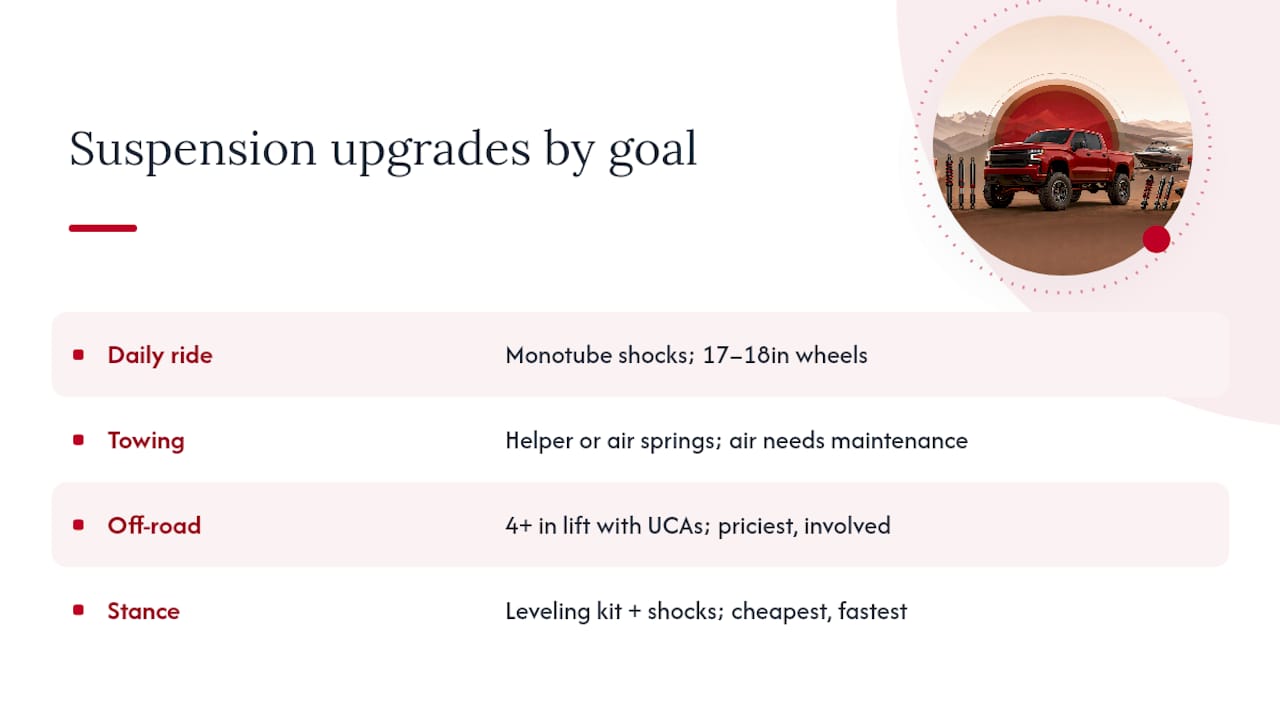
Smoother daily ride. Monotube shocks paired with a tire pressure and wheel size check solve most harshness complaints. Downsizing from 22" wheels to 17 or 18" wheels adds sidewall height, and that taller sidewall cushions impacts before they ever reach your suspension. Cost is moderate, install is straightforward, and there’s no tradeoff beyond wheel aesthetics.
Towing stability. Helper springs or rear air springs fight sag under load. Timbren SES kits bolt on with zero maintenance and often preserve your factory warranty, while air springs give you adjustable ride height at the cost of more complexity and occasional compressor maintenance.
Off-road capability. A 4 inch or larger lift with new UCAs opens up tire clearance and suspension travel. This is the priciest, most involved category, and skipping the UCAs on anything over roughly 2.5 to 3 inches accelerates ball-joint wear.
Stance. A leveling kit combined with upgraded shocks levels the factory rake and keeps the ride from feeling harsh afterward. It’s the cheapest, fastest upgrade path, but it does little for load capacity or off-road clearance.
What Do Different Suspension Upgrades Actually Change?
Every upgrade in this category solves a different mechanical problem, and confusing them is the fastest way to spend money on the wrong fix.
A leveling kit raises only the front end, typically 1.5 to 2.5 inches, correcting the factory rake that leaves most Silverados sitting lower up front than in back. It’s a bolt-on job in most driveways, usually $150 to $500 in parts, with a few hours of labor if you’re not doing it yourself.
A full lift kit raises all four corners, commonly 4 to 6 inches, and opens up room for larger tires and more suspension articulation. Quality systems in that range run $800 to $2,500, and that price typically includes the UCAs and shock upgrades the taller ride height demands.
Shock and damper upgrades don’t change ride height at all. They change how the truck reacts to bumps. Swapping worn factory shocks for a quality monotube design, especially on a truck past 50,000 miles, sharpens handling and reduces the floaty feeling that comes with age.
Rear leaf-spring changes, including add-a-leaf kits or full leaf-pack replacements, add load capacity but stiffen the unloaded ride. This is a blunt tool: effective for constant towing, uncomfortable if you rarely carry weight.
Helper springs like Timbren SES units sit dormant until the truck is loaded, then engage to prevent sag. They’re mechanically simpler than air systems and require no maintenance.
Air spring systems replace or supplement the rear suspension with adjustable air bags, letting you dial in ride height and stiffness based on load. They cost more and add a compressor and lines to maintain, but no other option matches their flexibility for owners who tow occasionally and drive empty the rest of the time.
- Pick a leveling kit or shocks if your truck is stock height and you just want better manners.
- Pick a full lift with UCAs if you’re running larger tires or hitting real trails.
- Pick helper springs or air springs if towing sag, not ride harshness, is your complaint.
Does Your Silverado Generation Change Which Kit Fits?
Yes, and this is where a lot of owners waste money on parts that don’t match their truck. GMT900 trucks use a torsion-bar front suspension, so leveling is done by adjusting torsion keys rather than swapping struts. K2XX trucks (roughly 2014 to 2018) switched to a coil-over-strut front end, so leveling relies on strut spacers instead. T1XX trucks, the current generation, moved to independent rear suspension, which fundamentally changes how a rear lift works.
That IRS layout matters more than most buyers realize. On solid-axle GMT900 and K2XX trucks, you can lift the rear with axle blocks. On a T1XX, you can’t use a block at all; rear lift height comes from spacers or full coilover replacements instead.
- Confirm your generation before ordering: a K2XX kit will not bolt onto a T1XX rear end.
- Any lift crossing roughly 2.5 to 3 inches needs new upper control arms, regardless of generation.
- T1XX rear lifts require coilover-specific hardware, not axle blocks.
- Taller lifts on any generation often need extended sway-bar end links and brake-line extensions to prevent binding.
What Does a Suspension Install Actually Require?
A basic tool list covers a floor jack, jack stands, a torque wrench, and a socket set, but the parts list grows fast once you cross into lift territory. Expect to add upper control arms, extended sway-bar end links, and brake-line extensions on anything past a leveling kit, plus a wheel alignment afterward no matter what you install.
- Leveling kit: 2 to 4 hours of labor, DIY-friendly with basic tools.
- 3 inch lift: 4 to 6 hours, UCAs required, alignment mandatory.
- 4 to 6 inch full lift: 8 to 12 hours, shop-recommended given the added brake-line and driveline work.
- Shock swap alone: 1 to 2 hours, one of the easiest DIY jobs on this list.
Shop labor for a full lift often runs $400 to $800 on top of parts, while a leveling kit or shock swap might only add $100 to $200 in labor if you’re not doing it yourself. Alignment alone typically costs $80 to $150, and skipping it after any height change is how you end up chewing through tires in a few thousand miles.
What Tire and Wheel Sizes Work After a Lift?
Bigger isn’t automatically better. Larger wheels reduce sidewall cushion, which means a 35 inch tire on a 22 inch wheel rides harsher than the same tire on an 18 inch wheel, even at identical lift height.
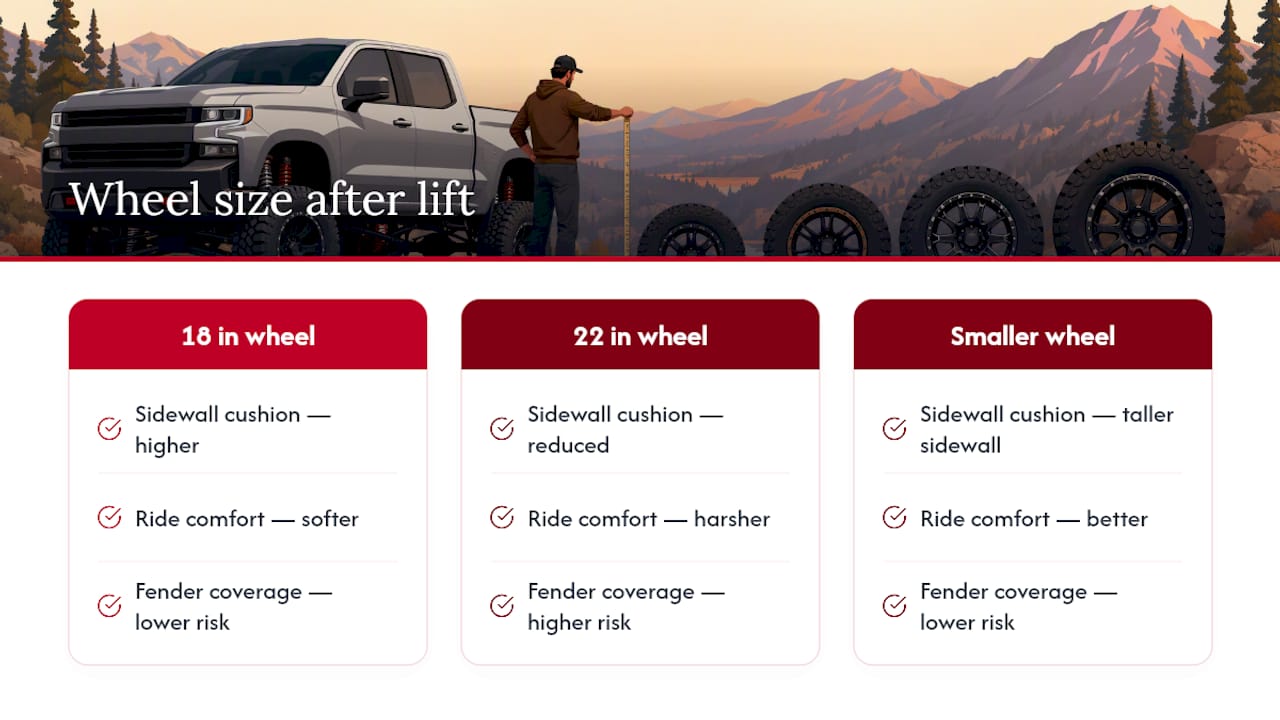
Keep fender coverage in mind at larger sizes, since exposed tread can run afoul of local clearance rules. If comfort matters more to you than stance, a smaller wheel diameter with a taller sidewall almost always beats a bigger wheel wrapped in a low-profile tire.
What Should You Confirm Before Buying Parts?
A wrong-fitment order is the single most common way Silverado owners lose money on this project, and most of it is preventable with a five-minute check before checkout.
- Confirm your exact generation, axle code, and cab/bed configuration match the kit’s listed fitment.
- Check whether the kit includes UCAs or whether you’ll need to buy them separately.
- Verify wheel offset and tire size compatibility with your intended lift height.
- Ask what fitment guarantee or return policy applies if the part doesn’t match your truck.
- Review whether the kit includes installation hardware, instructions, and specific shock valving, or if those are sold separately.
None of this is complicated, but it’s exactly the kind of detail that gets skipped when you’re excited to order and regretted three weeks later when a box shows up with the wrong bracket.
What Goes Wrong After a Suspension Upgrade?
The most common failure isn’t a bad part. It’s a skipped step. Installing a 3 inch or taller lift without replacing the UCAs is the top mistake, followed closely by skipping the post-install alignment and running mismatched shocks that can’t handle the payload you’re actually carrying.
- Inspect ball joints and control-arm bushings every 15,000 to 20,000 miles on a lifted truck.
- Check shock condition and alignment annually, or sooner if you notice pulling or uneven tire wear.
- Squeaking usually points to dry bushings; rubbing at full lock usually means the tire is too wide for the offset; premature edge wear on tires usually means alignment was skipped.
- Aggressive wheel and tire combos without matching fender clearance are the most common cause of body-panel rubbing after a lift.
Why Do Upper Control Arms and Damping Shackles Matter?
The 2.5 to 3 inch UCA threshold isn’t arbitrary. Lifting a Silverado that far changes the ball-joint angle enough that the factory arm forces the joint to operate outside its intended range, wearing it out faster than normal. New UCAs correct that geometry rather than fighting it.
On the rear end, Sulastic-style damping shackles work on a different problem entirely. Leaf springs transmit small, high-frequency vibrations straight into the cab, and a rubber-insulated shackle intercepts that motion the way a dedicated shock would, cutting down on the rear-end hop you feel when the bed is empty.
Pro Tip: Before you spend money on shocks or springs, check your tire pressure against the door-jamb sticker, not the tire’s max rating. Overinflated tires are one of the most common, cheapest-to-fix causes of a harsh-riding Silverado.
How We Approach Parts Selection at Ozkonic Kustomz
We prioritize fitment-verified kits over cheap ones that might not match your generation, and we push owners toward matching shocks to their actual payload rather than guessing. On lifts past that 2.5 to 3 inch mark, we favor UCAs every time. It costs more upfront, but it protects the joints you’d otherwise replace twice as often, and that tradeoff is worth explaining honestly rather than upselling around it.
Get the Right Parts and Fitment Support for Your Build
Ozkonickustomz stocks the suspension components that matter most once you know your goal: air bag kits and air lift systems for towing, upper control arms for taller lifts, and helper springs for owners who tow occasionally but don’t want a full air setup.
Unlike a generic parts search where fitment is a guess, Ozkonickustomz sources directly from vetted manufacturers and checks compatibility against your Silverado’s generation before you commit to a cart. That means no chasing down the wrong torsion key or discovering after install that your T1XX rear end needed a coilover spacer instead of a block. If towing sag is your issue, our towing suspension guide walks through helper spring and air spring options in more depth. Current stock levels and shipping times are listed on each product page, and our return policy covers incorrect fitment if a part doesn’t match your build. Reach out for a fitment check before you order, or browse the suspension catalog directly to get started.
Sources
Recommended
- Towing Suspension Upgrades That Actually Reduce Sag – Ozkonic Kustomz LLC
- Sierra Suspension Parts: What Every Sierra 1500 Owner Should Buy – Ozkonic Kustomz LLC
- Lowered Truck Suspension: The Practical Buyer’s Guide – Ozkonic Kustomz LLC
- Tundra Suspension Parts: What to Buy and Why – Ozkonic Kustomz LLC