
K&N air filters are washable, reusable, oiled cotton-gauze replacement filters that trade slightly lower initial filtration for higher airflow and a service life measured in decades, not months. If you do your own maintenance and plan to keep your vehicle long term, a genuine K&N High-Flow Air Filter backed by the K&N Lifetime Warranty is worth serious consideration. If you prefer zero maintenance overhead or drive in extreme dust daily, a premium paper filter may suit you better. Either way, start by running a vehicle fitment lookup before you buy anything, and purchase only from a vetted seller to avoid counterfeits.
Key Takeaways
K&N air filters are a sound long-term investment for DIY owners who maintain their vehicles and plan to keep them past 60,000 miles, but they require correct cleaning and re-oiling to deliver on that promise.
| Point | Details |
|---|---|
| Performance gains are modest | Expect 1–4 HP on naturally aspirated engines; throttle response improvement is more noticeable than peak power. |
| Filtration efficiency is high but not absolute | K&N tests in the high-90s percent range; premium paper filters can match or exceed that in high-dust conditions. |
| Service interval up to 50,000 miles | Highway use allows long intervals; dusty or off-road driving cuts that to 10,000–15,000 miles. |
| Verify fitment before buying | Use year/make/model/engine code in a part-finder and confirm the K&N part number matches your exact airbox. |
| Ozkonickustomz for vetted stock | Ozkonickustomz cross-checks part numbers against vehicle data and offers straightforward returns on fitment issues. |
Table of Contents
- What are K&N air filters, and which type do you need?
- K&N filter benefits and tradeoffs versus OEM paper
- Do K&N filters actually make a measurable difference?
- How do you find the right K&N filter for your vehicle?
- How to install and maintain a K&N filter correctly
- Warranty, spotting counterfeits, and buying genuine K&N in the U.S.
- The Ozkonic Kustomz take on recommending K&N to DIYers
- Genuine K&N parts, verified fitment, shipped fast
- Sources
What are K&N air filters, and which type do you need?
K&N Engineering, a U.S.-based manufacturer, builds its filters around a layered cotton-gauze media sandwiched between wire mesh and seated in a rubber or foam frame. That construction is what allows cleaning and reuse, unlike a paper filter you toss every 15,000–30,000 miles.
The product line breaks into four main formats:
- Drop-in panel filters: Direct replacements for the OEM paper element inside your factory airbox. Easiest install, no extra hardware.
- Cone and round filters: Designed for aftermarket intake tubing. More flow area than a panel filter, but they require compatible intake ducting to seat correctly.
- Cold-air and short-ram intake kits: Complete systems that replace the factory airbox and ducting. These pair a cone filter with optimized tubing for maximum flow improvement.
- Specialty lines: The Blackhawk dry-media series (no oil required) and Heavy Duty Diesel filters for commercial and off-road applications where oil migration is a concern.
Drop-in panels are the right call for most daily drivers. Cone filters and full intake kits make sense when you are already modifying the intake tract or want the most airflow possible on a dedicated performance build.
K&N filter benefits and tradeoffs versus OEM paper
The core appeal is straightforward: more airflow, less frequent replacement, and a filter that pays for itself over time. VehicleBar’s long-term review confirms that K&N filters flow more than many OEM paper filters and become economically attractive for owners who keep vehicles long term, though correct maintenance is non-negotiable.
Filtration note: K&N’s cotton-gauze media tests in the high-90s percent efficiency range in many SAE-style evaluations, but some ISO-style lab comparisons show higher particle passage versus premium paper filters in certain conditions.
The tradeoffs are real. CartipsDaily’s ISO-style test summaries document higher particle passage and elevated wear markers for some oil-based reusable filters versus premium paper alternatives, particularly in high-contamination environments. If you drive unpaved roads daily, a dry-media option or a pre-filter wrap is worth considering. The other tradeoff is maintenance: you must clean and re-oil the filter on schedule. Skip that step and you lose both filtration quality and the flow advantage.
For realistic horsepower upgrade expectations, a drop-in K&N panel filter is one piece of a larger picture, not a standalone power mod.
Do K&N filters actually make a measurable difference?
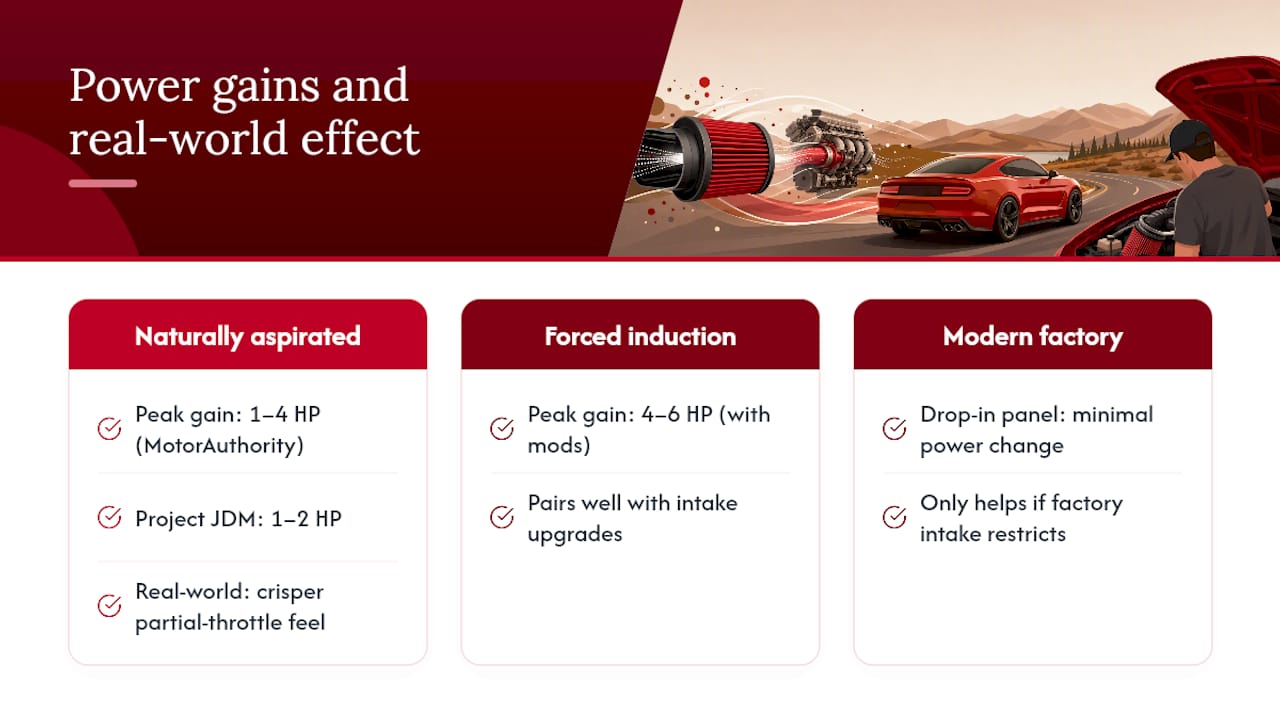
Yes, but the gains are modest and context-dependent. MotorAuthority’s analysis puts peak horsepower gains from high-flow filters at roughly 1–4 HP on naturally aspirated engines, with clearer throttle response being the more noticeable real-world effect for most drivers.
Typical gain range: Project JDM’s vehicle testing documents 1–2 HP gains on many naturally aspirated platforms, with some forced-induction setups showing around 4–6 HP when paired with other intake modifications.
Where you actually feel the difference is partial-throttle response. Oiled cotton gauze reduces intake restriction, so the engine overcomes partial vacuum more quickly under load. That translates to a crisper feel when you accelerate from 30–50 mph, not a dramatic surge on a dyno sheet.
Gains are largest when the factory airbox is already a restriction point, or when K&N is part of a broader intake upgrade. On modern vehicles with highly optimized factory intake tracts, a drop-in panel filter alone produces minimal measurable power change.
Pro Tip: To assess your own gains honestly, do a baseline pull with the OEM filter on a cool morning, note throttle feel and any data-logging readings, then swap in the K&N and repeat the same run within an hour under the same conditions. Same road, same gear, same throttle position. That A/B comparison tells you more than any spec sheet.
For a deeper look at how a full intake system changes the equation, the cold air vs. short ram intake comparison at Ozkonickustomz breaks down when upgrading the whole intake tract makes sense.
How do you find the right K&N filter for your vehicle?
Use your vehicle’s year, make, model, and engine displacement code in K&N’s part-finder or your seller’s fitment lookup. That search returns the correct K&N part number, which you then verify against the physical dimensions of your airbox opening before checkout.
Before you confirm the order, check these four things:
- K&N part number: Confirm it matches your exact engine code, not just the model name. A 2.0T and a 2.5 in the same chassis often take different filters.
- Physical dimensions: Outer diameter, flange diameter, and filter height must match your airbox or intake tubing. A close fit is not a correct fit.
- Orientation and seating: Some airboxes require the filter to seat against a gasket or clip. Verify the frame type (rubber lip vs. foam seal) matches your housing.
- MAF housing compatibility: Vehicles with a mass airflow sensor in the intake path are sensitive to filter orientation. Confirm the cone or panel does not disrupt airflow direction to the MAF.
Common pitfalls: older airboxes with non-standard flange diameters that accept a “close” filter but don’t seal fully; vehicles where the MAF sits immediately downstream of the filter and requires a specific pleat orientation; and cone filters that need adapter rings or intake tubing not included in the base kit. Filter design details, including media pleat count and frame molding quality, affect seal integrity as much as the brand name itself, per comparative enthusiast testing.
How to install and maintain a K&N filter correctly
Installation on most vehicles is a 10-minute job: open the airbox, pull the OEM filter, drop in the K&N panel, and close the housing. Cone filters on aftermarket intakes take a bit longer but follow the same principle.
Cleaning and re-oiling is where most problems happen. Follow these steps in order:
- Remove the filter from the airbox or intake tube. Tap it gently to dislodge loose debris.
- Inspect the media for tears, collapsed pleats, or frame damage. A damaged filter goes in the trash, not back in the car.
- Apply K&N Power Kleen (or the equivalent K&N cleaner) to both sides of the filter. Let it soak for 10 minutes.
- Rinse with low-pressure water from the clean side outward, flushing contaminants back the way they came in. Never use a pressure washer.
- Air dry completely. This takes at least 20–30 minutes at room temperature. Do not use compressed air or heat to speed it up.
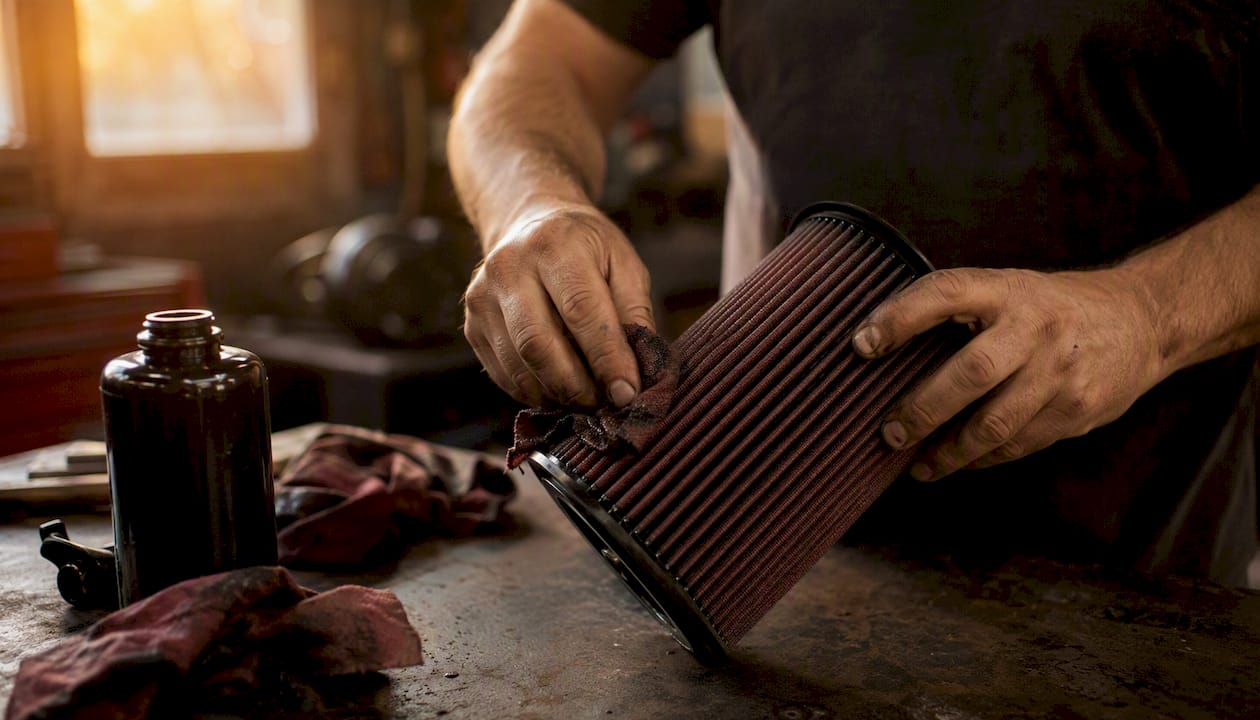
- Apply K&N air filter oil in a thin, even bead along each pleat on the outside of the filter. One pass per pleat, not a soak.
- Wait 20 minutes for the oil to wick evenly through the media before reinstalling.
K&N recommends cleaning every 50,000 miles under normal highway conditions. Dusty roads, construction zones, or off-road use cut that interval significantly, sometimes to 10,000–15,000 miles. With proper maintenance, these filters routinely last 100,000 miles or more.
Pro Tip: Over-oiling is the single most common mistake. If the media looks saturated or red oil is visible pooling in the pleats, you’ve applied too much. Wipe the excess with a clean cloth and let it wick again before installing. A MAF sensor coated in filter oil is an expensive fix that MotorAuthority specifically flags as a real risk from improper servicing.
Warranty, spotting counterfeits, and buying genuine K&N in the U.S.
K&N’s Lifetime Limited Warranty covers the filter against defects in materials and workmanship for as long as the original purchaser owns it. In practical terms, that means a genuine K&N panel filter you buy today should never need replacement, only cleaning. Keep your purchase receipt and the original packaging, because warranty claims require proof of purchase and the part number.
Counterfeits are a real problem in the U.S. market. Here’s how to verify you’re getting the genuine article:
- Packaging: Genuine K&N boxes use consistent, high-quality printing with a clear part number on the outside. Blurry text, off-color logos, or missing part numbers are red flags.
- Part number cross-check: Run the part number on K&N’s official site after purchase. If it doesn’t return a result for your vehicle, the part is suspect.
- Authorized dealer verification: K&N publishes a list of authorized dealers. Buying from a vetted seller with a clear return policy is the most reliable protection.
- Filter construction: Genuine filters have uniform pleat spacing, consistent oil application (even red color throughout), and a firm rubber or foam frame with no gaps.
Counterfeit risk: The performance filter market has enough fake product circulating that buying from an unauthorized third-party marketplace listing carries real risk of receiving a non-genuine part with no warranty coverage and unknown filtration quality.
Keep your OEM filter after switching to K&N. If you ever need a diagnostic baseline, a warranty inspection, or a loaner filter during a deep clean, having the original on hand saves you a trip to the parts store.
The Ozkonic Kustomz take on recommending K&N to DIYers
K&N makes a genuinely good product for the right buyer, and that buyer is someone who does their own maintenance, plans to keep the vehicle past 60,000 miles, and wants a filter they install once and service on a schedule rather than replace repeatedly. For that person, the economics and the performance case both hold up.
Where we’d push back on the default recommendation: if you’re driving in consistently dusty or high-contamination conditions, the filtration tradeoff matters more than the marketing suggests. In those cases, a dry-media option like K&N’s Blackhawk line, or adding a pre-filter wrap to a standard oiled filter, is the smarter call. The same goes for anyone who genuinely won’t commit to the cleaning procedure. An over-oiled or neglected K&N is worse than a fresh paper filter.
At Ozkonickustomz, every K&N part we source goes through fitment verification before it ships. We cross-check part numbers against vehicle data, so you’re not guessing whether the filter seats correctly in your airbox. If something doesn’t fit, our return policy is straightforward and our team can help you find the right part the first time.
Genuine K&N parts, verified fitment, shipped fast
Ozkonickustomz stocks genuine K&N filters sourced directly from vetted manufacturers, with part-number verification built into the purchase process. You get the filter that actually fits your vehicle, not a close match that leaks around the frame.
Every order ships fast, and if the fitment isn’t right, the return process is straightforward. The catalog covers drop-in panel filters, cone filters, and full intake kits, with compatibility support available if your vehicle has an unusual airbox or MAF configuration. Browse the full parts catalog at Ozkonickustomz, confirm your part number using the vehicle lookup, and place your order knowing the filter has been verified for your specific year, make, model, and engine.
Sources
- Do performance air filters actually work? | MotorAuthority
- K&N Air Filter Review: Real HP on Modern JDM or Hype? | Project JDM
- K&N Air Filter Review: Worth the Investment? 2025 | VehicleBar
- K&N Engineering
Recommended
- LS Engine Swap Guide: Fitment-First Checklist for DIYers – Ozkonic Kustomz LLC
- Performance Parts for Daily Drivers: 2026 Guide – Ozkonic Kustomz LLC
- Real Horsepower Upgrades Under $500 That Actually Work – Ozkonic Kustomz LLC
- Air Lift Performance Kits: How to Choose the Right One – Ozkonic Kustomz LLC