
The fastest way to find discontinued parts is to nail down the OE part number or VIN first, then search specialist channels instead of generic listings. Pull the number off the part itself, cross-reference it through a dealer parts locator or supplier database, and confirm fitment before you pay. Skip that first step and you’ll waste weeks chasing parts that look right in a photo but don’t bolt up.
TL;DR:
- Identifying the exact discontinued part requires photographing and transcribing stamped numbers, referencing exploded diagrams, and verifying with VIN checks to ensure correct variants.
- Sourcing should progress from dealer and OEM channels to specialist suppliers, salvage yards, and filtered marketplace searches, especially for complex truck components.
- Verification involves cross-checking OE and superseded numbers with manufacturer bulletins and requesting measurements to confirm fitment before purchase.
- Speedy acquisition relies on setting alerts, contacting clubs or forums, and using advanced search tools to stay ahead of demand for rare parts.
- Reproduction parts often offer the most affordable alternative when original items become scarce or too costly, with pricing decreasing as rarity increases.
Table of Contents
- How Do I Identify the Exact Discontinued Part I Need?
- Where Can I Find Discontinued Auto Parts?
- How Do I Verify a Discontinued Part Before Buying?
- What’s the Fastest Way to Track Down a Rare Part?
- How Long Does It Take to Find a Discontinued Part, and What Should It Cost?
- How Ozkonic Kustomz Speeds Up the Search for Hard-to-Find Parts
- Why Method Beats Luck in Every Successful Parts Hunt
- Get Expert Help Sourcing Your Next Hard-to-Find Part
- Where to Look When You’re Stuck
- Sources
- FAQ
How Do I Identify the Exact Discontinued Part I Need?
Guessing kills more restoration timelines than actual scarcity does. Before you type anything into a search bar, get the identifiers that make your search specific instead of hopeful.
Start with the part in your hand or on the vehicle. Most OEM components carry a stamped number, a casting mark, or a printed label somewhere on the housing, bracket, or body. Photograph it clearly, then write down every character exactly as it appears, including suffixes and revision letters that look like typos but aren’t.
Next, pull up the exploded diagrams in a dealer parts catalog for your exact model year. These diagrams show you which variant of a part applies to your specific trim, engine, or production run, since manufacturers often ran three or four versions of the “same” bracket across a model’s lifespan.
A VIN lookup fills in the gaps the part number alone can’t answer. Running your VIN through a dealer-facing platform like PartsVoice’s parts locator can surface build-specific assemblies and confirm which factory option package your vehicle originally shipped with, information that isn’t always obvious just by looking at the part.
If the number is worn off or was never stamped in the first place, fall back on measurements. Thread pitch, flange spacing, connector pinout, and overall dimensions let a specialist cross-reference your part against known substitutes even without a clean part number.
- Photograph and transcribe every stamped number or casting mark before starting your search
- Pull exploded diagrams from a dealer catalog to confirm the exact variant
- Run a VIN check to catch trim-specific or build-specific differences
- Measure thread size, flange spacing, and connector type when the number is illegible
Pro Tip: Keep a dedicated folder, digital or physical, with every photo, number, and measurement for a given part. When you finally find a seller with a matching item, you’ll need to answer their questions fast, and hesitation often means someone else buys it first.
Where Can I Find Discontinued Auto Parts?
Hagerty’s research on vintage parts hunting lays out a tiered approach: work through dealer and OE sources before escalating to salvage, specialist suppliers, and marketplaces. That order matters because each tier gets progressively harder to verify, and jumping straight to a marketplace listing skips the checks that would have saved you a return shipment.
- Start with dealer heritage programs and parts locators. Call the dealer’s parts department directly and ask if they can query a dealer-facing locator network. When a manufacturer discontinues a part, remaining stock sometimes gets sold off to third-party distributors who specialize in reselling it as new-old-stock. A parts counter with fifteen years of experience will know who bought that inventory. Bring your VIN, your part number, and photos.
- Move to specialist obsolete-parts suppliers and NOS dealers. Businesses like Vintage Parts, Inc. maintain relationships with dozens of OEMs and trade in legacy inventory that never made it to a general marketplace. Vet any specialist supplier by checking how long they’ve operated, whether they list grading standards for NOS versus used stock, and whether marque clubs reference them by name.
- Search salvage yards and specialist breakers through their networks, not just one lot. Regional salvage networks let you search hundreds of yards at once by part number, and many yards now post photos of pulled components before you commit. Ask specifically about donor-vehicle mileage and whether the part was tested before removal.
- Optimize your marketplace searches with exact-match filters and saved alerts. Search by OE number, not just a generic description, and set up saved searches so new listings notify you automatically. Dedicated stores focused on discontinued catalogs, the kind that specialize in a single make or era, tend to have cleaner inventory than general listings.
For truck-specific components, the sourcing calculus shifts slightly. finditparts recommends leaning heavily on VIN and part-code verification because heavy-duty trucks run far more drivetrain and chassis variants per model year than passenger cars, and a part that fits one axle configuration may not fit another that looks identical. When downtime is costing you money, that source suggests escalating to specialist channels immediately rather than waiting on a general search to turn something up.
How Do I Verify a Discontinued Part Before Buying?
A part that “looks right” in a listing photo isn’t the same as a part that’s confirmed to fit. Skipping verification is how enthusiasts end up with two returns, a restocking fee, and the same broken bracket six weeks later.
Cross-reference the OE number against superseded part numbers using dealer parts diagrams or manufacturer technical bulletins. Manufacturers frequently update a part number mid-production without changing the physical component, so a listing showing a different number than yours might still be an exact match.
Compare the specs that actually matter: mounting hole spacing, overall dimensions, connector type, and thread size. Ask the seller for measurements and multiple angles of photos, not just the one stock image in their listing. A seller unwilling to provide either is a warning sign worth taking seriously.
For anything tied to steering, braking, or restraint systems, insist on VIN-based verification or direct dealer confirmation rather than trusting a private seller’s word. The stakes for a wrong-fit brake caliper are considerably higher than for a wrong-fit trim clip.
- Cross-check OE and superseded numbers against manufacturer bulletins before committing
- Request measurements and multiple photos, especially of connectors and mounting points
- Confirm safety-critical parts through VIN lookup or dealer verification, not seller assurance alone
- Walk away from vague listings and insist on clear return terms in writing
Pro Tip: If a seller’s photo shows a part number that doesn’t match what you have, ask before assuming it’s wrong. A quick search of the superseded-number history through a dealer catalog often shows both numbers point to the same physical part.
What’s the Fastest Way to Track Down a Rare Part?
Speed comes from being proactive instead of reactive. Waiting for the right listing to appear is a passive strategy; the following tactics put you ahead of other buyers chasing the same rare component.
- Set saved searches and match alerts on marketplaces and specialist supplier sites so you’re notified the moment inventory appears
- Post a precise request, complete with photos, part number, and VIN, to marque-specific clubs and dedicated forums where members often have leads on private stashes
- Call dealer parts departments directly and ask staff whether they have records of who purchased remaining stock when the part was discontinued, since experienced counter staff sometimes know exactly who to call
- Coordinate a group buy through a club or forum when a part is rare enough that a small reproduction run only makes financial sense with pooled demand
Specialist match services also exist for exactly this scenario. Tools like CarSpanner let you describe or photograph a part and have it searched across multiple supplier inventories at once, which can be worth the cost when your restoration timeline matters more than saving on a service fee.
How Long Does It Take to Find a Discontinued Part, and What Should It Cost?
Not all discontinued parts vanish at the same rate. Trim pieces, interior plastics, and low-volume electrical components tend to disappear fastest because they were made in small runs and rarely get reproduced. Mechanical parts like brackets, suspension components, and common drivetrain pieces linger longer since aftermarket manufacturers see enough demand to justify reproduction.
Pricing follows scarcity in a fairly predictable pattern. New-old-stock typically commands the highest price because supply only shrinks over time. Used parts sit in the middle, with pricing swinging based on condition and how many are circulating through salvage networks. Reproduction parts often land as the most affordable option once a manufacturer decides the demand justifies a production run.
- NOS: highest price, zero wear, but supply only decreases
- Used/salvage: variable pricing tied to condition and yard availability
- Reproduction: often the most budget-friendly option once available, though quality varies by manufacturer
At some point, chasing an exact original stops making sense. If a modern equivalent or remanufactured part meets the same specs and passes your fitment checks, it can save months of searching without compromising the repair. Restoration purists may disagree, but a daily driver rarely needs a numbers-matching bracket to run safely.
How Ozkonic Kustomz Speeds Up the Search for Hard-to-Find Parts
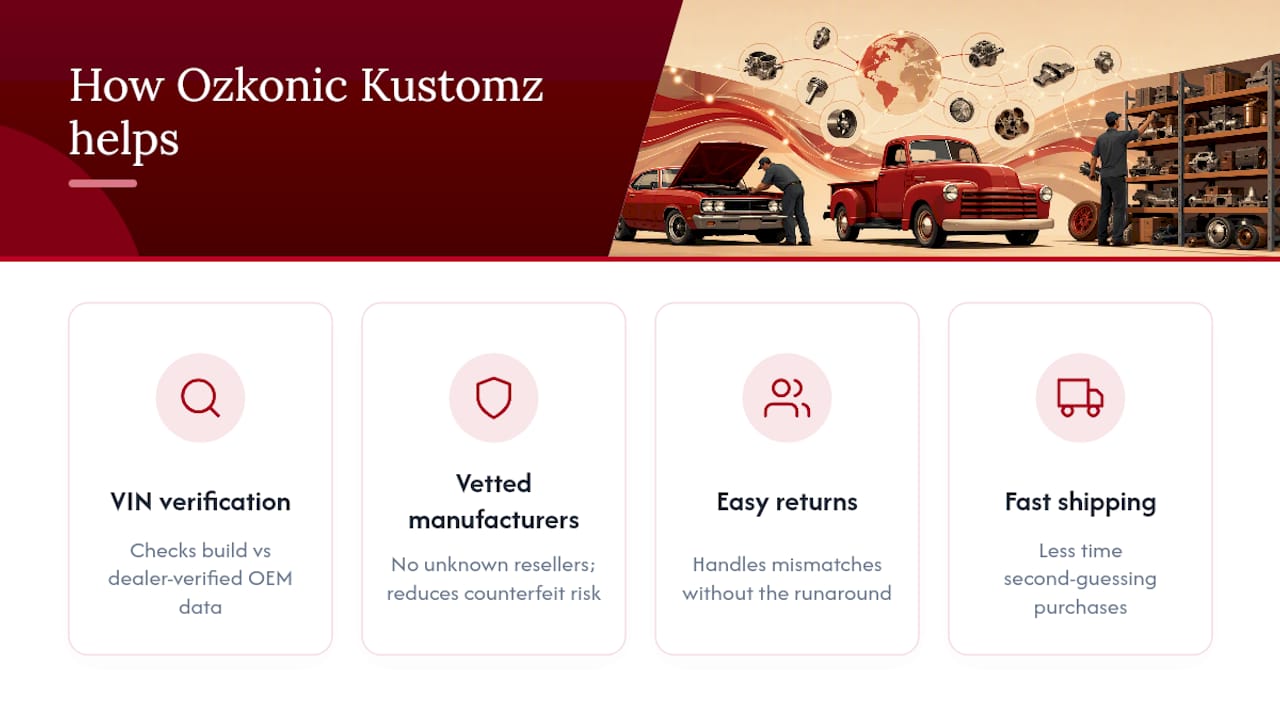
Verification is where most parts hunts go wrong, and it’s the piece Ozkonic Kustomz was built to solve. Our VIN-based parts finder checks your build against dealer-verified OEM data before you buy, which cuts down on the wrong-fit purchases that cost enthusiasts time and return shipping.
Every component we carry comes from carefully selected manufacturers rather than unknown third-party resellers. That sourcing standard exists specifically to eliminate the counterfeit and mismatched-fitment risk that plagues open marketplace searches.
When a part isn’t a clean fit or the listing photos don’t match what arrives, our return process and support team handle it without the runaround. Combined with fast shipping, that means less time spent second-guessing a purchase and more time actually working on the vehicle.
Why Method Beats Luck in Every Successful Parts Hunt
Every successful hard-to-find parts search follows the same sequence: identify precisely, verify thoroughly, buy last. Skip a step and you’re gambling with your budget and your timeline. Build relationships with clubs, set alerts before you need them, and treat verification as non-negotiable rather than optional.
— Ozkonic Kustomz
Get Expert Help Sourcing Your Next Hard-to-Find Part
Chasing down a discontinued bracket or a long-gone suspension component eats hours you’d rather spend wrenching. This service shortens that search by pairing VIN-verified lookups with parts sourced directly from vetted manufacturers, reducing the risk of buying from uncertain listings.
Whether you’re rebuilding a suspension system that’s aged out of dealer stock or hunting a replacement for an intake component that no longer shows up in standard catalogs, our team can check fitment before you spend a dollar. Browse Suspension & Chassis or Air Intake & Induction for verified aftermarket options, or if you need a specific replacement fast, a replacement hose kit or replacement bellows may solve the problem without the hunt at all. Submit your VIN and part details through our site, and our team will confirm compatibility before you check out.
Where to Look When You’re Stuck
A few resources are worth bookmarking before you start your next hunt:
- Dealer parts locators like PartsVoice for checking current and legacy OEM inventory across dealer networks
- NOS and obsolete-parts specialists such as Vintage Parts, Inc. and dedicated eBay stores focused on discontinued catalogs for make-specific stock
- VIN and exploded-diagram tools to confirm build-specific variants before you buy, and match services like CarSpanner when a photo is all you have to go on
If you’re weighing a local specialist for verification work on a classic or import build, shops like Artec Automotive handle exotic and European fitment checks that a generalist might miss.
Sources
FAQ
How Do I Find Discontinued Appliance-Style Automotive Parts?
Start with the part’s stamped number or casting mark, then check a dealer parts locator before moving to salvage yards or specialist suppliers. Small components like switches, sensors, and trim clips often turn up through marque-specific forums faster than general marketplaces.
Where Can I Find Discontinued Truck Parts?
Dealer parts departments and specialist truck-parts locators are the most reliable starting points, since heavy-duty trucks run many chassis and drivetrain variants per model year. finditparts recommends VIN and part-code verification before buying, since a part that fits one configuration may not fit another that looks identical.
Where Can I Find Discontinued GM Parts Online?
Dealer-facing locator networks like PartsVoice let dealers search current and legacy GM inventory, and asking your local dealer’s parts counter to run that search is often faster than browsing listings yourself. Specialist NOS suppliers and marque-specific forums are the next stop if the dealer network comes up empty.
Where Can I Buy Discontinued Ford Parts?
Check dealer heritage and locator programs first, since remaining OEM stock sometimes gets sold to specialist distributors when a part is discontinued. From there, NOS specialists, salvage networks, and Ford-specific owner clubs are the most productive channels for tracking down what a dealer can’t source.
Does Ozkonic Kustomz Help With Hard-to-Find Parts?
Yes. Ozkonic Kustomz sources from vetted manufacturers and offers VIN-based fitment verification to reduce the risk of buying an incorrect or counterfeit part. Current pricing and availability for specific categories are listed on the site.