
DOT 4 has higher dry and wet boiling points than DOT 3, giving it a bigger safety margin under heavy braking. Both are glycol-based and mix freely, but combining them drags your whole system down to the lower grade. Follow your owner’s manual first. If you’re upgrading to DOT 4 or driving something demanding, like a tow rig or a track car, flush the system fully rather than just topping it off.
TL;DR:
- Mixing DOT 3 and DOT 4 reduces the system’s boiling point to the lower grade, so a full flush is necessary after topping off to restore performance.
- Upgrading from DOT 3 to DOT 4 requires a complete system flush because partial swaps create a blend that behaves like the lower grade.
- Both fluids are glycol-based and compatible, but DOT 4’s higher boiling points make it better suited for modern, high-performance, or heavy-duty vehicles.
- Brake fluid should be flushed every two to three years, especially in severe conditions like towing or mountain driving, to prevent moisture-related boiling point drops.
- The dry and wet boiling points are governed by federal law, with the wet boiling point being the more critical factor in real-world conditions.
Table of Contents
- DOT 3 vs DOT 4: What the Numbers Actually Mean
- Can You Mix DOT 3 and DOT 4 Brake Fluid?
- When Should You Change Your Brake Fluid?
- Which Brake Fluid Should You Actually Use?
- Our Take: Stop Overthinking Fluid Grade, Start Respecting the Flush
- Get Your Brake System Fluid Ready and Fully Matched
- Where These Numbers Come From
- Sources
- FAQ
DOT 3 vs DOT 4: What the Numbers Actually Mean
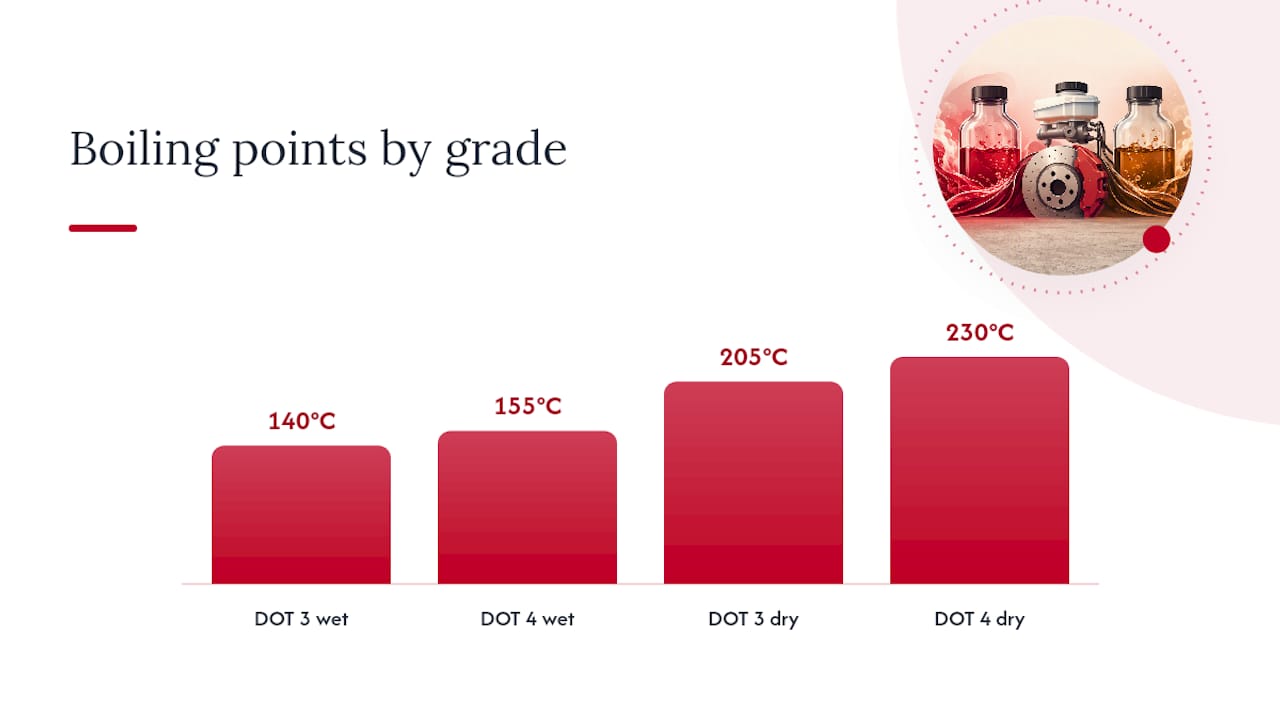
The gap between DOT 3 and DOT 4 isn’t marketing talk. It’s written into federal law. 49 CFR § 571.116, the standard that governs brake fluid in the United States, sets hard minimums for how much heat each grade has to withstand before it fails.
Here’s where the two grades split:
- DOT 3 minimum dry boiling point: 205°C (401°F)
- DOT 3 minimum wet boiling point: 140°C (284°F)
- DOT 4 minimum dry boiling point: 230°C (446°F)
- DOT 4 minimum wet boiling point: 155°C (311°F)
Pro Tip: The wet boiling point is the number that actually matters day to day. The dry figure tells you how fresh fluid performs straight out of a sealed bottle. Almost no fluid in a running vehicle stays that pure for long.
Dry boiling point measures fluid with 0% water content, basically a lab condition. Wet boiling point measures the same fluid after it’s absorbed about 3.7% water by volume, which happens naturally over months of driving. The gap between DOT 3 and DOT 4 on the wet spec is significant in real-world conditions, and it’s the factor that influences whether your pedal stays firm or softens from boiling fluid vapor in the lines.
Composition explains the gap. Both fluids share a glycol ether base, but DOT 4 usually adds borate esters, which push the boiling point higher and improve resistance to heat cycling. That’s part of why many modern vehicles now specify DOT 4 from the factory instead of DOT 3.
There’s a tradeoff worth knowing about. DOT 4 typically has a slightly higher viscosity at low temperatures than DOT 3, which matters for ABS and electronic stability systems that rely on fast fluid movement through small valve bodies. It’s a minor difference for most drivers, but it’s one reason manufacturers spec fluid grades carefully rather than leaving it to guesswork.
Can You Mix DOT 3 and DOT 4 Brake Fluid?
Yes, chemically. DOT 3, DOT 4, and DOT 5.1 are all glycol based and miscible, meaning they blend without curdling, separating, or damaging seals. DOT 5 is the outlier here. It’s silicone based, and mixing it with any glycol fluid can trap moisture at the bottom of lines and cause seal problems, since the two liquids don’t blend evenly.
The catch with DOT 3 and DOT 4 compatibility is performance, not chemistry. Once mixed, the blend’s boiling point drops to whatever the lower grade fluid can handle. Add DOT 3 to a DOT 4 system and you’ve effectively downgraded the whole system, even though nothing looks or feels different at the pedal.
Here’s the practical sequence if you’re stuck on the road:
- Top off with whatever compatible glycol fluid is available to get to a shop safely.
- Treat the vehicle as running on the lower grade fluid until it’s serviced.
- Schedule a complete flush as soon as reasonably possible to restore full performance.
Emergency topping off is fine. Making it a habit is not, especially on vehicles with ABS or ESP, since those systems depend on consistent fluid behavior under rapid cycling.
When Should You Change Your Brake Fluid?
Brake fluid doesn’t wear out the way pads or rotors do. It absorbs water straight out of the air, a property called hygroscopy, and that water content is what quietly lowers the wet boiling point over time, even in a fluid that started out well above spec.
Most manufacturers call for a flush every two to three years, though severe duty, think towing, mountain driving, or track days, pushes that timeline shorter. Watch for these signs that fluid has degraded:
- Pedal feels soft or sinks slightly under sustained pressure
- Fluid in the reservoir looks dark brown instead of clear to light amber
- ABS warning light activates without an obvious mechanical cause
- Brakes fade noticeably during repeated hard stops or long descents
A refractometer or a boiling point tester gives you a real number instead of a guess, and some shops use test strips that estimate moisture content in seconds. When you do flush, push all of the old fluid out of every line and caliper rather than just refilling the reservoir. If your car shows symptoms of fade beyond fluid age, it’s worth a closer look at what’s actually causing brake fade before assuming fluid alone will fix it.
Which Brake Fluid Should You Actually Use?
The manufacturer’s recommendation in your owner’s manual overrides everything else here. It accounts for your specific seal materials, caliper design, and ABS calibration.
Beyond that baseline rule, here’s how it usually breaks down:
- DOT 3 works for older vehicles without ABS, lighter daily driving, and cars where the manual specifically calls for it.
- DOT 4 is the better call for most modern vehicles, anything with ABS or ESP, towing setups, mountain driving, and track use where heat builds fast.
- If you’re upgrading from DOT 3 to DOT 4, flush the entire system first. Partial swaps just create a blended fluid that behaves like the older grade.
- If you’re only topping off in an emergency, treat it as temporary and book a flush within days, not months.
Upgrading is usually safe on vehicles where the seals accept borate compounds, but it’s worth confirming with your manufacturer’s documentation rather than assuming compatibility across every model year.
Our Take: Stop Overthinking Fluid Grade, Start Respecting the Flush
The DOT 3 versus DOT 4 debate gets more attention than it deserves. Both meet federal minimums, both protect your brakes when maintained properly, and the performance gap between them matters far less than whether you’re actually flushing on schedule.
Where most owners go wrong isn’t picking the wrong grade. It’s treating brake fluid as a set it and forget it component. A DOT 4 system running three year old, moisture saturated fluid performs worse than a DOT 3 system that’s been flushed on time. The number on the bottle is a starting spec, not a lifetime guarantee.
Our advice: match your fluid to your owner’s manual, upgrade to DOT 4 if you tow, track, or drive mountains regularly, and flush the whole system anytime you change grades. Pair that with brake components you actually trust the fit on, since a full flush is also the right moment to inspect pads and hardware for wear you might have missed.
— Ozkonic Kustomz
Get Your Brake System Fluid Ready and Fully Matched
Once you’ve settled on the right fluid grade, the parts around it matter just as much, and knowing the right procedure for automotive air conditioning diagnosis can help keep your brake system and vehicle operating smoothly. Brake components can be sourced directly from vetted manufacturers, reducing risks of counterfeit calipers or caliper kits that may not fit your setup.
If your flush turns up a worn caliper, a cracked line, or a pressure switch acting up, check the Brakes & Brake Systems collection before you order anything. Parts in the collection include fitment verification features that help ensure compatibility. For diagnostics tied to fluid pressure issues specifically, the low pressure brake switch is a common failure point worth ruling out. It’s helpful to confirm part numbers match your vehicle identification number and contact support if needed before ordering.
Where These Numbers Come From
The boiling point figures cited above trace back to FMVSS 116, the federal standard governing brake fluid. For deeper technical detail on composition and compatibility, see Brake fluid on Wikipedia and Millennium Refinery’s technical comparison.
Sources
- 49 CFR § 571.116 — Federal Motor Vehicle Safety Standards: Motor vehicle brake systems
- Brake fluid — Wikipedia
- What happens if you mix different types of brake fluid in your car? — NRS Brakes
FAQ
What Happens if You Mix DOT 3 and DOT 4 Brake Fluid?
Nothing dangerous happens chemically since both are glycol based and fully miscible, but the mixed fluid’s boiling point drops to match the lower grade. Schedule a full flush soon after to restore the higher grade’s performance.
Can I Use DOT 4 Instead of DOT 3?
Yes, in most vehicles where the manufacturer allows it, since DOT 4 meets or exceeds DOT 3’s boiling point minimums. Flush the system completely rather than topping off, since a partial swap just creates a blend that behaves like DOT 3.
Which Is Best, DOT 3 or DOT 4?
DOT 4 offers higher dry and wet boiling points, making it the better choice for modern vehicles, ABS-equipped cars, towing, and track use. DOT 3 remains acceptable for older, non-ABS vehicles where the manufacturer specifically calls for it.
Can I Use DOT 3 Instead of DOT 4 in My Motorcycle?
Only if your motorcycle’s manual permits it, since many bikes with ABS or high-performance brakes are specifically engineered around DOT 4’s higher boiling point. Using DOT 3 where DOT 4 is specified reduces your heat safety margin under hard braking.
How Often Should Brake Fluid Be Flushed?
Most manufacturers recommend a flush every two to three years, though towing, mountain driving, or track use call for more frequent service. Moisture absorption steadily lowers the wet boiling point regardless of which grade you run, so the interval matters more than the grade itself.