
Ceramic coating your exhaust headers is worth it. For heat control, corrosion resistance, and long-term appearance, a properly applied ceramic coating outperforms bare metal and most alternatives over a multi-year service life. The short version: hire a professional shop for high-value or high-heat applications, and consider a quality DIY kit only for low-stress street headers where you’re comfortable with a shorter service window.
-
Main benefits: Radiant heat reduction, corrosion protection, and a cleaner engine bay that holds up through weather and road grime
-
Main limitations: Coating quality depends almost entirely on surface prep and cure method, not the brand name on the can
-
Pro vs DIY: Go professional if the headers are expensive, turbo-adjacent, or need a lasting finish; DIY aerosol kits are acceptable for basic street builds with realistic expectations
Key Takeaways
Professional ceramic coating is the most reliable long-term solution for exhaust headers, with prep quality and cure method determining durability far more than brand choice.
| Point | Details |
|---|---|
| Prep determines durability | Abrasive blasting and contamination control matter more than the coating brand; most failures trace to prep errors. |
| Heat reduction is measurable | True thick ceramic coatings can cut radiant heat by 35–55%, with modest but real intake-temp and horsepower benefits. |
| DIY suits low-stress builds only | Aerosol kits work for basic street headers with careful prep; expect 1–2 years before touch-up is needed. |
| Wrap and ceramic are not interchangeable | Combining both can trap heat and accelerate metal fatigue; choose based on your actual goal. |
| Ozkonickustomz for parts and prep | Ozkonickustomz stocks vetted aftermarket headers with guaranteed fitment and provides installation guidance for coating projects. |
Table of Contents
- What does ceramic coating actually do for your headers?
- What are your coating options, and which one fits your build?
- Can you coat used or rusty headers?
- DIY ceramic coating process: when to do it yourself and when to hire a shop
- How much does ceramic coating headers cost in the U.S.?
- How do you pick a ceramic header coating shop?
- What to expect after your headers are coated
- Ozkonic Kustomz prep checklist before sending headers for coating
- What do owners and builders say about popular ceramic coating brands?
- Does ceramic coating actually improve header performance?
- What are the real risks of ceramic coating headers?
- What the conventional wisdom on header coatings gets wrong
- Ozkonickustomz has the parts and guidance to get this right
- Sources
What does ceramic coating actually do for your headers?
Ceramic coatings reduce surface temperatures and protect the base metal from oxidation, scaling, and corrosion. That’s the core value. A true thick ceramic thermal barrier, like Swain Tech’s White Lightning, is applied at roughly .015" and can cut radiant heat by 35–55%. That heat reduction keeps under-hood temperatures lower, which matters for intake charge temps, nearby wiring, and fuel lines.
The performance connection is real but modest. For a naturally aspirated street engine, that’s a small but measurable improvement. For a turbocharged build, keeping heat out of the engine bay has compounding benefits for intercooler efficiency and air density.
Beyond power, coated headers resist rust far better than bare steel. Uncoated mild steel headers begin oxidizing quickly under the heat-cool cycles of normal driving. A ceramic coating seals the surface and dramatically slows that process, which matters especially in salt-belt states.
Pro Tip: Ceramic coatings reduce radiant heat, but they don’t insulate the pipe the way wrap does. If your goal is maximum heat retention inside the pipe for exhaust velocity, wrap is a different tool. If your goal is protecting the engine bay and the headers themselves, ceramic is the right choice.
Reputable shops often back their work with a warranty or lifetime guarantee on adhesion. That’s a meaningful trust signal, but read the fine print: some cover appearance only, not thermal failure.
What are your coating options, and which one fits your build?
Four categories cover most of what’s available for exhaust headers in the U.S.
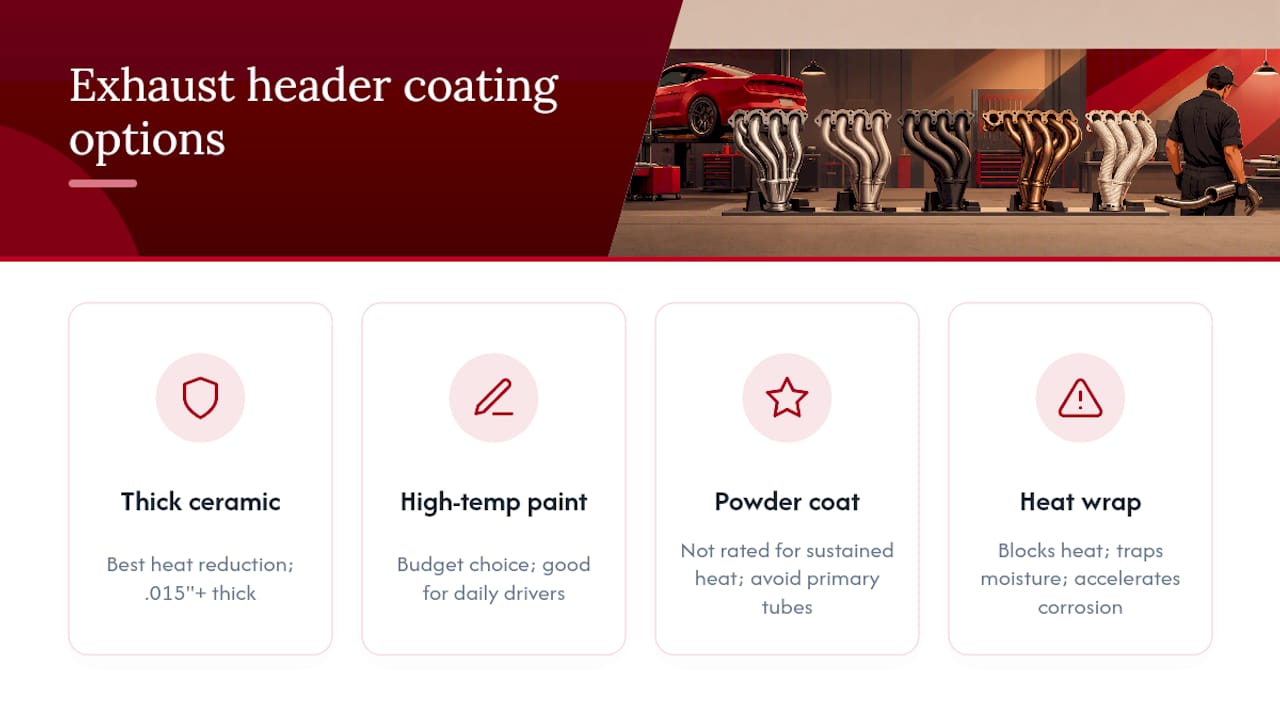
True thick ceramic thermal barrier (example: Swain Tech White Lightning) is the highest-performing option. Applied at .015" or more, it delivers the best heat reduction and longest service life. Requires professional application with abrasive blasting and oven cure. Best for turbo builds, track cars, and high-value restoration projects.
Ceramic-reinforced high-temp paints are thinner (often .002" or less), available in aerosol or brush-on form, and cure via heat cycling on the vehicle. They reduce surface temps and resist rust but don’t match thick ceramic’s insulating performance. Silicone-ceramic hybrid coatings rated 1,600–1,900°F offer a practical middle ground: more flexibility than rigid ceramics, solid heat stability, and better durability than basic aerosol paints when professionally applied.
Powder coat is durable and available in a wide range of colors, but most powder coats are not rated for the sustained heat of exhaust headers. They can discolor, blister, or peel under repeated thermal cycling. Not recommended for primary header tubes.
Heat wrap is a different approach entirely. Exhaust wrap generally blocks more radiant heat than surface ceramic coatings, but it traps moisture against the pipe, which accelerates corrosion on mild steel. Combining wrap and ceramic can increase the risk of metal fatigue and premature failure. Pick one, not both.
For a daily driver street car, a quality aerosol ceramic paint is a reasonable budget choice. For a turbo build or a show car, thick professional ceramic is the only answer worth considering.
Can you coat used or rusty headers?
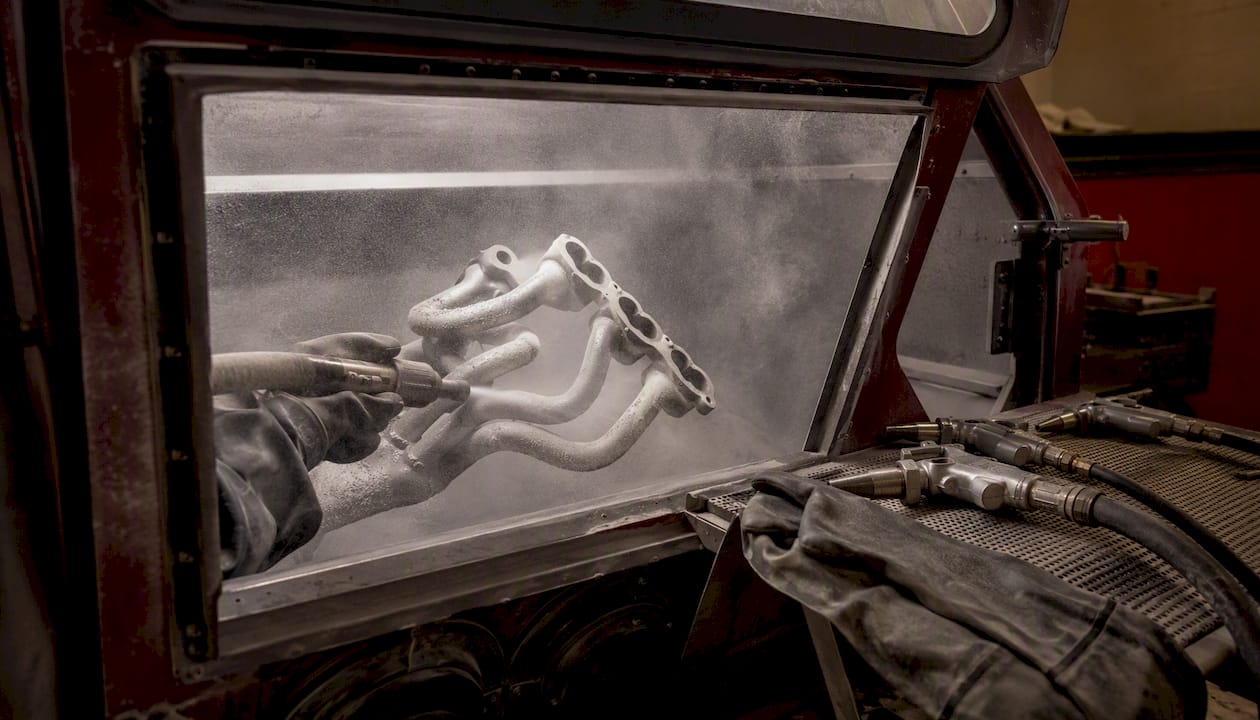
Yes, with the right prep and depending on how far gone the metal is. Surface rust that hasn’t pitted or compromised wall thickness is manageable. A shop will media blast the headers to bare metal, removing oxidation and creating the surface profile the coating needs to bond.
The failure modes that make coating a bad investment are structural: cracks, thin spots from corrosion, or warped flanges. A coating applied over a crack won’t seal it and will fail at that point under heat cycling. Thin metal that flexes under thermal stress will cause the coating to delaminate regardless of prep quality.
Before sending old headers to a shop, check for:
- Visible cracks at welds or collector joints
- Flange warping that would require machining
- Wall thickness loss from deep pitting
- Collector damage or previous weld repairs that weren’t finished cleanly
If any of those are present, repair or replace first. Coating is a surface treatment, not a structural fix. For headers that are cosmetically rough but structurally sound, blasting will reveal the true condition and the shop can advise before committing to the full job.
Pro Tip: Ask the shop to inspect after blasting and before coating. A good shop will flag structural issues at that stage rather than coat over them and let you find out later.
DIY ceramic coating process: when to do it yourself and when to hire a shop
For a basic street header on a low-budget build, DIY aerosol ceramic coatings can work. For anything else, hire a professional. That’s the honest starting point.
A correct professional application follows these steps:
- Abrasive blast the header to bare metal using aluminum oxide or similar media to create a clean, profiled surface
- Degrease and clean to remove all blast media, oils, and contamination
- Mask all mating surfaces, flanges, and threaded ports to maintain fitment tolerances
- Apply coating in controlled conditions, with attention to film thickness and coverage
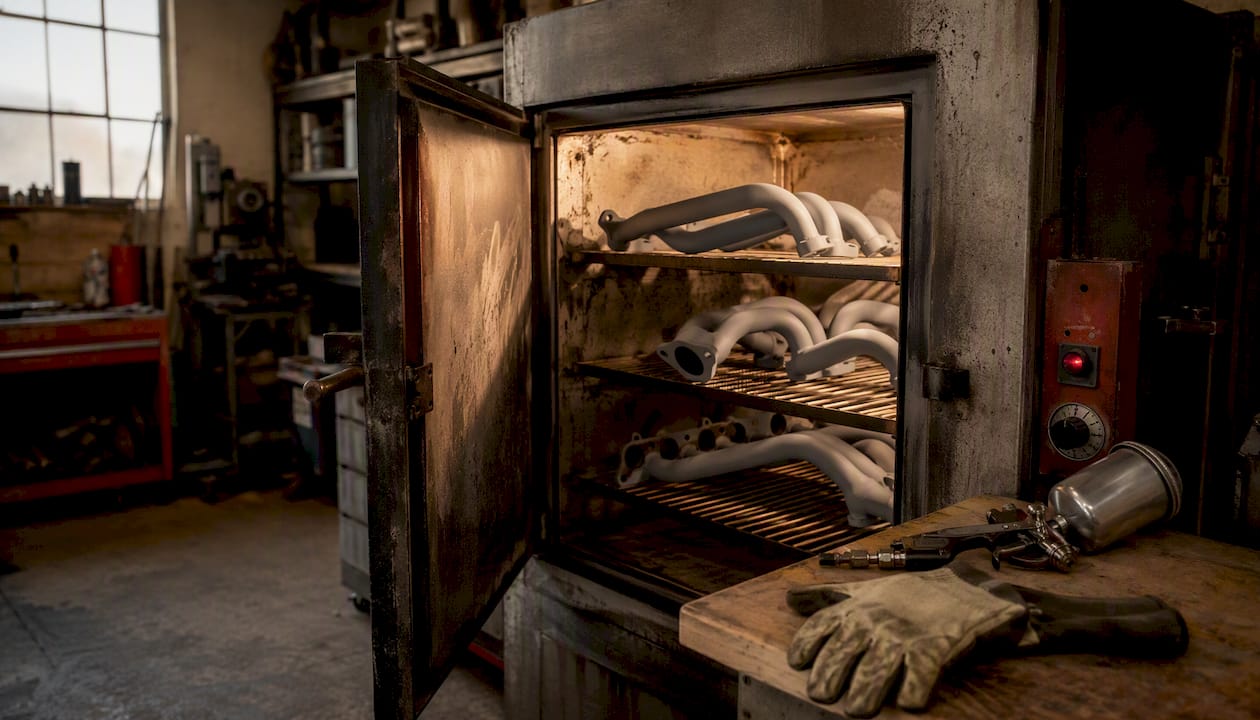
- Oven cure at the manufacturer’s specified temperature and duration for full crosslinking and adhesion
- Inspect for coverage gaps, runs, or missed areas before delivery
Application quality — blasting, contamination control, and cure schedule — affects performance and durability more than the brand label. Most coating failures trace back to prep or cure errors, not chemistry.
DIY aerosol kits skip the blast step (most users clean with solvent only), apply a thinner film, and cure via heat cycling on the vehicle rather than a controlled oven. Community reports show acceptable results for low-stress applications, but adhesion and longevity depend heavily on how clean the surface actually is before the first coat goes on.
Safety considerations matter too. Blasting generates fine metal and abrasive dust. Aerosol coatings contain solvents. Oven curing produces fumes. If you’re doing any of this at home, work outdoors or in a well-ventilated space and use appropriate respiratory protection.
Pro Tip: Controlled oven cures deliver more consistent crosslinking and durability than vehicle heat cycling. Not every shop has ovens sized for full headers, so confirm the cure method before you pay.
How much does ceramic coating headers cost in the U.S.?
- DIY aerosol kits: $20–$80 for a set of headers, depending on coverage area and brand
- Professional ceramic-reinforced paint or hybrid: $100–$300 depending on header size, inside coating, and prep required
- Professional thick ceramic thermal barrier: $150–$400 or more for a full header set, with inside coating adding to that cost
- High-end racing ceramic systems: $400+ for complex manifolds, inside-and-out coating, and full oven cure
What drives the price up: inside-pipe coating (which requires specialized equipment and adds meaningful thermal benefit), the number of individual tubes and collectors, the amount of prep work needed on used parts, and whether the shop uses an oven cure or a heat-cycle protocol.
Expected service life follows prep quality closely. A well-prepped professional job can last multiple years under street use, with field examples showing 24–36 months before minor fading on street-driven vehicles. DIY or poor-prep jobs often show adhesion failures within 6–18 months, especially in wet climates or on vehicles driven hard.
When evaluating warranties, look for what’s actually covered: adhesion failure, thermal failure, or appearance only. A lifetime guarantee on appearance is not the same as a lifetime guarantee on adhesion. Jet-Hot, for example, is known in the U.S. market for advertising lifetime guarantees on certain coatings. Ask the shop to put the coverage terms in writing before the job starts.
How do you pick a ceramic header coating shop?
Start with the application, not the finish color. A shop that produces beautiful results on a clean set of new headers may not have the equipment or process discipline for used parts or inside-pipe work.
Confirm these capabilities before committing:
- Abrasive blast capability: If they only clean with solvent or wire brush, walk away
- Inside-pipe coating: Not all shops offer it; for turbo builds it’s worth the extra cost
- Oven cure: Ask the cure temperature and duration; vague answers are a red flag
- Experience with headers specifically: Tube headers have complex geometry; ask to see before/after photos of similar work
- Masking practice: Flanges and threaded ports must be masked to maintain fitment; ask how they handle it
Questions worth asking directly: What blasting media do you use? What film thickness do you apply? Do you coat the inside of the tubes? How do you mask flanges? What’s your turnaround time? What does your warranty actually cover?
Red flags: shops that quote over the phone without seeing the parts, shops that can’t show you before/after photos of header work, and any shop that describes their process as “spray and bake in the sun.”
Pro Tip: For mail-in shops, ask for a written condition report after blasting and before coating. That step protects you if structural issues are found and prevents disputes about pre-existing damage.
What to expect after your headers are coated
Routine care is light, but the first few heat cycles and your cleaning habits matter more than most owners expect.
- First heat cycles: Allow the coating to fully cure by running the engine through 3–5 heat cycles (warm up, cool down) before hard driving. This is especially important for aerosol-cured coatings
- Cleaning: Use mild soap and water or a dedicated engine-bay cleaner. Avoid aggressive degreasers, acidic wheel cleaners, or anything with high pH that can attack the coating surface
- Corrosion inspection: Check the coating annually, especially at welds and collector joints where thermal stress concentrates
- Touch-ups: Small chips or scratches can sometimes be touched up with compatible aerosol products; full delamination requires stripping and recoating
- Road salt: In salt-belt states, rinse the undercarriage regularly. Salt accelerates coating degradation at any chips or thin spots
- Physical damage: Rocks, debris, and contact with other components during installation can chip the coating. Handle coated headers carefully during reinstallation
Ozkonic Kustomz prep checklist before sending headers for coating
Follow this checklist to reduce rework, avoid adhesion failures, and make the shop’s job straightforward.
- Remove all attached components before shipping: oxygen sensors, heat shields, temperature senders, and any brackets. Coating over sensors or shields creates fitment and warranty problems
- Mark flanges and mating surfaces clearly with masking tape and a note specifying “do not coat.” A .015" ceramic coating at a flange can affect gasket fit if not masked
- Document existing damage with photos before shipping. Photograph cracks, pitting, previous weld repairs, and any thin spots. This protects you if disputes arise about pre-existing conditions
- Specify inside-coat requirements in writing. If you want the inside of the tubes coated, state it explicitly and confirm the shop has the equipment to do it
- Note the blasting media preference. Aluminum oxide is the standard for most header steel; ask the shop to confirm their media choice and whether it’s appropriate for your header material
- Catalog all parts going in and expected back. List each piece by description and count, and include that list inside the package and in your communication with the shop
- Pack securely with adequate padding between tubes. Coated surfaces are more vulnerable to chipping than bare metal, and headers returned damaged from shipping are a common frustration
- Label the package clearly with your name, contact information, and order or job number if the shop provides one
- Confirm turnaround time and shipping method for return before you send. Get it in writing
For additional guidance on header installation and fitment before or after coating, the Ozkonickustomz header installation guide covers prep steps that apply directly to coating prep as well.
Pro Tip: Take a photo of the packed box before sealing it. If something arrives damaged, that photo is your first line of evidence for a shipping claim.
What do owners and builders say about popular ceramic coating brands?
Jet-Hot is the name that comes up most often in U.S. enthusiast forums when the topic is professional header coating. Owners consistently report good adhesion, clean finishes, and the brand’s lifetime guarantee as a reason for choosing them. Complaints, when they appear, usually involve turnaround time rather than coating quality.
Swain Tech’s White Lightning draws strong reviews from the racing community specifically. Builders running high-output engines point to the measurable heat reduction and the coating’s ability to hold up through repeated hard heat cycles. It’s a premium product at a premium price, and the reviews reflect that.
DIY aerosol products get more mixed feedback. Community threads show that owners who prep carefully, including a thorough solvent clean and light sanding, report surface temperature drops and acceptable durability for street use. Owners who skip prep steps report peeling within a season. The pattern is consistent: the product matters less than what you do before you apply it.
Does ceramic coating actually improve header performance?
The performance impact is real but indirect. Ceramic coatings don’t change the header’s tube diameter, collector design, or scavenging characteristics. What they do is keep exhaust gas temperatures higher inside the pipe by reducing heat loss through the tube wall. Hotter, faster-moving exhaust gas improves scavenging efficiency, which means the outgoing exhaust pulse does a better job of pulling the next intake charge into the cylinder.
The measurable effect on a street engine is modest. On a turbocharged engine, the compounding effect of lower under-hood temperatures on intercooler efficiency can make the benefit more pronounced.
For a budget-conscious performance build, ceramic coating headers is one of the more cost-effective ways to extract a small but real performance benefit while simultaneously protecting a significant investment in aftermarket parts.
What are the real risks of ceramic coating headers?
Ceramic coatings are not bulletproof. The most common failure mode is delamination, where the coating separates from the base metal. This almost always traces back to inadequate surface prep: residual oil, mill scale, or insufficient blast profile. Once delamination starts, it spreads under thermal cycling.
Cracking is the second failure mode. Rigid ceramic coatings can crack if the base metal flexes significantly, which happens with thin-wall headers under extreme heat cycles. Silicone-ceramic hybrids are more flexible and handle this better, which is why they’re the preferred choice for turbo hot-side applications.
Extreme heat beyond the coating’s rated temperature causes degradation regardless of prep quality. Most professional ceramic coatings are rated for 1,200–1,900°F depending on chemistry. Running a header consistently above that rating will shorten the coating’s life. For high-output builds, confirm the coating’s temperature rating against your expected exhaust gas temperatures before choosing a product.
Physical damage during installation is underrated as a failure cause. Dropping a coated header, overtightening a clamp, or scraping a tube against the chassis can chip the coating and create a starting point for corrosion and further delamination.
Finally, combining heat wrap with ceramic coating is a mistake. The wrap traps heat against the pipe surface, which can push temperatures beyond what the ceramic was designed to handle and accelerates metal fatigue at welds.
What the conventional wisdom on header coatings gets wrong
Most guides treat ceramic coating as a straightforward upgrade decision. It’s not. The decision that actually matters is which shop you choose and how you prep the parts before they arrive. A mediocre coating from a shop with a disciplined blast-and-cure process will outlast a premium coating applied over a poorly cleaned surface every time.
The second thing most guides understate: heat wrap and ceramic coating are not interchangeable, and they’re not additive. They solve different problems. Wrap keeps heat inside the pipe; ceramic protects the pipe and the engine bay. Choosing between them depends on what you’re actually trying to accomplish, not which one sounds more technical.
For enthusiasts building serious engines, the prep checklist and shop evaluation criteria in this guide matter more than any brand recommendation. The coating is only as good as the surface it’s bonded to.
Ozkonickustomz has the parts and guidance to get this right
Ozkonickustomz sources aftermarket exhaust headers and engine-bay components directly from vetted manufacturers, with guaranteed fitment and compatibility for trucks, performance builds, and off-road rigs. When you’re sourcing headers for a coating project, getting the right part the first time saves you from a second round of prep and shipping costs.
Beyond parts, Ozkonickustomz provides practical installation and prep resources that apply directly to coating projects. Whether you’re pulling headers for the first time or reinstalling after a professional coat, the guidance covers fitment, sealing, and the details that prevent rework. For restoration builds where headers and wiring are being updated together, the classic wiring kit for 53–62 Corvette is one example of the hard-to-find components Ozkonickustomz stocks for exactly these projects. Check the full catalog at Ozkonickustomz and reach out with fitment questions before you order.
Sources
- White Lightning Exhaust Coatings – Swain Tech Coatings | Industrial Coatings | High Performance Racing Coatings
- How to Apply Ceramic Exhaust Coating
- Best High-Temperature Coating for Exhaust Manifolds and Headers - INCURE INC.
- Exhaust wrap vs. ceramic coating: Which controls header heat better? | Design Engineering
Recommended
- Header Installation Guide: Boosting Performance on Your Small Block Ch – Ozkonic Kustomz LLC
- Performance Parts for Daily Drivers: 2026 Guide – Ozkonic Kustomz LLC
- Types of Aftermarket Intercoolers: 2026 Buyer’s Guide – Ozkonic Kustomz LLC
- Axle Shaft Upgrade: What Enthusiasts Need to Know – Ozkonic Kustomz LLC