
For most enthusiasts, the Borla S-Type cat-back is the right starting point. It delivers a genuine sport exhaust note without crossing into drone territory on the highway, and it fits the widest range of vehicles across Borla’s lineup. If you want something quieter for daily commuting, go Touring. If you want neighbors to know you left the driveway, go ATAK.
Quick picks by buyer persona:
- Daily driver / commuter: Borla Touring — deep, refined tone with minimal cabin drone
- Weekend cruiser / show car: Borla S-Type — the crowd-pleasing middle ground
- Track or performance build: Borla ATAK — maximum decibels, engineered for aggressive use
- Truck or towing owner: Borla S-Type or ATAK truck-specific kits — vehicle-specific fitment with bolt-on installation on many platforms like the Silverado 1500
- Turbocharged car: Borla ProXS or Polyphonic Harmonizer-equipped systems — designed to restore exhaust richness that turbos naturally suppress
Every Borla system is built from T-304 stainless steel and backed by a million-mile warranty on qualifying applications. That combination of material quality and long-term coverage is what separates Borla from most budget alternatives before you even hear the sound.
Table of Contents
- What are the differences between Borla exhaust lines?
- Why T-304 stainless and Borla’s warranty matter
- How do you find the right Borla kit for your vehicle?
- What kind of performance and sound should you realistically expect?
- How does Borla’s ATAK and Polyphonic technology actually work?
- What does a Borla kit cost, and how long does installation take?
- How does Borla compare to other exhaust options?
- How do you choose the right Borla kit without making a mistake?
- What is the final verdict on Borla exhaust kits by buyer type?
- Key Takeaways
- The case for buying Borla the right way
- Get your Borla kit from Ozkonickustomz
- Useful sources and product links
What are the differences between Borla exhaust lines?
Borla organizes its performance exhaust systems into distinct sound tiers, each engineered for a specific driver profile. The material baseline stays the same across all lines — T-304 stainless construction and the same warranty language — but the acoustic tuning and muffler design change significantly from one series to the next.
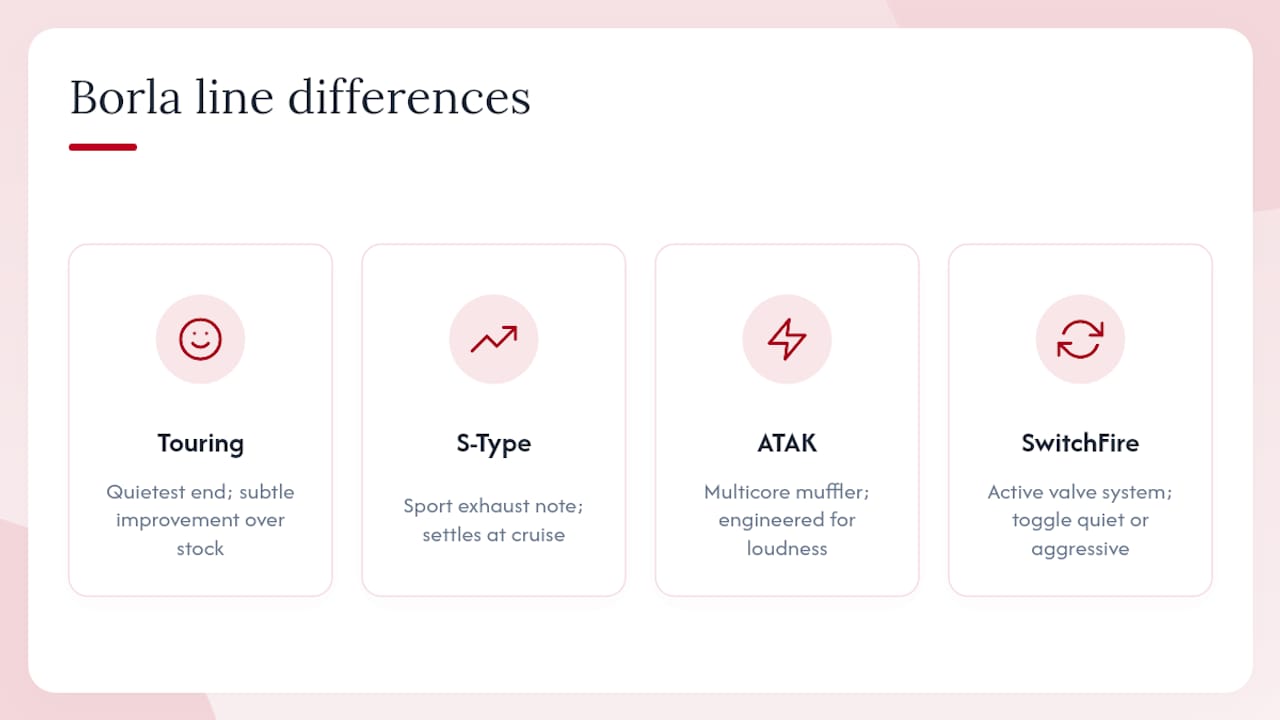
Borla Touring sits at the quietest end. It adds a noticeable improvement over stock without drawing attention. Think of it as the exhaust equivalent of a well-tailored suit: you notice it, but it never shouts.
Borla S-Type is the volume sweet spot for most enthusiasts. It produces a sport exhaust note that sounds confident under acceleration and settles down at cruise. This is the series that moves the most units for good reason.
Borla ATAK (Acoustically Tuned Applied Kinetics) uses a multicore muffler design with multiple solid and perforated cores to push maximum decibels while keeping the tone clean rather than raspy. ATAK systems are engineered for loudness and vehicle-specific acoustic tuning, not just raw volume.
Borla ProXS targets turbocharged and forced-induction applications. Turbos naturally muffle exhaust character, and ProXS is tuned to work with that restriction rather than against it.
Borla SwitchFire adds an active valve system, letting you toggle between a quieter mode and a more aggressive note from the cabin. It suits drivers who want flexibility across different driving environments.
Borla Polyphonic Harmonizer is a multi-pipe insert rather than a full muffler replacement. It fits into specific locations along the exhaust path and adds harmonic richness, particularly on turbocharged platforms. It was introduced at SEMA 2017 for vehicles including the Focus RS, Fusion Sport, Dodge Challenger, and Infiniti Q60S.
Why T-304 stainless and Borla’s warranty matter
Most budget exhaust kits use aluminized steel, which holds up fine in dry climates but corrodes faster when exposed to road salt, moisture, and heat cycling. T-304 stainless steel resists all three. It handles the thermal expansion and contraction of repeated heat cycles without cracking at welds, and it won’t rust through in the wheel wells of a truck that sees winter roads.
Borla’s product pages reference a million-mile warranty on qualifying systems, which is the kind of language that signals genuine confidence in the material. That claim only holds if the construction backs it up, and T-304 does.
Borla on T-304 stainless: “Our exhaust systems are constructed from T-304 stainless steel and are designed to provide a permanent sound characteristic — the same great sound for the life of the vehicle.” — The Borla Sound
Practical tips to extend system life:
- Inspect mounting hardware and fasteners regularly, as vibration can loosen clamps over time
- Check rubber hangers for cracking regularly; a failed hanger puts stress on welds
- Rinse the undercarriage after driving on salted roads — T-304 resists corrosion, but accumulated salt speeds surface oxidation on any metal
- Avoid pressure-washing directly at muffler seams or collector joints
- If you notice a ticking or rattling sound, check the heat shields before assuming the muffler is at fault
For a broader look at how aftermarket parts hold up against OEM components over time, the OEM vs. aftermarket parts comparison at Ozkonickustomz covers the durability trade-offs in detail.
How do you find the right Borla kit for your vehicle?
Fitment is where most exhaust purchases go wrong. A system that fits a 2021 F-150 5.0L with a single-exit stock exhaust will not fit the same truck with a factory dual-exit setup. Here is how to confirm before you order.
- Confirm your exact year, make, model, engine, and trim. Engine displacement alone is not enough — trim level often determines whether your truck has a single or dual exhaust from the factory, which changes the entire system layout.
- Identify your current exhaust configuration. Is it a cat-back (from the catalytic converter back), axle-back (from the rear axle back), or header-back (full system from the headers)? Cat-back kits are the most common upgrade and deliver the best balance of sound improvement and power gain.
- Look up the Borla part number using their vehicle application table. Cross-reference the part number against your VIN-decoded specs, not just the year/make/model dropdown.
- Check tip configuration. Dual tips vs. single tip, angle-cut vs. straight-cut, and tip diameter all affect fitment at the bumper cutout. A kit with 4-inch tips won’t clear a bumper designed for 3-inch tips without modification.
- Verify emissions compliance for your state. California and several other states require CARB-compliant parts; Borla lists CARB EO numbers on applicable products.
- Confirm hanger locations match. Count the factory hanger points and compare them to the kit’s hanger diagram. Missing a hanger means the system will vibrate against the chassis.
Common fitment pitfalls:
- Ordering a truck kit without specifying cab/bed configuration (short bed vs. long bed changes pipe routing)
- Confusing axle-back and cat-back kits — they are not interchangeable
- Overlooking the difference between turbo and naturally aspirated versions of the same engine (e.g., EcoBoost vs. non-turbo V6)
Borla’s bolt-on design for many truck platforms, including the Silverado 1500, means no cutting or welding on most applications — but that only holds when the part number is correct.
Pro Tip: Before ordering, measure the outside diameter of your stock tailpipe where it exits the muffler, and photograph your hanger bracket locations. If a kit’s spec sheet lists different measurements, call the seller for clarification rather than assuming it will adapt.
What kind of performance and sound should you realistically expect?
Exhaust upgrades do not produce the same horsepower gains as internal engine work. The honest answer is that a cat-back system on a stock engine typically adds modest power, and the amount varies significantly based on how restrictive the factory exhaust was to begin with. Borla’s flow-focused engineering and XR-1 racing heritage aim to reduce backpressure and improve exhaust velocity, which helps power delivery — but the gains are most meaningful when paired with other supporting mods like a cold air intake or a tune. For context on how exhaust fits into a broader power build, the horsepower upgrades under $500 guide at Ozkonickustomz puts it in perspective.
Sound character by series:
- Touring: Approximately 85–90 dB at the tailpipe. Deep and refined, barely louder than stock at idle, noticeable under hard acceleration.
A few things shift how loud a system sounds in practice. V8 engines fill out an aggressive muffler better than a 4-cylinder. A cat-back swap changes more of the sound path than an axle-back, so it produces a more dramatic result. Header upgrades add the most change of all, but they also require the most installation work and can affect emissions compliance.
Local noise regulations are real. Several municipalities and states enforce sound limits for modified vehicles, and 100+ dB at the tailpipe can put you in violation during a roadside inspection. Check your local ordinances before committing to ATAK on a street-driven car.
How does Borla’s ATAK and Polyphonic technology actually work?
Borla’s acoustic engineering is not about making an exhaust louder by removing restriction. It is about shaping which frequencies come out of the tailpipe, the same way an organ pipe shapes a musical note by controlling tube length and diameter.
From MotorTrend’s coverage of Borla’s polyphonic engineering: “Borla engineers record the exhaust signature of a specific engine, then design pipe sizes and configurations to emphasize the harmonic intervals that sound pleasing while cancelling the harsh, droning frequencies.” — MotorTrend
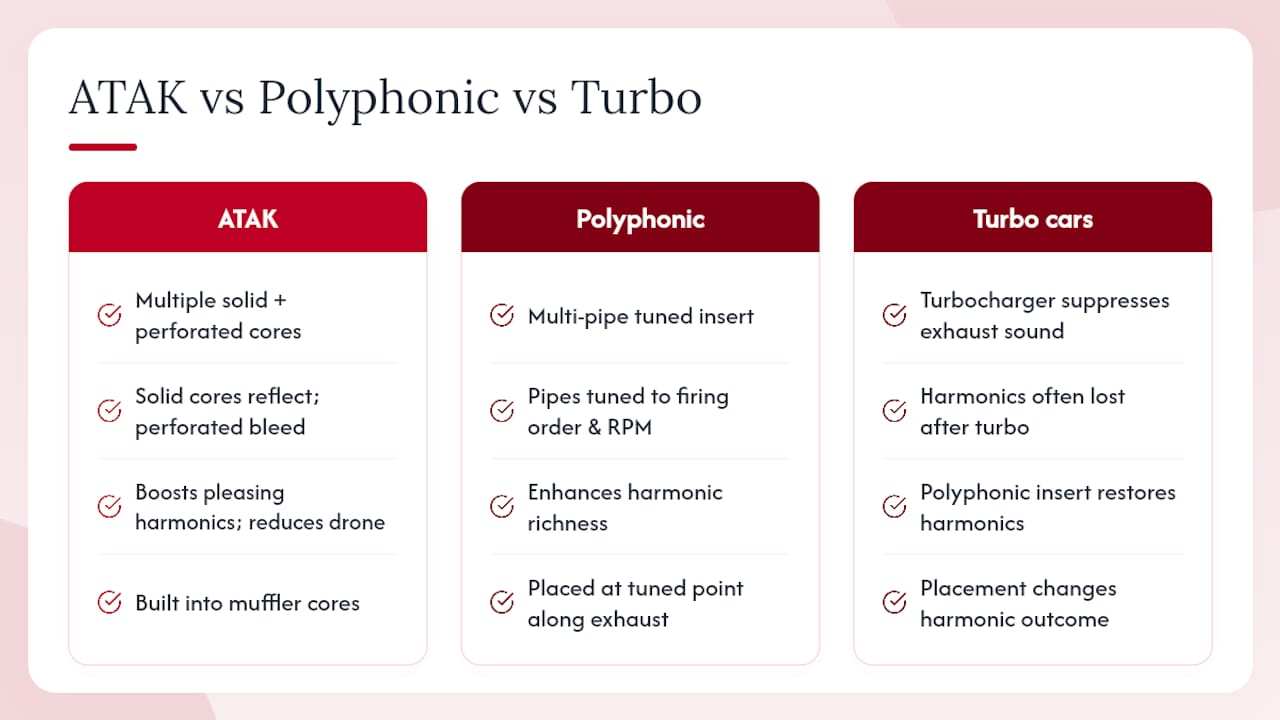
The ATAK muffler uses multiple cores, some solid and some perforated, arranged to interact with exhaust pulses at specific frequencies. The solid cores reflect sound waves; the perforated cores let certain frequencies bleed through. The result is a muffler that amplifies the harmonics that make an engine sound powerful while suppressing the mid-range drone that makes long highway drives miserable.
The Polyphonic Harmonizer takes this further by adding a multi-pipe insert at a specific point in the exhaust path. The insert’s pipe lengths are tuned to the engine’s firing order and RPM range. On turbocharged applications, where the turbo itself acts as a sound suppressor, the Polyphonic insert restores harmonic richness that would otherwise be lost. Placement along the exhaust path matters: an insert near the muffler produces a different harmonic result than one closer to the downpipe.
Pro Tip: When evaluating Borla sound demos online, look for clips recorded outside the vehicle at 3/4 throttle in the 3,000–5,000 RPM range — that is where the harmonic character is most audible. In-cabin clips and idle recordings tell you almost nothing about how the system will sound during a real pull.
What does a Borla kit cost, and how long does installation take?
Price varies by series, vehicle platform, and whether you are doing a cat-back or axle-back swap. Amazon listings and retail pages show a broad spread across part numbers, but the general bands hold fairly consistently.
Typical price and installation ranges
| Category | Touring | S-Type | ATAK |
|---|---|---|---|
| Parts MSRP (axle-back) | — | $350–$600 | — |
| Shop labor (standard bolt-on) | 1–2 hours | 1–2 hours | 1–2 hours |
| Shop labor (rusted hardware) | 2–4 hours | 2–4 hours | 2–4 hours |
| Extra cost: header/downpipe work | Add $150 labor | Add $150 labor | Add $150 labor |
High-clearance trucks and lifted vehicles add time because the technician has to work around suspension geometry and may need to re-route hangers. Budget an extra hour for lifted trucks.
Installation steps for a standard bolt-on cat-back:
- Lift the vehicle safely on jack stands or a lift; never work under a vehicle supported only by a floor jack
- Spray all factory fasteners with penetrating oil the night before — this is the single step most DIYers skip and regret
- Remove the factory muffler and mid-pipe, starting from the rear and working forward
- Transfer or replace rubber hangers as needed; worn hangers should be replaced now, not later
- Install the new mid-pipe and muffler, hand-tightening all clamps before final torque
- Check tip alignment at the bumper cutout before torquing anything permanently
- Start the engine and listen for leaks at collector joints; a ticking sound at idle usually means a loose clamp
Parts to budget for beyond the kit itself:
- Replacement rubber exhaust hangers ($5–$15 each; replace any that show cracking)
- Band clamps or V-band clamps if the kit does not include them
- New gaskets at the collector or downpipe flange
- Anti-seize compound for all fasteners
For readers pairing an exhaust upgrade with other bolt-on work, the bolt-on upgrades guide at Ozkonickustomz covers how to sequence mods for the best combined result.
How does Borla compare to other exhaust options?
The honest comparison is not Borla vs. a specific brand. It is Borla vs. the category of product you would otherwise buy.
Entry-level aluminized kits cost less upfront, often $150–$350 for a cat-back, but aluminized steel corrodes faster in wet climates and the sound tuning is rarely vehicle-specific. You get louder, but not necessarily better.
Budget muffler-brand kits (universal-fit or semi-universal designs) require cutting and welding for a clean install. They can sound decent on the right engine, but fitment is never guaranteed, and there is no engineering behind the acoustic character.
High-end race-only systems (titanium or Inconel construction, straight-pipe designs) are built for track use where weight and peak flow matter more than street manners. They drone badly on the highway and often fail emissions inspections.
Borla’s position in that spectrum:
- T-304 stainless construction outlasts aluminized alternatives in every climate
- Vehicle-specific R&D means the sound is tuned for your engine’s firing order, not just made louder
- Million-mile warranty language backs the material claims
- Bolt-on fitment on most applications means no cutting or welding
- Price is higher than budget alternatives — that is the real trade-off
Where Borla is the wrong choice: If your only goal is maximum decibels at minimum cost and you are building a dedicated track car that never sees the street, a race-only straight-pipe system will outperform any Borla kit on peak flow. For everything else — street, show, daily, truck — Borla’s engineered tuning and material quality justify the price.
How do you choose the right Borla kit without making a mistake?
Start with use-case, not sound level. Most buyers anchor on “how loud” before they have thought through “how often am I driving this car and where.” A system that sounds incredible on a Saturday canyon run can make a 45-minute highway commute genuinely unpleasant.
Selection checklist:
- Define your primary use. Daily driver, weekend show, track, towing? This eliminates half the lineup immediately.
- Set a sound level target. If you have never heard an ATAK in person, find a YouTube clip of your specific vehicle with that system before ordering.
- Confirm fitment using your VIN-decoded specs, not just year/make/model. Trim level, engine code, and factory exhaust configuration all matter.
- Check your state’s emissions rules. Some states require CARB-compliant parts; Borla lists EO numbers on applicable products.
- Set a total budget including installation. Parts cost is only part of the number; add shop labor and replacement hardware.
- Decide cat-back vs. axle-back. Cat-back changes more of the system and produces more sound improvement and power gain. Axle-back is cheaper and simpler but changes less.
Red flags in listings to watch for:
- No vehicle application table or fitment notes in the listing
- Part numbers that don’t match Borla’s official catalog
- Listings with no return policy or a “no returns on exhaust” clause
- Prices significantly below MSRP from unknown sellers (counterfeit Borla kits exist on third-party marketplaces)
- Photos showing generic mufflers without Borla branding on the body
Questions to ask a seller or shop before purchase:
- Does this part number fit my specific trim and engine code?
- Will this affect my ECU or require a retune?
- Is this CARB-compliant for my state?
- What is the return policy if the fitment is incorrect?
When buying from a marketplace, always verify the seller’s authenticity and confirm the part number against Borla’s official product pages. Ozkonickustomz sources directly from vetted manufacturers, which eliminates the counterfeit risk that comes with third-party marketplace listings.
What is the final verdict on Borla exhaust kits by buyer type?
The S-Type is the right answer for most enthusiasts. It sounds genuinely good on nearly every platform, installs without drama on most vehicles, and won’t make your daily commute a noise endurance test. For everyone else, the choice is straightforward once you know your use-case.
Recommended picks by persona:
- Daily driver: — Borla Touring — refined, durable, and won’t attract unwanted attention
The one thing that cuts across all five personas: confirm fitment before you order. The best-sounding system in the world is worthless if it doesn’t bolt up to your vehicle correctly.
Key Takeaways
Borla S-Type cat-back exhausts offer the best balance of sound, fitment breadth, and daily drivability for most enthusiasts, backed by T-304 stainless construction and a million-mile warranty.
| Point | Details |
|---|---|
| Match series to use-case | Touring for daily, S-Type for sport/show, ATAK for track/aggressive, ProXS for turbo builds. |
| Confirm fitment precisely | Use VIN-decoded specs including trim and engine code, not just year/make/model. |
| Expect modest HP gains | Power improvements vary by configuration; gains are most meaningful paired with intake or tune work. |
| T-304 stainless and warranty | T-304 outlasts aluminized steel in all climates; million-mile warranty applies to qualifying systems. |
| Ozkonickustomz for purchase | Ozkonickustomz sources directly from vetted manufacturers, eliminating counterfeit risk and fitment errors. |
The case for buying Borla the right way
The exhaust category has a counterfeit problem that most buyers don’t think about until they receive a box that smells wrong and fits worse. Borla’s reputation is built on vehicle-specific engineering and T-304 construction, and both of those things disappear the moment a fake part number enters the picture. The sound won’t be right, the fitment won’t be right, and the warranty won’t apply.
What actually matters when buying a performance exhaust system is not just the brand on the muffler. It is whether the seller confirmed your fitment before the order shipped, whether the return policy covers you if something is wrong, and whether you can reach a person who knows the product when you have a question during installation.
Most online exhaust purchases go smoothly. The ones that don’t almost always trace back to a part number that was never verified against the buyer’s actual vehicle configuration. That is a process problem, not a product problem, and it is entirely preventable.
The Polyphonic Harmonizer and ATAK technology represent genuine engineering investment. Borla records exhaust signatures, runs spectrum analysis, and tunes pipe geometry to shape harmonics rather than just removing restriction. That kind of R&D is worth paying for — but only when the part number is correct and the seller stands behind it.
Get your Borla kit from Ozkonickustomz
Ozkonickustomz stocks aftermarket exhaust components sourced directly from vetted manufacturers, which means every part number is confirmed authentic before it ships. No counterfeit risk, no fitment surprises, and no chasing down a return label from a marketplace seller who has already moved on.
How to order:
- Visit ozkonickustomz.com and use the vehicle selector to find your year/make/model
- Browse available Borla systems and confirm the part number against your engine code and trim
Every purchase is backed by straightforward return policies and expert support. If you are pairing your exhaust upgrade with other exterior accessories, check out the truck latch kit and other hardware available in the store. The same fitment-first approach applies across every product category.
Ready to order? Head to Ozkonickustomz and get the right Borla system for your vehicle, confirmed before it ships.
Useful sources and product links
- Borla ATAK® Technology: Custom-Tune Exhaust Sound
- Borla pipe-organ tech gets your car riffing like AC/DC (MotorTrend)
- The Science of Speed: How to Choose the Best Performance Exhaust for Horsepower and Sound — Blog
- Top 10 Benefits of Upgrading Your Silverado 1500 Exhaust System with Borla — Blog
Recommended
- Real Horsepower Upgrades Under $500 That Actually Work – Ozkonic Kustomz LLC
- Best Examples of Bolt-On Upgrades for Car Enthusiasts – Ozkonic Kustomz LLC
- Best 88rotorsoffroad.com Alternatives for Suspension Lift Kits – Ozkonic Kustomz LLC
- Budget Car Upgrades for High Performance – Ozkonic Kustomz LLC