
For most street and performance vehicles, a medium to large stacked-plate cooler or a properly sized universal kit with a thermostatic sandwich plate delivers the best mix of cooling capacity and durability. Stick with an OEM direct-fit unit for straightforward replacements. Fitment beats brand loyalty every time, which is why Ozkonic Kustomz verifies part numbers against your VIN before anything ships.
TL;DR:
- Proper fitment verification against your vehicle’s VIN is crucial to avoid leaks, mounting issues, or incorrect parts that cause failures.
- For sustained high-load conditions like towing or track use, a stacked-plate cooler sized with 16 or more rows and -10AN or -12AN plumbing provides the best thermal management.
- Liquid-to-liquid coolers are suitable for tight spaces or inconsistent airflow but carry risks of internal failure that can total an engine if internal walls crack.
- Oil coolers typically last 10 to 12 years under normal conditions, with failures often caused by stress cracks, corrosion, or neglected fluid maintenance.
- Matching the cooler size to your engine’s operating temperature range and expected duty cycle prevents overcooling or undercooling, ensuring optimal engine lubrication and longevity.
Table of Contents
- What Are the Best Oil Coolers for Your Vehicle?
- How Do You Size an Oil Cooler Correctly?
- Installation, Fitment, and Plumbing Checklist
- How Long Do Oil Coolers Last, and What Fails First?
- Which Oil Cooler Fits Your Use Case?
- Ozkonic Kustomz Perspective: Fitment First, Every Time
- Where to Find Fitment-Verified Oil Coolers and Plumbing
- Sources
- FAQ
What Are the Best Oil Coolers for Your Vehicle?
Not every “best” oil cooler is best for your engine. The right pick depends on how the vehicle gets used, how much airflow the mounting location gets, and whether you’re chasing sustained track temperatures or just keeping a daily driver’s oil out of the danger zone.
Three core designs cover almost every application on the road today.
Tube-and-fin (air-to-oil) coolers route oil through finned tubes exposed directly to airflow. They’re the cheapest option, simple to install, and fine for mild street use. The downside: they’re bulkier for the cooling they provide, and the fins are vulnerable to road debris and curb strikes.
Plate/stacked-plate coolers stack thin plates to pack more surface area into a smaller footprint. They handle sustained heavy loads better than tube-and-fin designs, which is why they show up on serious performance and towing builds. Comparisons between the two designs consistently favor plate coolers for steady-state cooling under load, though they cost more and can be harder to service in a tight engine bay.
Liquid-to-liquid coolers use engine coolant instead of ambient air to pull heat out of the oil, usually through a heat exchanger tied into the cooling system. These work well where space for ducting is tight or airflow is inconsistent, but they add a failure mode the other two don’t have: a cracked internal wall lets oil and coolant mix, which can total an engine fast.
Here’s how to think about the choice:
- Tight engine bay, no room for ducting: liquid-to-liquid, if your coolant system has the capacity to handle the added heat load.
- Mild street use, budget matters: tube-and-fin, mounted somewhere it won’t catch a rock.
- Track days, towing, or forced induction: stacked-plate, sized for sustained thermal load rather than peak-only cooling.
- Debris-heavy environments (off-road, low ground clearance): plate coolers with a guard, or a liquid-to-liquid setup tucked behind other components.
The trade-off across all three is consistent: more efficiency usually means more complexity, and more complexity usually means more places for something to leak.
How Do You Size an Oil Cooler Correctly?
Oil does its job best between roughly 180°F and 220°F. Below that range, oil stays thick and doesn’t lubricate as well on cold starts. Above it, viscosity breaks down and wear accelerates, with real trouble starting as oil temperatures push toward 260°F.
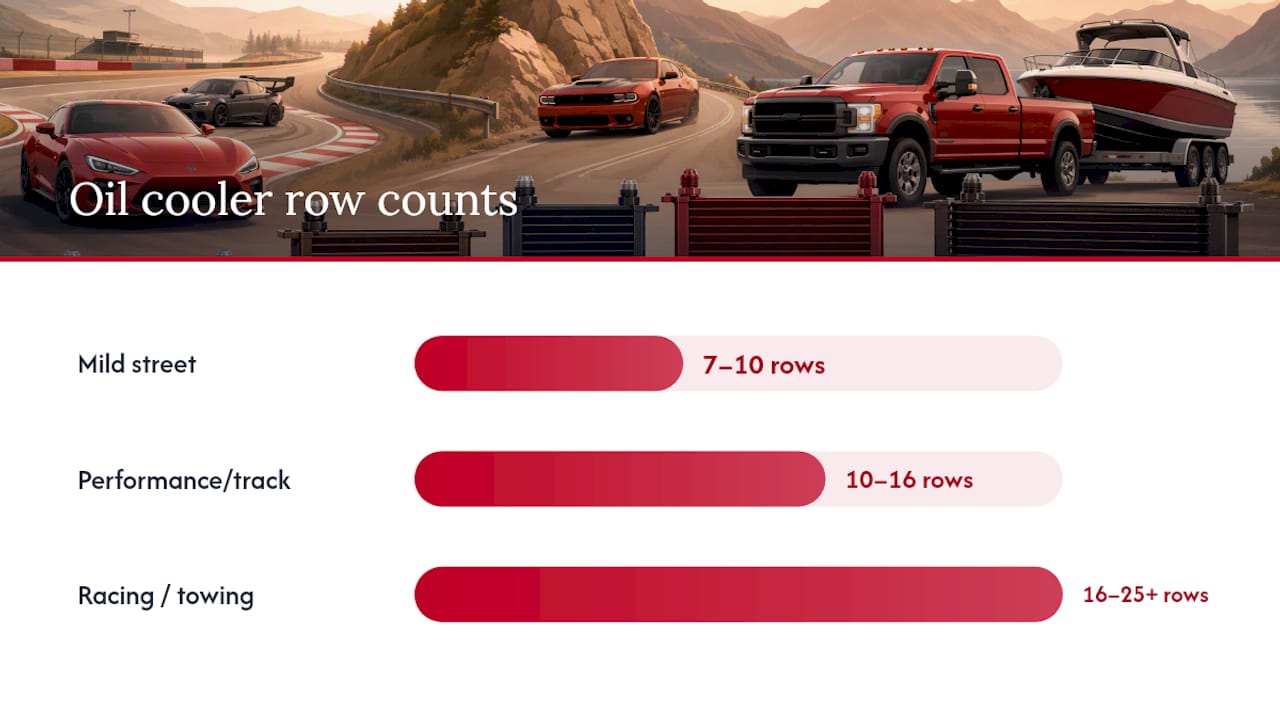
Row count is the practical shorthand the aftermarket uses to communicate cooling capacity:
- 7 to 10 rows: mild street driving, stock or lightly modified engines
- 10 to 16 rows: most performance builds, occasional track use, moderate forced induction
- 16 to 25+ rows: racing, towing, and sustained high-load applications
Those tiers come from row-count guidance built around real-world duty cycles, not just theoretical core size. Airflow still governs how well any of them perform, so a 20-row cooler buried behind a solid bumper cover underperforms a 12-row unit mounted in clean air.
Pro Tip: A bigger core isn’t automatically better. Oversized cores can create pressure drop that starves oil flow to bearings under high RPM, so match the core to your oil pump’s capacity, not just your ambition.
Aluminum is the standard core material for good reason: it sheds heat efficiently and resists the corrosion that plagues liquid-to-liquid units built with weaker alloys. For plumbing, most performance builds run -8AN lines for street applications and step up to -10AN or -12AN for high-flow, high-heat setups like towing or track use.
Installation, Fitment, and Plumbing Checklist
Most oil cooler failures trace back to installation, not the part itself. A cracked line, a mismatched fitting, or a cooler mounted where it can’t breathe will undo even the best core on the market.
- Confirm fitment against your VIN, not just the part number listed for your model year. Small variations in port spacing and mounting bolt patterns cause more returns than any other single issue, and confirming fitment before ordering saves both time and money.
- Use motorsport-grade braided hoses with properly machined AN fittings. Hose and fitting mismatches are a frequent failure point in custom plumbing, especially where cheap compression fittings meet high-pressure lines.
- Torque fittings to spec, not by feel. Over-tightened AN fittings crack under heat cycling; under-tightened ones weep oil slowly until they blow.
- Mount the cooler where it gets clean airflow but stays shielded from road debris, typically ahead of the radiator or in a duct that pulls from outside the wheel well.
- Install a thermostatic sandwich plate so oil bypasses the cooler until it reaches operating temperature. This protects bearings during cold starts and prevents the overcooling that thick, cold oil causes on short trips.
How Long Do Oil Coolers Last, and What Fails First?
Technicians commonly estimate engine-mounted oil coolers last around 10 to 12 years under normal conditions, though that figure moves a lot depending on maintenance habits and how hard the vehicle gets driven.
Failures rarely come out of nowhere. Mechanics report that premature failures usually stem from stress cracks, corrosion, and neglected fluid maintenance rather than a defective part straight out of the box. Liquid-to-liquid coolers carry the added risk of internal wall failure, which lets oil and coolant cross-contaminate.
A basic maintenance routine catches most of this before it becomes expensive:
- Inspect hoses and fittings for weeping, cracking, or chafing every oil change.
- Pressure-test the system if you notice slow oil loss with no visible drip.
- Watch oil color and check for a milky tint, which signals coolant intrusion in liquid-to-liquid setups.
- Keep coolant fresh and non-acidic. Dirty coolant leaves deposits that reduce heat transfer and shorten cooler life.
- Stick to your manufacturer’s oil-change interval. Old oil breaks down and stresses every component it touches, cooler included.
For heavy-duty engines under sustained load, a new stacked-plate unit generally beats a remanufactured one on reliability, even at a higher upfront cost. Light-duty replacements on a low-mileage vehicle are usually fine going remanufactured or OEM.
Which Oil Cooler Fits Your Use Case?
Matching the cooler to how you actually drive saves money and prevents the two most common mistakes: undersizing a track build or overspending on a daily commuter.
- Street commuter: a direct-fit OEM cooler or a modest tube-and-fin unit with a thermostat handles daily driving without adding complexity you don’t need.
- Performance street, occasional track days: a medium plate or stacked-plate cooler with a thermostatic sandwich plate and -10AN plumbing covers spirited driving without overcooling on the way to work.
- Track use, forced induction, or towing: a large stacked-plate or high-row multi-pass unit with -10AN or -12AN lines, paired with proper ducting and a debris shield, holds up under sustained heat that would cook a smaller core.
- Diesel and heavy-duty applications: liquid-to-liquid setups or OEM-spec plate solutions are the norm here, and professional part-number verification matters more than usual given how much these systems vary by drivetrain and towing package.
One distinction worth remembering: transmission coolers are built for higher flow and faster response than engine oil coolers because transmission fluid can spike in temperature fast under load, like a long grade or heavy towing. Don’t assume an engine oil cooler and a transmission cooler are interchangeable just because they look similar.
Ozkonic Kustomz Perspective: Fitment First, Every Time
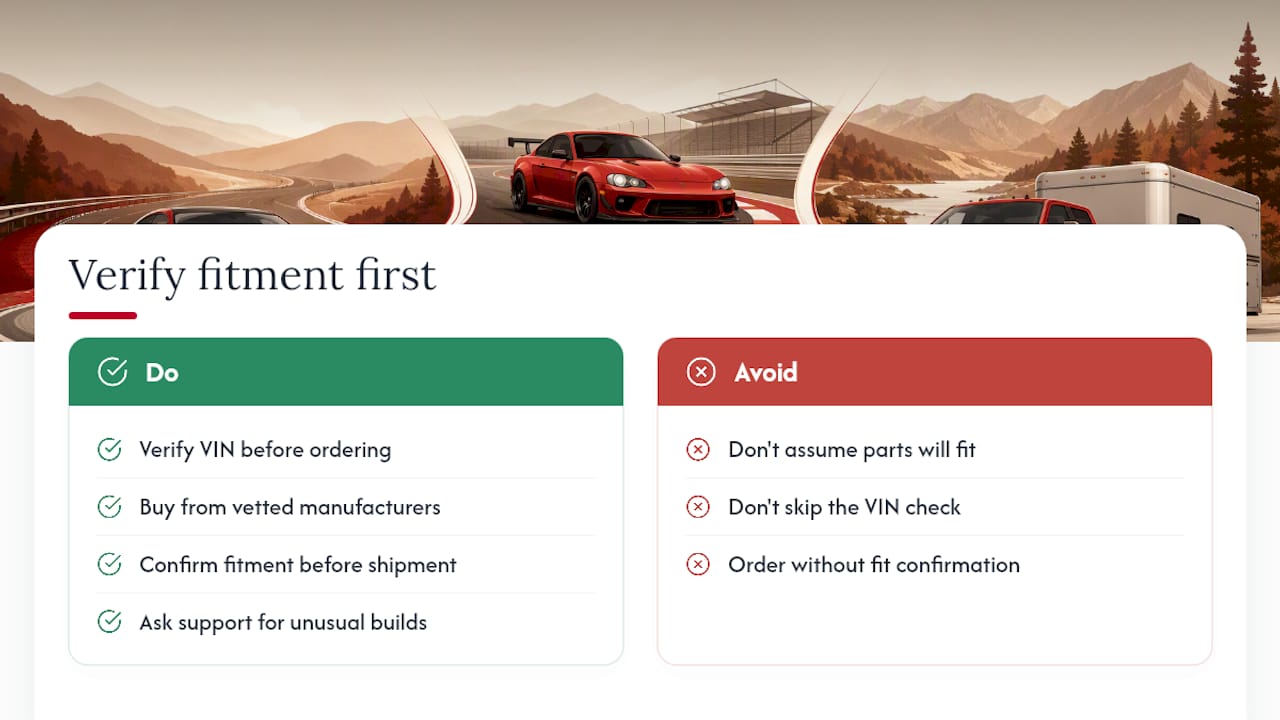
Most oil cooler complaints have nothing to do with the metal itself. They come from a part that almost fit, a port that was a few millimeters off, or a supplier that never checked the VIN before shipping. Sourcing from vetted manufacturers and verifying fitment against your specific vehicle before shipment helps ensure proper installation and reliability.
If your build is unusual (custom mounting, non-standard plumbing, a swapped engine), talk to support before ordering. Confirming fitment upfront is cheaper than a return.
— Ozkonic Kustomz
Where to Find Fitment-Verified Oil Coolers and Plumbing
Most oil cooler problems start before the part even ships, which is why verifying fitment against your VIN rather than just your model year and trim is beneficial. This helps ensure the part matches your vehicle’s exact specs, avoiding generic listings that may not fit.
Browse the Air Intake & Induction collection for cooling-adjacent components, or check Turbo & Supercharger parts if you’re building around forced induction and need the plumbing to match. Every listing comes from vetted manufacturers, and support is available to confirm compatibility on anything unusual before you place an order. If you’re not sure which configuration fits your build, request confirmation first. It’s faster than dealing with a return.
Sources
- Ask a tech: oil cooler upkeep — Aviation Consumer
- How long does an oil cooler last? — YourMechanic
- How to pick the right size engine oil cooler? — VolkswagenBuddy
- Engine oil cooler maintenance & replacement guide — Goldfarb & Associates
- Oil cooler: failure symptoms, replacement & maintenance guide — Vaden Original
FAQ
Which cooler brand is the best?
There’s no single brand that wins every category. What matters more than the badge on the box is whether the core is sized correctly for your engine and verified to fit your specific vehicle, which is why checking fitment against your VIN before shipping is recommended.
Which transmission oil cooler is the best?
The best transmission cooler is one sized for your vehicle’s flow rate and heat spikes, not just borrowed from an engine oil cooler spec sheet. Transmission coolers are built for higher flow and faster response because transmission fluid can spike quickly under towing or descent conditions.
What is the typical lifespan of an oil cooler?
Technicians commonly estimate 10 to 12 years for an engine-mounted oil cooler under normal use, though maintenance habits and driving conditions shift that range significantly in either direction.
Which cooler stays cold the longest?
Stacked-plate coolers generally hold steady cooling performance longer under sustained load than tube-and-fin designs, thanks to their greater surface area per volume. That makes them the stronger choice for towing, track days, or extended high-RPM use.