
The best fuel injectors for a performance build are modern, characterized by high-impedance units sized to keep duty cycle at or below 80% and flow-matched across every cylinder. Before buying anything, write down your target flywheel horsepower, fuel type, and injector count. Plan on a fuel-pump upgrade and an ECU retune if you’re stepping up in size, since bigger injectors rarely work in isolation.
TL;DR:
- Modern high-impedance injectors are now capable of supporting flow rates once reserved for low-impedance units, making them suitable for most performance builds.
- Proper sizing involves calculating fuel needs based on flywheel horsepower, fuel type, and injector count, with a maximum duty cycle of 80% to ensure reliability.
- Compatibility with your fuel system depends on matching connector types, fuel pump capacity, pressure settings, and using manufacturer-provided characterization data for precise tuning.
- Reputable injectors include flow curves at specified pressures, tight flow-matching tolerances, detailed latency tables, and verified sourcing to ensure performance and reliability.
- Using low-impedance injectors on ECU designed for high-impedance units without proper resistor packs Risks ECU damage, so always check impedance and incorporate necessary hardware.
Table of Contents
- What Are the Best Fuel Injectors: High-Z vs Low-Z, Port vs Direct
- How Do You Size Fuel Injectors for Your Engine?
- Installation Checklist: Matching Injectors to Your Fuel System
- What Vendor Data Actually Proves an Injector Is Good?
- A Look at the Leading Aftermarket Fuel Injector Brands
- How Do You Choose Injectors for Your Specific Build?
- What Are the Warning Signs of a Failing Injector?
- How Should You Maintain Fuel Injectors Over Time?
- How Do Injectors Interact With ECU Tuning?
- Publisher Perspective: Why Vetted, Characterized Injectors Matter
- Ready to Upgrade? Where to Buy and Get Fitment Support
- Sources
- FAQ
What Are the Best Fuel Injectors: High-Z vs Low-Z, Port vs Direct
Fuel injectors split into two electrical categories, and mixing them up is one of the fastest ways to fry an ECU driver. High-impedance (saturated) injectors run 12 to 16 ohms and connect straight to most factory and aftermarket ECUs with no extra hardware. Low-impedance (peak-and-hold) injectors run 2 to 5 ohms, open faster, and need a resistor pack or a dedicated peak-and-hold driver to avoid cooking the ECU’s output transistors. Hondata’s own technical guidance is blunt about this: low-Z injectors run hotter and can damage drivers when installed without proper resistors.
You can check which type you’re holding with a $15 multimeter. Set it to ohms, touch the probes to the two injector terminals, and read the resistance.
- 12 to 16 ohms: high-impedance, saturated, plug-and-play with most ECUs
- 2 to 5 ohms: low-impedance, peak-and-hold, requires resistor packs or a compatible driver
- Port fuel injection sprays into the intake port before the valve, the standard for most street and drag builds
- Direct injection sprays straight into the combustion chamber at much higher pressure, common on modern factory engines but rarely retrofitted for aftermarket work
Modern high-Z injectors used to top out well below what serious builds needed, but that gap has closed. EngineLabs notes that today’s saturated designs now reach flow ranges once reserved for low-Z units, without the heat and driver-compatibility headaches. That’s why high-Z is the default recommendation for nearly every street and performance project on the market now.
Pro Tip: If you’re unsure which impedance your factory harness expects, check the resistor pack. A visible resistor pack in the harness usually means the factory injectors were low-impedance, and swapping to high-Z units means you can often delete that pack entirely.
How Do You Size Fuel Injectors for Your Engine?
Sizing injectors wrong in either direction causes real problems. Too small and you run out of fuel at high RPM, risking a lean, engine-damaging condition. Too large and idle quality suffers, since the injector’s minimum pulse width may not be short enough to meter fuel accurately at low load.
The calculation isn’t complicated once you know the inputs:
- Start with flywheel horsepower, not wheel horsepower. Dyno numbers measured at the wheels lose 10 to 20% to drivetrain friction, so sizing off a wheel figure will leave you short on fuel exactly when you need it most.
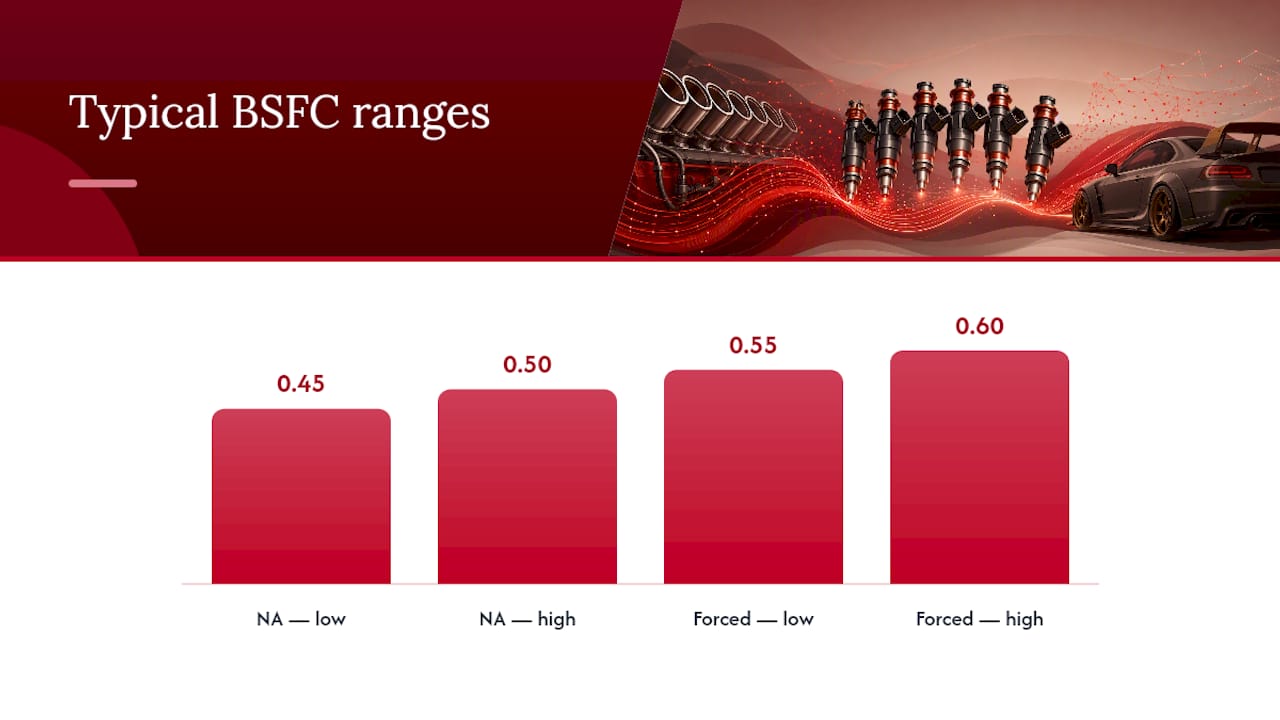
- Apply a BSFC (brake specific fuel consumption) value. Naturally aspirated engines typically run around 0.45 to 0.50 lb/hr per horsepower; turbocharged and supercharged engines run richer, often 0.55 to 0.60 lb/hr per horsepower, because they’re less thermally efficient under boost.
- Multiply horsepower by BSFC to get total fuel flow in lb/hr, then divide by injector count to get the flow required per injector.
- Divide that number by your target duty cycle, not 100%, to get the injector size you should actually buy.
That last step is where the 80% duty cycle rule comes in.
Fuel type changes the math too. As a reference point, EngineBuilder Magazine reports that a roughly 1,000 cc injector supports about 500 horsepower on pump gasoline. Methanol pushes that multiplier considerably higher still.
If you’re running a supercharger or turbo, size for gross engine output, including parasitic losses from driving the supercharger itself, not just the net horsepower that reaches the flywheel. LSXmag’s sizing guidance specifically warns builders that skipping this step leaves the fuel system undersized right when boost comes in. When in doubt, round up slightly. Sizing a little larger than the bare minimum preserves tuning headroom for future upgrades, though going too large can make idle tuning genuinely difficult on a street-driven car, so don’t oversize just because bigger sounds safer.
Installation Checklist: Matching Injectors to Your Fuel System
Buying the right injector is only half the job. It has to physically and electrically fit the rest of your fuel system, or you’ll be troubleshooting a car that runs rough for reasons that have nothing to do with the injector itself.
- Connector type: confirm whether your harness uses EV1 connectors or EV6 connectors before ordering, since the wrong style means an adapter harness or a re-pin
- Fuel pump capacity: your pump has to supply more volume than your injectors can flow at your target rail pressure, with margin for pressure drop under load
- Regulator setting: confirm your fuel-rail pressure matches the pressure used in the injector’s published flow data, since flow numbers are meaningless at the wrong pressure
- Resistor packs: required for low-Z injectors on most factory ECUs; skipping them risks driver damage, per Hondata’s guidance
- Characterization data: pulse-width and latency tables from the manufacturer let your tuner dial in fueling far faster than guessing from scratch
Pro Tip: Save your injector’s characterization file (the pulse-width versus flow data) before you hand your car off for a tune. Most tuners can load it directly into the ECU’s injector table, which shaves real time off dyno tuning and reduces the trial-and-error at idle and light load.
Get any one of these wrong and you’ll chase phantom problems, a lean stumble that looks like a bad injector but is actually a pump that can’t keep up, or an idle that hunts because the ECU is fighting an injector it wasn’t calibrated for.
What Vendor Data Actually Proves an Injector Is Good?
Skip the brand-name debate for a second and look at what a listing actually publishes. That’s the real signal.
- Flow curves at a specified rail pressure: without a stated pressure, a flow number is meaningless
- Flow-matching tolerance: reputable sets are matched within 1 to 2% across the full set, which EngineLabs points out materially speeds up tuning and smooths drivability
- Pulse-width and latency tables: these let a tuner map fueling accurately instead of estimating
- Warranty coverage and return policy: a short or vague warranty often signals the vendor isn’t confident in long-term reliability
- Verified sourcing: evidence the parts came from the actual manufacturer, not a gray-market reseller passing off look-alikes
| What to check | Why it matters |
|---|---|
| Flow curve with stated rail pressure | Confirms the flow number applies to your fuel system |
| Flow-match tolerance (1 to 2%) | Prevents cylinder-to-cylinder fueling imbalance |
| Pulse-width/latency data | Speeds up ECU tuning and improves idle behavior |
| Warranty length and terms | Signals vendor confidence in build quality |
| Verified manufacturer sourcing | Protects against counterfeit or mislabeled parts |
A listing with no flow data, no stated test pressure, and a 30-day warranty is a red flag, regardless of how the injector is branded. A listing with published characterization files and a flow-matching guarantee tells you the vendor actually tested what they’re selling.
A Look at the Leading Aftermarket Fuel Injector Brands
The aftermarket injector market breaks roughly into two camps: OE-derived injectors from the same manufacturers that supply factory production lines, and purpose-built performance injectors designed from scratch for high flow and fast response.
OE-derived injectors, the kind built on Bosch or Denso platforms, tend to have the longest reliability track record because the base design has already logged millions of miles in factory applications. They’re a common choice for street builds where a small bump in power is the goal and rock-solid idle quality matters. Purpose-built performance injectors, by contrast, are engineered around high flow rates and fast pulse response from the start, aimed at forced-induction and race applications where duty cycle headroom and flow accuracy at the top end matter more than idle finesse.
Within either camp, reputation comes down to three things: how consistently the company flow-tests and matches its sets, how complete its published characterization data is, and how it stands behind failures. A brand with a strong name but no published flow-match tolerance is still a gamble. A lesser-known manufacturer with detailed pulse-width tables and a documented matching process is often the safer buy, especially for a tuner who needs accurate data to dial in the ECU. That’s the real lesson buyers keep relearning: judge the data sheet, not the sticker on the box.
How Do You Choose Injectors for Your Specific Build?
The right injector depends entirely on what the engine is being built to do, not on grabbing the biggest number available.
Daily-driven street builds with modest power goals should lean toward high-impedance injectors sized close to the calculated minimum, prioritizing smooth idle and easy ECU compatibility over raw headroom. Forced-induction builds need injectors sized to gross output, including parasitic losses from the turbo or supercharger, with enough duty-cycle margin to handle boost creep and altitude variation. Race and drag applications often justify going larger and accepting a rougher idle, since the car spends little time at idle anyway and top-end flow accuracy matters more.
Fuel type is its own decision point. A build running E85 needs roughly 30% more flow than the same power target on gasoline, and a methanol build needs considerably more still. If there’s any chance you’ll switch fuels later, or add boost down the road, size with that future state in mind rather than re-buying injectors twice. Injector count matters too. A V8 running eight injectors splits the fuel load very differently than a four-cylinder running four, so always divide total required flow by your actual cylinder count, not a number from a generic online chart built for a different engine.
What Are the Warning Signs of a Failing Injector?
Aftermarket injectors fail in fairly predictable ways, and catching the signs early usually means a cheap fix instead of an expensive one.
A rough or hunting idle, especially on one or two cylinders, often points to a clogged or unevenly flowing injector disrupting the air-fuel balance. A misfire under load that a scan tool traces to a specific cylinder is a classic sign of an injector that’s flowing too little fuel for the demand, sometimes from internal fouling, sometimes from wear. A fuel smell around the engine bay, particularly after the car sits, usually means an external leak at the injector O-ring or seal, not the injector body itself. Poor fuel economy that develops gradually, without any other obvious cause, can mean an injector is stuck slightly open and dribbling fuel even when it should be closed.
Electrical failures show up differently. A dead cylinder with no misfire code but a confirmed spark can mean the injector’s coil has failed internally, which a resistance check with a multimeter will usually confirm against the expected impedance value. If a resistance reading falls well outside the 12 to 16 ohm range expected for a high-Z injector, or the 2 to 5 ohm range for low-Z, that injector is likely bad regardless of how it’s performing on the road right now.
How Should You Maintain Fuel Injectors Over Time?
Fuel injectors don’t need constant attention, but skipping maintenance entirely shortens their working life and slowly degrades performance in ways that are easy to miss until they’re significant.
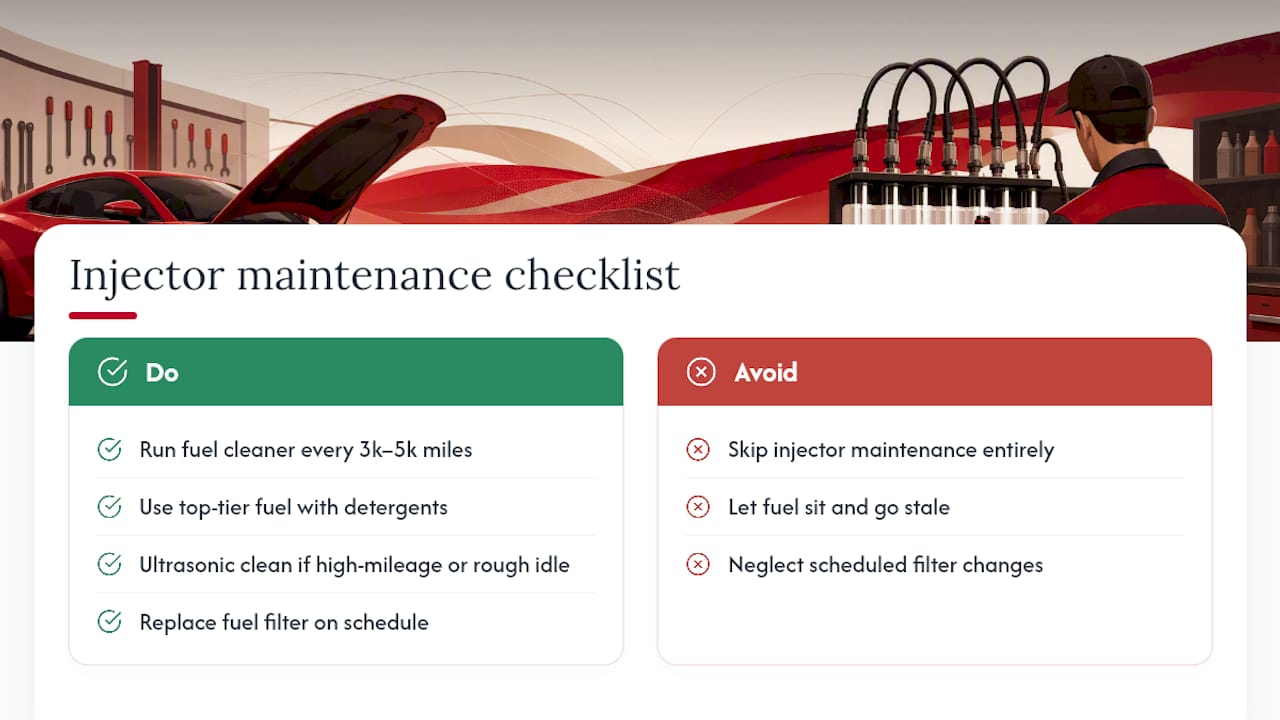
Running a quality fuel system cleaner through a full tank every 3,000 to 5,000 miles helps prevent the carbon and varnish buildup that gradually restricts injector spray patterns. This matters more on vehicles that see a lot of short trips or sit for extended periods, since fuel can degrade and leave deposits behind. Using a top-tier fuel brand with strong detergent additives reduces how often you need aftermarket cleaner in the first place.
For higher-mileage engines or ones showing rough idle symptoms, professional ultrasonic cleaning is worth the cost. A shop pulls the injectors, runs them through an ultrasonic bath that breaks down internal deposits a bottle additive can’t reach, and flow-tests them afterward to confirm they’re back within spec. This is also the point where flow-matching gets rechecked, since injectors can drift out of tolerance with age and mileage even without a hard failure.
Replace fuel filters on schedule, since a clogging filter forces injectors to work against more resistance and accelerates wear on the pump feeding them. And if a car sits for months at a time, consider running a fuel stabilizer, since stale fuel left sitting in the rail and injectors is one of the more common causes of hard starts after long storage.
How Do Injectors Interact With ECU Tuning?
Swapping injectors almost always requires a retune, and skipping that step is one of the most common mistakes builders make. The ECU calculates fuel delivery based on injector flow data programmed into its tables. Install a different injector without updating those tables and the ECU is guessing, which usually means it’s either too rich or too lean somewhere in the RPM range.
Most standalone and tunable factory ECUs handle this through an injector characterization table, essentially a map of how much fuel flows at each pulse width across the operating range. Feeding the tuner accurate characterization data from the injector manufacturer, rather than letting them estimate from a generic curve, is the difference between a tune that’s dialed in during the first dyno session and one that takes several sessions of trial and error to settle.
Compatibility runs both directions too. A high-Z injector generally works with almost any ECU without modification, while a low-Z injector may need the ECU’s driver stage confirmed as peak-and-hold capable, or a resistor pack added, before the ECU ever sees the new injector. Skipping that check is exactly the scenario Hondata’s technical documentation warns against, since a mismatched low-Z injector can damage the ECU’s output driver over time even if the car seems to run fine at first.
Publisher Perspective: Why Vetted, Characterized Injectors Matter
Most injector problems we see traced back to their root cause aren’t bad injectors. They’re injectors bought without flow data, installed without checking impedance, or paired with a fuel pump that couldn’t keep up. Some vendors source exclusively from vetted manufacturers and verify fitment before parts ship, specifically to eliminate the guesswork that turns a straightforward injector upgrade into a diagnostic headache. When characterization data ships with the part, tuning goes faster and idle quality suffers less. That’s not a marketing detail. It’s the difference between a dyno session and a month of chasing a misfire.
— Ozkonic Kustomz
Ready to Upgrade? Where to Buy and Get Fitment Support
Ozkonickustomz’s Fuel System collection covers injectors, pumps, regulators, and the connectors and harnesses that actually make an upgrade work the first time, not just the headline part. Every listing goes through fitment verification before it’s published, so you’re not stuck guessing whether an EV1 or EV6 connector matches your harness, or whether the pump you’re eyeing can actually feed the injectors you want.
If you’re upsizing injectors on a forced-induction build, pair that upgrade with a look at the Turbo & Supercharger collection to make sure your boost hardware and fuel system are sized to the same power target. Need connectors specifically? The EV1 kit and EV6 kit cover the two most common styles on American and import engines. If you’re not sure what fits your specific build, reach out to customer support before you order. They can walk through your target horsepower, fuel type, and existing harness, and point you to a part with the fitment and flow data already confirmed instead of leaving you to piece it together from a spec sheet alone.
Sources
- Clearing up the confusion in modern fuel injector technology — EngineLabs
- Sizing fuel injectors for high-performance engines — LSXmag
- Fuel injector selection & service — EngineBuilder Magazine
- Technical information low and high impedance injectors — Hondata
FAQ
Which Fuel Injector Brand Is the Best?
There’s no single brand that wins every build, since the right choice depends on flow requirements, impedance, and fuel type. Focus on vendors that publish flow curves at a stated rail pressure, offer flow-matching within 1 to 2%, and back the part with real characterization data, since that data speeds up tuning and improves reliability more than any brand name does on its own.
What Fuel Injection Setup Is Best for Performance Builds?
They run cooler, work with nearly every ECU without extra hardware, and now reach flow ranges that used to require low-impedance units.
Which Injectors Are Best for My Horsepower Target?
As a rough reference, 1,000 cc injectors support around 500 horsepower on pump gasoline, with roughly 30% more flow needed on E85.
Who Makes the Best Aftermarket Fuel Injection Systems?
The strongest aftermarket options come from manufacturers that publish complete flow-matching and characterization data rather than relying on reputation alone. Some vendors source fuel-system parts, including injectors, pumps, and connectors, from vetted manufacturers and verify fitment before listing them, which reduces counterfeit and mismatch risks buyers face when shopping generic listings online.
Do I Need a Resistor Pack for My New Injectors?
You need a resistor pack only if you’re installing low-impedance (2 to 5 ohm) injectors on an ECU designed for high-impedance units. Hondata’s technical guidance recommends either switching to high-Z injectors or adding a proper resistor pack, since running low-Z injectors without one can damage the ECU’s driver transistors over time.