
For most owners replacing a worn control arm, Moog is the safest overall pick for OE-style fit and reputation. Some sellers offer verified fitment and manufacturer-vetted sourcing as a service for certain parts. Off-road and towing rigs hold up better on steel arms from Mevotech or Dorman, and import owners get better results from Beck/Arnley or Febi Bilstein. The right choice depends less on brand hype and more on matching material, bushing type, and fitment data to your exact vehicle.
TL;DR:
- Steel control arms are more durable for off-road and towing applications, while aluminum arms offer weight savings and corrosion resistance mainly for performance vehicles.
- Verifying exact fitment, including vehicle year, model, and lift modifications, is crucial to prevent costly mismatches regardless of brand reputation.
- Costs for replacement typically range from $250 to $600 per arm, including labor and alignment, with full-arm replacements often more practical than bushing-only repairs.
- Brands like Moog, Mevotech, TRW, and Delphi are reputable depending on the application, but fitment accuracy outweighs brand prestige for long-term reliability.
- Using verified, manufacturer-vetted parts, especially for lifted or modified trucks, reduces the risk of fitment issues and premature failure.
Table of Contents
- Best Control Arm Brands Compared
- Aluminum vs. Steel: Which Material Actually Holds Up?
- How to Choose the Right Control Arm for Your Vehicle
- What Control Arm Replacement Really Costs
- Why Fitment Verification Matters More Than the Sticker Price
- Why Most Buying Guides Get This Wrong
- Get the Right Control Arm Without the Guesswork
- Sources
- FAQ
Best Control Arm Brands Compared
A control arm links the chassis to the suspension upright, and on most modern vehicles the bushings and ball joint arrive already integrated into the arm, which is why full-arm replacement has become the standard approach rather than pressing new bushings into an old arm. That shift matters when you’re shopping, because brand reputation now hinges as much on how the whole assembly is built as on the raw material.
Moog remains the benchmark for OE-style fit. It’s a good match for owners who want a factory feel without factory pricing, built with steel or hybrid designs depending on application and backed by a limited warranty that varies by part number. Mevotech runs several product tiers, including a reinforced line aimed at trucks and SUVs that see rough roads, making it a strong pick for heavier use. TRW carries genuine OE supplier pedigree, since it manufactures for several automakers directly, which appeals to buyers who want a part with an actual factory paper trail.
Dorman covers an enormous range of makes and models at accessible price points, useful when you need a fast, budget-friendly fix rather than a performance upgrade. Beck/Arnley and Febi Bilstein both lean into import and European fitment precision. Febi Bilstein in particular has a following among BMW and Mercedes owners who’ve been burned by generic aftermarket parts that almost fit. VAICO occupies similar territory, focused on European vehicles with solid build tolerances.
ACDelco makes sense if you’re working on a GM platform and want OEM-branded parts without paying dealer prices. Delphi brings decades of OEM supply chain experience and a broad aftermarket catalog. GSW tends to show up in budget and mid-tier applications, a reasonable option when you need functional replacement without chasing premium branding.
Then there’s Ozkonic Kustomz, which isn’t a manufacturer but solves a different problem entirely: finding a part that’s actually vetted before it ships. Every listing is sourced from manufacturers checked for fitment accuracy and build quality, which matters most for lifted trucks and modified vehicles where a “should fit” part often doesn’t.
- Best overall fit and reputation: Moog
- Best for heavy-duty and towing: Mevotech
- Best OEM pedigree: TRW or Delphi
- Best budget coverage: Dorman or GSW
- Best for European imports: Febi Bilstein or VAICO
- Best for verified fitment and support: Ozkonic Kustomz
Aluminum vs. Steel: Which Material Actually Holds Up?
Aluminum control arms shed unsprung weight and resist corrosion, which improves steering response and handling feel, especially on performance cars and EVs where every pound at the wheel matters. Steel arms trade some of that agility for raw strength. They handle impact loading better and typically cost less, which is why steel remains the default choice for off-road rigs and heavy towing setups.
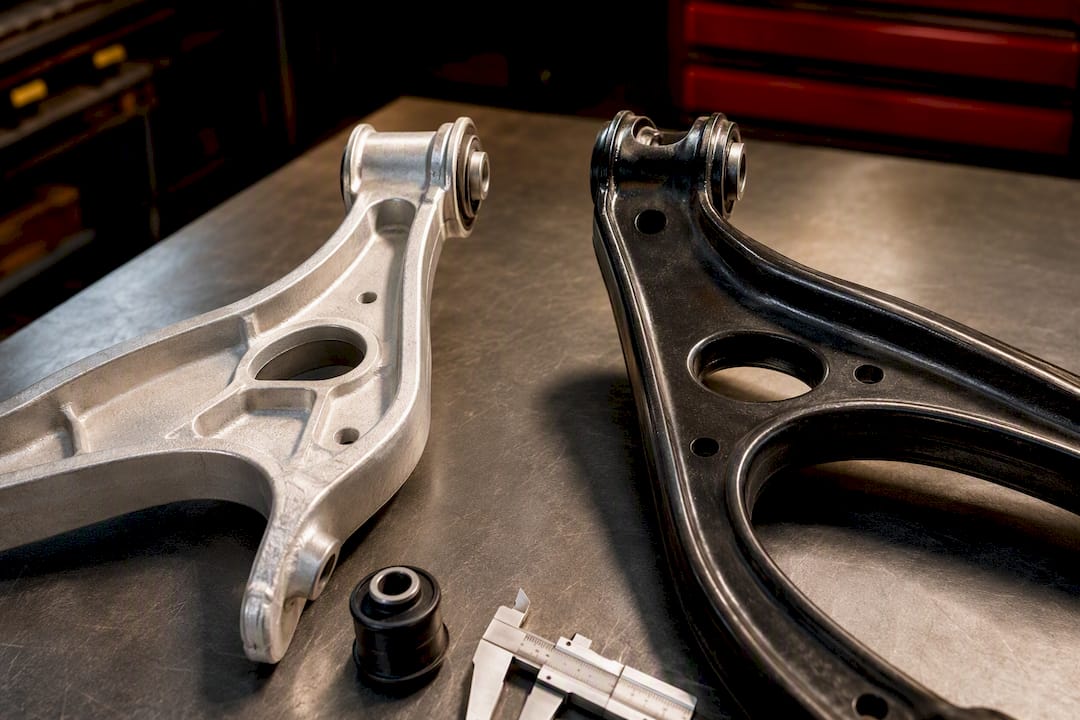
Material alone doesn’t tell the whole story. Forging quality, weld strength, and heat treatment often decide whether an arm survives a decade of potholes or cracks at 40,000 miles, and that’s true whether the arm is aluminum or steel. A cheaply cast aluminum arm can fail faster than a well-forged steel one.
When you’re reading a spec sheet, check for:
- Bushing material (rubber for comfort, polyurethane for longevity and firmer geometry)
- Ball joint design (sealed and unitized versus serviceable)
- Corrosion coating on steel arms, especially in salt-belt climates
Statistic to remember: fitted control arm replacements commonly run in the $250 to $600 range per arm including labor, and a bad ball joint left unaddressed can, in extreme cases, cause a wheel to separate from the vehicle, which is a serious safety risk.
How to Choose the Right Control Arm for Your Vehicle
Buying the wrong control arm usually comes down to skipping one of a handful of checks. Here’s the order that actually prevents a return shipment.
- Confirm exact fitment first. Year, trim, submodel, and whether the vehicle is lifted all change the correct OE part number. A part that fits a stock 2022 Silverado 1500 may not fit the same truck on a 4-inch lift.
- Match material to how you drive. Performance and daily-driver builds lean toward aluminum for weight savings; towing, off-road, and high-mileage work trucks lean toward steel for impact resistance.
- Decide on bushing type. Polyurethane holds alignment geometry longer under stress but rides firmer and sometimes needs periodic greasing, while rubber stays quieter for daily commuting.
- Ask the seller pointed questions. Does the ball joint come pre-installed? What’s the warranty term? Is there a corrosion coating on steel arms?
- Replace in pairs. Uneven wear on one side almost always means the other side isn’t far behind, and mismatched arms can throw off handling symmetry.
- Book an alignment immediately after installation. Skipping this step accelerates tire wear even if the new arm is perfect.
Red flags that should make you walk away from a listing: no OE part number cross-reference, no stated warranty, vague “universal fit” language, or a material description that just says “metal.”
Pro Tip: Screenshot the OE part number stamped on your old control arm before you order a replacement. Sellers and support teams can verify fitment in seconds when you give them that number instead of just your VIN.
What Control Arm Replacement Really Costs
Budgeting for a control arm job means accounting for parts, labor, and the alignment you can’t skip afterward. Costs shift based on whether you’re replacing a simple bushing or the entire arm assembly, and whether the shop has to fight rusted bolts to get the old one out.
| Item | Typical Range | Notes |
|---|---|---|
| Parts (per arm) | varies by vehicle and whether ball joint is integrated | Varies by vehicle and whether ball joint is integrated |
| Labor (per arm) | Included in $250–$600 fitted total | Higher on rusted or hard-to-reach mounts |
| Wheel alignment | wheel alignment is required afterward and costs extra | Required after replacement |
| Bushing-only press job | Comparable labor to full-arm swap | Often not worth the tool investment for DIYers |
On many vehicles, pressing new bushings into an old arm costs nearly as much in labor as installing a fresh preassembled arm, which is why full-arm replacement has become the practical default. Expect a control arm to last 70,000 to 100,000 miles under normal conditions, less in regions with heavy road salt or frequent off-road use. Inspect bushings and ball joints at every alignment or tire rotation, and don’t ignore a new clunk over bumps.
Why Fitment Verification Matters More Than the Sticker Price
A control arm that’s technically the right part number but slightly off in bushing geometry can still cause clunking, wandering steering, or uneven tire wear within a few thousand miles. Certain sellers source parts directly from manufacturers vetted for build quality and fitment accuracy, which cuts down the guesswork that comes with buying blind from a generic marketplace listing.
Some sellers’ teams can confirm a part matches your vehicle’s year, trim, and ride height, which matters more for lifted trucks than for stock sedans. Fast shipping and straightforward return policies can help reduce the risk if something still doesn’t line up. If you’re unsure which control arm fits a modified suspension setup, reaching out to sellers’ support before ordering can save a return shipment and a lost afternoon under the truck.
Why Most Buying Guides Get This Wrong
Most comparisons rank control arms like sneakers: whichever brand has the loudest name wins. That’s backwards. A forged steel Mevotech arm on a lifted work truck will outlast a premium aluminum arm bought for the wrong application, and a Delphi part with a genuine OE lineage is worthless if it doesn’t match your exact submodel.
The conventional advice to “just buy the trusted brand” skips the step that actually prevents failures: verifying fitment against your specific year, trim, and ride height before you compare brand names at all. Reputation matters, but it’s a tiebreaker, not the first filter.
If you take one thing from this comparison, prioritize fitment verification and honest material tradeoffs over brand loyalty. That’s the whole reason Ozkonic Kustomz built its sourcing process around vetted manufacturers instead of just listing whatever ships fastest. A great brand on the wrong vehicle is still the wrong part.
— Ozkonic Kustomz
Get the Right Control Arm Without the Guesswork
Some sellers offer an alternative to blind online ordering by checking parts against your vehicle’s actual specs before shipping.
Buying is straightforward. Browse the suspension catalog, confirm your year, trim, and lift height against the listed fitment data, and check out. If you’re not sure a part matches your setup, especially after a lift kit or aftermarket wheel swap, contact the support team before ordering. That single message can save you a mismatched part and a second round of shipping. Some sellers back orders with straightforward returns to help if there is a fitment issue.
Start with the AUTO-LOC latch kit or browse the wiring and hardware selection like the Highway 22 modular wiring kit while you’re finalizing your suspension order, and check out the Silverado suspension upgrade guide if you’re building a truck rather than just replacing a worn part.
Sources
- Control arms: When to Replace Them — Signs, bushings & ball joints (Jalopnik)
- Control arm — Wikipedia
- Aluminum vs Steel Control Arms: Key Differences & Which to Choose | GDST Auto
FAQ
Is Moog or OEM Better for Control Arms?
Moog is engineered to OE-style specs and often matches factory fit closely enough that most owners won’t notice a difference in handling, though genuine OEM parts still carry the exact manufacturer part number for warranty-sensitive repairs.
Is Moog or a Premium Brand Better?
Moog competes directly with premium names like TRW and Delphi on fit and reputation, so the better choice usually comes down to your specific vehicle’s part availability and the warranty terms offered on that exact part number.
What’s Better, Steel or Aluminum Control Arms?
Steel handles heavy impact and towing loads better and costs less, while aluminum cuts unsprung weight and resists corrosion, making it the stronger pick for handling-focused and performance builds.
Which Control Arm Is Better, Delphi or Moog?
Both offer solid OE-style fitment; Delphi leans on longstanding OEM supply chain experience, while Moog has a broader aftermarket reputation for handling feel, so the right pick often depends on which one has verified fitment data for your exact vehicle.
How Do I Know if My Control Arm Bushings Are Worn?
Clunking over bumps, wandering steering, and uneven tire wear are the clearest signs, and a severely worn ball joint can lead to wheel separation if left unaddressed.