

For most vehicle owners, the right call is an OE-quality compressor or a vetted aftermarket unit backed by a real warranty and confirmed fitment, not the cheapest listing that matches a part number. Some sellers source from vetted manufacturers specifically because fitment mistakes and mystery-brand compressors cause most of the repeat failures buyers report. The rest of this guide walks through the selection checklist, the new-versus-reman decision, installation precautions that protect your warranty, and how to shop without getting burned.
TL;DR:
- Verify exact fitment using VIN and OE cross-references before purchasing, as incorrect compressor fitment can cause cooling issues or clutch overloads.
- Choose new OE-supplier compressors for maximum warranty coverage and reliability, or remanufactured units for cost savings if they are tested and come with proper documentation.
- Always confirm the compressor matches the vehicle’s refrigerant type and oil specifications, and ensure proper system flushing and oil adjustment during installation to prevent premature failure.
- Expect to pay more for labor and ancillary parts like filter-driers and expansion valves, which are critical for system longevity and should be replaced during the compressor swap.
- Prioritize tested, pre-oiled units backed by clear warranties and seller support to avoid common failure causes linked to installation errors or system neglect.
Table of Contents
- What makes the best AC compressors for cars and trucks?
- New versus remanufactured: which compressor should you buy?
- Fitment, oil, and refrigerant: the technical checklist before you buy
- Installation and system prep that keeps a new compressor alive
- Where to buy and how to read a warranty before you commit
- How do top AC compressor brands and models compare?
- What should you expect to pay for an AC compressor, installed?
- How long should an AC compressor last, and what maintenance does it need?
- Do energy efficiency and refrigerant type matter for compressor choice?
- What do customer reviews and experts say about buying compressors?
- Why Ozkonic Kustomz recommends vetted OE-quality and tested aftermarket kits
- Ozkonic Kustomz: tested compressor components without the fitment guesswork
- Sources
What makes the best AC compressors for cars and trucks?
Picking the right compressor comes down to four things: confirmed fitment, the correct type and refrigerant match, a seller who tests before shipping, and a warranty long enough to matter. Skip any one of those and you’re gambling on a part that bolts on but never cools right.
Fitment verification comes first, before you look at price or brand. Run your VIN through the seller’s lookup tool, then cross-check the OE part number against your specific engine and trim. A 2018 truck with the base engine and the same truck with a tow package can carry different compressors, and the wrong one won’t just fail to fit. It can bolt on and still starve the system or overload the clutch.
Compressor type matters just as much as fitment. Most gas-powered vehicles use a fixed-displacement or variable-displacement compressor driven off the accessory belt, while hybrids and EVs increasingly run high-voltage electric compressors that operate independently of engine RPM. These aren’t interchangeable, and refrigerant compatibility splits the same way: older systems run R-134a, while most vehicles built since roughly 2013 use R-1234yf. Installing an R-134a compressor into an R-1234yf system (or vice versa) contaminates the entire loop and can damage seals rated for the wrong refrigerant.
Seller quality signals separate a smooth install from a return-and-repeat cycle. Look for:
- Units shipped pre-oiled with the oil type and quantity labeled on the box
- Clutch assembly included, not sold separately and hoped to match
- Evidence the compressor was bench-tested before it shipped, not just boxed
- Warranty terms stated in writing, not “ask customer service”
- A US-based support line you can actually reach if fitment questions come up
There’s also a cost trade-off worth naming honestly. Buying the compressor yourself and having a shop install it can save real money on parts markup, but it shifts fitment responsibility onto you. Let the shop source the part, and you pay more, but any fitment error becomes their problem to fix under their own labor warranty. Neither route is wrong. Just know which one you’re choosing.
Pro Tip: Screenshot or save the seller’s fitment confirmation (VIN match, OE cross-reference) before you install. If a warranty claim comes up later, that record is your proof the part was sold as correct for your vehicle.
New versus remanufactured: which compressor should you buy?
New, OE-supplier-built compressors give you the longest warranty and the fewest surprises, but remanufactured units make financial sense far more often than people assume. The right pick depends on how the vehicle gets used and how long you plan to keep it.
A new compressor, especially one built by an OE supplier, comes factory-fresh with the correct internal oil charge and typically carries the longest warranty coverage, often around a year or more. DENSO supplies over 40% of the global OE market for A/C compressors, which is part of why OE-supplier units tend to fit right the first time. You’re paying for that certainty.
A remanufactured compressor starts as a used core that’s disassembled, inspected, and rebuilt with new bearings, seals, and wear parts, then tested before resale. Reman units cost noticeably less than new, and reputable rebuilders back them with roughly six months of coverage minimum, sometimes more depending on the shop.
Here’s how to decide:
- Choose new when the vehicle is a daily driver you plan to keep for years, or when it’s a hard-to-find application where a bad reman core means a long wait for a replacement.
- Choose new for fleet vehicles or anything that can’t afford downtime.
- Reman is the sensible pick for older vehicles, budget-conscious repairs, or when you’ve confirmed the rebuilder tests every unit before shipping.
- Whichever you choose, demand documentation: warranty length in writing, confirmation the unit was tested, and the oil type/amount used in the rebuild.
Fitment, oil, and refrigerant: the technical checklist before you buy
Getting the wrong compressor onto your doorstep almost always traces back to skipping one of four checks. Work through these in order before you click “buy.”
-
Match displacement, type, and refrigerant exactly. Confirm the compressor’s displacement and design (fixed, variable, or electric) matches your original unit, and never mix an R-134a compressor into an R-1234yf system or the reverse. The refrigerants use different oils and pressures, and cross-contamination usually means flushing the entire system.
-
Verify oil type and quantity. Most compressors ship pre-filled with PAG oil, but PAG comes in different viscosity grades depending on the compressor and refrigerant. DENSO’s technical documentation specifies oil recommendations by refrigerant type, and using the wrong grade or mixing it with old oil already in the system can void your warranty. If the shipped oil quantity doesn’t match your vehicle’s total system oil spec, you’ll need to drain and adjust it before install, not after.
-
Check the physical details: pulley grooves, connector, and mounting. Count the pulley grooves and match the belt style, confirm the electrical connector shape matches your harness, and check that mounting ear positions line up with your bracket. Confirm whether the clutch assembly ships attached. This sounds obvious until you’re holding two compressors that look identical from ten feet away and aren’t.
-
Use VIN and OE number lookups, and read the listing for red flags. A legitimate seller’s fitment tool should ask for your VIN or at minimum year, make, model, engine, and trim. If a listing only lists “fits 2015-2020” with no engine breakdown, that’s a red flag. So is a listing with no stated oil fill, no mention of testing, and no warranty terms beyond “30-day returns.”
Installation and system prep that keeps a new compressor alive
A brand-new compressor dying within weeks is almost never a defective part. It’s almost always a system that wasn’t prepped correctly before the new unit went in. This is the step buyers skip and shops sometimes rush, and it’s the single biggest driver of preventable failure.
Flushing isn’t optional if the old compressor failed internally. When a compressor dies, it often sheds metal debris and clutch material into the lines, condenser, and evaporator. Skipping the flush sends that debris straight into your new compressor, and improper system preparation is a documented leading cause of premature compressor returns. The filter-drier (or receiver, depending on system layout) must be replaced every time a compressor is swapped. It’s a cheap part and it’s not designed to be reused. Depending on the failure, the expansion valve or orifice tube and sometimes the condenser need replacement too, since debris loves to hide in condenser tubes where a flush can’t fully reach it.
Oil management is the step most DIYers get wrong. You need to know your vehicle’s total system oil capacity, drain and measure what comes out of the old components, and adjust the new compressor’s pre-fill accordingly so you land at spec, not double-dosed. Before first startup, rotate the compressor pulley by hand several times. This circulates oil across the shaft seal and prevents it from spinning dry the instant the engine turns over.
Evacuating the system properly matters as much as filling it. Pull a deep vacuum long enough to boil off trapped moisture, then charge with the exact refrigerant amount your vehicle’s label specifies, no eyeballing it.
Startup deserves its own careful sequence. Start the engine at idle, and cycle the A/C on and off in short bursts rather than running it continuously right away. This lets oil circulate gradually instead of slamming the compressor with full load cold. Documenting each of these steps with photos or a written log protects you if you ever need to file a warranty claim.
Before you even get to installation, rule out the usual misdiagnoses. A surprising share of “the compressor is dead” complaints trace back to something else entirely:
- A loose or misaligned drive belt causing clutch slip
- Worn or broken compressor mounting points causing noise mistaken for internal failure
- A blocked or damaged condenser restricting airflow and spiking system pressure
- A failed clutch relay, fuse, or wiring fault preventing engagement entirely
HELLA’s technical guidance notes that checking these surrounding components first frequently uncovers the actual problem before a compressor ever needs to come off the vehicle. A cooling fan relay issue, for instance, can starve the condenser of airflow and mimic compressor failure entirely, which is worth ruling out with a cooling fan relay check before you spend money on a new compressor.
Where to buy and how to read a warranty before you commit
The buying decision is really a research task disguised as a shopping trip. Spend twenty minutes on these checks and you’ll avoid the two most common outcomes: the wrong-fit part and the unwarrantied dud.
- Demand a tested, pre-oiled unit with the oil type and amount stated on the listing, not buried in a spec sheet you have to request.
- Cross-reference your VIN and the OE part number directly with the seller, and get written confirmation the clutch ships with the unit and was tested before shipping.
- Price the whole job, not just the compressor: filter-drier, expansion valve or orifice tube, refrigerant, and labor if you’re not doing it yourself. A $150 compressor with a botched install still fails.
- Photograph or log every installation step. Documented installation protects your warranty claim if the part fails within coverage and the seller asks for proof of proper procedure.
- Know when to source it yourself: buying the part directly can save a meaningful cut of the shop’s parts markup, sometimes a substantial percentage, but only makes sense if you’re confident in your fitment check or working with a supplier who guarantees it.
Reputable sellers test every unit before it ships and back it with warranty terms you can read in plain language, not a support ticket you have to open to find out what’s covered.
How do top AC compressor brands and models compare?
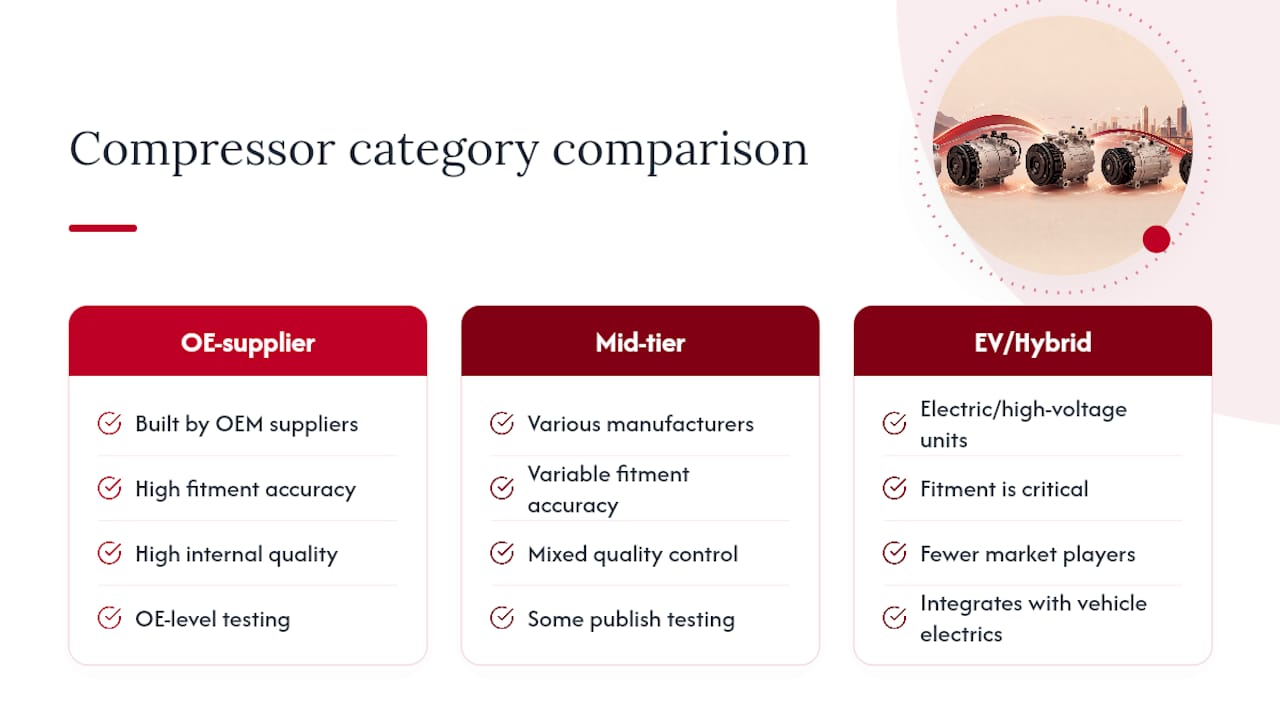
Reliability in this category tracks closely with who actually built the unit and whether it went through OE-level testing, more than which name is printed on the box. OE-supplier compressors, the kind built by the same manufacturers who supply automakers directly, consistently score highest on fitment accuracy and internal component quality, because they’re built to the exact tolerances the vehicle manufacturer specified in the first place.
Mid-tier aftermarket brands vary more widely. Some run their own test benches and publish warranty terms up front; others assemble from mixed-origin parts with inconsistent quality control, and you often can’t tell the difference from the listing photo alone. This is where seller reputation matters more than brand name recognition. A well-tested reman from a rebuilder with a solid track record can outperform a poorly assembled “new” unit from an unknown source.
Electric and high-voltage compressors for hybrids and EVs are a newer category with fewer players, and fitment accuracy here is even more critical since these units integrate with the vehicle’s electrical system rather than just the belt drive. For any category, the pattern holds: prioritize confirmed OE-quality construction and a seller who tests before shipping over chasing the lowest price on a part number match.
What should you expect to pay for an AC compressor, installed?
Compressor prices vary widely by vehicle and compressor type, generally running from budget reman units on common vehicles up toward premium OE-supplier units on less common or high-voltage applications. The compressor itself, though, is rarely the whole bill.
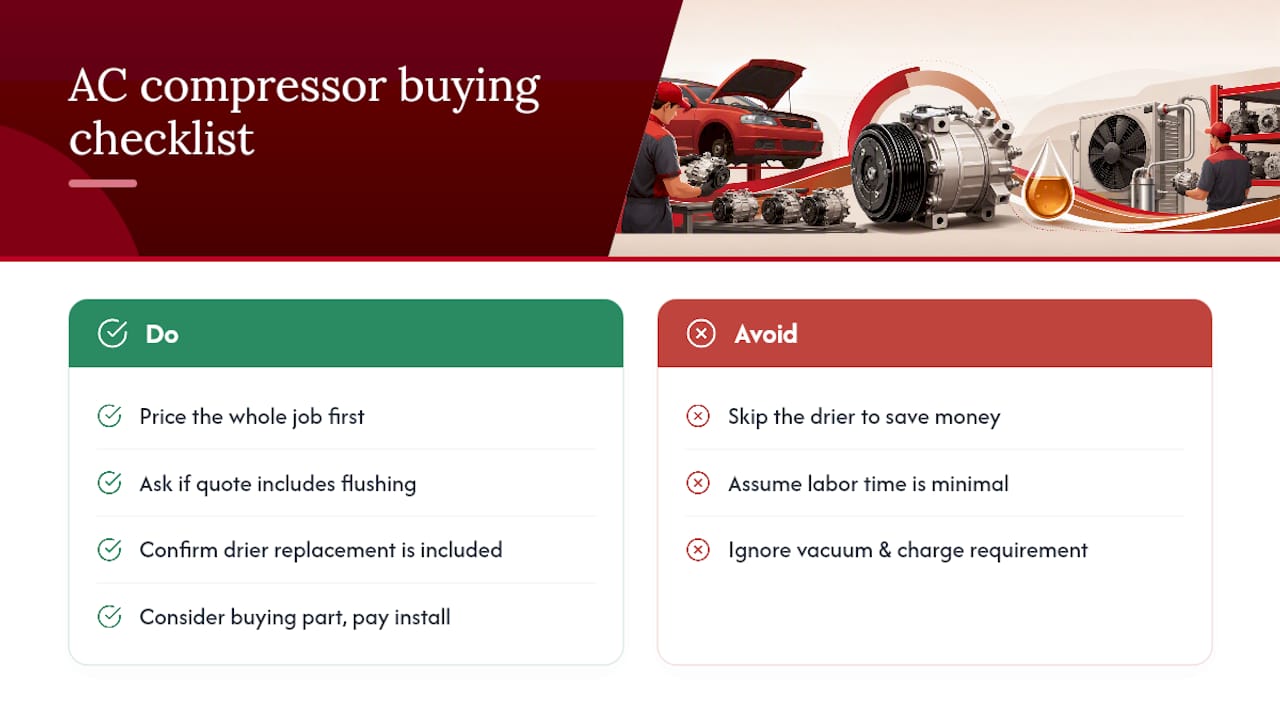
Total cost includes the parts that must be replaced alongside it: the filter-drier or receiver, potentially the expansion valve or orifice tube, refrigerant, and shop labor if you’re not installing it yourself. Skipping the drier to save money is a false economy. It’s one of the cheapest parts in the job and one of the most common causes of a repeat failure if left in place.
Labor cost depends heavily on vehicle layout. Some vehicles put the compressor in an easy-access spot; others bury it behind the engine mount, turning a two-hour job into a half-day teardown. If you’re paying a shop for labor, ask upfront whether their quote includes system flushing, drier replacement, and a full vacuum-and-charge, or if those get added as surprise line items later.
Buying the compressor yourself and having a shop install it typically lands somewhere between full DIY and full-service pricing, since you’re saving on parts markup while still paying labor. Whichever route you take, price the entire job before you commit, not just the part that shows up in your search results.
How long should an AC compressor last, and what maintenance does it need?
A properly installed compressor, on a system that was flushed and prepped correctly, can reasonably be expected to last for many years or well over 100,000 miles under normal use. The compressors that die early almost always trace back to one of two causes: a system that wasn’t cleaned out before install, or years of running low on refrigerant, which starves the compressor of the oil that circulates with it.
Maintenance is minimal but not zero. Running the A/C periodically, even in winter, keeps the internal seals lubricated and prevents them from drying out and cracking. A slow refrigerant leak that goes unaddressed is the most common maintenance failure, since low refrigerant means low oil circulation, and that’s exactly the condition that burns out a compressor prematurely. Getting a system checked for leaks every couple of years, especially once a vehicle passes the five-year mark, catches this before it becomes an expensive repeat repair.
Do energy efficiency and refrigerant type matter for compressor choice?
Refrigerant type affects both efficiency and environmental impact more than most buyers realize when they’re just trying to match a part number. R-1234yf, now standard on most vehicles built since around 2013, has a dramatically lower global warming potential than the older R-134a it replaced, which is why automakers shifted to it under regulatory pressure rather than by choice.
Compressor design has followed that shift. Newer compressors built for R-1234yf systems are engineered around that refrigerant’s different pressure and oil requirements, and running them efficiently depends on getting the oil viscosity and refrigerant charge exactly right, not approximately right. An overcharged or undercharged system doesn’t just cool poorly. It forces the compressor to work harder and shortens its working life.
For high-voltage electric compressors in hybrids and EVs, efficiency ties directly into overall vehicle range, since the compressor draws from the same battery pack that powers the drivetrain. That’s a growing reason OE-quality construction matters even more in this segment: a poorly matched electric compressor doesn’t just risk comfort, it risks measurable range loss.
What do customer reviews and experts say about buying compressors?
The recurring theme across buyer feedback and technical guidance is remarkably consistent: most negative experiences trace back to fitment mistakes or skipped installation steps, not the compressor itself failing on its own. Reviews that read “compressor died in two weeks” almost always turn out, on closer inspection, to involve a system that wasn’t flushed, an oil quantity that wasn’t adjusted, or a startup that went straight to full blast instead of a gradual cycle.
Buyer guides consistently point the same direction: confirm fitment before ordering, insist on a pre-oiled and tested unit, and read the warranty terms before you buy, not after something goes wrong. The sellers who get repeat business are the ones who make fitment verification easy and stand behind their testing claims in writing.
Expert recommendations from technical sources echo the same priorities: rule out belt, mount, and airflow issues before condemning the compressor, and when a replacement is genuinely needed, treat the surrounding system prep as equally important as the part itself.
Why Ozkonic Kustomz recommends vetted OE-quality and tested aftermarket kits
Some sellers source compressor components from vetted manufacturers and run compatibility checks before a part ever gets listed, because a fitment mismatch discovered after installation costs the customer time, money, and a redo they shouldn’t have to pay for. That’s the whole reason vetting exists.
The practical benefit for you is fewer surprises: parts that match your vehicle the first time, components that have actually been tested rather than assumed to work, and support you can reach if a fitment question comes up before you order. Straightforward returns matter too, since even a carefully vetted part occasionally doesn’t suit an edge-case build, and a buyer shouldn’t have to fight for a resolution.
— Ozkonic Kustomz
Ozkonic Kustomz: tested compressor components without the fitment guesswork
Some parts selections are built around one rule: every compressor and related component comes from a vetted manufacturer, with compatibility checked before it’s listed for sale. That’s the difference between ordering a part number and ordering a part that’s confirmed to fit your truck, car, or off-road build.
Buyers working with reputable sellers get documented fitment verification instead of a guess, direct support if a question comes up mid-project, and a straightforward return process if something still doesn’t line up. The catalog also covers the components that go hand-in-hand with a compressor swap, including electrical and cooling-system parts like the A/C-activated cooling fan relay that keeps airflow issues from getting blamed on the compressor in the first place.
If you’re planning a build that touches the climate system, browse the wiring and electrical hardware built for truck-mount installs to see how Ozkonic Kustomz handles fitment documentation across the catalog, then check current availability for your specific vehicle before you order.
Sources
- Change air conditioning compressor | HELLA TechWorld
- Replacing the AC system’s compressor - Professional Motor Mechanic
- Buying an AC Compressor Online: Complete Buyer’s Guide - R & Y A/C Compressors®