
Air Lift Performance kits are vehicle-specific aftermarket air-suspension systems that replace or convert your stock suspension to give you adjustable ride height, tunable spring rates, and real daily drivability. The product line covers four management options: ALP4, 3P, 3H, and manual. For most buyers, the fastest path to the right kit is running your year/make/model through the Air Lift configurator, then confirming fitment and ordering through Ozkonickustomz.
Table of Contents
- What Air Lift Performance kit families are available?
- How do ALP4, 3P, 3H, and manual control compare?
- How do you pick the right kit for your vehicle and goals?
- What comes in a typical Air Lift kit and what upgrades are worth adding?
- Buying, fitment verification, and installation options
- Maintenance tips and common failure points to watch
- Why ALP4 changes the installation and ownership experience
- Ozkonickustomz stocks Air Lift kits with fitment support built in
- Key Takeaways
- The case for getting the management system right the first time
- Official resources and further reading
What Air Lift Performance kit families are available?
Air Lift Performance builds around three core kit families, each aimed at a different buyer goal.
- Performance Series (vehicle-specific): Bolt-in kits engineered for a specific year, make, and model. Top mounts, strut lengths, and bag geometry are pre-matched to your chassis. Best for daily drivers and show builds where you want a clean install without custom fabrication. Application-specific kits reduce fitment risk compared with universal setups.
- Universal air springs: Bags sold without vehicle-specific hardware. They require custom bracketry, routing, and top-mount fabrication. Best for builders doing a full custom build or fitting air to a platform with no direct application kit.
- Coilover and conversion kits: Designed to convert a non-air vehicle to air suspension by replacing the entire strut/shock assembly. These are the go-to for track-oriented builds and performance-focused stance cars that need precise damping alongside adjustable height.
- Replacement parts and closeout lines: Individual air springs, fittings, and hardware for owners maintaining or upgrading existing systems.
For tank options, Flo Air tanks are a popular pairing with any of these kits. They offer a range of sizes and mounting configurations that work with both ALP4 and 3P/3H management.
Pro Tip: Always use the Air Lift vehicle selector before purchasing. Even within the Performance Series, strut compatibility and top-mount fitment vary by trim level and model year. A five-minute configurator check prevents a costly return.
How do ALP4, 3P, 3H, and manual control compare?
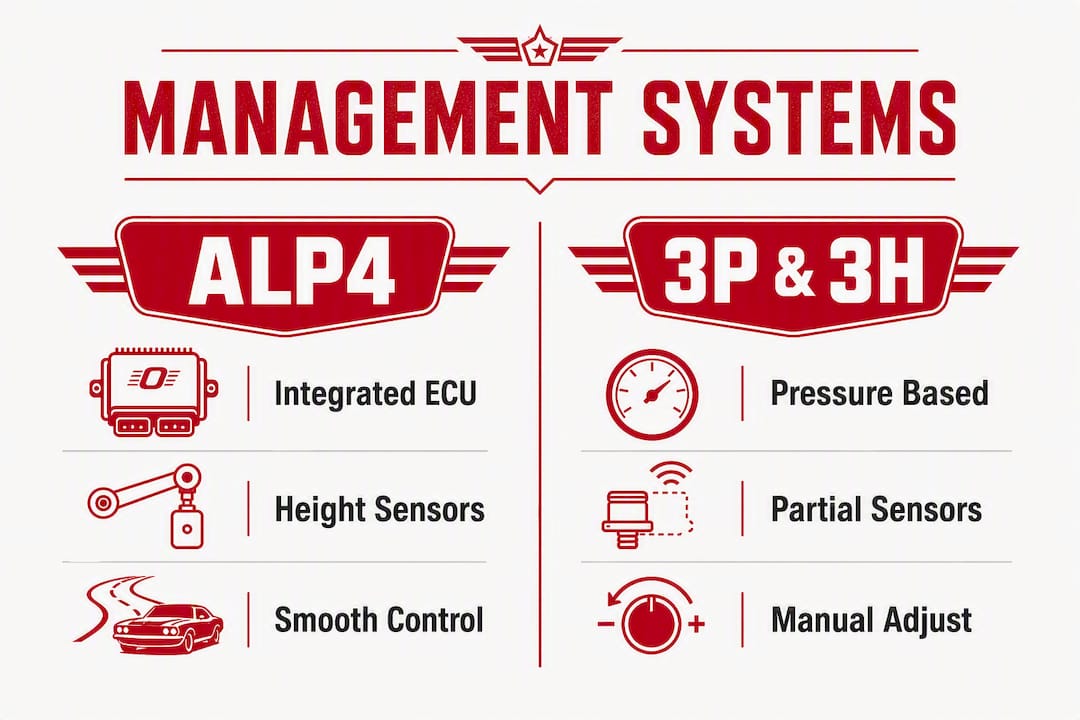
The management system you choose shapes how the car behaves every day, not just at a show. Here is how the four options stack up.
| Feature | ALP4 | 3H | 3P | Manual |
|---|---|---|---|---|
| Best for | Daily driving, show, track | Daily + show with height presets | Show, stance, budget-conscious daily | Garage queens, budget builds |
| Control method | Pressure + adaptive algorithms | Height + pressure sensors | Pressure only | Manual valve control |
| Manifold design | Integrated ECU, valves, sensors in one billet unit | Separate height sensors + controller | Pressure controller only | No electronic controller |
| Presets | Yes, app-controlled | Yes, multiple height presets | Yes, pressure presets | No |
| Installation difficulty | Moderate (cleaner wiring) | Moderate to advanced | Moderate | Simple |
| Upgrade path | Endpoint platform | Upgradeable to ALP4 | Upgradeable to 3H or ALP4 | Manual to any electronic |
| Airline size | 1/4" or 3/8" | 3/8" standard | 1/4" or 3/8" | Varies |
ALP4 is the newest and most capable platform. Its integrated manifold combines the ECU, solenoids, and pressure sensors into a single billet unit, which cuts wiring complexity and speeds up installation. The software runs adaptive learning algorithms that reduce pressure “hunting” — the unstable cycling older systems were known for — and adds slow lift/lower zones for smooth transitions at shows or in tight parking structures.
3H adds height sensors at each corner on top of pressure control, giving the system two data points to hold a preset. Upgrading from 3P to 3H is a well-documented path: you keep the existing bags, struts, and compressor, and add the height sensor hardware and updated controller.
3P is pressure-based only. Its full-color controller displays individual corner pressures, which makes it easy to diagnose uneven ride height and dial in a stance. It is the most common entry point for show builds on a tighter budget.
Manual control suits static-style builds or garage show cars that rarely need to adjust on the fly. No controller, no diagnostics, no presets.
How do you pick the right kit for your vehicle and goals?
Work through these questions before you buy. They will narrow your choice faster than any spec sheet.
- What is the primary use? Show/stance, daily driver, load-leveling for a truck, or track performance. Each use case points to a different kit family and management system.
- Does a Performance Series bolt-in kit exist for your vehicle? Run the configurator first. A bolt-in kit eliminates top-mount fabrication, shock-length guesswork, and most fitment surprises.
- Which management system fits your budget and goals? ALP4 for the best daily drivability and future-proofing; 3H for height-preset accuracy at a lower entry cost; 3P for a clean show build on a budget; manual for the simplest possible setup.
- Are your shocks compatible with the air springs? Coilover conversion kits include matched dampers. If you are adding bags to existing shocks, verify the shock’s travel and valving are suited to the expected pressure range. Air systems are progressive: higher pressure raises the effective spring rate, so shocks need to be tuned for the range you plan to run.
- Where will the compressor and tank mount? Trunk, bed, or under-hood placement each has clearance and heat requirements. Confirm available space before ordering a tank size.
- What is your total budget? Kit-only prices vary by application. Add management, a compressor, and a tank for a complete system. Then factor in installation labor, which typically runs several hours at a shop rate depending on your region and whether the installer needs to fabricate any brackets.
- Are you upgrading an existing system? Owners moving from 3P or 3H to ALP4 can often reuse struts, airlines, and compressor hardware, which cuts upgrade cost significantly.
For trucks carrying heavy loads, a load-leveling kit like the LoadLifter 7500XL is purpose-built for that duty cycle. For a Ford F-150 owner who wants adjustable support without a full suspension conversion, the LoadLifter 5000 Ultimate for 04–14 F-150 4WD is a direct bolt-in example of how specific these kits get.
What comes in a typical Air Lift kit and what upgrades are worth adding?
Standard kit contents vary by family, but most complete Performance Series packages include:
| Component | Performance Series | Universal Kit | Coilover Conversion |
|---|---|---|---|
| Air springs / bags | Vehicle-specific | Generic sizing | Integrated with strut |
| Struts / shocks | Matched or included | Not included | Included (matched dampers) |
| Top mounts | Vehicle-specific | Not included | Included |
| Airline | Yes (1/4" or 3/8") | Yes | Yes |
| Fittings and hardware | Yes | Partial | Yes |
| Management system | Sold separately | Sold separately | Sold separately |
| Compressor and tank | Sold separately | Sold separately | Sold separately |
ALP4 is available in both 1/4-inch and 3/8-inch line configurations, so confirm your airline size before ordering fittings. The 3/8-inch line flows more air volume, which means faster lift and lower times, a real advantage on a daily driver or a show car that needs to drop quickly at an event.
Upgrades worth considering:
- Higher-capacity compressor: If you are running a larger tank or need fast fill times, a dual-compressor setup reduces strain on each unit and cuts fill time.
- Flo Air tank: Larger tank volume means the compressor runs less often, extending its service life. Flo tanks are available in configurations that fit most trunk and bed setups.
- Upgraded valves: Larger valves improve flow rate for faster height changes, especially relevant on 3/8-inch line systems.
- Protective airline sleeves: Chafing is one of the most common failure points. Sleeving airlines where they pass through tight routing areas costs almost nothing and prevents the most common leak source.
For owners who want a replacement air spring down the road, having the part number from your original kit makes reordering straightforward.
Buying, fitment verification, and installation options
The path from purchase to a fully operational system typically runs 1–3 weeks depending on shipping, installer availability, and whether any custom fabrication is needed.
Step 1: Confirm vehicle fitment. Use the Air Lift configurator with your exact year, make, model, and trim. Check strut compatibility and top-mount clearance, especially if you are running aftermarket wheels with reduced clearance at full drop.
Step 2: Select your kit and management system. Choose the Performance Series bolt-in if one exists for your vehicle. Pair it with the management system that matches your use case from the comparison above.
Step 3: Choose tank and compressor. Size the tank to your expected duty cycle. A show car that drops once a day needs less tank volume than a daily driver that adjusts at every parking garage.
Step 4: Decide on DIY vs. professional installation. A bolt-in Performance Series kit on a straightforward platform is manageable for an experienced DIYer with basic air-fitting tools and a few hours. Coilover conversions, ALP4 wiring, and height-sensor calibration are faster and cleaner with a professional installer. When you factor in ALP4’s diagnostics and adaptive calibration, a pro install often pays for itself in reduced troubleshooting time.
Step 5: Register the warranty and save your invoice. Air Lift Performance warranties require registration. Keep the purchase invoice and installation records; they matter if you need warranty support.
For a broader look at how suspension changes interact with braking performance, the brake upgrade guide at FrenzyCars is a useful companion read before finalizing your build plan.
Maintenance tips and common failure points to watch
Air suspension is reliable when installed and maintained correctly. Most failures trace back to a handful of predictable causes.
Common failure points:
- Rubber bellows wear: Road salt, debris, and UV exposure accelerate cracking. Inspect bellows every 6 months in northern climates, annually in dry regions.
- Airline chafing: Airlines that rub against frame edges or suspension components develop micro-cracks that cause slow leaks. Sleeve and secure every run.
- Loose fittings: Vibration works push-to-connect fittings loose over time. Check all connections at each inspection interval.
- Compressor overwork: A compressor that runs constantly is either fighting a leak or undersized for the tank. Diagnose the root cause before the compressor fails.
Maintenance checklist:
- Inspect bellows for cracks, abrasion, or contact with suspension components
- Test system pressure at each corner and compare to your saved presets
- Verify all airline routing is secured and sleeved at contact points
- Check compressor run-time; excessive cycling indicates a leak
- Apply corrosion protection to fittings and exposed hardware in salt-belt regions
- Review the performance car maintenance checklist for seasonal inspection timing
Pro Tip: Proper airline routing and protected compressor/tank placement matter more for long-term reliability than the hardware tier you choose. A premium kit installed with unprotected airlines routed near exhaust or suspension pivot points will fail faster than a budget setup installed correctly.
Why ALP4 changes the installation and ownership experience
The biggest shift ALP4 brings is architectural. Older systems wire the ECU, solenoids, and sensors as separate components connected by a harness. ALP4 puts all of that into one billet manifold. The result is fewer connection points, a cleaner engine bay or trunk install, and a single unit to diagnose when something goes wrong.
The software side is equally significant. ALP4’s reengineered algorithms reduce the pressure hunting that plagued earlier systems, where the controller would overshoot a target pressure and cycle repeatedly trying to correct. Adaptive learning and road filtering mean the system reads real-world conditions and adjusts smoothly rather than reacting to every bump as a height deviation.
For daily drivers, the slow lift/lower zones are a practical feature that often goes unmentioned. They prevent the car from slamming to ride height when you pull out of a driveway, which protects the bags and the undercarriage over thousands of cycles.
The upgrade path is also worth understanding before you buy a 3P or 3H system. In many cases, owners can migrate to ALP4 while keeping their existing struts, airlines, compressor, and tank. That makes 3P a reasonable starting point if budget is the constraint today, with a clear path to ALP4 capability later.
Modern application-specific kits have closed the gap with coilover systems for daily drivability. The remaining variable is installation quality, specifically protected airline routing and correct component placement. Get those right and the reliability argument against air suspension largely disappears.
Ozkonickustomz stocks Air Lift kits with fitment support built in
Ozkonickustomz sources Air Lift Performance kits directly from vetted manufacturers, which means every kit ships with guaranteed fitment and no counterfeit risk. The catalog covers load-leveling kits for trucks, bolt-in Performance Series kits, and individual components for owners upgrading or replacing parts. If you need a specific fitting or installation hardware to complete your build, the swivel elbow fitting is one example of the small-parts inventory that keeps your install moving without a second order.
Fitment questions get answered before the order ships, not after. Contact the Ozkonickustomz support team with your year, make, model, and intended use, and they will confirm compatibility and walk you through management system options. Fast shipping and a straightforward return policy mean you are not stuck if something changes. Check the product pages at ozkonickustomz.com to confirm availability and get a quote for your build.
Key Takeaways
Air Lift Performance kits deliver the most reliable results when you match the kit family and management system to your specific vehicle and use case before you buy.
| Point | Details |
|---|---|
| Match kit to use case | Show/stance suits 3P or ALP4; daily driving favors ALP4; load-leveling needs a purpose-built truck kit. |
| ALP4 is the upgrade endpoint | Its integrated manifold cuts install complexity and supports adaptive algorithms for smoother daily drivability. |
| Upgrade path saves money | Moving from 3P or 3H to ALP4 often reuses existing struts, airlines, and compressor hardware. |
| Routing determines reliability | Protected airline routing and correct component placement matter more than hardware tier for long-term durability. |
| Ozkonickustomz for fitment | Ozkonickustomz stocks Air Lift kits with direct sourcing, fitment verification, and support before the order ships. |
The case for getting the management system right the first time
Most buyers focus on the air springs and overlook the management system until they are already installed and frustrated. That is backwards. The bags are largely commoditized at the application level. What separates a system that feels polished from one that feels like a science project is the controller, the software, and how well the install was executed.
ALP4 is not just a newer version of 3P. It is a different philosophy: fewer components, smarter software, and a platform designed to grow with the car. If you are building something you plan to drive daily and show on weekends, starting with ALP4 is the right call even if it costs more upfront. If budget is the real constraint, 3P is a legitimate starting point, but go in knowing the upgrade path exists and plan the install with it in mind.
The other thing most guides skip: talk to your installer before you order the tank. Tank size and placement affect compressor duty cycle, fill time, and how the car behaves at a show when you are cycling height repeatedly. A shop that has done a dozen Air Lift installs will have strong opinions about tank placement for your specific chassis. That conversation is worth having before the parts arrive.
Official resources and further reading
- Air Lift Performance official site — vehicle configurator, full product catalog, and spec sheets
- ALP4 product page and launch overview — technical detail on the integrated manifold and software
- 3H/3P management system page — feature comparison and upgrade path from 3P to 3H
- Upgrading from 3P/3H to ALP4 — what hardware carries over and what you need to add
- 3P product page with manual download — spec sheet and installation manual for the 3P system
- LoadLifter 7500XL for F-250 4WD at Ozkonickustomz — heavy-duty truck load-leveling kit
- LoadLifter 5000 Ultimate for 04–14 Ford F-150 4WD at Ozkonickustomz — vehicle-specific bolt-in example
- Replacement air spring at Ozkonickustomz — maintenance and replacement parts
Register your kit through the Air Lift Performance website after installation and keep your purchase invoice. Warranty claims require proof of purchase, and registration speeds up any support request.